This plant at Exotenherz
Check the shop offer for current availability, price and what is included.
Check the shop for the current price, availability and offer contents.
Your care table
| Topic | What to do | Why it helps |
|---|---|---|
| Light | Choose filtered daylight and shield hot direct rays. | Golden lines show in soft light; glass must not become a hot sun trap. |
| Watering | Check edge moisture and weight before every watering; keep lightly moist. | Reserves are small in a 6 cm pot, but condensation says nothing certain about the root ball. |
| Drainage | Water slowly and remove every surplus from the outer vessel. | Moisture is needed, but a standing water film under the pot displaces air. |
| Mix | Use a fine airy terrestrial-orchid mixture, for example with bark and loose sphagnum. | The young plant grows in moisture-retentive medium and is not treated like an orchid mounted on coarse bark. |
| Air humidity | Arrange an accessible glass climate with air exchange; avoid leaf contact with glass. | More humid surroundings can suit it, while wet touching leaves and hidden pot rims complicate inspection. |
| Warmth | Maintain even warmth and avoid cold window draughts. | A small moist root ball cools rapidly; abrupt changes are unfavourable for young shoots. |
| Feeding | Feed sparingly during visible growth by a suitable fertiliser label. | Account for existing mix nutrients and the small root space. |
| Repotting | Only for a space need or exhausted mixture, move gently into a suitable shallow vessel. | Sideways-growing shoots need accessible room, not an oversized constantly wet pot. |
| Leaf care | Hold the pot rather than foliage, leave fresh tips alone and remove dead remains. | Soft leaves and fine young shoots can be injured by rubbing and pulling. |
Check the compost and pot weight. The care table explains how far the compost may dry.
Water only when needed. The water should reach the root ball without spilling over the rim.
Remove surplus water from the saucer or cachepot. Then return the plant to a suitable position.
Golden lines with room between
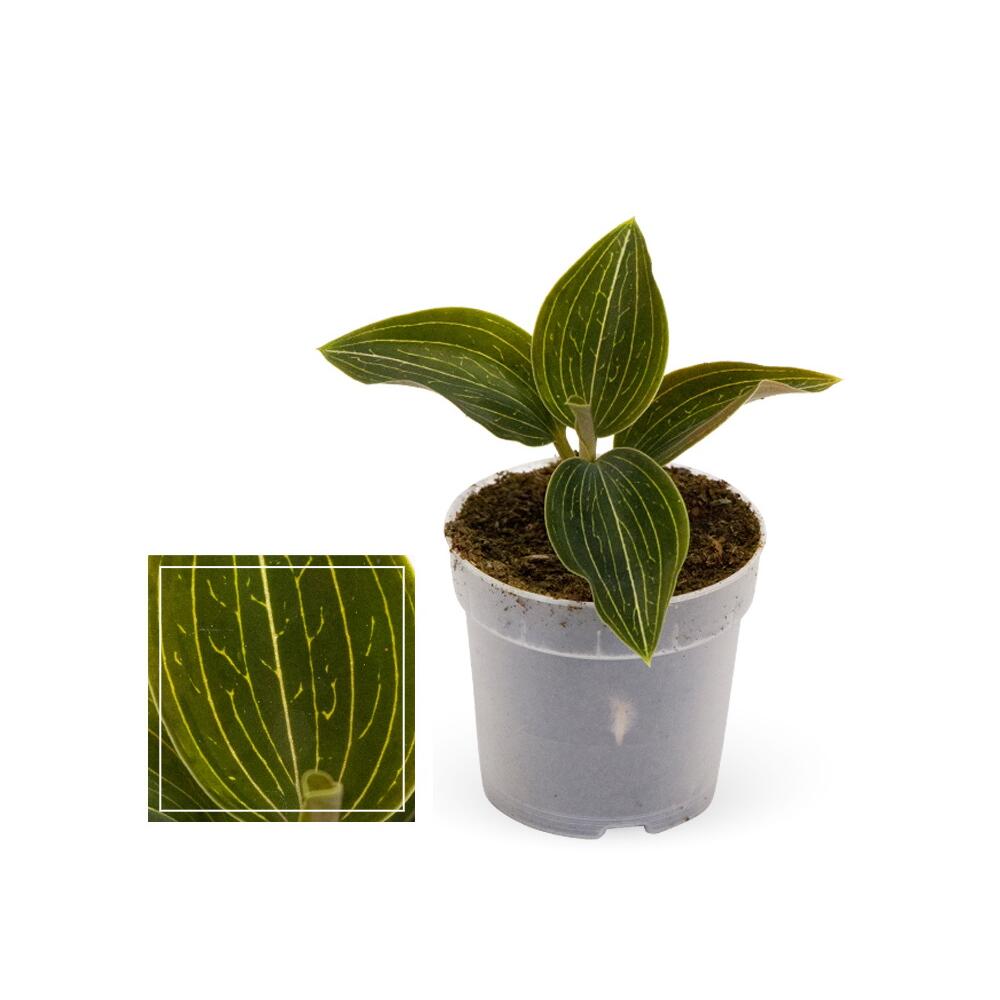
Fine golden veins lie as long curved lines on Citrine’s green pointed oval leaves, following shape towards the tip. Few short cross-connections interrupt the quiet arcs, leaving much visible surface. Own original shows neither a broad cream centre nor a tightly closed network. This open spacing makes the pattern readable. Position for an oblique view; gentle light suffices, without forcing shine in sun. The original inset enlarges veins while the whole picture shows the actual small young pot.
Citrine and the young offer
Citrine is a named jewel-orchid trade selection. The shop uses Macodes petola Citrine. Macodes petola is a recognised wild species, but that does not independently determine this delivery plant as it. Observed foliage and evidenced terrestrial culture guide positioning first. The 6 cm pot and about 7–9 cm overall height including pot describe a young plant, not final dimensions. Preserve the ball when unpacking, check moisture and keep rim, leaf base and growth accessible without rearrangement.
Warm observation with gentle light
Brightness outside hot direct sun suits this foliage orchid. Fine lines remain clear without heating leaf surfaces behind glass. A small open tabletop terrarium can work if daylight and warmth fit. Check morning and afternoon: late sun may change a sheltered spot. Avoid immediate heater airflow and cold window draughts too. A dark shelf is no shortcut to gentle light. A steady acclimatisation place helps more than daily switching among window, desk and glass. Observe growth under the same conditions.
Recognise the moment in a small pot
Water according to medium. Lift the pot and gently check edges without pressing leaves or base. Preserve light moisture; heavy wet mix gets no top-up. If the surface pales, check below rather than using colour alone. Slowly water medium, drain and empty decorative covers. Open shelves dry differently from humid glass, so short moisture and weight notes help more than a fixed watering day. Reassess after every move.
Arrange glass with accessible soil
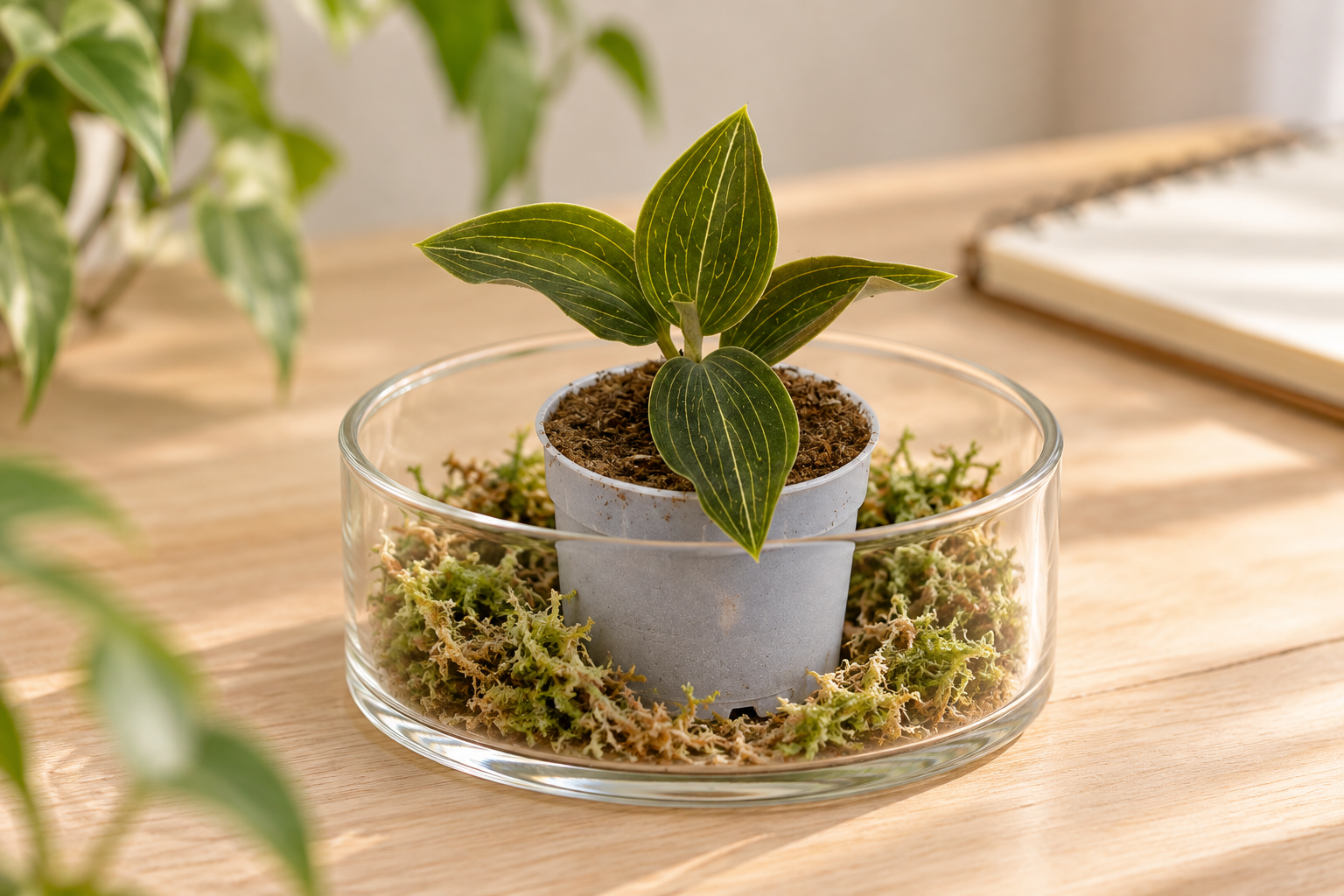
Terrariums can supply more humid air. A removable inner pot lets you feel mix and identify surplus. Fine bark and loose sphagnum can retain moisture and structure; compact wet moss is no substitute for airy mix. Leave room around tips and do not completely hide pot rims. Condensation indicates glass climate, not reliably ball water. Air exchange and reachable care remain necessary. Before direct glass planting, learn the youngster in its existing pot and check whether the planned vessel permits inspection.
Accompany leaves through seasons
Own image has no flower spike. Aim for a stable base and intact new leaves, without pulling them apart or polishing. Sparse feeding by a suitable label during visible growth accounts for existing nutrients. With slow low-light winter growth, recheck consumption and warmth. No cold dry rest is imposed on this warm-grown selection. Later shoots may need sideways space: gently repot appropriately instead of adding much wet mix around a small ball. No flower colour, date or fixed adult height is promised.
Interpret changes calmly
Compare new spots first with natural fine veins; not every pale line is damage. Soft tissue, dry margins or prolonged absent growth warrant checking moisture, drainage, light and warmth together. Extra feeding does not fix lasting wetness. Inspect bases and undersides for deposits or animals without needless handling. Remove dead remains with clean tools. First change the clearly poor condition and watch the next leaf. A small photograph under similar light helps compare progress over weeks. This quiet foliage plant rewards another close look.
One plant, several views

Good to know
Is Citrine securely determined as Macodes petola?
The offer uses the name, but here it is conservatively a named jewel-orchid trade selection, without secure delivery-plant wild-species inference.
How to recognise its pattern?
Green pointed ovals, few long curved golden veins and sparse short cross-lines. No broad cream central band in own original.
Is 7–9 cm final size?
No: young offer’s overall height including 6 cm pot. No fixed final height evidenced.
Can it grow in a terrarium?
Yes, gently bright and warm with accessible roots, air exchange and controlled moisture. Glass and decoration are not promised delivery contents.
Does condensation tell me when to water?
No. Check edges and weight for remaining light moisture; remove water below pot.
Does it need winter rest?
No cold dry rest is imposed. Re-observe actual use when development slows.
Feed harder for flowers?
No. Support healthy leaves with sparse suitable label-based feeding. No specific bloom promised.
Sources and editorial note
- Exotenherz: own offer and original (04.10.2026)
- American Orchid Society: Anoectochilus and culture (04.10.2026)
- American Orchid Society: Macodes and terrestrial culture (04.10.2026)
- Kew Plants of the World Online: Macodes petola, recognised species name (04.10.2026)
Shop offer, originals and specialist sources checked on 04.10.2026. Current availability in the shop.