This plant at Exotenherz
Check the shop offer for current availability, price and what is included.
Product and delivery details are given in the individual offer.
Your care table
| Topic | What to do | Why it helps |
|---|---|---|
| Light | Choose bright partial shade with some gentle sun. | Flowering often remains weaker in deep shade. |
| Soil | Prepare loose, humus-rich soil without permanent standing water. | Moisture-retentive soil supports the initial roots; a waterlogged hollow burdens them. |
| Planting | Plant the thoroughly moistened root ball at its previous height and water in. | The small original root ball needs to connect with surrounding soil. |
| Spacing | Allow about 30 cm centre to centre as an offer guide. | Small young plants develop into broader clumps. |
| Water | During the first garden year, check the planting spot in dry weather. | Older established plants tolerate drier spells more readily than young root balls. |
| Feeding | Feed moderately in spring if needed. | Extra nutrients do not compensate for too little light or wet roots. |
| Foliage care | Remove dead leaves selectively in spring. | Healthy leaves still contribute to the shape; hard cutting is not an annual obligation. |
| Division | Divide strong older clumps in spring when needed. | Rooted sections retain the variety’s characteristics and need establishment care again. |
For young plants, feel the soil directly at the root ball. The surface and deeper soil may have different moisture levels.
Water thoroughly after planting; later, water according to the soil, weather and establishment rather than a fixed calendar.
Avoid standing water. For plants in containers, also check that water runs out of the drainage hole.
Late colour starts long before flowering
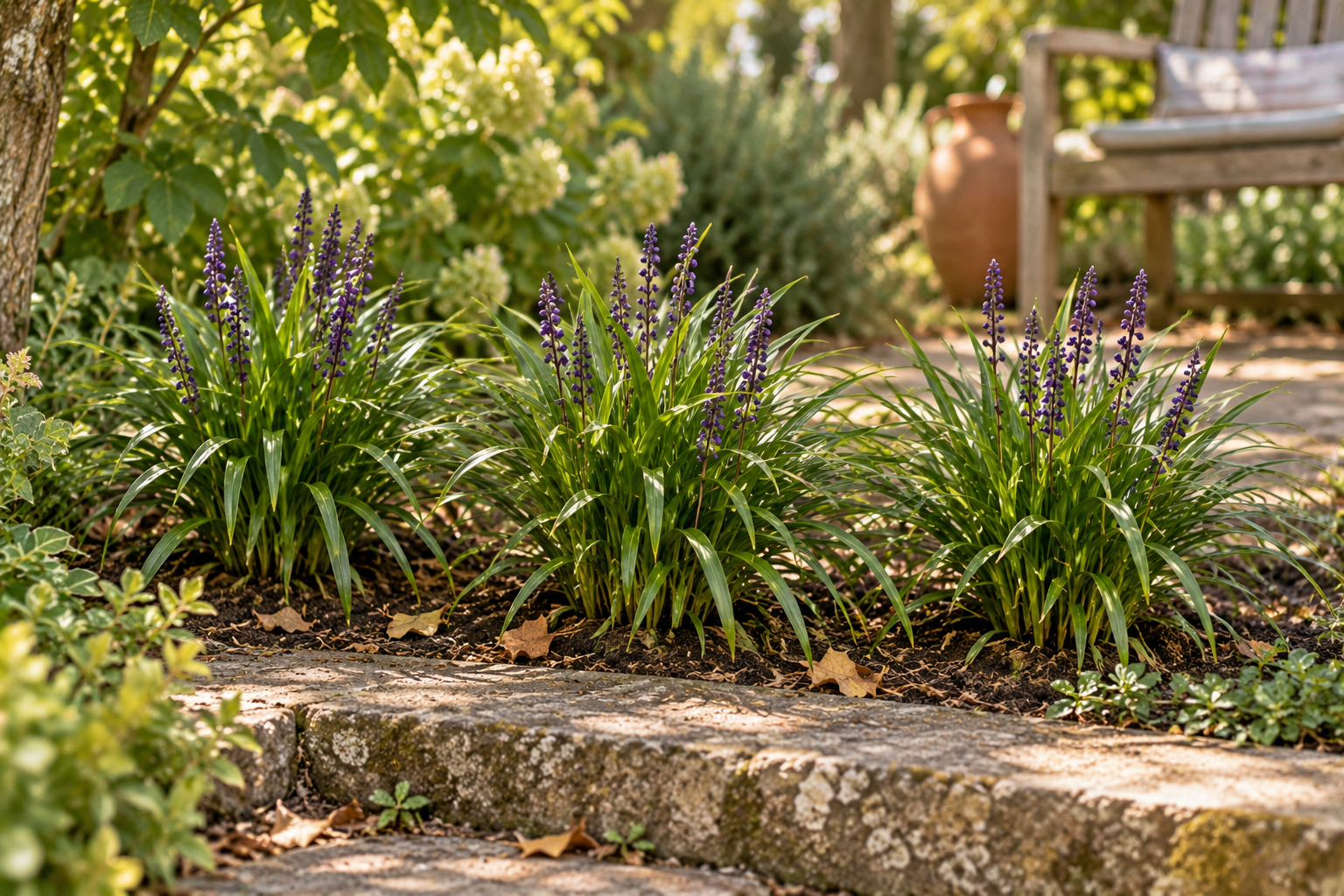
Ingwersen attracts attention before its flowers appear. Narrow leaves start at a dense base and lean outwards in green arcs. Upright dark-violet flower spikes can later emerge between them. Up close, their many small individual flowers become recognisable. The grass-like foliage belongs to a perennial, not a true ornamental grass. Lilyturf is not equivalent to an early-flowering grape hyacinth either. Its late display gives a planting a different rhythm: while some summer perennials are already fading, another fine accent of colour appears along the low border edge.
A young set plant is the beginning of a clump
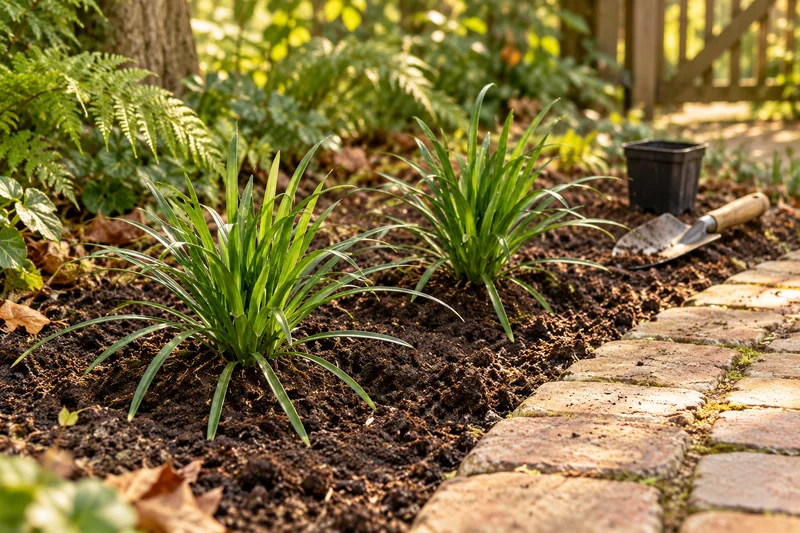
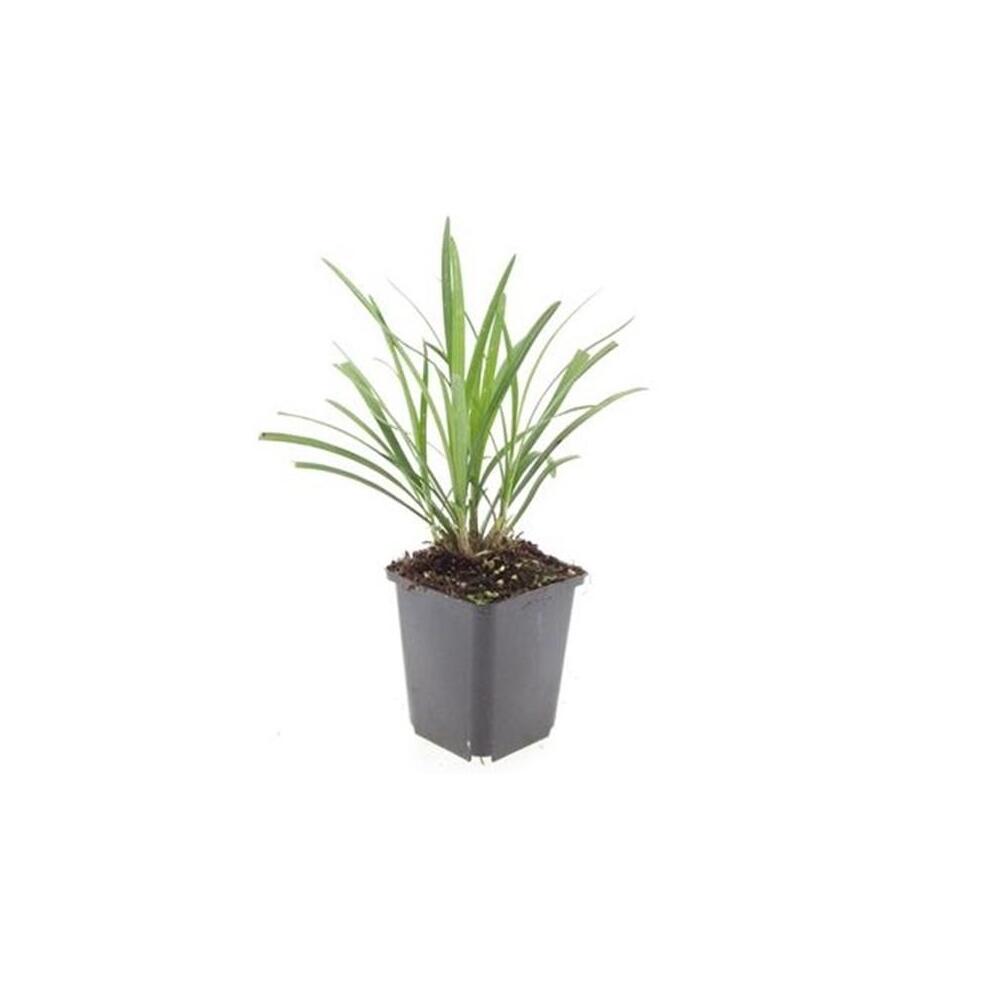
The offer includes various quantity sets of individual plants in 9 cm pots. Their delivery height is described as approximately 10–25 cm. The later-developed variety typically reaches about thirty centimetres, with soil and position affecting size. I therefore plan with the future clump shape rather than just the gaps between the small pots. The shop gives about thirty centimetres spacing, or nine to eleven plants per square metre, as a guide. The garden image shows three older flowering clumps as a design example. It says neither that the selected set contains three plants nor that the delivery will already be so dense or flowering.
Between dark shade and a hot sunny position
Bright partial shade is a good starting point for Ingwersen. Gentle sun during part of the day can support flowering. If the plant stands very dark instead, the green arcs may remain while fewer flowers appear. In front of a hot wall or in dry full summer sun, water and leaf condition become more important. I prefer a quiet border edge beneath an open woody plant to a position that dries out every afternoon. I also look beneath the leaves: tree roots and a dense canopy can make an apparently cool shady spot surprisingly dry. Light alone does not describe the position fully.
Really reach the small root ball when planting
Spring or early autumn make starting easier, provided the soil is frost-free and not waterlogged. First the root balls are thoroughly moistened and the area loosened. Then I set the plants at their previous height and water so that soil and roots make contact. In the first months, I pay particular attention to the area of the original pot root ball. Moist soil beside it does not always mean that its interior has taken up water too. Slow thorough watering helps it connect with its surroundings. Between waterings, the actual condition decides, not a fixed weekday. If water remains in the planting hole, better drainage is needed first.
Accompany the violet spikes in their season
The flowers belong to late summer and autumn, often between August and October. Weather, development and planting position shift the start and duration. A young delivery therefore need not carry flowering spikes yet. If a well-developed plant remains without flowers for a long time, I would first look at light and the clump’s condition. More and more fertiliser is no answer to deep shade. After flowering, dark fruits may remain on the stems; they serve as ornament here and are not recommended as edible. Small rounded flowers and later fruiting spikes offer different details without displacing the border’s quiet green foundation.
Winter-green foliage needs an attentive hand in spring
Ingwersen retains much foliage through winter under suitable conditions. Cold and drying wind can nevertheless damage individual leaves. In spring, I remove dead or disruptive parts selectively. If the entire old tuft has become unattractive, a stronger cut before new growth may make sense. Fresh tips are protected during this. A sheltered garden position and good drainage matter more than a blanket promise that every winter will be trouble-free. In containers, limited root space reacts more strongly to frost and changing moisture. That needs separate consideration even when the same variety already copes well in the border.
Maintain older clumps and interpret changes
Over the years, the leaf base grows denser. A strong healthy clump can be divided in spring if more space is needed or a planting is to be extended. Each section receives its own roots and careful initial watering again. Thickenings on Liriope roots can be natural storage areas; by themselves they are not proof of disease. With damaged leaves, however, I look more closely for feeding marks, wet soil or an extended dry spell. Not every yellow tip needs fertiliser, water and a major cut simultaneously. I first want to understand what has changed at the planting site. Only then does the plant receive the care that actually helps it at that moment.
One plant, several views
Good to know
Is Ingwersen a grass?
No. The leaves look grass-like, but lilyturf is a perennial from the asparagus family.
When do the flowers appear?
Usually in late summer and autumn, often August–October; development and weather influence the timing.
What colour is typical?
Small dark-violet flowers in upright spikes.
How large does the clump become?
Typically approximately 30 cm tall, depending on position. Delivery size is about 10–25 cm in a 9 cm pot.
What planting time suits it?
Preferably spring or early autumn in frost-free soil that is not waterlogged.
What spacing should I plan?
The offer gives about 30 cm, or nine to eleven plants per square metre, as a guide.
Must all foliage go in spring?
Remove dead and damaged leaves first. Only consider stronger cutting if old foliage is unattractive overall, before new growth.
Sources and editorial note
- Exotenherz: Ingwersen and directly checked quantity sets (01.10.2026)
- De Hessenhof: exact variety, height and flowering period (01.10.2026)
- Planta: variety characteristics and position (01.10.2026)
- RHS: planting, caring for and dividing liriope (01.10.2026)
- NC State Extension: species characteristics and root structure (01.10.2026)
Shop checked directly with all five selected child products: 6/12/60 available,20/40 inactive. Variety characteristics read directly from Hessenhof and Planta; typically about 30 cm growth, a wider site-dependent range is not an exact promise. RHS and NCState for species cultivation. No blanket frost guarantee. Original 6 advertising-free and unchanged; scene accepted against original: narrow unbranched green strap leaves, clump base, simple dark-violet spikes, later garden size clearly labelled.