This plant at Exotenherz
Check the shop offer for current availability, price and what is included.
Product and delivery details are given in the individual offer.
Your care table
| Topic | What to do | Why it helps |
|---|---|---|
| Light | Choose partial shade with some sun during the day. | Very deep shade can reduce flowering. |
| Soil | Prepare humus-rich, well-drained soil. | Moisture should remain available without standing at the roots. |
| Planting | Set the thoroughly moistened root ball at its previous height and water in. | The small pot root ball must root into its surroundings. |
| Water | Check the soil regularly during establishment. | Tolerance of older clumps does not replace young-plant care. |
| Spacing | Consider the offer’s 25–30 cm as a starting point. | Greater spacing can make sense for loose individual clumps. |
| Feeding | Supply nutrients moderately in spring. | Lavish feeding is no guarantee of additional flowers. |
| Foliage care | Remove old unattractive foliage before fresh spring growth. | Later cutting can damage new tips. |
| Winter | Maintain drainage and protect young or exposed plants as needed. | Winter-green foliage does not mean insensitivity to every winter weather condition. |
For young plants, feel the soil directly at the root ball. The surface and deeper soil may have different moisture levels.
Water thoroughly after planting; later, water according to the soil, weather and establishment rather than a fixed calendar.
Avoid standing water. For plants in containers, also check that water runs out of the drainage hole.
Late flowers between quiet green arcs
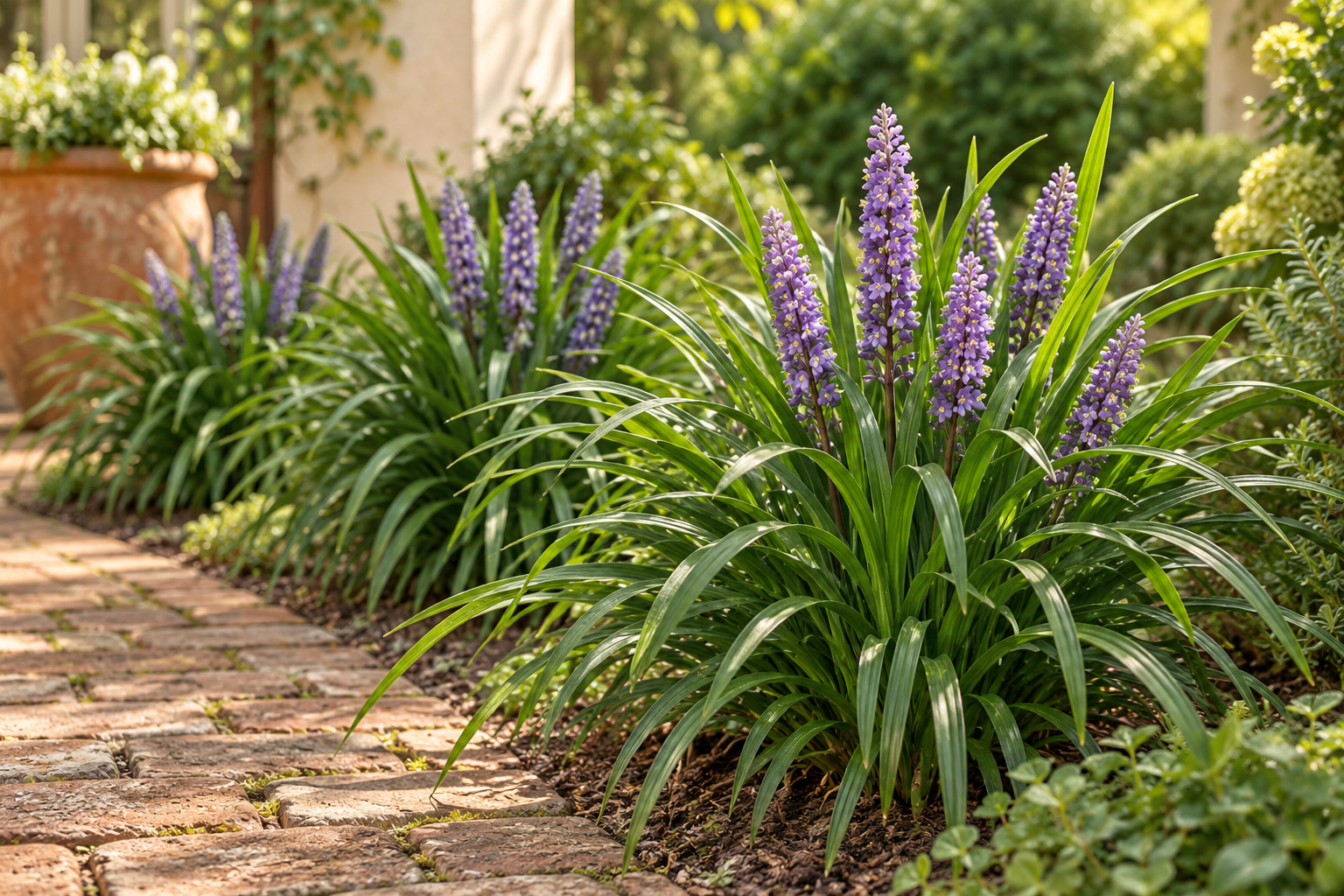
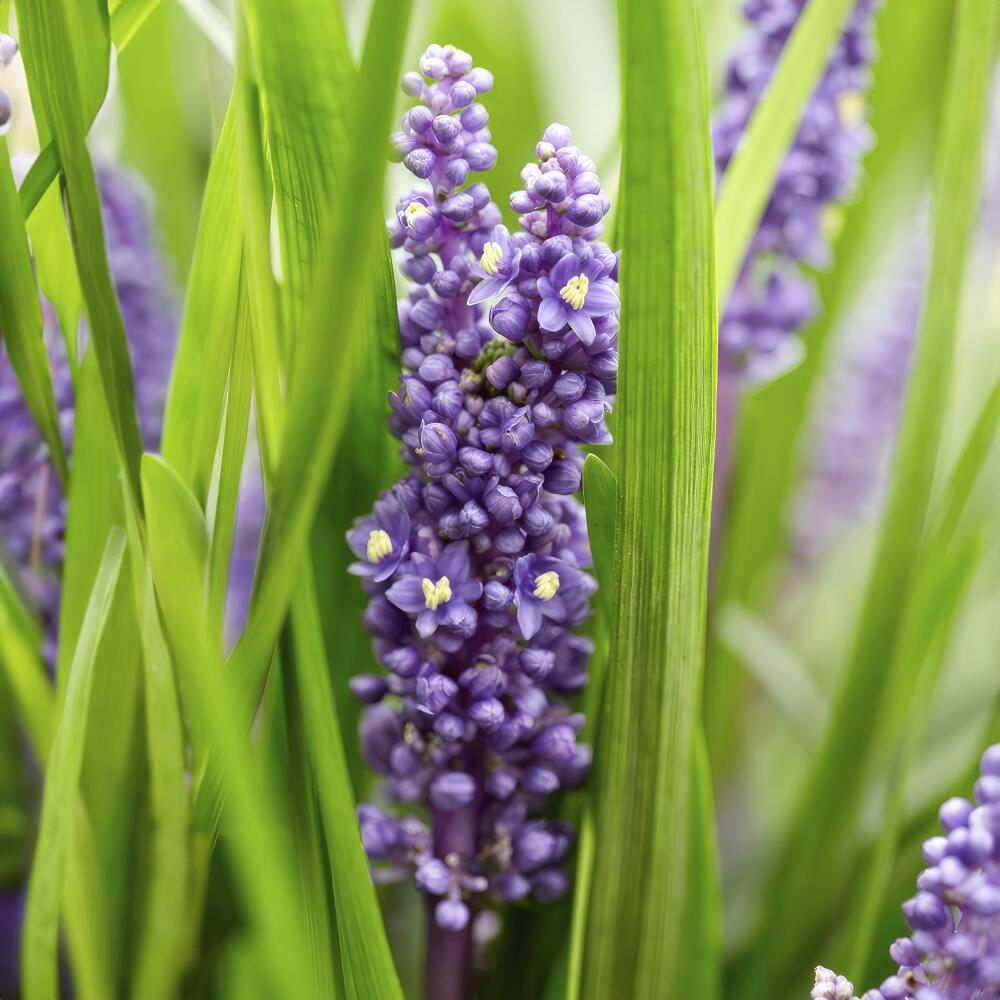
At a partly shaded border edge, Moneymaker first attracts attention through its foliage. The long narrow leaves bend outwards and form a dense clump. Only later do upright flower spikes push between them. Many small violet-blue flowers sit close to the stem and open gradually. A closer look reveals their fine bell-like shape and lighter stamens. Despite the trade name lily grass, this plant is not a garden grass. It is a perennial whose decorative foliage and late-summer flowers work together. I especially like that timing where early summer flowers are becoming more restrained and a quiet green framework should remain.
Partial shade with enough light for flowers
Beneath open woody plants, beside a garden path or at the edge of a taller perennial planting, lilyturf can show well. I choose partial shade and watch that it is not deeply dark all day. A little sun supports flowering. Hot open positions, however, need appropriate soil moisture; the small root ball must not dry out unnoticed. A group looks especially attractive when leaf arcs can fall freely outwards. Directly beside a narrow path, therefore, space is allowed rather than pressing plants closely against the edge. Later growth to roughly forty centimetres tall differs considerably from the young delivery state.
Humus-rich soil that lets water move on
Roots need soil that can hold moisture and release surplus water. I loosen the planting position and work in a suitable humus-rich addition if needed. A constantly damp hollow or compacted heavy soil does not automatically become suitable through that. The area’s water balance must be clarified first. Beneath larger woody plants, roots compete for water even when the position looks shady. I check that situation when planting too. A sheltered partly shaded position alone does not replace soil observation. In containers, drainage holes and structurally stable compost help; the vessel is not left in a permanently filled dish. Foliage and root space thus stay in view together.
Small set plants with a good beginning
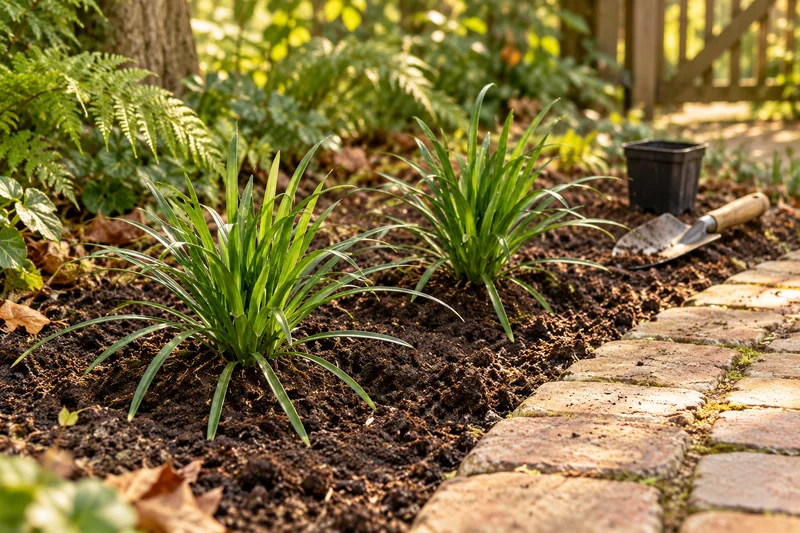
The offer includes young plants in nine-centimetre pots, approximately ten to twenty-five centimetres tall. I moisten the root balls, distribute them over the intended area initially and plant at their previous height. The shop states twenty-five to thirty centimetres spacing; design may also allow more room for individual loose clumps. A universal immediately closed carpet cannot be inferred from that. Spring and early autumn are good starting times when soil is workable and weather suitable. After watering in, original root balls are checked particularly attentively. Dry wind and neighbouring woody roots can dry them faster than the surrounding surface suggests.
Water and feed according to development
During establishment, moisture is checked regularly. Later, strong rooted clumps tolerate temporarily drier conditions better, but prolonged drought is still watched. In pots, reserves are limited and therefore checked more often. I supply nutrients moderately in spring and do not push the plant into soft foliage with especially strong feeding. A balanced start helps more than continual additional applications. Flowers appear mainly in late summer and autumn, often between August and October. Weather can shift that course. Missing flowers are therefore first considered alongside light, development and position rather than immediately answered with more fertiliser.
Care for winter-green foliage and protect new growth
Foliage usually remains over winter too, giving the area structure. Individual damaged or brown leaves may nevertheless occur. Before fresh spring growth, I reduce unattractive old foliage. Cutting too late can catch tips already regrowing; the clump is therefore inspected closely first. Young plants, exposed positions and containers deserve special winter attention. Good drainage remains as important as appropriate loose protection when needed. Plants are not described broadly as insensitive to every winter condition. A leaf with a brown tip tells less than a whole weakened clump; I check that difference before larger interventions.
A group is allowed to grow over the years
Older strong clumps can be divided in spring when rejuvenation or additional planting is desired. Sections receive enough roots and are then cared for as new plants. I do not break up a well-developed group every year merely because it is possible. Dense leaf arcs need time to unfold their effect. Dark fruits may appear after flowering; they are no invitation to snack. For garden design, the quiet foliage and violet flower spikes matter most. In the gallery, an unchanged shop photograph shows flowering up close. The border scene shows later development and is explicitly not a representation of the delivered set size.
One plant, several views
Good to know
Is Moneymaker a grass?
No, despite lily grass as a trade name, it is a perennial.
When does it flower?
Mainly in late summer and autumn, often August to October. Weather and position influence timing.
Why are there no flowers?
Very deep shade, development that is still young or unfavourable cultivation may be involved.
How densely do I plant?
The offer states 25–30 cm. Wider spacing can suit loose clumps and paths.
When do I cut old foliage?
Before fresh spring growth; do not cut off new tips too.
Are the dark fruits edible?
They are not offered here as edible fruits.
Which sets are linked?
Sets with 6, 12 and 60 plants available at the check; 20 and 40 were unavailable.
Sources and editorial note
- Exotenherz: offer and direct set variants (01.10.2026)
- RHS Plants: Moneymaker, variety growth and cultivation (01.10.2026)
- RHS: growing and caring for liriope (01.10.2026)
- NC State Extension: Liriope muscari (01.10.2026)
Shop name and direct child offers individually checked live with SKU/GTIN. Unavailable sets inactive in the register. Originals unchanged and without unverified advertising seals; scenes explicitly show later garden growth. Flowering, height, lifespan, planting time and spacing separate from delivery size. Spacing from offer, no quantity claim calculated from contradictory shop density. Originals2/5 with advertising seals not used publicly.