This plant at Exotenherz
Check the shop offer for current availability, price and what is included.
Product details, availability and delivery information in the shop.
Your care table
| Topic | What to do | Why it helps |
|---|---|---|
| Light | Very bright; acclimatise to sunlight slowly. | Insufficient light can elongate the bodies. |
| Leaf replacement | Keep dry until old pairs are largely papery. | New leaves initially use the old reserves. |
| Water | Water selectively during the active phase, then allow to dry. | A fixed weekly schedule ignores the annual cycle. |
| Summer heat | Ventilate well and consider growth rest. | Trapped heat and wet compost are unsuitable. |
| Compost | Very free-draining and mineral-based. | The small bodies do not tolerate persistent wetness. |
| Fertiliser | Only sparingly during the active phase. | Compact growth requires few nutrients. |
| Winter | Bright and frost-free; observe leaf replacement. | Shrinking old leaves are often part of the normal cycle. |
| Handling | Do not forcibly remove old coverings. | Young leaf pairs may be injured. |
Check the compost and pot weight. The care table explains how far the compost may dry.
Water only when needed. The water should reach the root ball without spilling over the rim.
Remove surplus water from the saucer or cachepot. Then return the plant to a suitable position.
Small bodies with remarkable patterns
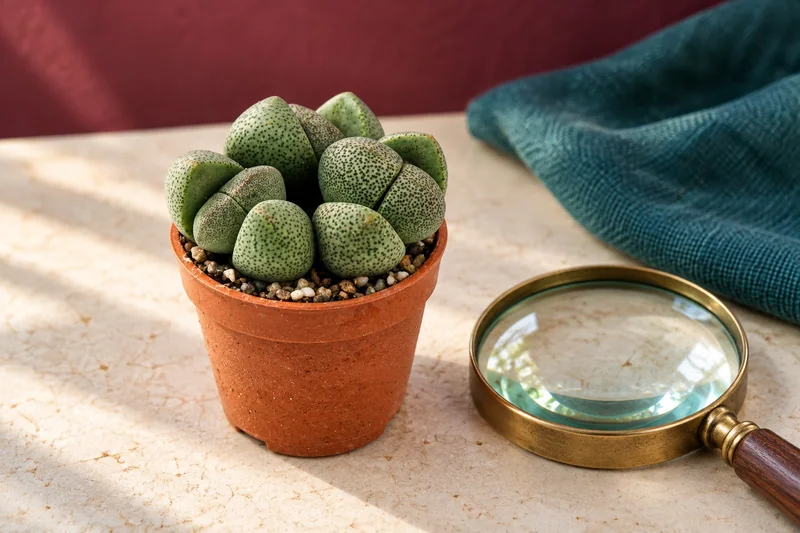
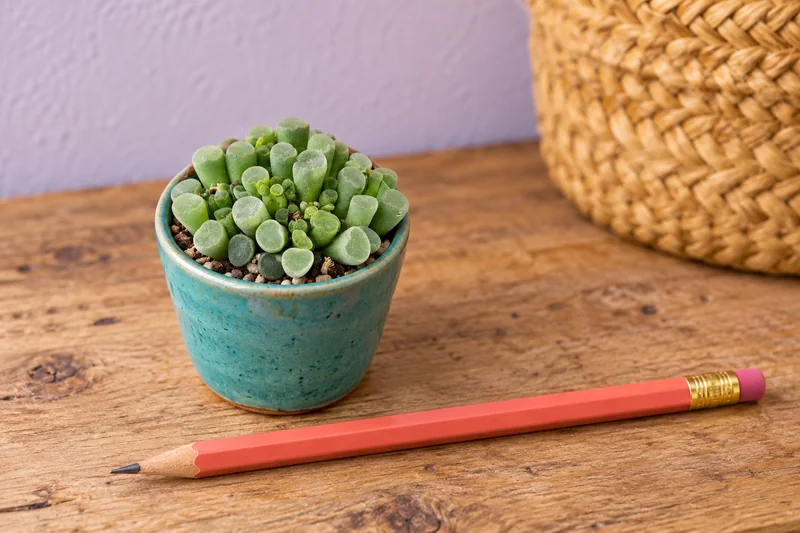
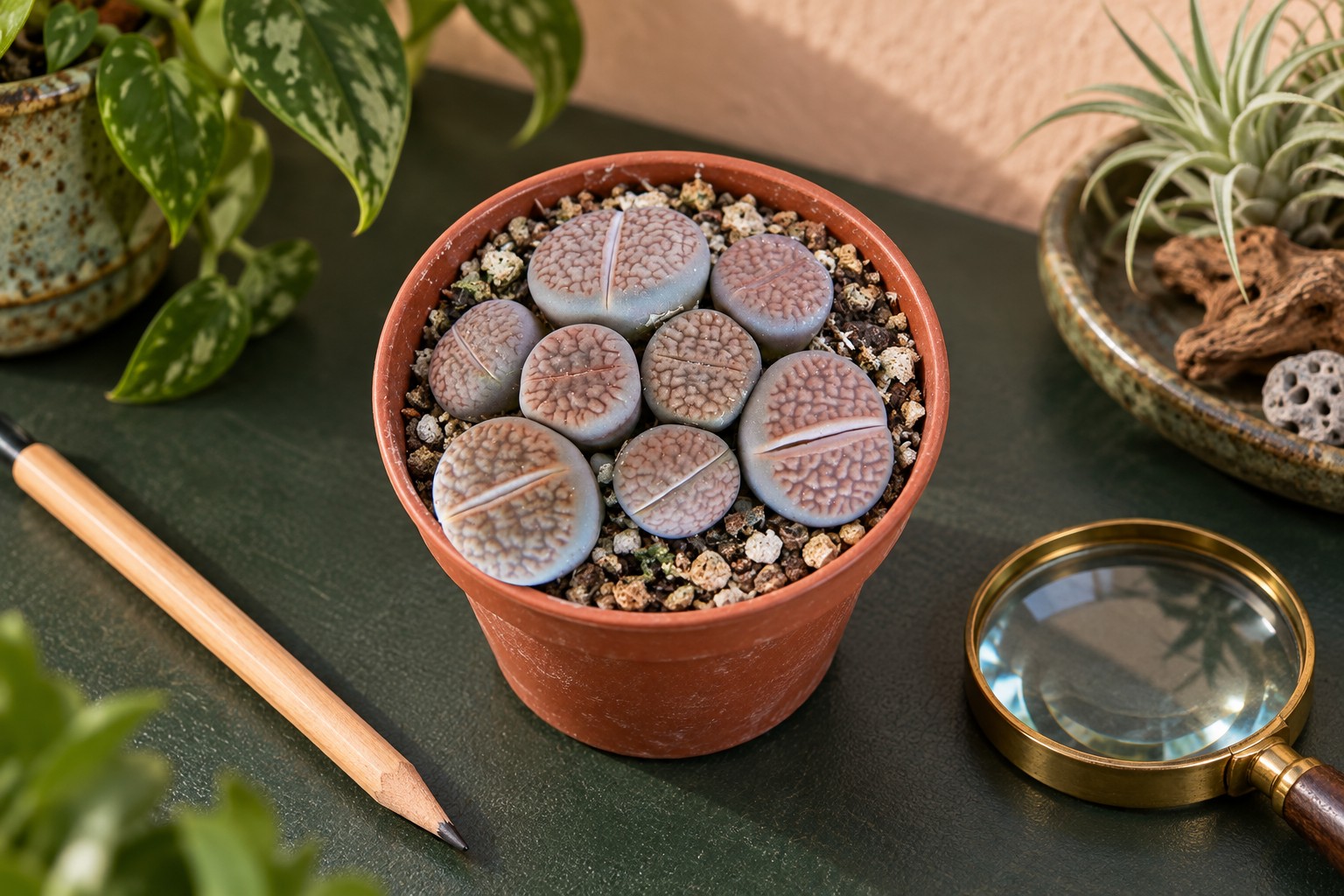
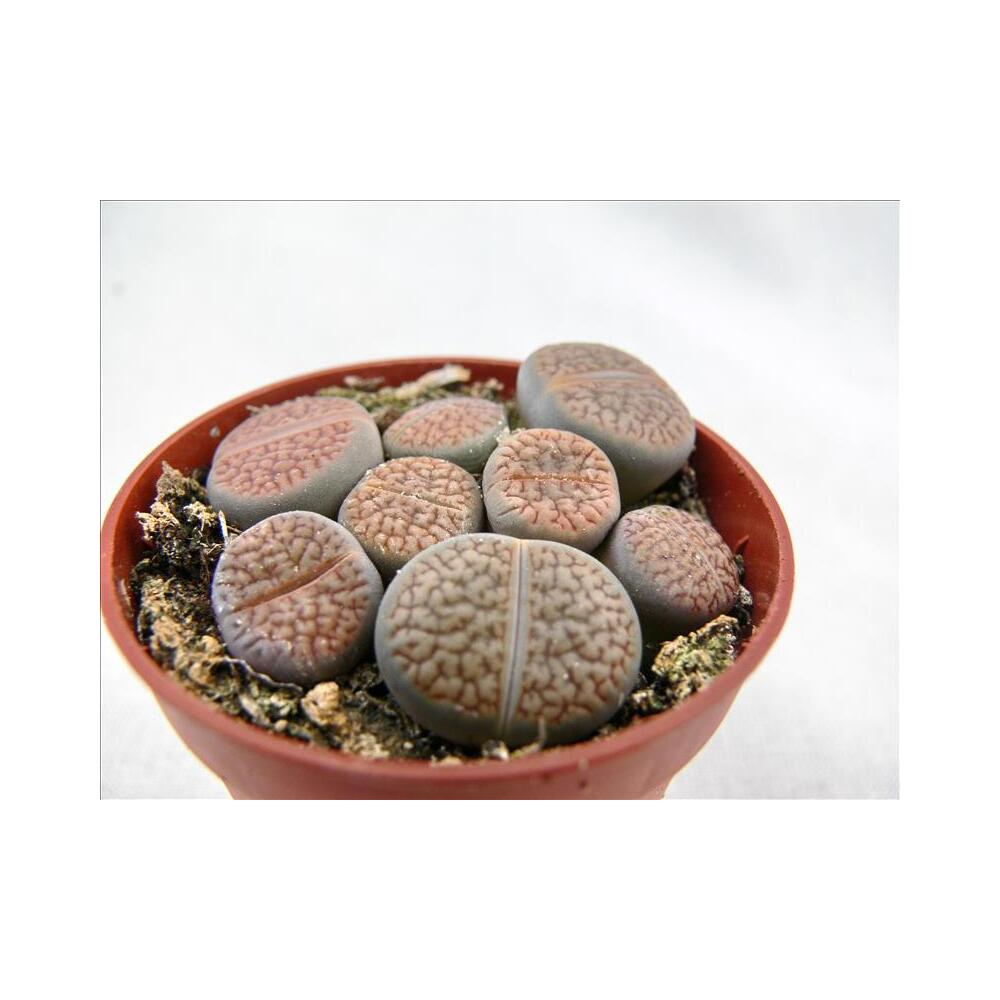
Several low plants sit in the 8.5 cm pot. The total height of approximately 8–10 cm includes the pot; the bodies themselves project only slightly above the compost. Fine lines, spots and a central fissure mark their upper surfaces. The offer names no individual species or forms. Neither a specific flower colour nor identical patterns in every delivery is therefore promised. The close-up reveals details without turning them into large stone balls.
Two leaves form a head
Lithops belong to the Aizoaceae family, not the cacti. A single head consists of a closely joined leaf pair. The next leaf generation develops inside while the old leaves gradually give up their reserves. Some plants form two new heads in the process and branch slowly. A blanket statement that an entire plant always has only two leaves would therefore be too simple. A bowl with several heads may also contain multiple individual plants or branching specimens.
Plenty of light and good air movement
A very bright, sunny position is important. Nevertheless, acclimatise gradually to strong sun after transport or winter conditions. The small surface can burn behind hot glass. Good ventilation and protection from extreme trapped heat help in summer. Too little light can produce elongated, unnatural bodies. A warm outdoor position sheltered from rain is possible temporarily, but uncontrolled rain does not suit targeted watering. Keep bright and frost-free in winter.
Leaf replacement determines the watering pause
When new leaf pairs form inside and old ones shrink, reserves are being transferred. This is not automatically a cry for water. During this phase, keep mostly dry until the old coverings are largely thin and papery. Do not try to maintain several thick leaf generations by regularly adding water. Only afterwards, and when activity is recognisable, resume careful supply. Do not forcibly pull away old coverings. With several plants in one pot, examine each individual’s development.
Water according to growth, not weekday
Outside leaf replacement, water selectively during active growth and let the root ball dry again. A weekly summer appointment does not automatically fit: very hot periods can slow growth. Damp compost then increases the risk for resting plants. Normal watering is largely suspended during winter leaf replacement. A very free-draining mineral-based mix and drainage holes are essential. Feeding remains sparing and belongs, at most, in the active growing phase. An individual small shrinking old head must be assessed together with the annual cycle, compost moisture and new leaf pair.
Support repotting and flowers with patience
When needed, repot carefully at the transition into an active phase without unnecessarily damaging stronger roots. A sufficiently deep small pot is better than a shallow decorative bowl that stays wet. Do not divide healthy heads in the name of supposed rejuvenation. Seed is the usual means of propagation; seedlings need their own finer cultivation and must not follow the dry schedule for adult plants. Flowers may emerge from the fissure, but are not guaranteed annually on every specimen. Translucent, soft bodies collapsing above wet compost are instead warning signs of rot.
One plant, several views

Good to know
Why do the old leaves become soft and thin?
During leaf replacement, their reserves are transferred to the new generation. Look for the new pair first and check compost moisture.
Should I water more when they split?
Normally not. Wait until the old leaf pairs are largely used up and papery.
Are all the heads the same species?
The offer does not specify this. Patterns and developmental stages may differ.
Are Lithops suitable for a fixed watering schedule?
No. Leaf replacement, activity, temperature and root-ball moisture must be considered.
Sources and editorial note
- Product and delivery contents: Exotenherz
- Royal Horticultural Society: plant and care information
- Terry Smale: Lithops cultivation experience
Sources checked: 16 September 2026. Product information and the contents of delivery follow the linked shop offer. Care advice was checked against the cited specialist sources and should still be adapted to the plant’s condition, position and season.