This plant at Exotenherz
Check the shop offer for current availability, price and what is included.
Product and delivery details are given in the individual offer.
Your care table
| Topic | What to do | Why it helps |
|---|---|---|
| Light | Choose sun or bright partial shade. | The broad variety needs a light, accessible position. |
| Soil | Use well-drained soil without constant waterlogging. | Air in the root zone supports perennial development. |
| Planting | Plant in mild weather at the existing root-ball level. | The young 9 cm root ball needs to establish contact with the garden soil. |
| Spacing | Plan approximately 60–90 cm as a guide. | Later width is considerably greater than delivery size. |
| Water | Check regularly during establishment; subsequently water as needed. | Drought tolerance does not apply to an unwatered young root ball. |
| Fertiliser | Feed moderately according to soil and growth. | Too much nitrogen encourages soft, overlong shoots. |
| Pruning | Cut back faded stems after the first flowering. | Pruning may encourage compact new growth and further flowers. |
| Checking | Examine deposits and stippled foliage closely. | Powdery mildew and leafhoppers are possible, different causes. |
| Winter | Allow dieback and keep container root balls protected with free drainage. | A dormant perennial still needs intact roots. |
For young plants, feel the soil directly at the root ball. The surface and deeper soil may have different moisture levels.
Water thoroughly after planting; later, water according to the soil, weather and establishment rather than a fixed calendar.
Avoid standing water. For plants in containers, also check that water runs out of the drainage hole.
A large catmint with a loose outline
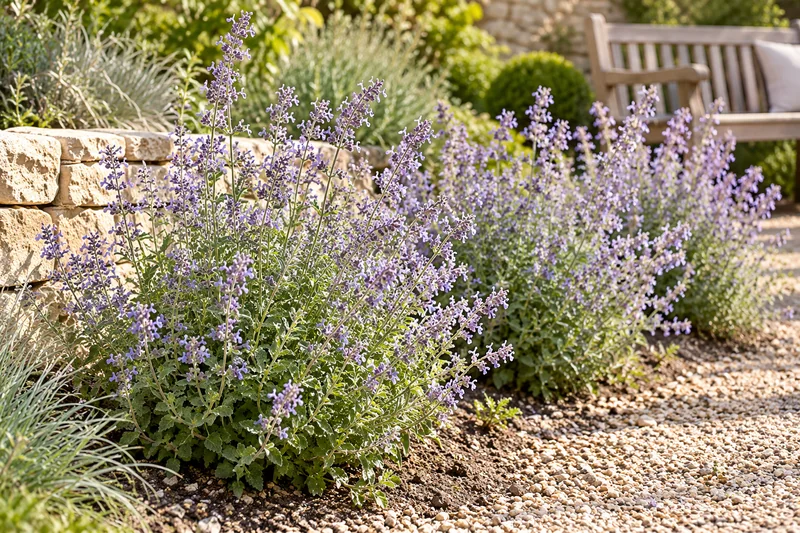
Six Hills Giant combines small grey-green leaves with long flower stems bearing many small blue-violet lipped flowers. The foliage grows in pairs and has crenate margins. The cultivar name is independently documented; the RHS profile lists Nepeta 'Six Hills Giant' and gives Nepeta × faassenii as a synonym attribution. Both names refer to the same catmint. In a developed planting the perennial looks loose and broad. It suits a sunny perennial border where arching shoots can stand out without completely obscuring a narrow passage.
Young plants leave room for growth
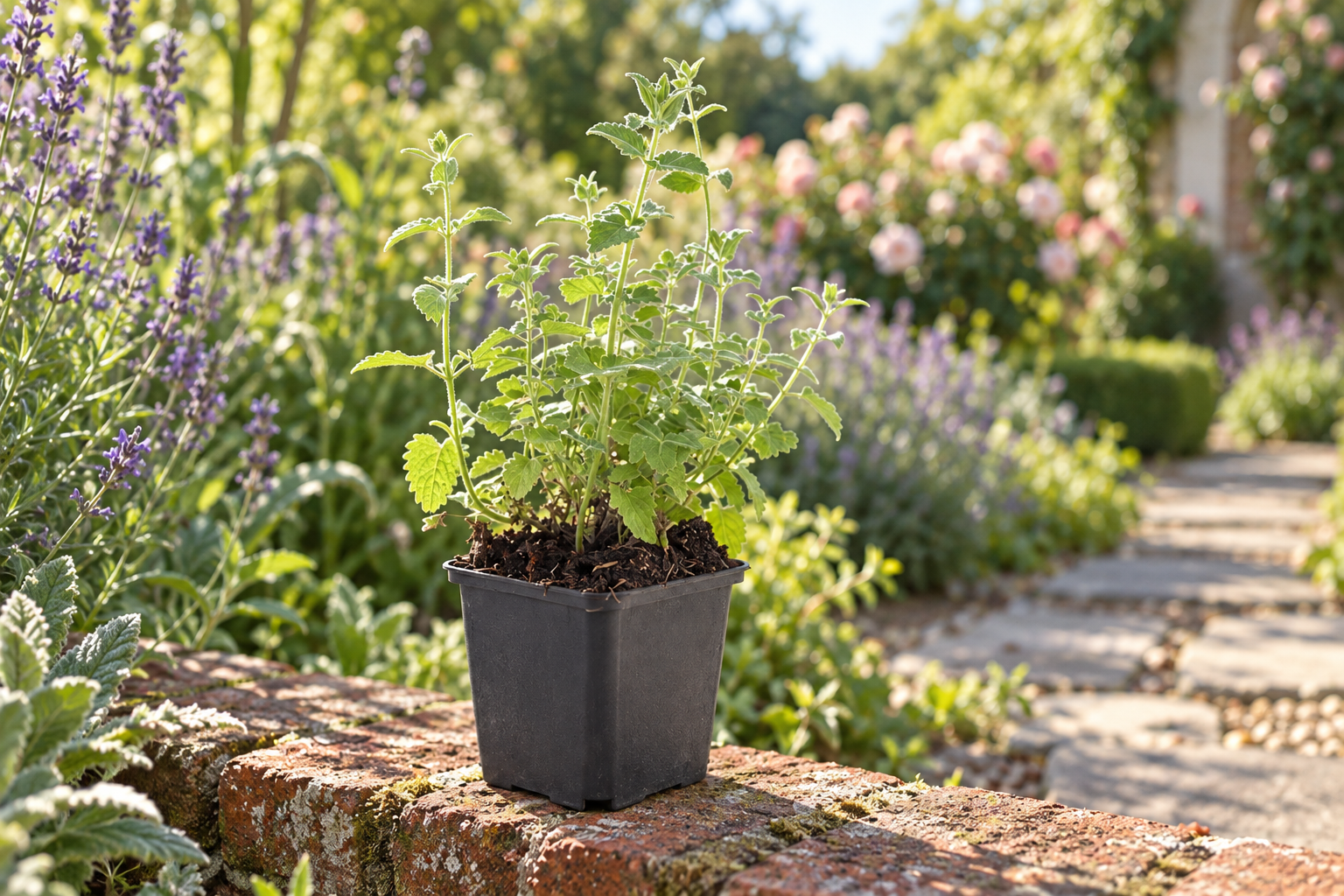
The linked child offers contain 9 cm pots with approximately 10–25 cm total height including the container. Quantity depends on the set selection. Their slender young shoots do not yet have the height and width of a developed Six Hills Giant. Approximately 50–100 cm height and similar width are a cultivar guide for the later planting; the more modest shop figures describe a possible cultivated form rather than a fixed maximum. Check the root ball when unpacking and initially place the plants in a bright position. A young delivered plant without flowers is consistent with its stage of development.
Allow for the later arch beside a path
Sun or bright partial shade and well-drained soil are suitable. In a sunny position the loose habit is usually easier to accommodate than in cramped, damp shade between large neighbours. Approximately 60–90 cm spacing is a practical garden guide; plan according to later width rather than current pot size. Beside a path, a slightly set-back planting position lets the flower stems extend over the border edge. A discreet support may be useful depending on position and growth. A dense, tightly tied bunch would alter the natural shape.
Establishment comes before drought tolerance
Plant in mild weather in frost-free, workable soil. Spring or autumn provide suitable opportunities as long as the soil is neither waterlogged nor completely dry. Set the root-ball surface at its previous level and water thoroughly. Check the small original root zone over the following weeks. An established Six Hills Giant tolerates drier periods, but a young 9 cm root ball initially explores very little garden soil. Permanent container growing needs more root space and an open drainage outlet. Even a drought-tolerant perennial planting needs attentive care in a hot container.
Resetting after the first flowering
When the first main flowering fades and the stems fall apart, cutting back can make the shape more compact and encourage further flowers. Cut back faded shoots without unnecessarily damaging healthy young growth at the base. Water as needed if the soil is dry afterwards, so new shoots do not immediately begin with an inadequate water supply. Renewed flowering depends on the season, weather and plant and is not guaranteed. Removing only individual troublesome shoots initially retains more of the existing loose appearance, but gives up a uniform fresh start for the border.
Grey-green is not automatically a problem
The soft grey-green leaf colour is normal for catmint. A new white coating may instead indicate powdery mildew, especially in dense growth. Check leaves and shoots and keep the planting accessible. Leafhoppers can also occur; stippled leaves therefore need closer inspection rather than just additional water. Feed moderately according to soil and growth. Plenty of nitrogen may encourage long, soft shoots and does not turn a broad variety into a small, compact edging plant. Yellow or wilted foliage is initially a reason to assess roots, moisture and possible damage together.
Retreating in winter and restarting in spring
The perennial largely dies back above ground in the cold season. An empty border space is therefore not equivalent to a failed summer delivery. Remove dead remains in line with new growth and, especially in containers, ensure free drainage and a protected root ball. On frost-free days it must not dry out completely. Older dense clumps can be divided in spring or autumn; division reliably retains the named selection. Young set plants do not yet need this measure. Their first care priority remains a well-prepared position with spare space.
One plant, several views


Good to know
Why is the name given without × faassenii ?
The RHS profile lists Nepeta 'Six Hills Giant' as the accepted name and the × faassenii attribution as a synonym. The named selection remains the same.
How large does it become compared with the delivery pot ?
Approximately 10–25 cm total height including a 9 cm pot can develop into a perennial planting 50–100 cm tall and similarly wide.
Does cutting after flowering help ?
Yes, cutting back may make the shape more compact and encourage further flowering. Its extent also depends on the season and care.
Does it never need support ?
A discreet support may be useful depending on position and growth. The cultivar remains loose and broad.
Does grey foliage always mean mildew ?
No. Grey-green leaves are normal for catmint. They must be distinguished from a newly appearing white coating.
Why is there little green in winter ?
The perennial dies back above ground. Check for new growth in spring and protect container roots in particular from waterlogging.
Sources and editorial note
- Exotenherz: current parent offer, delivery measurements and original gallery (03.10.2026)
- Specialist reference read directly: nepeta-rhs (03.10.2026)
- Specialist reference read directly: nepeta-nc (03.10.2026)
- Exotenherz: checked 6-plant child offer directly (03.10.2026)
- Exotenherz: checked 12-plant child offer directly (03.10.2026)
- Exotenherz: checked 20-plant child offer directly (03.10.2026)
- Exotenherz: checked 40-plant child offer directly (03.10.2026)
- Exotenherz: checked 60-plant child offer directly (03.10.2026)
Identity and product SKU checked against the canonical 642 entries and shared and isolated portraits. Public parent offer, child sets and specialist sources read directly on 03.10.2026; precise URL and file-hash evidence is stored separately. Total delivery height and later growth distinguished. Sets and colour offers do not count as additional identities. Publication not authorised: Root handles shared page building and acceptance.