This plant at Exotenherz
Check the shop offer for current availability, price and what is included.
Product and delivery details are given in the individual offer.
Your care table
| Topic | What to do | Why it helps |
|---|---|---|
| Light | Position brightly in filtered daylight. | Leaf markings need light, while hot direct sun can damage them. |
| Water | Let the upper soil begin to dry and check each pot individually. | The different leaf forms may use water at different rates. |
| Drainage | Water thoroughly, then let excess drain and empty outer pots. | The small roots remain sensitive to persistent wetness. |
| Warmth | Keep warm and sheltered from draughts. | These are tropical houseplants, not frost-hardy succulents. |
| Soil | Use loose, well-draining houseplant compost with airy components. | Water and air should remain balanced around the roots. |
| Repotting | Move up only a small size when the root space is densely filled. | Large pots remain moist for a long time around small peperomia roots. |
| Nutrition | Feed weakly according to the label when fresh growth appears. | Extra food cannot replace a suitable position. |
| Winter | Keep bright and warm, watering more cautiously when growth slows. | Check each root ball in winter too, rather than watering all three by the calendar. |
Check the compost and pot weight. The care table explains how far the compost may dry.
Water only when needed. The water should reach the root ball without spilling over the rim.
Remove surplus water from the saucer or cachepot. Then return the plant to a suitable position.
Three leaf surfaces we enjoy comparing
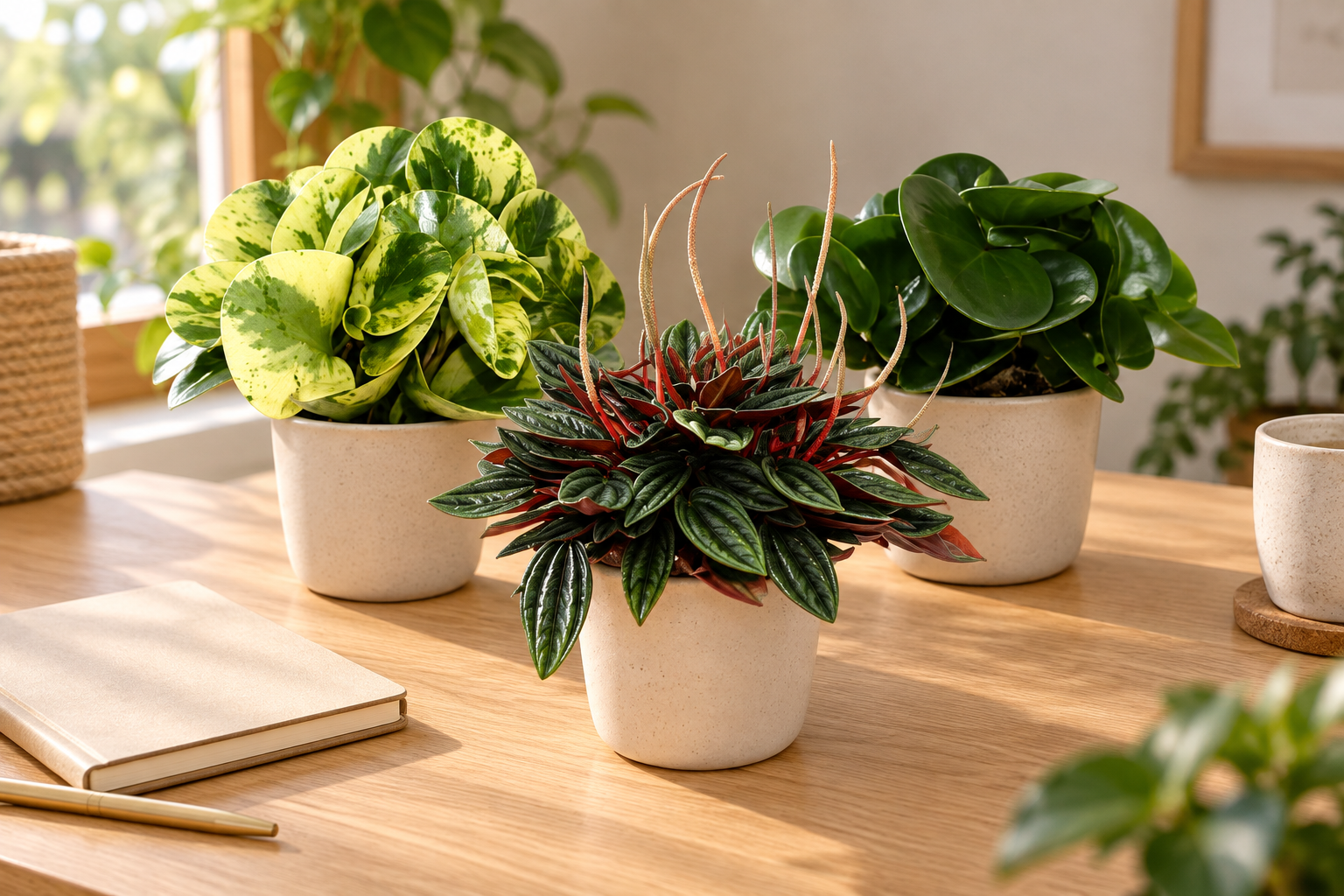
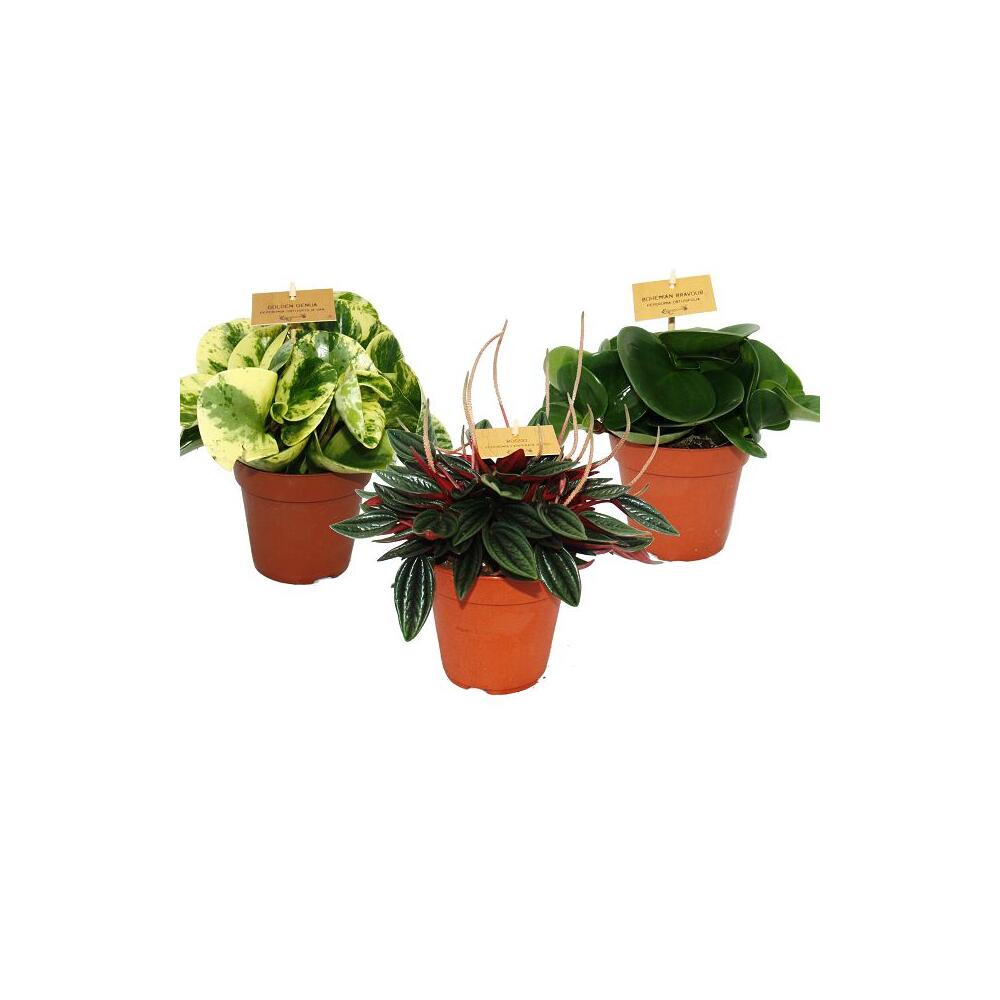
Eden Mix shows how different peperomias can look. One plant has rounded, glossy green leaves; another has yellow-marked foliage. Rosso adds narrow ridged leaves with red undersides. On a bright desk shelf, this becomes a small comparison of shape and surface. We leave some space so that the red undersides show clearly when leaves are lifted. The original photograph shows this offered combination. The foliage needs no extra shine treatment. The contrast between firm round surfaces and fine ridges makes the group interesting.
The shop forms and their botanical connection
The offer names Bohemian Bravour, Golden Genua and Rosso. The two round-leaved forms are placed under Peperomia obtusifolia; Rosso belongs to Peperomia caperata. Each plant stands in its own twelve-centimetre pot and is described at approximately twenty centimetres total height. This height including the container is a delivery measurement, not a fixed eventual size. The decorative outer pots in the scene are not included. Keep existing labels with the plants. This makes it easier to assign new leaves and different watering needs to the right form later.
A good desk position is bright and warm
Filtered daylight suits the offered peperomias. Their foliage is easy to enjoy on a warm, bright shelf, whereas a deep, dark shelving recess may weaken the next growth. Assess hot direct sun behind glass cautiously. Cold draughts and a position immediately above a radiator are unsuitable. Keep the plants accessible: a very narrow edge where leaves are constantly brushed makes care harder. After a change of position, we mainly observe new leaves. Yellow markings alone do not yet show how well the next growth will do in the chosen spot.
Fleshy leaves do not mean desert care
Before watering, feel the upper soil in each pot and compare its weight. The compost may dry partly, but the root ball should not repeatedly dry out completely. Rosso with its ridged leaves, in particular, is not treated like a tough desert cactus. Then water thoroughly and let it drain. Empty the outer pots. Three similar pot sizes do not justify identical amounts of water on a fixed schedule. A soft leaf first calls for a look at the root ball: severe dryness and wet, damaged roots can look similar. Soft, temperate water is helpful.
A small root space remains easy to monitor
Loose, well-draining soil with airy components suits this group. When roots densely fill their space, choose a pot only slightly larger. A large, deep pot stays moist for a long time even though a small peperomia uses little water. The plants do not need to be repotted together. Assess each form according to its own root ball. Feed sparingly during active growth according to the label and allow for any fertiliser already in the compost. A heavy dose produces neither more red undersides nor reliably stronger yellow markings. Healthy new leaf formation is our useful comparison point.
Small flowers and gentle shaping
Peperomias can carry narrow flower spikes. These are less conspicuous than the leaf surfaces but still part of development. Abundant conventional flowers are not expected. Remove old dry leaves carefully without bending the young leaves between them. If a shoot of a round-leaved form becomes long and loose, check light first and shorten it selectively if needed. Clean, healthy stem sections can be used for rooting. Do not cut all three plants to the same height merely to make the collection strictly symmetrical. Their different outlines can remain.
A care notebook for three small companions
In winter the peperomias stay bright and warm. Usually water less during slower growth, but continue checking each root ball separately. Look under leaves and around shoot bases for unusual pests; they are easily missed in tight leaf groups. Old damage does not visually disappear. Healthy new growth shows more clearly whether a position or watering correction has helped. A short note for each plant keeps things clear. Eden Mix thus remains more than a colour-coordinated group: three small plants can continue growing in everyday life with their different leaf shapes.
One plant, several views
Good to know
Which plants does the set name?
Bohemian Bravour and Golden Genua as offered obtusifolia forms, plus Peperomia caperata Rosso.
Are they all in one pot?
No. Each of the three plants stands in its own 12 cm pot.
What does the twenty-centimetre height mean?
The approximate delivery height including the pot, not a fixed final size.
Can I keep all three dry like cacti?
No. The upper soil may begin to dry, but repeated complete drying of the root ball is unsuitable for this selection.
Are the thin spikes a problem?
No. They may be the small flower spikes of the peperomias.
Must I repot them at the same time?
Only if each root space requires it. The three plants may grow differently.
Sources and editorial note
- Exotenherz: offer and original images (02/10/2026)
- RHS: peperomia care (02/10/2026)
- NC State Extension: Peperomia obtusifolia (02/10/2026)
- NC State Extension: Peperomia caperata and Rosso (02/10/2026)
Shop offer, article number, GTIN, availability and original images checked directly on 02/10/2026. Specialist sources read directly. Shop trade names retained; botanical spelling obtusifolia and caperata corrected, measurements from the set description.