This plant at Exotenherz
Check the shop offer for current availability, price and what is included.
Check the shop for the current price, availability and offer contents.
Your care table
| Topic | What to do | Why it helps |
|---|---|---|
| Position | Bright filtered daylight; soften hot summer rays. | The leaf base needs light without overheating at the window. |
| Warmth | Keep warm without cold draughts or direct heating airflow. | Buds and foliage respond to abrupt changes. |
| Space | Keep branches clear at the sides and carry by the pot. | Branched flowering stems remain protected from pressure and breakage. |
| Water check | Assess pot weight, bark and visible roots together. | A date alone cannot explain current moisture. |
| Watering | When bark is largely dry, water thoroughly with room-temperature water. | Water reaches the roots without leaving the medium parched for a long time. |
| Drainage | Let it drain completely; empty the outer pot again. | Persistent water under the inner pot deprives roots of air. |
| Leaf centre | Water in the morning and remove accumulated water from the centre. | Bases that remain wet for a long time become vulnerable to rot. |
| Bark and feeding | Repot when bark breaks down; feed weakly during growth according to the label. | Loose support and moderate nutrients accompany firm living roots. |
| Flower stems | Assess green nodes and remove completely dry stems. | New flowers remain possible, but cutting does not guarantee them. |
Check the compost and pot weight. The care table explains how far the compost may dry.
Water only when needed. The water should reach the root ball without spilling over the rim.
Remove surplus water from the saucer or cachepot. Then return the plant to a suitable position.
A flower edge that invites a closer look
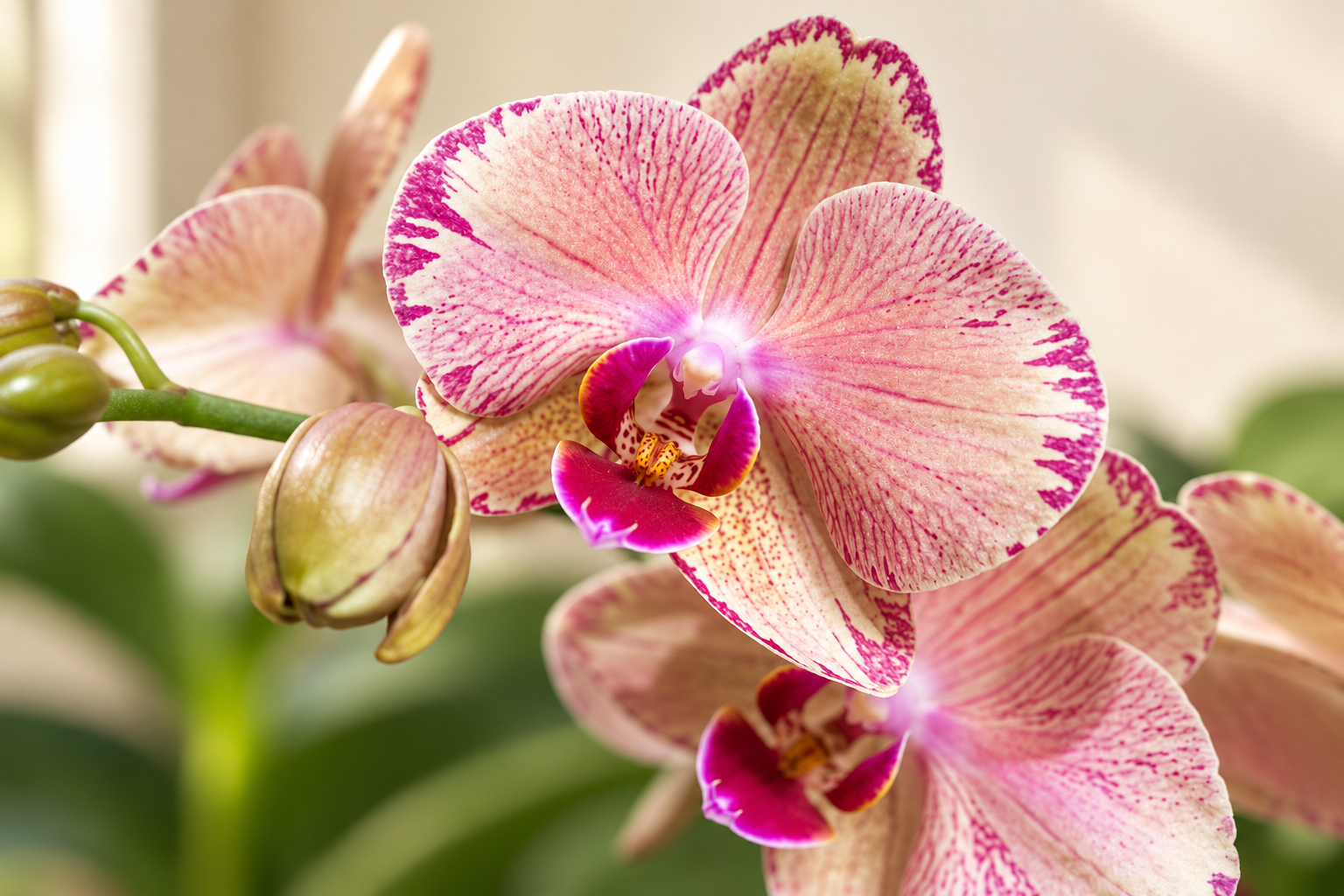
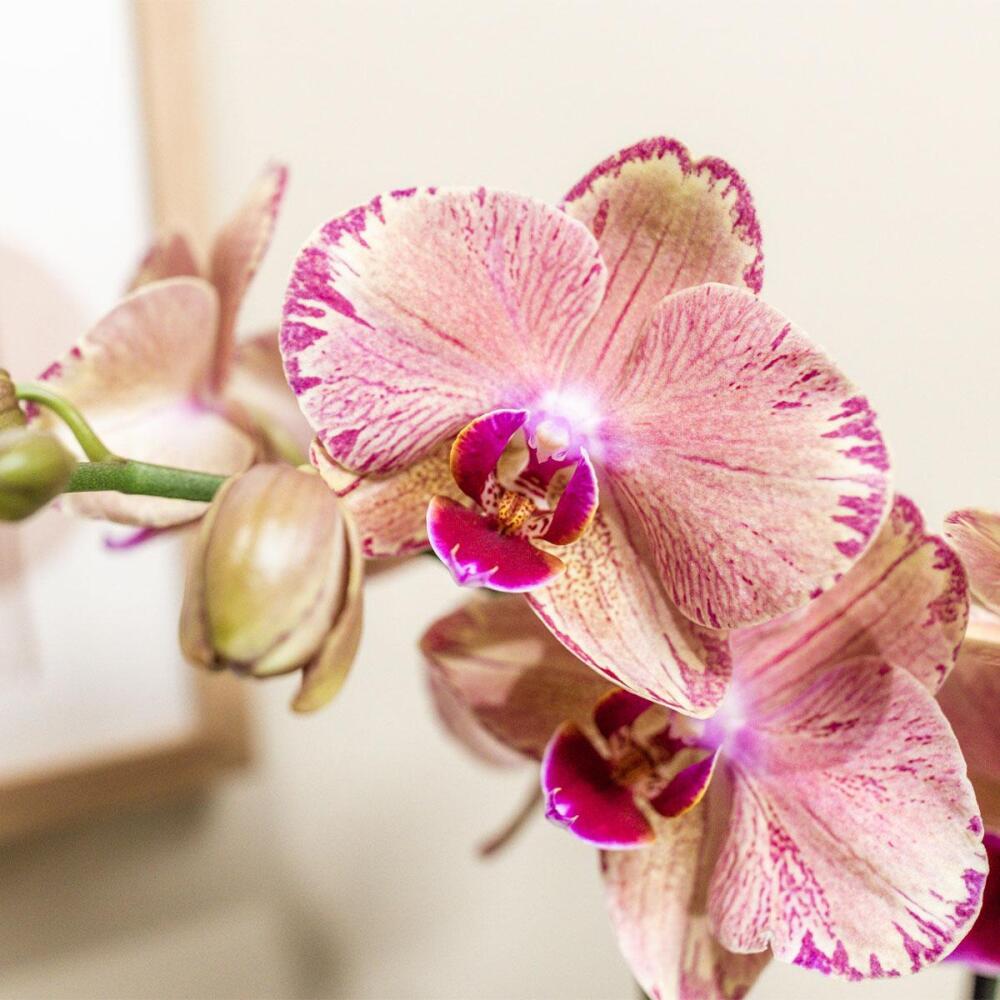
Pirate Picotee is particularly lovely to examine closely. Fine pink veins run towards the centre over a warm cream to apricot ground. Stronger magenta strokes at the edge do not form an even line. The broad lip repeats the deeper pink, with small yellowish and reddish areas inside. Rounded, slightly overlapping petals give the pattern a calm surface. Beneath branched flowering stems sits a strong tuft of green leaves. A bright shelf beside a reading chair suits this contrast between fine pattern and firm foliage. Clear space between branches keeps the flowering canopy visible and makes lifting the pot out easier later.
A named selection from the Jewel line
The shop lists this Phalaenopsis as Jewel Pirate Picotee. Kolibri also directly names Pirate Picotee as its own orchid selection. Jewel is the associated trade line; the plant name accompanies the distinctive flower pattern. It is a bred moth orchid for pot culture. Fleshy leaves sit low at the base while flowers stand above on slender green stems. Aerial roots may grow beyond the pot rim. They belong to these orchids’ structure and are not cut off merely for a tidy appearance. When moving it, support the base rather than grasping flowering stems. Individual veins and marginal strokes may be distributed slightly differently from flower to flower.
Twelve centimetres of pot and space to the sides
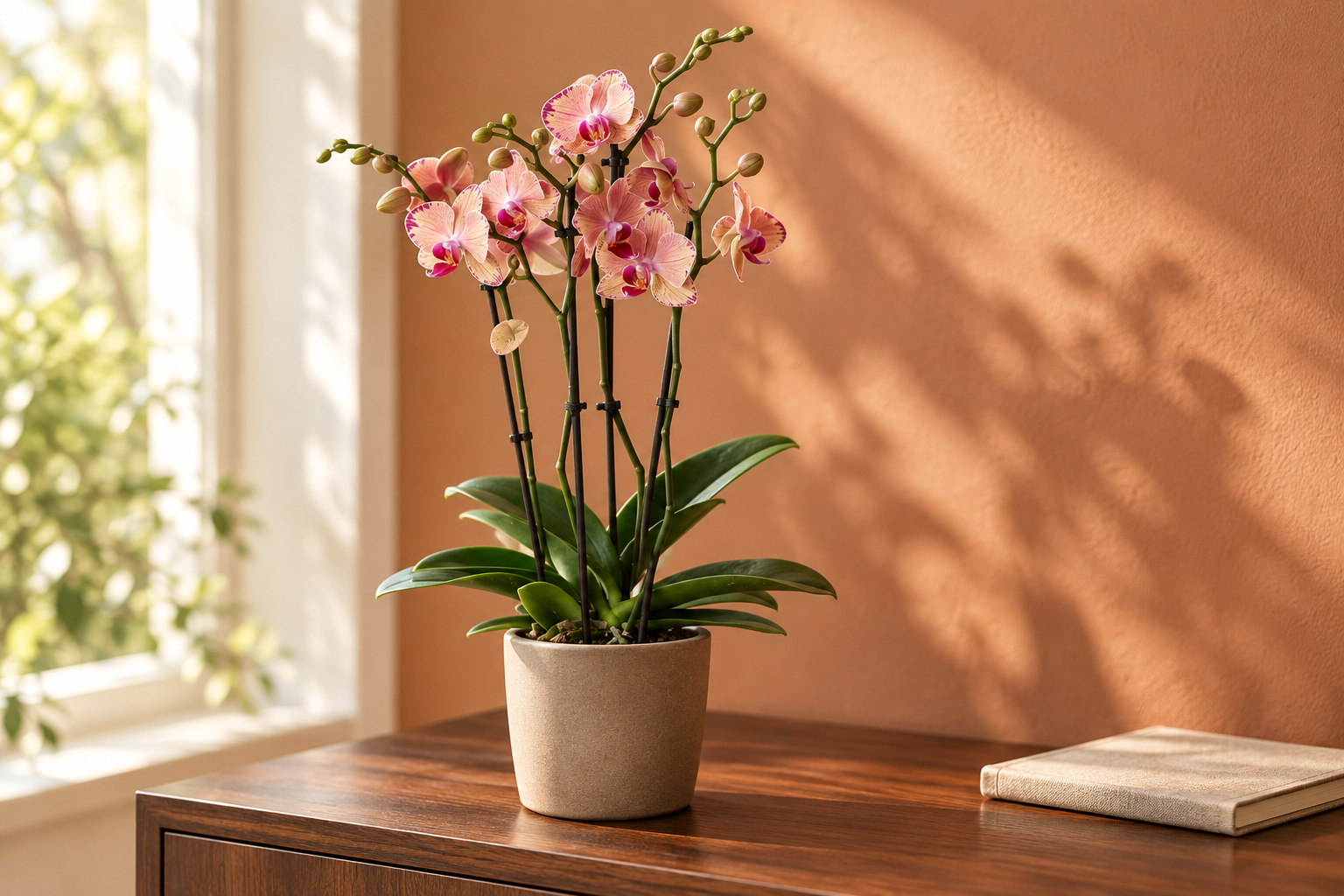
The shop’s own offer specifies a twelve-centimetre nursery pot, with no fixed total height. Plan space according to the actual spread of your plant: branches should neither hit a shelf nor rub a curtain. The original photograph shows several slender supported stems with side flowers and buds. This snapshot is not a fixed flowering display. Choose an outer pot that lets the inner pot lift out comfortably. It must not become a heavy handle for the branches. The AI reading scene is a decorating idea; its container, furniture and notebook are decoration. When unpacking, first loosen packaging carefully, then check leaf bases and the pot.
The pattern needs daylight, the foliage protection
A bright spot with filtered daylight makes the fine veins visible and supplies the green leaves. Morning light is often favourable; soften strong summer rays at a south- or west-facing window. Leaves can suffer directly behind hot glass. Do not simply put the orchid in the darkest corner beside the chair. Ordinary warm room temperatures suit its culture. When airing the room, avoid a cold airflow directly over buds and leaves. Also avoid dry direct heating air. Keep a suitable position as consistent as possible. If a plant in bud loses buds after being moved, first consider changes in light, warmth and moisture rather than immediately increasing fertiliser.
Get to know the inner pot for moisture checks
Lift the nursery pot before watering. Its weight and the state of the bark, together with visible roots, show how far moisture has been used. Moist roots often appear greener; as they dry, they look more silvery. When the mixture is largely dry, water thoroughly with room-temperature water, then let it drain completely and empty the outer pot. Bark may dry noticeably between applications, but should not stay completely parched for long. A rigid weekday cannot replace observation. Morning watering gives wet leaf bases time to dry. Carefully remove water that remains in the leaf centre. At first, note the feel of the pot rather than a fixed volume of water.
Support roots without enclosing them
Suitable orchid bark offers support and air between its pieces. Dense potting compost does not suit these roots. When the medium softens and breaks down, careful repotting is useful, preferably during new root growth after flowering. Retain firm living roots; remove only soft dead portions. Choose a suitable new draining pot, not an unnecessarily large one. Do not bury the base deeply. During active growth, apply suitable orchid fertiliser weakly according to its label. More feed does not automatically create stronger edging or larger flowers. When gently wiping leaf dust, also inspect bases for small woolly deposits. Healthy leaf surfaces matter as much as the striking flower pattern.
Continue care after the last coloured stroke
When flowers wilt, continue caring for living leaves and roots. A green flowering stem may still have nodes capable of development; on a strong plant it can be shortened above a suitable node. Remove a completely brown dry stem. New flowering is possible, but has no certain date. New root tips or a leaf are also development. With lower winter light, check actual consumption again and allow for slower growth. Limp foliage alone does not prove water shortage: damaged wet roots may also absorb water poorly. Examine the inner pot before watering again. Pirate Picotee thus remains a carefully supported orchid between flowering phases.
One plant, several views
Good to know
What does Pirate Picotee mean?
Pirate Picotee is the named Kolibri Phalaenopsis selection from the Jewel line. The original shows fine pink veins and an irregular magenta edge.
How tall is the offered plant when delivered?
The specific offer states a 12 cm nursery pot but no fixed total height. Plan according to your plant’s actual branches.
Is the pictured container included?
The container, furniture and book in the AI scene are decoration. Delivery contents of the linked specific shop offer remain authoritative.
Why are dry roots silvery?
Firm orchid roots can look more silvery as they dry. Assess colour, firmness and pot weight together; silvery does not automatically mean dead.
Should I keep the bark constantly moist?
No. Let it dry largely between thorough waterings, without prolonged complete dryness. Afterwards let water drain completely.
What happens to a green stem after flowering?
Living nodes can develop further. Observe it or shorten above a suitable node on a strong plant; remove fully dry stems.
What can cause limp foliage?
Water shortage or damaged overly wet roots. Check the inner pot first rather than automatically watering more.
Sources and editorial note
- Exotenherz: own offer and originals (04.10.2026)
- Kolibri: own Pirate Picotee selection in the producer portrait (04.10.2026)
- RHS: complete Phalaenopsis growing guide (04.10.2026)
- NC State Extension: Phalaenopsis, roots and culture (04.10.2026)
- American Orchid Society: Phalaenopsis Culture Sheet (04.10.2026)
Shop offer, original photographs and specialist sources checked on 04.10.2026. Current availability in the shop.