This plant at Exotenherz
Check the shop offer for current availability, price and what is included.
Check the selected shop offer for price, availability and delivery contents.
Your care table
| Topic | What to do | Why it helps |
|---|---|---|
| Light | Bright filtered daylight; shade hot summer glass. | Leaves need brightness, not strong overheating. |
| Placement | Warm and stable, away from cold draughts and heating airflow. | Buds and branches remain protected from abrupt changes. |
| Bee container | Lift inner pot for checks and carry by the container. | The described decorative container does not replace controllable root space. |
| Water check | Inspect bark, visible roots and weight together. | A 9 cm pot does not set a fixed watering routine. |
| Watering | When largely dry, water thoroughly at room temperature. | Bark may dry but should not stay completely parched for long. |
| Drainage | Let everything drain and empty the Bee container again. | Constant residual water threatens air-needing roots. |
| Leaf centre | Carefully remove collected water; preferably water in the morning. | Bases can dry rather than stay wet for long. |
| Bark and feeding | Gently repot when decomposed, retain firm roots; feed weakly during growth. | Airy support and moderate nutrition accompany further development. |
| After flowering | Watch green nodes, remove dry stems and check leaves. | Healthy leaves and roots matter more than a fixed flowering date. |
Check the compost and pot weight. The care table explains how far the compost may dry.
Water only when needed. The water should reach the root ball without spilling over the rim.
Remove surplus water from the saucer or cachepot. Then return the plant to a suitable position.
Raspberry-red islands on a pale ground
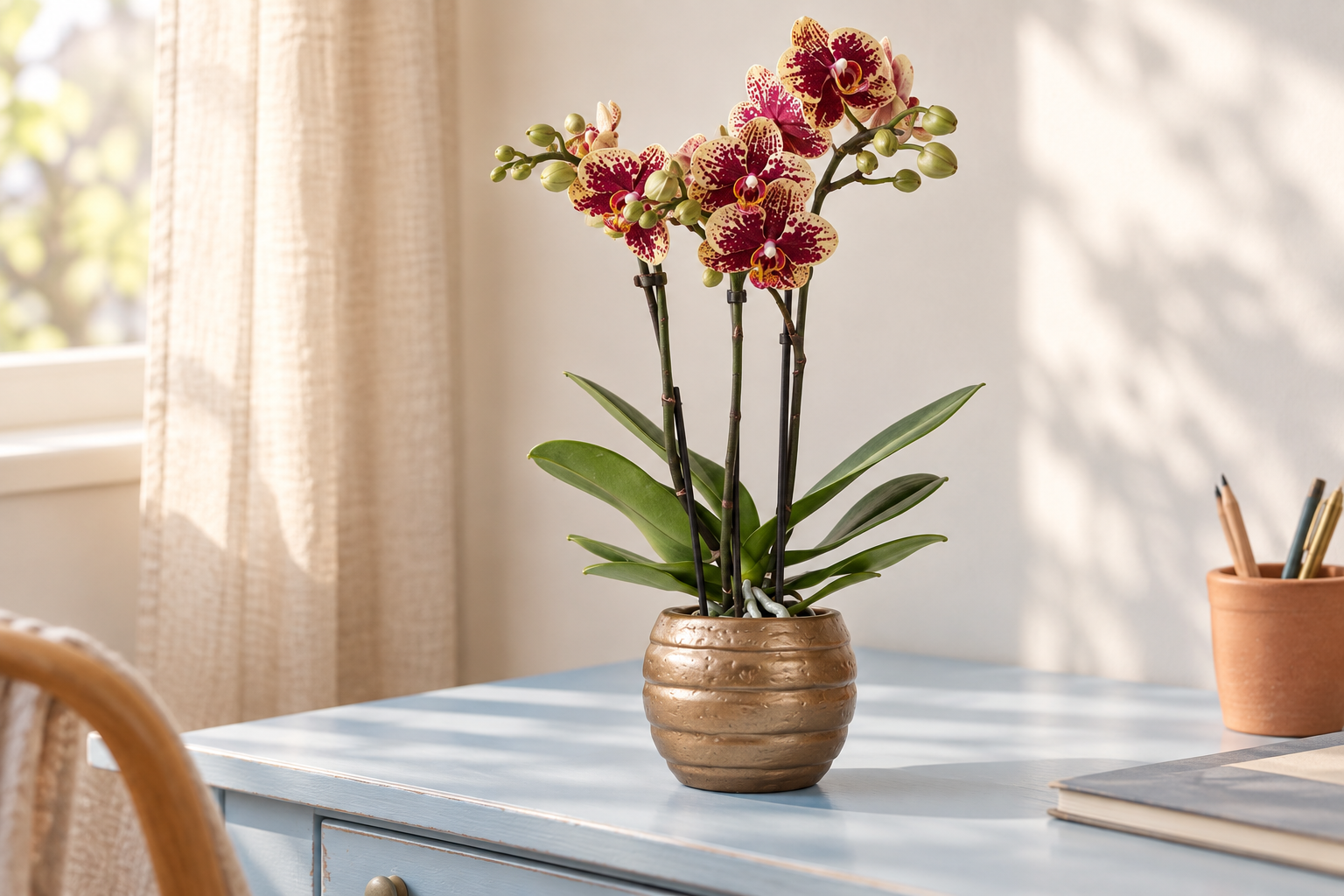
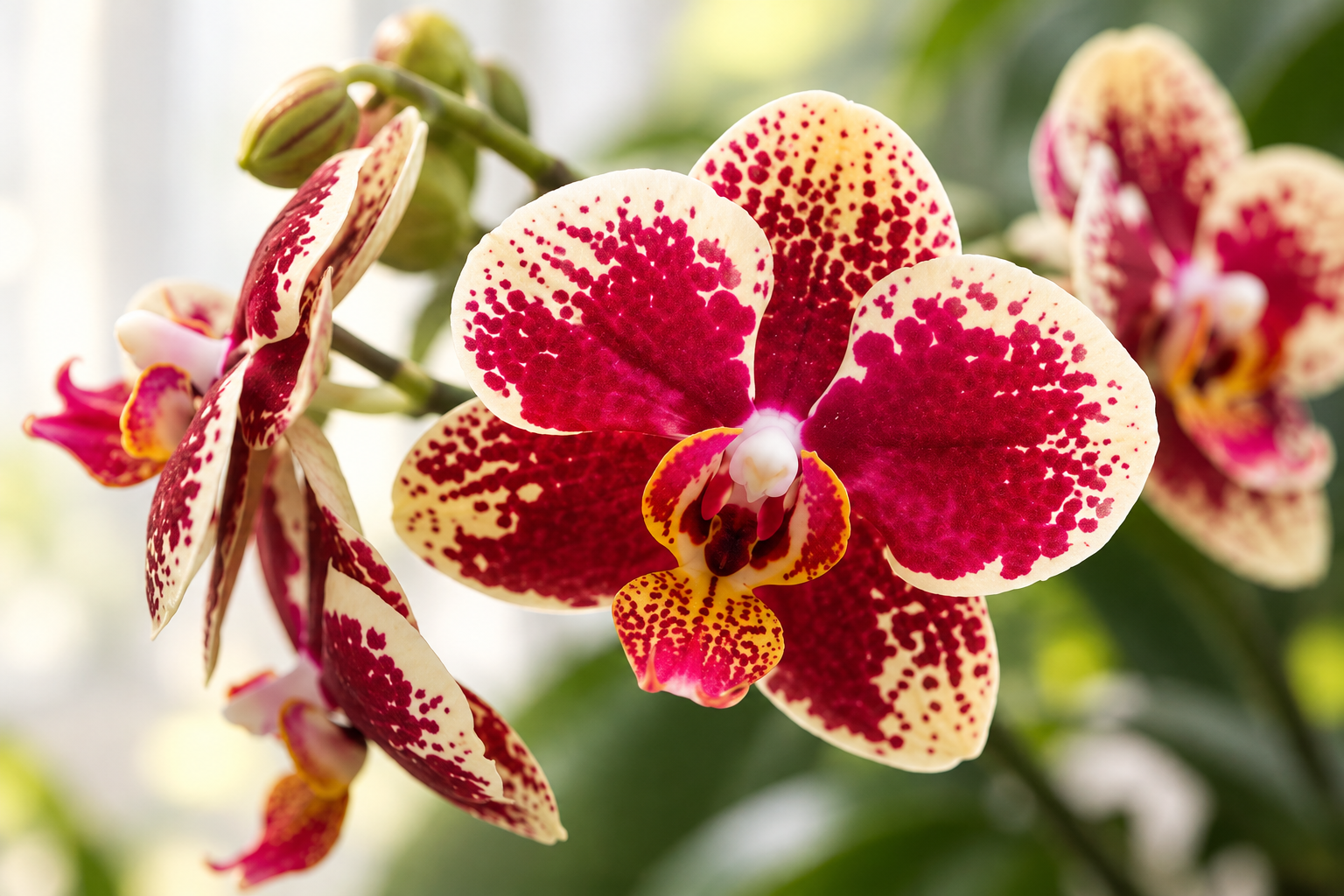
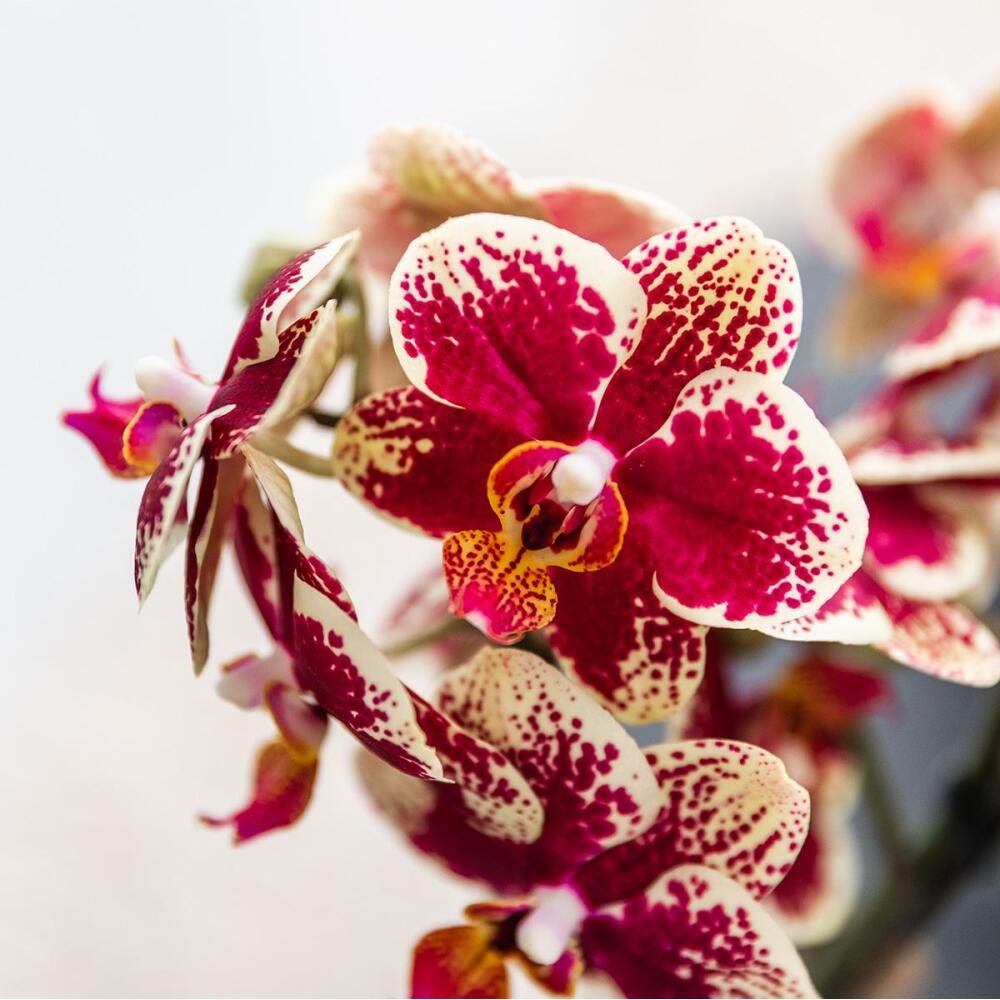
Spain shows its pattern in strong contrast. Dense raspberry-red spots sit on creamy-yellow rounded petals. Towards the centre they may merge into larger areas, while more pale islands and single dots remain at edges. The lip combines yellow and reddish-pink parts, with a pale column above. The next flower may already distribute the pattern differently. Slender green branches carry this broad flower surface above elongated firm leaves. A bright desk makes the small plant easy to admire. A quiet background helps reveal dots rather than hiding their pattern among other patterned objects.
Spain is also called Spanien in the shop
Our offer uses Spanien; the long text says Spain. Producer Kolibri uses Spain for a Phalaenopsis selection in its Diamond family, a trade line with striking flower patterns. The name describes the bred potted orchid, not wild origin in Spain. Care follows moth orchid structure: fleshy green leaves, air-needing roots and flower axes from a low base. Red markings require no special colour fertiliser. Small differences in spot density and colour effect belong to living flowers and changing light. Treat originals as illustrations of the selection’s character, not an unchanging ornament. Looking at several open flowers helps: pale edges and dark areas vary even within one plant. Judge the whole living orchid, not a single dot.
A small nursery pot inside a Bee container
The exact shop text states a nine-centimetre pot. Our long text describes two or three flower branches and the combination with a Bee pot. It gives no fixed total height. The rounded horizontally textured container in the original belongs to this combination; other desk furnishings in the AI scene are decoration. Leave room sideways for leaves and aerial roots, above for branches. A small pot invites quickly pushing the plant aside by stems. Carry the pot instead and keep branches free. The shown number of open flowers is a momentary state, not a promise for every delivery.
A bright workplace without heat
Spain does well in bright filtered daylight, such as near an east-facing window. Soften strong summer rays behind south or west glass with a light curtain. Firm leaves should receive enough light without overheating the plant in hot sun. A bright workspace therefore means near a window, not a dark shelf deep in a room. Ordinary warm indoor temperatures suit cultivation. Avoid cold ventilation draughts and direct dry heating air. A frequently used work surface also needs a safe corner where sleeves, cables or opening windows do not hit branches. Buds are sensitive to marked location changes.
Watch bark in the small pot
The small nursery pot makes checking easier but does not automatically mean daily water needs. Carefully lift it out and check weight, bark pieces and visible roots. Greener roots often indicate moisture, silvery roots drying. When the mix is largely dry, water thoroughly at room temperature and let everything drain completely. No water reserve stays in the Bee container. Roots may receive air between waterings; avoid prolonged total drought too. Winter consumption changes with light. Reassess how fast the pot gets lighter. Spraying flowers does not replace water supply to roots.
Firm roots and a dry leaf centre
Aim water at bark where possible and then check leaf bases. Carefully remove water remaining in the centre. Morning watering helps accidentally wet surfaces dry. Roots stay in suitable airy orchid bark, not dense potting compost. When the mix breaks down, gently repot, preferably after flowering during new root growth. Neither cut firm healthy aerial roots nor force them beneath the rim. Remove only soft dead pieces and choose an appropriately small pot with drainage holes. In active growth, use suitable fertiliser weakly according to label; no extra feeding solely for denser red patterns.
Accompany the less-flowered period too
The green leaf base remains after flowering. Remove a dry brown stem; assess a green stem with living nodes first. On strong plants, careful shortening above a suitable node is possible without guaranteeing new flowers. Fresh root tips or a new leaf are equally useful signs of development. When cleaning leaves, check bases for woolly deposits and other abnormalities. If leaves go limp, inspect the rootball first: overly dry medium and wet damaged roots may look similar. If buds fall, review recent site and care changes. Larger water quantities or a fixed flowering calendar cannot force Spain into more reliable development.
One plant, several views
Good to know
Are Spain and Spanien different plants?
Here they name the same Kolibri selection in the exact offer. Spanien is in the title, Spain in long text and producer description.
Which dimensions are stated?
A 9 cm nursery pot; long text gives two or three branches and the Bee pot. No fixed total height is stated.
Is the Bee pot just image decoration?
For this offer our long text states the combination with the Bee pot. Other furniture and desk items in the AI scene are decoration.
Why does the pattern vary?
Spot distribution varies between living flowers. Light and photography also change colour effect; do not expect identical markings.
Does the small pot need daily water?
Not automatically. Check weight, roots and bark together and water thoroughly when largely dry.
May water remain at the bottom of the Bee container?
No. Let everything drain after watering and remove residual water from the container.
What do I do without flowers?
Keep caring for leaves and roots. Assess green stems, remove completely dry ones; more flowers are possible but not date-guaranteed.
Sources and editorial note
- Exotenherz: our offer and originals (04.10.2026)
- Kolibri: Spain and El Salvador in the Diamond line (04.10.2026)
- RHS: complete Phalaenopsis growing guide (04.10.2026)
- NC State Extension: Phalaenopsis, roots and cultivation (04.10.2026)
- American Orchid Society: Phalaenopsis Culture Sheet (04.10.2026)
Shop offer, original images and specialist sources checked on 04.10.2026. Current availability in the shop.