This plant at Exotenherz
Check the shop offer for current availability, price and what is included.
Product and delivery details are given in the individual offer.
Your care table
| Topic | What to do | Why it helps |
|---|---|---|
| Position | Bright filtered daylight; soften stronger summer rays. | The fine flower pattern remains visible and leaves do not overheat. |
| Warmth | Position warmly and as steadily as possible, without cold draughts. | Buds and leaves react to abrupt position changes. |
| Space and support | Leave short branches free and carry the plant by its pot. | The sideways branched flower canopy is not squeezed or strained as a handle. |
| Watering | Check roots, bark and pot weight; water when the mixture is largely dry. | Need depends on room climate and growth, not a rigid weekday. |
| Drainage | Let drain completely after watering and empty the outer pot. | Airy roots should not stand in a permanent water bath. |
| Leaf centre | Use room-temperature soft water; remove water from leaf bases. | A centre that stays wet increases the risk of damaged tissues. |
| Compost and repotting | Use suitable orchid bark; repot carefully if it breaks down or roots have problems. | Firm living roots are protected and regain airy support. |
| Feeding | During growth, supply suitable orchid fertiliser weakly according to the label. | Moderate nutrition avoids unnecessary salt loading in the small pot. |
| After flowering | Assess green stems, remove dry ones; monitor foliage and bases. | New roots and leaves continue development without a fixed flowering date. |
Check the compost and pot weight. The care table explains how far the compost may dry.
Water only when needed. The water should reach the root ball without spilling over the rim.
Remove surplus water from the saucer or cachepot. Then return the plant to a suitable position.
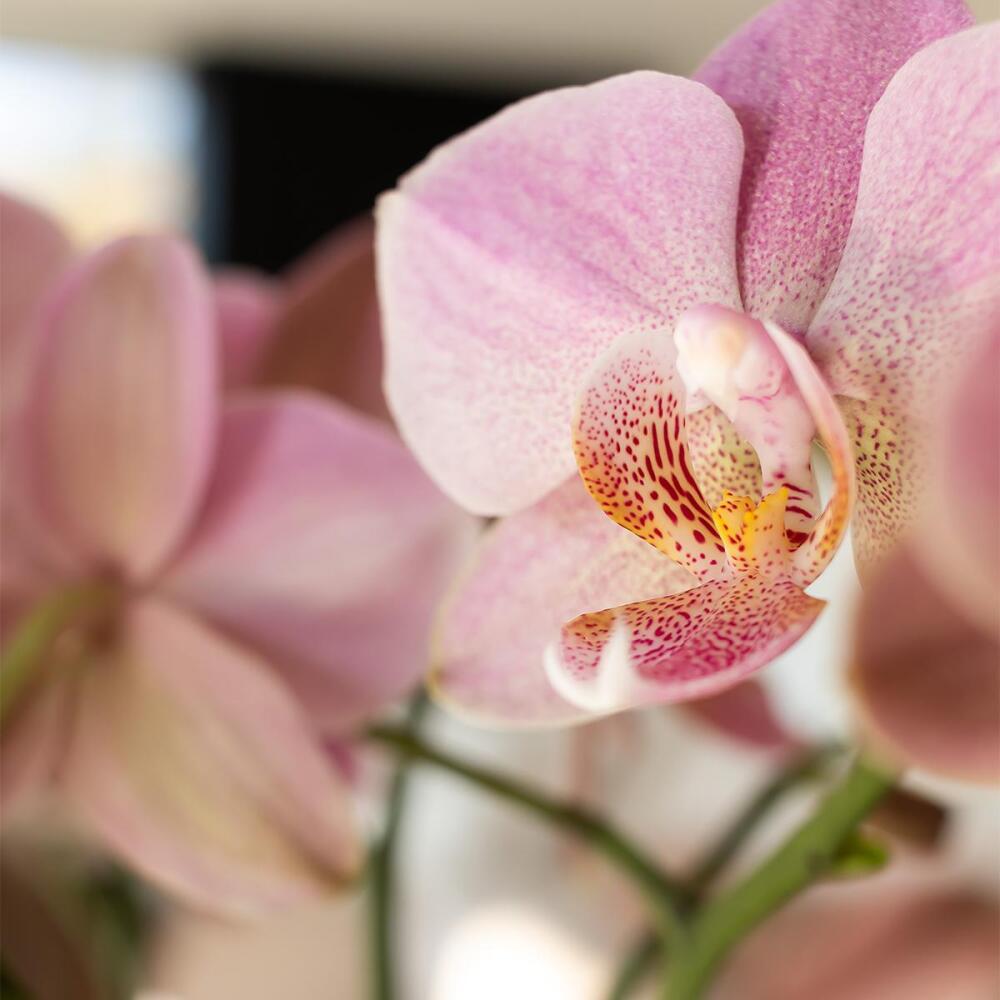
Dusky pink with fine dots
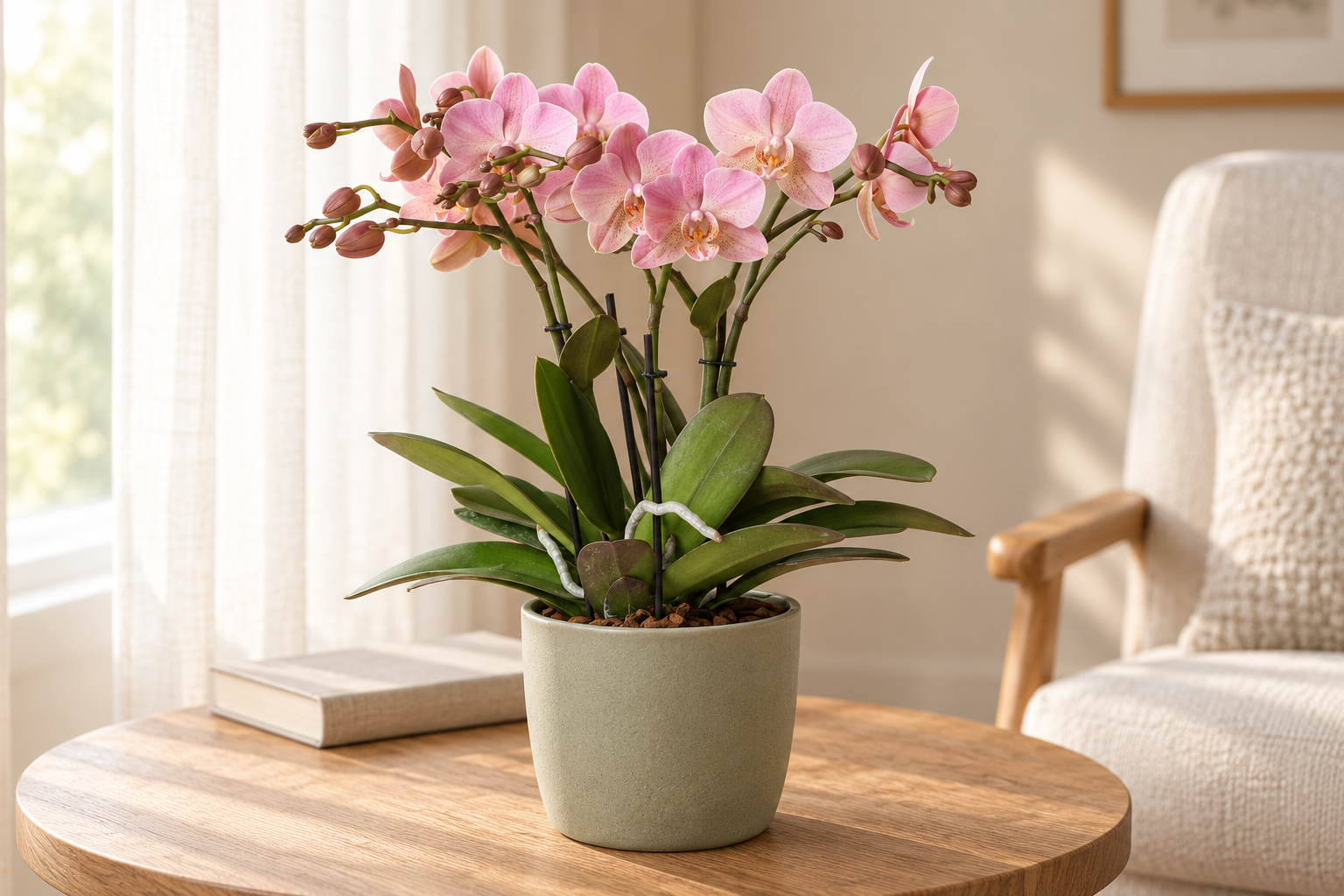
Treviso brings a gentle, slightly muted pink colour. Close up, the calm surface breaks into many very small dots, especially towards the flower centre. Pale and yellowish areas of the lip sit there with darker speckles. The rounded petals overlap slightly and stand on short branched flower axes. Below them is a distinct green leaf tuft with strong elongated leaves. A low shelf lets you view both together: the broad green base and the loose flower canopy above. A pale plain background gives the delicate pattern room. The muted colour works beside natural wood and calm fabrics without additional decoration needed between the branches. Leave some distance between flowers and curtains too, so fabric does not brush the delicate surfaces.
Treviso belongs to the Jewel selection
Treviso names a named Phalaenopsis selection by Kolibri. The offer states Jewel Treviso; the producer also lists this orchid under that name. Jewel is its associated trade line. Treviso is described as a bred moth orchid for pot culture. Its thick leaves and aerial roots belong to the typical structure of this orchid genus. A root growing over the rim is therefore not initially a fault. It is not cut off merely to make the plant look tidier. The living plant continues to develop its leaf arrangement and branching. Individual flowers can also differ slightly from neighbours in colour intensity and dot pattern.
Short branches in a twelve-centimetre pot
The specific offer states a twelve-centimetre nursery pot and at least four flower branches. No particular total height is given. For positioning, the actual width of the branched plant is therefore more useful than an estimated centimetre figure. Choose a place where lateral flowers and buds stay free. Carry the pot when moving; branches are not handles. A simple outer pot can hold the nursery pot but should leave enough room to lift it out. The reading scene shown is a furnishing idea. Outer pot and book are decoration there. Flower count, bud stage and branch position change in living plants.
Bright daylight and steady warmth
A bright window with filtered light suits Treviso. An east window is often straightforward; stronger summer rays at south- or west-facing windows are softened. Directly behind hot glass, the thick leaves can suffer damage despite their firm surfaces. Bright indirect daylight also means the orchid should not disappear deep into a dark room corner. Ordinary warm room temperatures suit its culture. Protect it from cold draughts when ventilating and keep away from dry heating air. Place a budded plant in a reliable position where possible rather than constantly moving it between very different light and temperature conditions. This also makes regular pot checks easier.
Water according to roots rather than the calendar
Before every watering, lift the nursery pot and inspect roots if it is transparent. Moist roots look greener, dry ones often silvery. Together with pot weight and bark condition, this gives a useful picture of water need. When the compost is largely dry, water thoroughly with room-temperature, preferably soft water. Afterwards drain completely and empty the outer pot. The bark mixture may dry noticeably between waterings but should not remain entirely parched for long. A fixed weekly appointment does not suit every season. Morning watering gives accidentally wetted leaf bases time to dry. No water stays in the leaf centre.
Airy bark and careful nutrition
Phalaenopsis roots need air between compost pieces. Use suitable orchid bark rather than dense potting soil. Repotting becomes useful when the mixture breaks down or roots encounter unfavourable conditions in the pot. A phase of new root growth is helpful, preferably after flowering. Remove only soft dead root pieces and protect firm roots. The new pot stays suitably small and has reliable drainage openings. During active growth, give suitable orchid fertiliser weakly according to its label. A larger fertiliser reserve does not automatically produce more flowers. Carefully wipe leaf dust away and check leaf axils for mealybugs without unnecessarily touching flowers.
An orchid remains after the flower canopy
When the final flowers fall, leaves and roots remain the starting point for the next development. A green flower stem may still have living buds. It can initially be watched or shortened above a suitable node on a strong plant. A completely brown dry stem is removed. New branches or another flowering are possible but have no fixed date. Strong foliage and new root tips are also welcome signs of growth. With limp leaves, check the root zone first: both lack of water and damaged overly wet roots can be responsible. More water alone is therefore not a reliable answer. A short inspection while lifting the pot out makes subsequent care more accurate.
One plant, several views

Good to know
What does Jewel Treviso mean?
Treviso is the named Kolibri Phalaenopsis selection; Jewel names the trade line. Its finely patterned dusky pink flowers belong to the appearance shown.
How large is the offered Treviso?
The own shop text states a 12-cm nursery pot and at least four flower branches. No fixed total height is given there.
Is the outer pot in the scene part of the offer?
The AI scene shows a furnishing idea. Outer pot and book are decoration; the delivery contents of the specific shop offer remain decisive.
Should I soak it every week?
Check roots, bark and pot weight first. The mixture should largely dry without remaining parched for long. Let drain completely after watering.
Can aerial roots grow over the pot?
Yes, that is normal for Phalaenopsis. Do not cut firm living aerial roots solely because of their appearance.
What should I do with a spent flower stem?
Initially observe a green stem or shorten it above a suitable node on a strong plant. Remove entirely brown dry stems.
Why do leaves become limp?
Check the root zone. Too little water and overly wet damaged roots can cause similar leaf symptoms; do not blindly water more heavily.
Sources and editorial note
- Exotenherz: exact own offer and originals (04.10.2026)
- Kolibri Company: Treviso in the Jewel range (04.10.2026)
- OK Plant/Kolibri: named orchid selection (04.10.2026)
- RHS: complete Phalaenopsis cultivation (04.10.2026)
- NC State Extension: Phalaenopsis, roots and cultivation (04.10.2026)
- American Orchid Society: Phalaenopsis Culture Sheet (04.10.2026)
Shop offer, original images and specialist sources checked on 04.10.2026. Current availability in the shop.