This plant at Exotenherz
Check the shop offer for current availability, price and what is included.
Check the shop for the current price, availability and offer contents.
Your care table
| Topic | What to do | Why it helps |
|---|---|---|
| Light | Hang in a bright position and screen hot sun. | The yellow-green leaf areas need a good light position. |
| Water | Let the surface dry, then water thoroughly. | A moist centre does not need daily topping up. |
| Drainage | Remove water from the decorative pot or hanging cover. | The root ball must not stand in water permanently. |
| Growing medium | Loose and humus-rich with reliable drainage. | Aerated roots support healthy new growth. |
| Feeding | During growth, in moderate doses. | Oversupply does not improve the leaf pattern. |
| Vines | Let them hang freely or guide loosely along a support. | Nodes and stems must not be crushed. |
| Pruning | Selectively shorten overlong shoots around a node. | The form stays manageable and can branch. |
| Winter | Check root-ball moisture and brightness together. | Consumption often decreases during darker weeks. |
Check the compost and pot weight. The care table explains how far the compost may dry.
Water only when needed. The water should reach the root ball without spilling over the rim.
Remove surplus water from the saucer or cachepot. Then return the plant to a suitable position.
Every heart has its own pattern
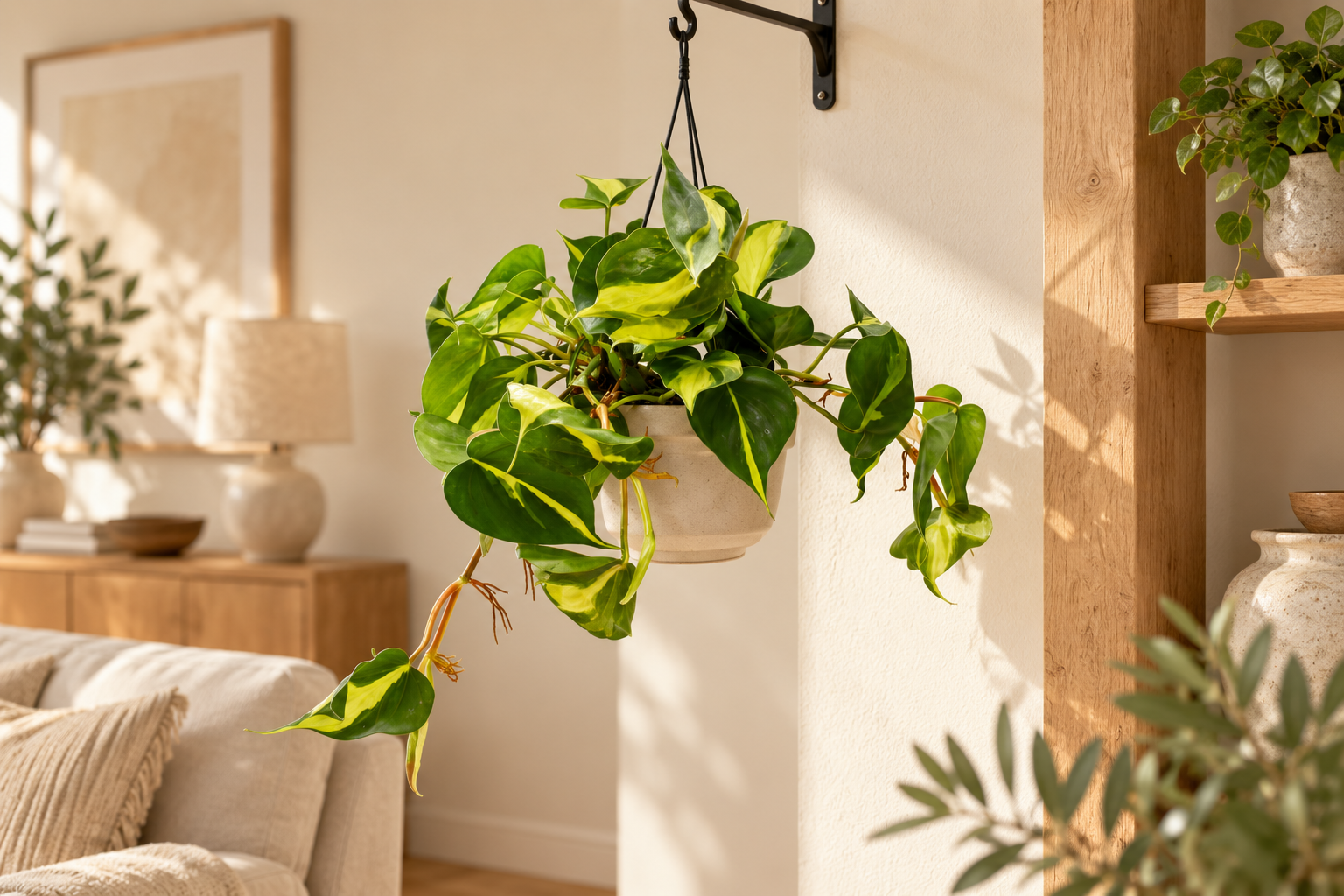
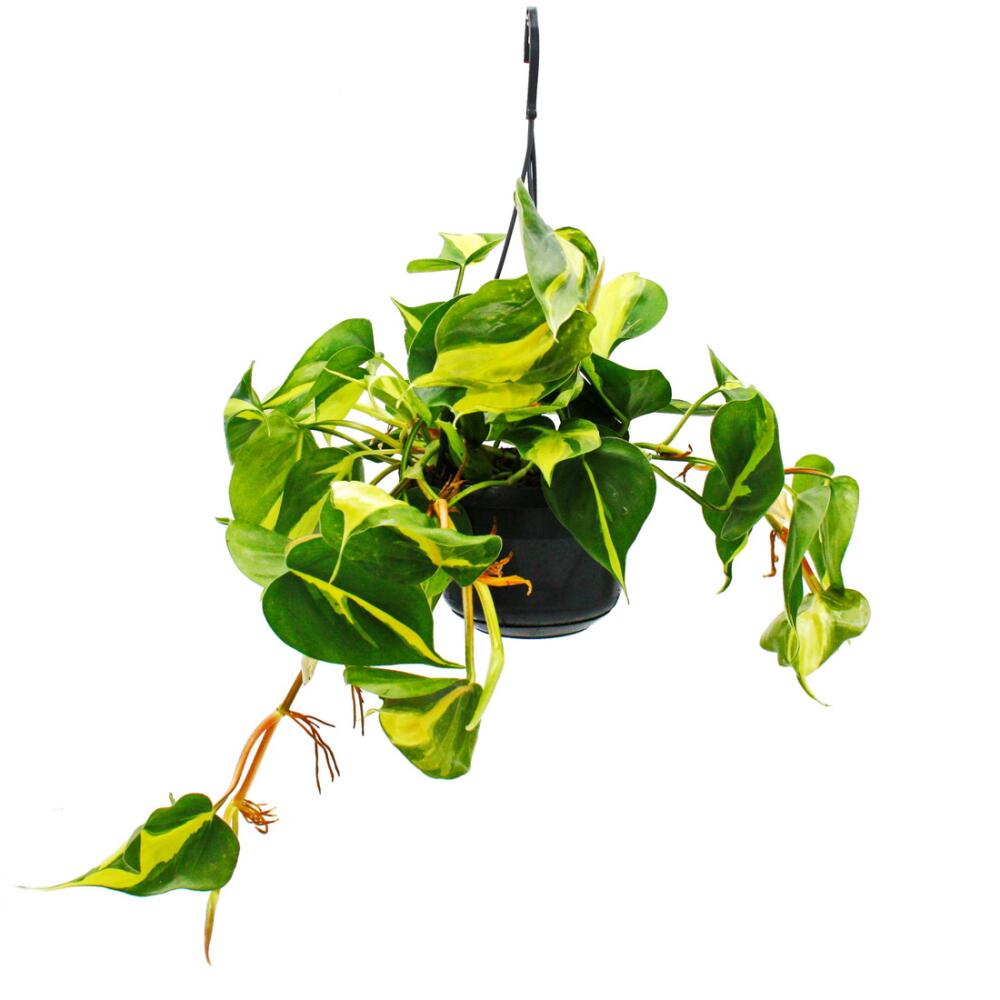
Brasil brings small yellow-green patches of light among rich green leaf surfaces. The hearts are not painted alike: some carry a broad pale stripe, while others remain mostly green. These very differences appeal to me in a living hanging plant. Short vines hang loosely over the pot rim and become longer over time. The offer describes a fifteen-centimetre hanging pot and an overall size of about twenty-five to thirty-five centimetres. For an initial arrangement, a clear position at a shelf edge or an accessible hanging point is enough. A large green curtain, however, is the result of later growth, not a fixed delivery promise.
A philodendron with several trade names
In the shop, the plant appears as Philodendron scandens Brasil. Botanically it is placed under Philodendron hederaceum. It therefore belongs to the heart-leaved philodendrons and is not a pothos, even though both plants can be used similarly in hanging planters. Its shoots develop nodes and can orient themselves along suitable supports using aerial roots. Those letting it trail give the vines a clear route. Those wanting it to climb plan a stable support. I decide according to the space available, not a supposed obligation to tie every vining plant immediately to a tall pole.
A bright position brings the pattern to life
Filtered daylight supports the leaf markings and strong new growth. A deep dark shelf compartment is less suitable for Brasil over time than an open surface in a bright room. Hot midday sun, on the other hand, can damage unprotected leaves. The hanging position is therefore observed throughout the day: a wall may be gently lit in the morning and heat up strongly later. A slightly shifted position or a light curtain then helps. The vines should not constantly rub against glass or a wall. In winter too, they stay warm and protected from the cold air stream of a frequently opened door.
Bring water all the way to the roots
For watering, I take the hanging plant down and first check the root ball. If the upper layer is slightly dry and the pot has become lighter, the compost is moistened evenly. Excess water drains away before the plant is hung up again. Small sips onto an already wet root ball bring no benefit. A pot containing loose growing medium behaves differently from compacted soil, so personal observation matters more than a fixed interval. A newly unpacked hanging plant does not automatically receive water either. Its existing moisture determines whether it needs watering now or first a short drying phase.
Shape the vines and maintain the compost
A humus-rich, structurally stable mixture supports the roots. Once the root ball is densely rooted later, a slightly larger pot can provide new space. The vines are carefully laid aside during work without pulling individual leaf stalks. Overlong shoots can be selectively shortened for a more compact form. Healthy pieces with a node are generally suitable for vegetative propagation; a leaf without a node does not have the same starting conditions. After a cut, the plant remains bright and warm. Freshly cut vines are not immediately squeezed into a large, persistently moist pot simply to produce a full hanging plant quickly.
Care in the rhythm of growth
While Brasil forms new leaves, moderately dosed houseplant fertiliser can support it. Depending on the product, new compost already brings nutrients; both are coordinated. Leaf surfaces can be carefully cleaned of dust. In a strongly heated winter position, I make sure not to confuse dry air with slower-drying soil. More water in the pot does not usefully increase humidity at the leaves. In low light and with weak growth, watering and feeding are more restrained. The plant may be slower at this time of year without requiring its whole cultivation routine to change.
Interpret changes attentively
Individual leaves with different markings belong to Brasil. However, if several new leaves are unusually small or the shoots lose leaves noticeably, checking the position is worthwhile. Yellow foliage also calls for a look into the decorative pot and at the roots. Pests may be noticed early on undersides and at nodes. Pruning and repotting use clean tools and gloves if needed, because sap may irritate. Plant parts are not intended for eating. With clear space for vines and calm care, Brasil remains a light green companion whose pale hearts look especially lovely among books, wood and simple containers.
One plant, several views
Good to know
Is the plant called scandens or hederaceum?
Philodendron scandens is a widespread trade name. Brasil is botanically placed under Philodendron hederaceum.
Is Brasil a pothos?
No. The heart-leaved philodendron and Epipremnum are different plants.
Do all leaves stay equally colourful?
No. The size and distribution of yellow-green markings naturally differ from leaf to leaf.
Can Brasil stand on a shelf?
Yes, if enough daylight reaches it and the vines can hang down freely.
When does the hanging plant need water?
When the surface dries slightly and the pot becomes lighter. Then water thoroughly and let it drain.
Can I shorten long vines?
Yes. A clean cut around a node keeps the plant manageable and may encourage branching.
Is Brasil edible for pets?
No. Plant parts may irritate and should not be nibbled or fed to animals.
Sources and editorial note
- Exotenherz: offer and original images (01.10.2026)
- NC State Extension: Philodendron hederaceum and Brasil (01.10.2026)
- RHS: growing philodendrons (01.10.2026)
Shop offer, SKU, GTIN and availability checked live on 01.10.2026. Original photograph unchanged. Our own researched gardening texts and individually approved scene.