This plant at Exotenherz
Check the shop offer for current availability, price and what is included.
Check the shop for the current price, availability and offer contents.
Your care table
| Topic | What to do | Why it helps |
|---|---|---|
| Light | Provide a bright position with filtered daylight. | Dark niches slow new growth. |
| Watering | Let the upper soil layer dry slightly, then water thoroughly. | Roots need both water and air. |
| Drainage | Let the nursery pot drain and empty the decorative pot. | Hidden waterlogging harms the root ball. |
| Growing medium | Use loose, structured houseplant compost. | Compacted soil stays wet inside for too long. |
| Feeding | Feed moderately during growth according to the pack instructions. | More fertiliser does not force a stronger red colour. |
| Repotting | In spring, move a densely rooted root ball to a slightly larger pot. | Too much unrooted soil makes water control harder. |
| Leaf care | Wipe carefully with a damp, soft cloth. | Dust hides the natural surface. |
| Winter | Bright, warm position; adjust watering to consumption. | Less light usually means slower development. |
Check the compost and pot weight. The care table explains how far the compost may dry.
Water only when needed. The water should reach the root ball without spilling over the rim.
Remove surplus water from the saucer or cachepot. Then return the plant to a suitable position.
A rosette with changing colours
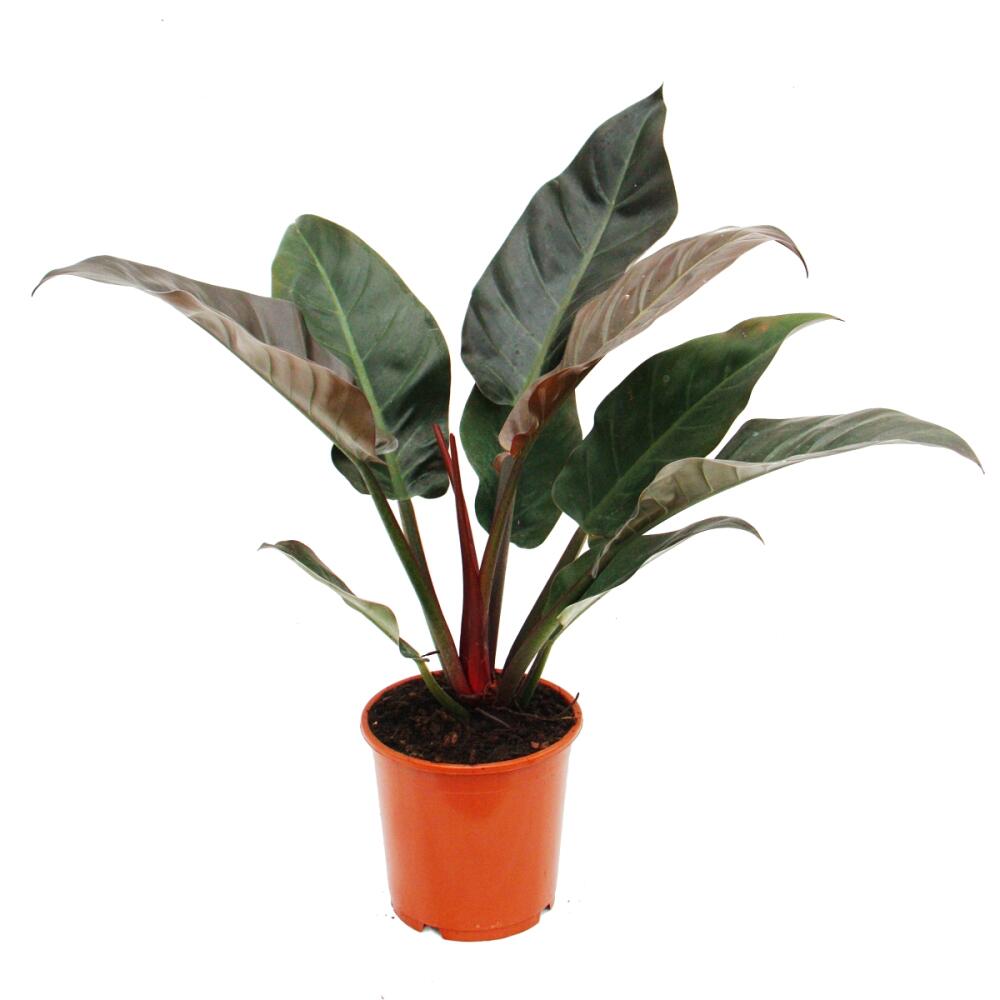
Imperial Red brings colour into a room without needing flowers. Young leaves show warm bronze and red tones; as they mature, the foliage becomes darker and greener. Red leaf stalks and still-rolled leaf tips stand between them. This very transition gives the plant life. I like to place it on a low sideboard where the new growth can also be viewed from above. The shop offer describes a nineteen-centimetre pot and an overall height of about fifty to sixty centimetres. It is already a clearly visible houseplant that nevertheless needs room for its further development.
The right position for broad leaves
This philodendron grows compactly and upright. A tall climbing support is usually unnecessary for its rosette-like structure. Clear space around the leaves matters more: foliage squeezed against a wall or leaf tips constantly touched can easily lose their lovely shape. A bright living room with filtered daylight works well. Shield particularly hot midday sun before the leaf surfaces heat up. An attractive green plant may initially remain in a dark corner, but new growth there can hardly be assessed usefully. A decorative position must therefore also provide enough light from the plant’s perspective.
On arrival, observe first
After unpacking, I check the root ball rather than watering as a precaution or immediately repotting. If the soil is still moist, it can first dry slightly. A rolled new leaf is not opened with the fingers; it unfolds by itself under suitable conditions. The first few days should be as calm as possible, without daily moves between several rooms. An existing, freely draining nursery pot can remain in the decorative pot. Leaves pressed closely together during transport are given free space again. Small differences in leaf position are natural growth and no reason to pull all the stalks into a symmetrical shape.
Water thoroughly and let it drain reliably
Before watering, I check the surface and the weight of the pot. Once the upper soil layer has lost a little moisture, the root ball receives water until the deeper roots are supplied too. Excess water is then removed. Small daily sips often wet the same spot while other areas remain dry. A heavy, persistently wet pot, on the other hand, needs no extra water. Room-temperature water avoids unnecessary temperature changes. In very hard-water areas, suitable low-lime water may help. What remains decisive, however, is the combination of thorough watering and subsequent air access within the growing medium.
Soil and nutrients work together
A loose houseplant compost supplemented with suitable ingredients that provide structure supports the root space. It should hold moisture without collapsing after every watering. Once the root ball is densely rooted, a pot only slightly larger provides new space in spring. The base of the plant remains at its previous level. Fertiliser is added in moderate doses during visible growth. If the root ball is very dry, I water normally first; concentrated nutrients do not belong on dried-out roots. Strong feeding cannot order red new growth. Its colour changes with leaf age and development, even on a well-cared-for plant.
Winter days are slower days
During the darker season, a root ball often dries more slowly. A warm radiator therefore does not automatically shorten the watering interval: dry air around the leaves and moisture in the pot are two different things. I look for a bright, evenly warm position away from hot air and cold draughts. The leaves are occasionally cleaned gently and inspected underneath. Additional food is only given if the plant is actually continuing to grow. A single old yellow leaf can be part of development; several rapidly yellowing leaves call for a check of roots, position and water balance.
Read new growth as a gardening clue
Beautiful leaf surfaces arise from suitable conditions, not constant intervention. If new leaves remain distinctly smaller or the plant stretches towards the light, I first check its position. Dry edges can indicate unsuitable air, water or roots and are not a diagnosis on their own. With spots, the undersides and leaf stalks are examined too. Dead foliage is removed with a clean tool, while gloves protect against irritating sap. Imperial Red belongs out of reach of children and animals that nibble plants. This calm observation of the whole plant lets its changing colours remain a lovely part of the room for a long time.
One plant, several views
Good to know
Do the leaves stay red?
New growth may be bronze to red; mature leaves become darker and greener. This is normal development.
Does Imperial Red need a moss pole?
Its compact, upright structure usually does not need a tall climbing support. Allow clear space for the leaf surfaces.
How often should I water?
Check the surface and pot weight. Water thoroughly after slight drying and remove water from the decorative pot.
Can the plant stand in sun?
Bright filtered light is suitable; hot, unprotected midday sun can damage leaves.
When should I repot?
When the root ball is densely rooted or water runs through very quickly, spring is a suitable time for a slightly larger pot.
Why is a leaf turning yellow?
An old leaf can die. If several leaves are affected, check waterlogging, light, cold and possible pests.
Is this philodendron edible?
No. Do not eat plant parts; the sap can irritate skin and mucous membranes.
Sources and editorial note
- Exotenherz: offer and original images (01.10.2026)
- RHS: philodendrons and their cultivation (01.10.2026)
Shop offer, SKU, GTIN and availability checked live on 01.10.2026. Original photograph unchanged. Our own researched gardening texts and individually approved scene.