This plant at Exotenherz
Check the shop offer for current availability, price and what is included.
Check the shop for the current price, availability and offer contents.
Your care table
| Topic | What to do | Why it helps |
|---|---|---|
| Position | Bright daylight and room for further climbing. | New growth follows the light. |
| Support | Guide the shoot loosely along the existing pole. | Tight ties cut into growing stems. |
| Water | Let the surface dry slightly, then water and allow drainage. | Constant moisture displaces air from the root ball. |
| Compost | Use an airy houseplant mixture. | Roots are sensitive to compaction. |
| Nutrients | During active growth, feed moderately with liquid fertiliser. | Strong growth uses more than winter rest. |
| Air | Protect against heating warmth and cold draughts. | Extremes dry or damage young leaf surfaces. |
| Repotting | In spring, move a rooted root ball to a slightly larger pot. | Plant and support need stability. |
| Inspection | Check leaf undersides and nodes regularly. | Pests or pressure marks are noticed early there. |
Check the compost and pot weight. The care table explains how far the compost may dry.
Water only when needed. The water should reach the root ball without spilling over the rim.
Remove surplus water from the saucer or cachepot. Then return the plant to a suitable position.
Red appears between the leaves
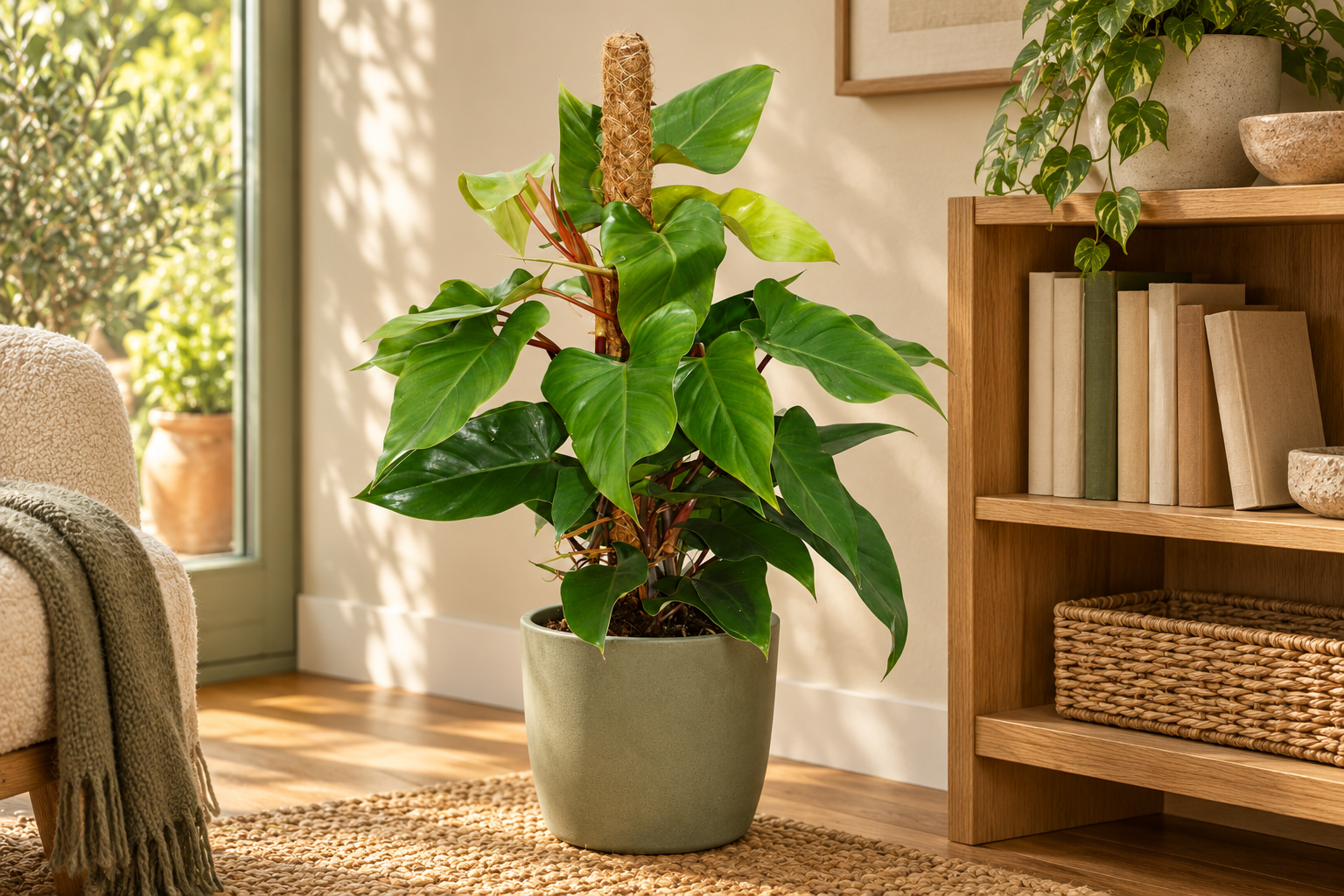
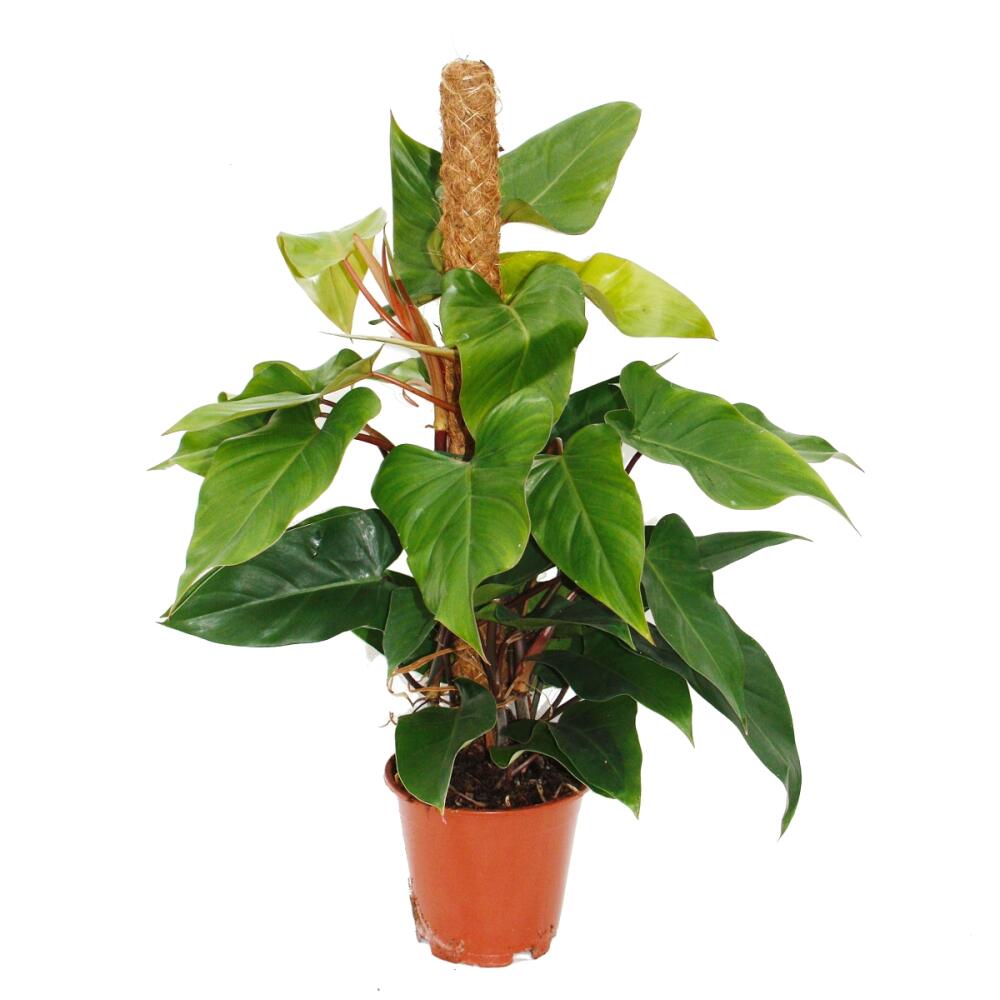
Red Emerald gets its distinctive impression from the interplay of rich green and reddish stems. Its elongated leaves, heart-shaped at the base, show a calm glossy surface while the shoots continue growing upwards. A simple decorative pot and a suitable support display this form well. The offered plant sits in a nineteen-centimetre pot and is around fifty to sixty centimetres tall. This delivery height is a starting point for further cultivation. When choosing a position, consider not just today’s silhouette but also future growth above the support.
A climbing plant is given direction
Unlike a compact rosette philodendron, Red Emerald develops elongated shoots with nodes and aerial roots. A stable support gives them a useful direction. I secure the shoot loosely and check the ties again later; young stems become stronger over time. Leaf stalks are not forced against the pole because their position remains flexible. The root ball and support must stand securely together. A leaning plant is not straightened by pulling hard on the stem. Gentle rearrangement during repotting or an additional loose tie that respects the existing growth is better.
Light for new foliage
Bright indirect daylight supports development. Gentle morning or evening sun can be suitable if the plant is accustomed to it; hot midday sun is screened. On a high shelf, access for care matters alongside brightness. Can I remove the pot and inspect the leaves, or does the root ball disappear behind decoration? A clear position beside a bookcase is often more practical. The plant stays in a warm room and is not pressed against cold glass in winter. It responds more reliably to new lighting conditions with a settled position than with daily moves.
The root ball decides, not the pole
A moist climbing pole does not replace controlled watering of the roots. Before watering, my fingers feel the upper soil layer; the pot weight also shows how much moisture remains. Once the surface has dried slightly, water thoroughly and allow the excess to drain. A full decorative pot is not left standing. The compost should be loose while retaining moderate moisture. Bark or mineral ingredients providing structure can improve a dense mixture. Topping up too frequently keeps the root ball wet, even when individual aerial roots look dry. These are not a reliable moisture gauge for the soil.
Accompany growth rather than force it
New leaves should unfold without help. Opening a rolled tip with the fingers can easily leave permanent damage. While the plant grows vigorously, a correctly dosed houseplant fertiliser can support it. During low-light weeks, feeding is not continued as a precaution. When cleaning, I support a leaf from below and gently wipe off dust. This keeps the natural surface visible. If shoots become too long for their position, targeted pruning with a clean tool is possible. Every cut should have a purpose: maintaining a manageable shape or removing a damaged shoot, rather than randomly shortening every tip.
Check the position in winter too
A heated room remains warm but receives distinctly less daylight in December than in June. Watering intervals may therefore become longer. Dry room air is not compensated for by a constantly wet root ball. I keep the plant away from radiators and cold draughts and inspect the leaf undersides. A fine pale coating, sticky patches or unusual speckling deserve closer investigation. With yellow leaves, I first check for hidden water in the decorative pot. Only after light, warmth and roots have been checked can one sensibly decide whether the plant needs more water or has already received too much.
Think bigger with the plant
A well-cared-for Red Emerald can grow considerably beyond its delivery height over the years. Its effect stays best when support, pot and position keep pace with this development. A densely rooted root ball receives a moderately larger pot in spring; compost is not heaped higher around the stem. Gloves protect against irritating sap during pruning and repotting. Plant parts are not eaten and remain inaccessible to nibbling children or pets. The philodendron is thus a carefully supported climber in the living room: green leaf surfaces, red accents and a form that slowly finds its own space.
One plant, several views
Good to know
Why are the stalks red?
Reddish stalks are part of Red Emerald’s appearance and contrast with the green foliage.
Can it trail instead of climb?
Shoots can spread without a support too. A stable climbing support is practical for upright cultivation and increasing size.
Must the moss pole stay wet?
No. The water balance of the root ball is decisive. A moist pole does not replace watering.
How large does the plant become?
Delivery height is about 50–60 cm. With good cultivation, shoots can become considerably longer; pruning and support manage the available space.
Why is a leaf not emerging from its sheath?
Even warmth and suitable humidity help. Do not pull the rolled leaf; first check the conditions.
When should I feed?
During visible growth, moderately according to the pack instructions; be restrained in low light and when there is no new growth.
Can it overwinter outside?
No. This tropical philodendron is grown warm and frost-free indoors.
Sources and editorial note
- Exotenherz: offer and original images (01.10.2026)
- RHS: philodendron cultivation (01.10.2026)
- RHS Plants: Red Emerald (01.10.2026)
Shop offer, SKU, GTIN and availability checked live on 01.10.2026. Original photograph unchanged. Our own researched gardening texts and individually approved scene.