This plant at Exotenherz
Check the shop offer for current availability, price and what is included.
Product and delivery details are given in the individual offer.
Your care table
| Topic | What to do | Why it helps |
|---|---|---|
| Position | Bright, warm and with space for the leaves. | A dark position far from the window encourages weak growth. |
| Support | Tie shoots loosely to a suitable climbing support. | The plant climbs rather than growing as a dense bush. |
| Water | Let the top layer dry slightly, then water thoroughly. | Roots need moisture and oxygen. |
| Decorative pot | Remove remaining water after watering. | Wet feet can easily go unnoticed from outside. |
| Growing medium | Use an airy, structurally stable mixture. | Compacted compost makes healthy root development harder. |
| Fertiliser | Feed moderately only during growth. | More nutrients do not solve a shortage of light. |
| Leaf care | Remove dust gently without scrubbing off the bristles. | The red hairs are characteristic features of the species. |
| Winter | Keep warm and adjust watering to reduced light. | A summer schedule does not suit slower winter growth. |
Check the compost and pot weight. The care table explains how far the compost may dry.
Water only when needed. The water should reach the root ball without spilling over the rim.
Remove surplus water from the saucer or cachepot. Then return the plant to a suitable position.
Red petioles make the difference
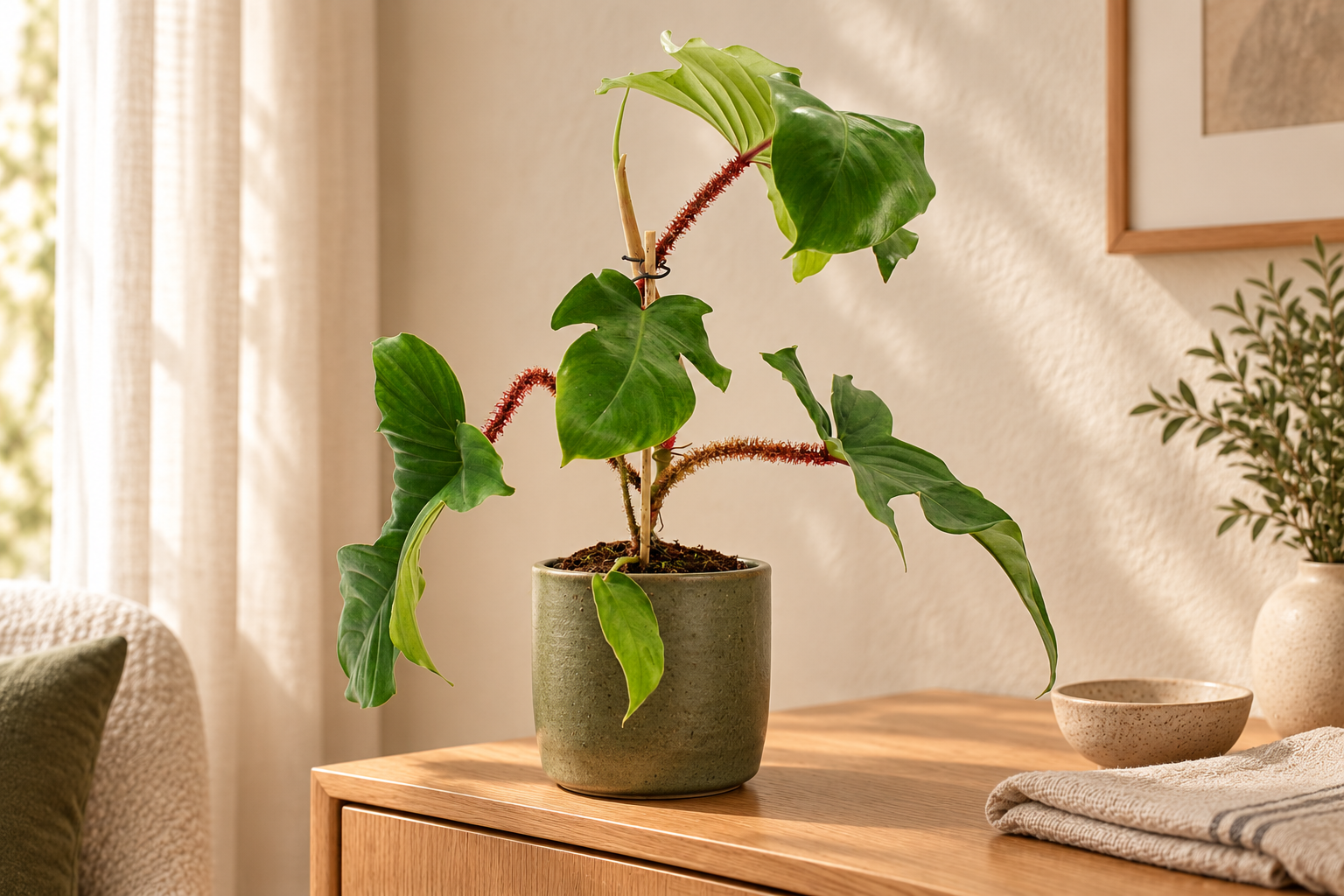
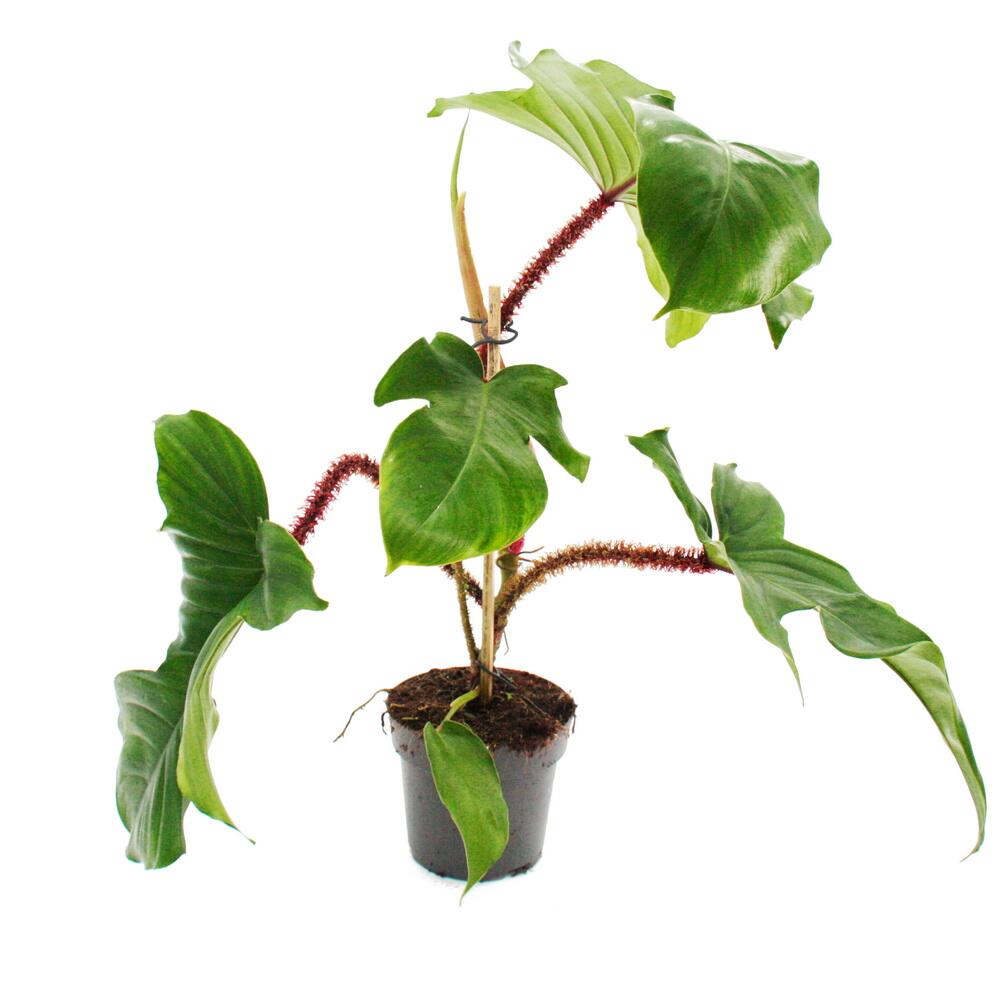
Philodendron squamiferum’s distinctive feature is not confined to its leaves. Reddish, bristly hairs sit on the petioles and immediately stand out against a quiet background. They are joined by green leaves with pronounced lobes and a lively, somewhat wild outline. This combination needs no further colourful decoration. I would give it some clear space on a bright chest of drawers so that the course of petiole and leaf is easy to see. The shop describes the young plant in a twelve-centimetre pot with an overall height around thirty-five to fifty centimetres. Its later climbing growth goes beyond this initial format.
A climbing support with room to grow
The young plant’s thin stake holds its initial shape together. When the shoot grows further, an appropriately sized support can follow. I tie it loosely and allow room for the stem to thicken. A tight tie must not cut into plant tissue. Petioles remain free; they are not used as attachment points. Some space from the wall behind the plant is useful so that lobed leaves are not constantly pressed against it or bent when someone passes. The support provides a direction but does not immediately force a new leaf into a particular posture. Fresh growth should first be allowed to unfold.
Brightness the foliage can tolerate
A warm spot with bright, indirect light supports this philodendron. Hot, direct sunshine behind glass can overwhelm sensitive leaf surfaces. A light curtain or some distance from a particularly sunny window creates a gentler transition. On a bookcase, I check whether the plant actually receives daylight rather than simply looking nice in an empty gap. Long bare intervals on the shoot or markedly weaker growth may prompt reconsidering the position. Cold air during winter ventilation should not sweep directly over the leaves. A bright chest of drawers is therefore not automatically a good place if a window above it is constantly opened.
Water with a look beneath the decorative pot
Before every watering, I look at the compost surface and feel it rather than work through a fixed weekday. When the top layer has become slightly dry, I water thoroughly. The water must then drain away completely. I check the bottom of the decorative container even when everything looks dry from above. If water remains underneath, it reaches the roots for longer than intended. A small plant in a warm room may need water quickly; in a cool, low-light winter the same pot stays moist much longer. This change is better observed than treated with an unchanged quantity throughout the year.
Choose compost and pot together
This philodendron develops better in a loose mixture than in permanently collapsed, wet compost. Suitable bark pieces and mineral structural ingredients can keep the growing medium airier. It must still hold enough moisture for the rootball not to dry out completely between checks. During repotting, the nursery pot is enlarged only appropriately. I first inspect the roots: have they thoroughly explored the existing space, or has mainly the above-ground shoot lengthened? Not every longer stem means an enormous pot is immediately necessary. Drainage holes remain essential even beneath a beautiful decorative pot.
The bristles belong to the plant
The red hairs are not removed to produce a supposedly clean petiole. A slightly irregular leaf outline is not a design flaw in this philodendron either. Dust can be carefully removed from leaf surfaces with a soft, damp cloth. New rolled leaves remain untouched. Moderate feeding is possible during visible growth; the product’s instructions matter more than an extra feeling of giving especially good care. Applications are reduced in winter. Leaf-shine spray and constant misting replace neither good light nor a suitable rootball.
Notice changes in time
Small pests can hide on leaf undersides, in leaf axils and on the climbing support. I briefly check these places during care. Sticky traces, fine webs or new pale spots require close observation, not an immediate collection of different treatments. Yellow leaves are assessed together with rootball moisture, temperature and light. Pruning is done cleanly and the irritating sap is kept away from skin and eyes. The plant is not pet food. The original gallery keeps the genuine young plant visible; the designed living-room scene shows how its striking petioles can look among ceramics, wood and soft light.
One plant, several views
Good to know
Are the red hairs pests?
No. The striking hairiness of the petioles is typical of squamiferum.
Does the plant need support?
A suitable climbing support is useful as climbing growth progresses.
Can it receive midday sun?
Avoid hot, direct sun; bright, filtered light is a good starting point.
How often should it be watered?
According to the rootball’s condition, when the top layer has dried slightly.
Why do new leaves stay rolled up?
Young growth needs time; do not force leaves open.
Can it go on a dark shelf?
A shelf is suitable only if enough daylight reaches the plant.
Is the decorative pot included?
The decorative pot in the AI scene is decoration, not a promised part of delivery.
Sources and editorial note
- Exotenherz: offer and original photographs (01.10.2026)
- NParks: Philodendron squamiferum (01.10.2026)
- RHS: caring for philodendrons (01.10.2026)
Shop offer, SKU, GTIN and availability checked live on 01.10.2026. Original photograph unchanged. Independently researched gardening texts and an individually reviewed scene.