This plant at Exotenherz
Check the shop offer for current availability, price and what is included.
Check the shop for the current price, availability and offer contents.
Your care table
| Topic | What to do | Why it helps |
|---|---|---|
| Light | Bright and indirect, protected from hot direct sun in summer. | Pale pink and cream-green leaf areas can be damaged by strong sun. |
| Water | Let upper compost dry slightly; do not let the small rootball dry completely. | Little compost holds little reserve, but waterlogging is not a useful reserve. |
| Drainage | Let it drip after watering and empty the saucer. | Roots also need air; limp foliage can occur in wet compost. |
| Warmth and air | Keep warm and draught-free; avoid direct heating air. | The tropical young plant needs as steady a position as possible. |
| Compost and pot | Humus-rich and airy; give a cramped rootball slightly more room during growth. | Too much unrooted new compost dries slowly and increases wetness risk. |
| Nutrients | Feed new growth according to instructions, allowing for pre-fertilisation. | Extra fertiliser does not replace good light and root conditions. |
| Growth and pruning | Later guide longer shoots or shorten above a node. | Delivery size is not a fixed final size; nodes allow cuttings. |
| Leaf care | Clean gently, inspect undersides and wear gloves when cutting. | Do not break delicate stalks; sap can irritate. |
Check the compost and pot weight. The care table explains how far the compost may dry.
Water only when needed. The water should reach the root ball without spilling over the rim.
Remove surplus water from the saucer or cachepot. Then return the plant to a suitable position.
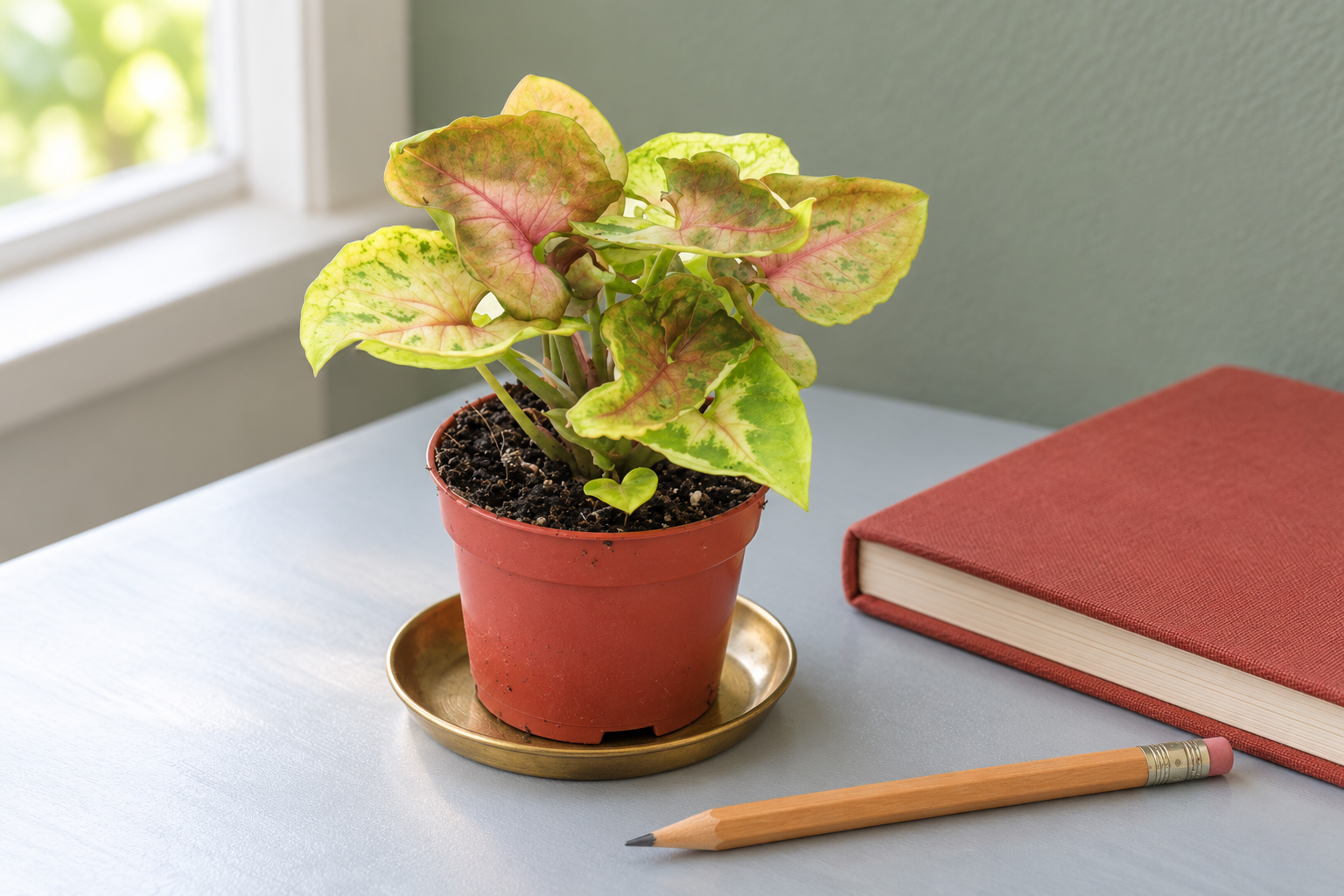
Pink veins across a cream-green leaf surface
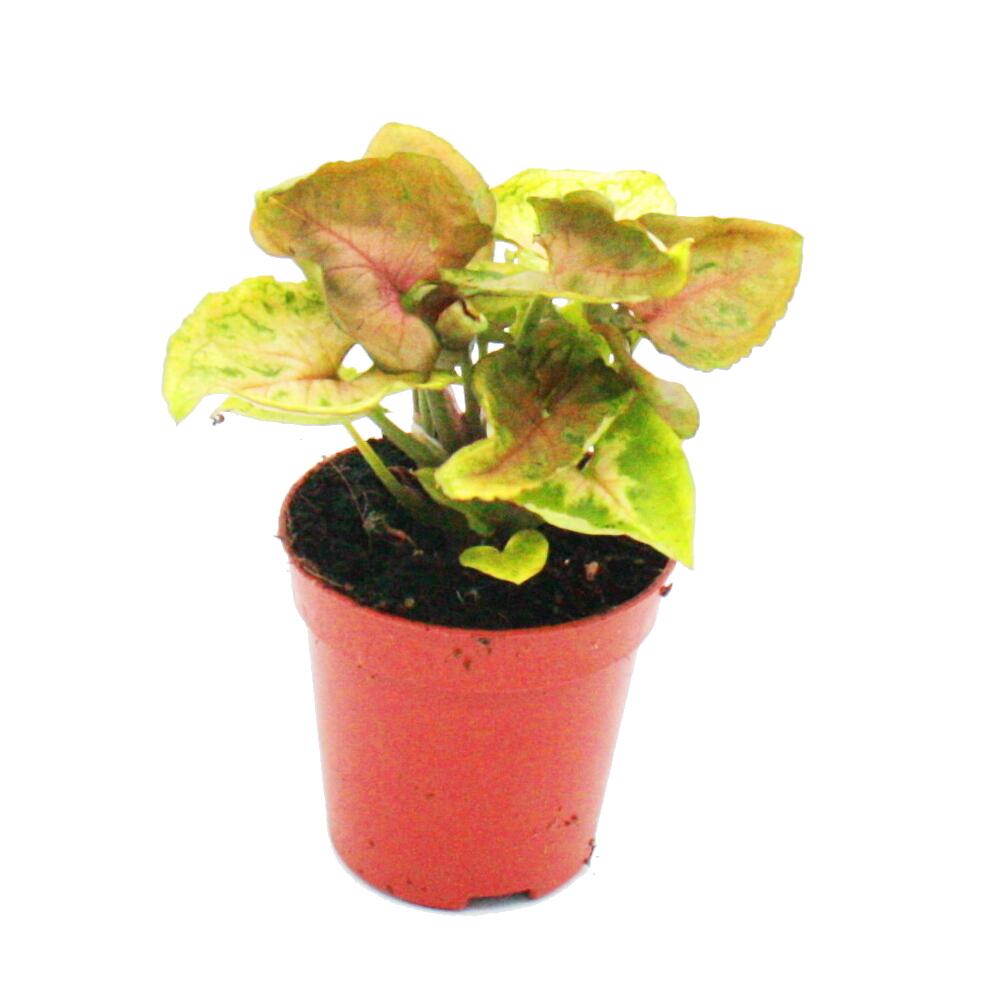
The small arrow-shaped leaves bear a soft pattern: pink runs through the midrib and side veins, expands in places at the centre and meets cream-green areas with irregular green patches. Several young leaves cluster on short stalks. This portrait shows the shop’s unnamed pink and cream-green Syngonium commercial form without assigning an additional cultivar name. The impression is delicate but far from one colour. Clear space on a bright work surface reveals different leaf faces and the small indentations at their bases. The original records young growth. New leaves can change colour proportions; an identical pattern on every later leaf is not promised.
Relieve delicate leaf stalks when unpacking
The offer places the arrowhead plant in a 5.5 cm pot at about 10–12 cm total height including container. This is delivery size, not a promised permanent miniature form. Hold the pot when unpacking and carefully release the wrapping between spreading leaves. Do not pull rolled new leaf tips. A small saucer keeps the container stable and accessible for watering. An open planting bowl needs controllable drainage; a closed glass additionally requires attention to ventilation, moisture and space. An accessible nursery pot is easier to manage initially. The mini plant holds little compost, and water must not remain unnoticed in a sleeve among closely packed stalks.
The desk becomes a bright leaf position
Pink and cream-green look especially calm beside a plain dark notebook. Choose sufficient indirect daylight. A shelf in a dark room corner would frame the plant decoratively but weaken new growth. Hot direct sun can damage pale leaf parts; a light curtain filters a sunny window. The tropical arrowhead stays warm and away from cold ventilation draughts. Leaves should not touch cold glass. A bright room with higher humidity is favourable if air circulates between leaves. Humid air alone does not make a windowless bathroom a suitable permanent position. In winter check again how much daylight actually reaches the small crown.
Check moisture before the next drops
Let the upper compost layer dry slightly, then water the small rootball with room-temperature water. A careful grip at the pot rim and its weight help you understand consumption better than a fixed calendar. The rootball should retain some moisture below without staying constantly soaking wet. After watering let water pass through drainage holes and empty the saucer. Limp leaves do not automatically mean thirst: when soil stays wet, roots may already function poorly. With very dry compost, water slowly and evenly rather than spraying the crown and forgetting the rootball. This distinction between humid air and well-supplied roots is especially important in a mini format.
More space starts beneath the soil
Loose humus-rich houseplant compost with airy structural ingredients holds moisture without compacting the root zone. When roots densely fill the existing ball, a slightly larger container is useful during dependable growth. The young plant should not have to handle a large amount of new compost that stays wet for a long time. Set the base at the same height and firm only enough to make it secure. Nutrients can be given according to the fertiliser label with new growth; account for already fertilised compost. More fertiliser does not automatically intensify pink areas. Arrowhead plants rarely flower indoors. Here the focus is foliage development and a healthy rootball rather than pushing the supplied plant into flower.
Longer shoots can emerge from the young crown
The compact original plant shows the juvenile stage of an arrowhead. With increasing age, longer creeping or climbing shoots can form; many Syngonium forms also later change leaf division. An exact later height or fixed leaf measurement is not documented for this unnamed commercial form. Observe growth and only then decide whether a small support or higher shelf is useful. Later, shoots can be shortened above a leaf node when space tightens. Healthy pieces with a node can serve as cuttings during growth. The young supplied plant initially needs no pruning. In the darker winter half-year, follow actual growth rest: less water with slower consumption and no additional feeding without new shoots.
Soft leaves need gentle checks
Remove dust with a slightly damp soft cloth while supporting the surface underneath. Leaf-shine products are unnecessary for this natural colour pattern. Check undersides and crowded stalk bases too: fine webbing, cottony areas or new pinpoint damage can suggest pests. First separate a suspicious plant. Brown edges are a reason to inspect the rootball, room air and sunshine; the pink pattern itself is not a disease sign. Occasional misting does not permanently compensate for very dry air; suitable room humidification is more reliable. Remove dead foliage cleanly and wear gloves. Sap can irritate; consume no parts and place the plant beyond nibbling children and animals.
One plant, several views

Good to know
Which cultivar is this pink arrowhead?
The shop offer only names Syngonium. Here the visible pink and cream-green commercial form is described; no additional cultivar name is assigned.
Will it stay 10–12 cm tall permanently?
No, the figure is delivery height including pot. The plant can produce longer shoots; later size of this unnamed form is not precisely documented.
Are all new leaves equally pink?
Colour proportions can change from leaf to leaf. The original shows pink veins and areas over a cream-green ground; a uniform later pattern is not promised.
Does it need a closed glass container?
No. A bright warm place with a rootball you can check is sufficient. In glass, ventilation, drainage and growth need careful observation.
What do I do with limp leaves?
First inspect the compost and saucer. A dry rootball may need water; if it remains wet, extra watering can worsen the situation.
Can I prune the little plant immediately?
Let the young supplied plant establish first. Later, longer shoots can be cut above a node; wear gloves and protect it from nibbling children and animals.
Sources and editorial note
- Exotenherz: exact mini form, measurements and original image; saved available readback03.10.2026 (directly read04.10.2026)
- NC State Extension: Syngonium podophyllum, pink juvenile foliage and growth development as specialist comparison; no exact cultivar assignment (04.10.2026)
- RHS: moisture checks, drainage, nutrients and repotting (04.10.2026)
- RHS: light, leaf loss, pest checks and distinguishing problems (04.10.2026)
- Iowa State Extension: humidity and limits of occasional misting (04.10.2026)
Exact SKU205418112021, GTIN4019515917426; saved exact InStock/cart product HTML fully read04.10.2026, no repeated product HTTP.5.5 cm/10–12 cm total height consistent in short/long descriptions. Clean Original1 actually viewed, conservative unnamed form, no cultivar assigned. Full canonical comparison in identity-original-gate.json; no simple pot variant counted. Only genus asserted for exact delivery. NCpodophyllum provides comparative juvenile pink arrow-leaf culture; species/cultivar NOT inferred as exact from image. No Pixie/Mottled/Batik assignment; no adult height propagated to unknown form.