This plant at Exotenherz
Check the shop offer for current availability, price and what is included.
Check the selected shop offer for price, availability and delivery contents.
Your care table
| Topic | What to do | Why it helps |
|---|---|---|
| Position | Choose bright filtered light with protection from hot window sun. | The pale-marked crown needs daylight; a sudden move into full sun can cause harm. |
| Temperature | Keep evenly warm and avoid cold draughts. | This tropical woody plant often reacts to sudden changes by dropping leaves. |
| Watering | Let upper soil dry slightly, then water the rootball thoroughly. | Roots should stay slightly moist without standing constantly in water. |
| Drainage | Remove surplus from saucer or cachepot. | Woody growth does not make roots resistant to constant wetness. |
| Humidity | Keep away from radiators and monitor dry room air. | Very dry air stresses the crown and encourages spider mites. |
| Feeding | During active growth feed moderately according to a suitable fertiliser label. | A small rootball cannot buffer excess salts indefinitely. |
| Repotting | When well rooted provide slightly more room during growth. | An appropriately sized pot dries more predictably than much unused wet soil. |
| Pruning | If needed shorten individual long tips above a leaf attachment, wearing gloves. | Targeted pruning retains green leaves and may encourage crown branching. |
Check the compost and pot weight. The care table explains how far the compost may dry.
Water only when needed. The water should reach the root ball without spilling over the rim.
Remove surplus water from the saucer or cachepot. Then return the plant to a suitable position.
A little crown with pale leaf edges
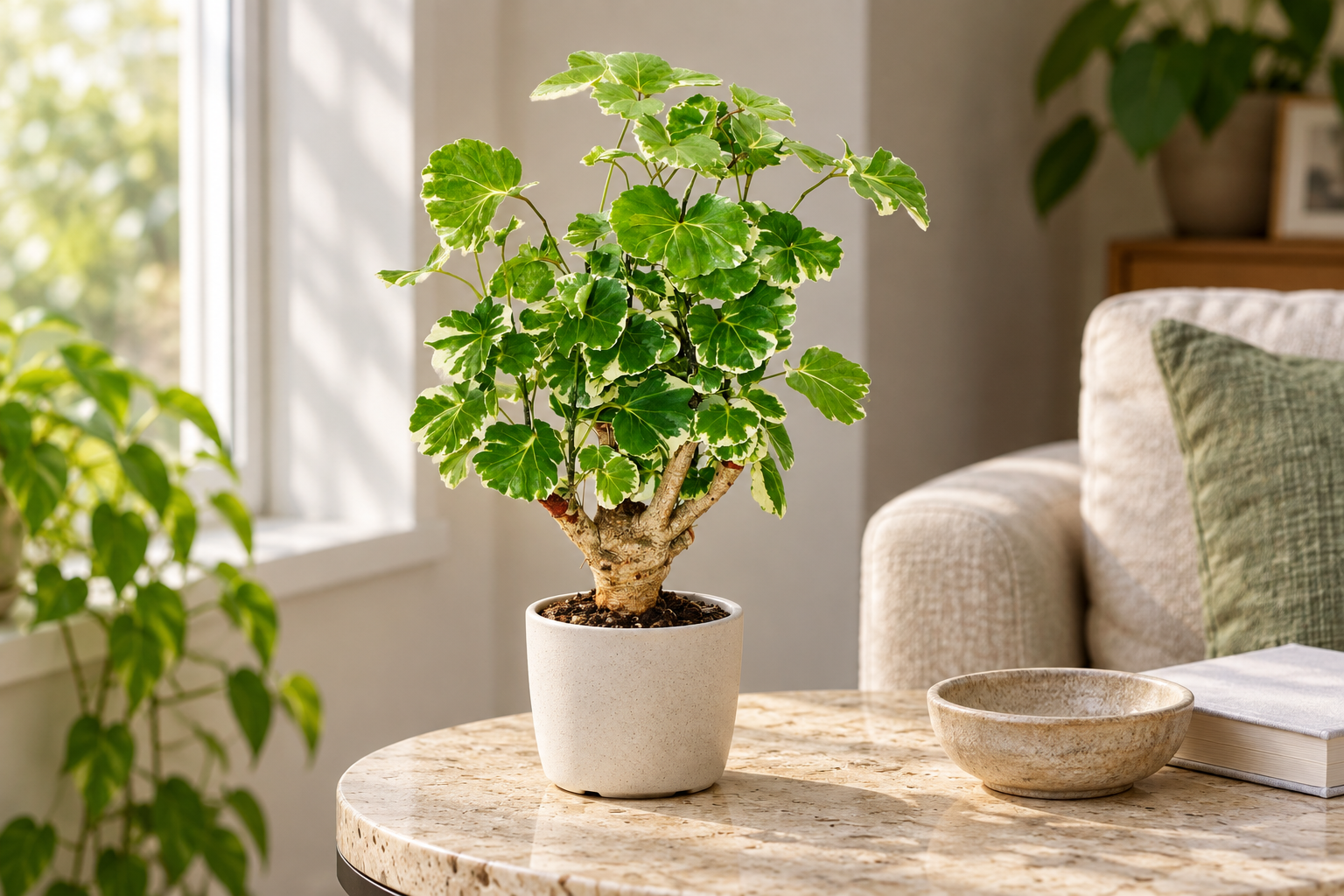
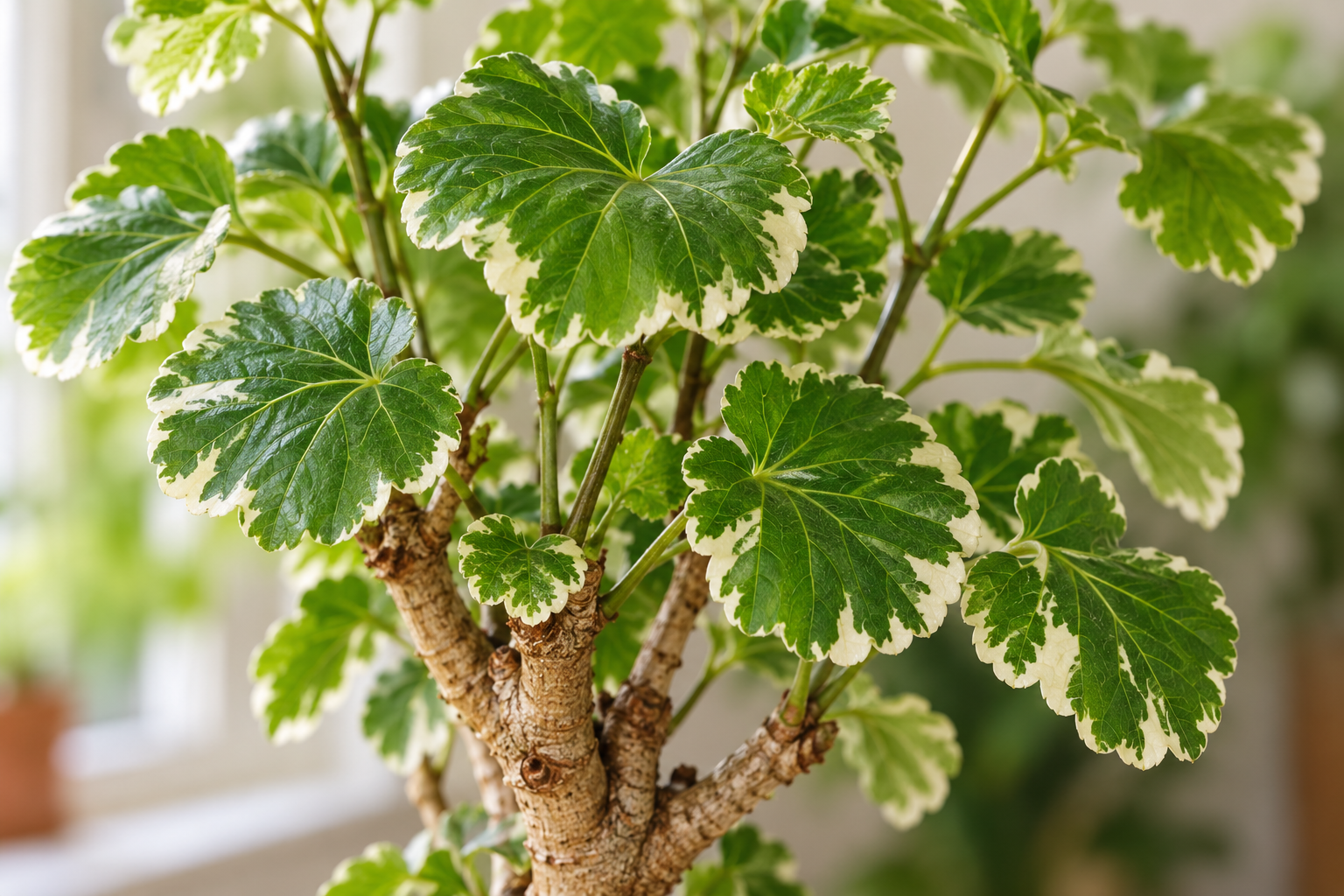
Balfouriana stands out through alternating darker green surfaces and irregular pale margins. Rounded to kidney-shaped leaves sit above a woody trunk and on already branched shoots. Small scallops appear along the edges; the foliage is neither smooth and oval like a ficus nor finely divided like a Ming aralia. On a little bright table the entire crown remains in view. A simple cachepot gives the patterned foliage space. Pale areas are not distributed equally on every leaf. Young leaves and older surfaces may differ a little without immediately indicating a care problem.
Keep the names together carefully
The shop offers this plant as Polyscias balfouriana. Kew accepts Polyscias balfouriana as a species and gives New Guinea and Queensland as its natural origin. Other classifications use Polyscias scutellaria Balfourii; the RHS profile also lists that name as a synonym. These different views are brought together transparently rather than turned into two new plants. At the same time a white leaf edge alone does not confirm an additionally named cultivar: the offered specimen carries the shop name Balfouriana, and that is retained. The genus belongs to Araliaceae. Species origin describes its botanical background, not the production location of the delivered plant or a particular cultivar with its own origin story.
Delivery size begins the development
The currently documented article stands in a 12 cm pot and has approximately 25 to 30 cm total height. The clean original photograph shows the small woody crown with pale-edged foliage. A precise trunk age, identical branch count or constant distribution of variegation cannot be inferred from it. As a perennial woody plant Balfouriana can keep growing in height and width; light, care and occasional pruning determine its later indoor form. When unpacking hold the pot and carefully free bent branches. A new environment, changed light and transport can trigger an adaptation phase. A quiet position and rootball checks are then more helpful than immediate repotting and strong feeding.
Light for the patterned crown
A bright indoor position with filtered daylight suits well. At an east-facing window or a little away from strongly sunlit glass the crown can be observed without sudden exposure to hot midday sun. A shelf deep in the room often gives too little light. Air should remain evenly warm; avoid cold ventilation draughts directly onto the pot. The genus is grown as a tropical houseplant and does not belong permanently on a cool balcony. Turn the pot gently if needed so the crown does not grow exclusively towards the window. Frequent moves between very different places make it harder to judge whether the chosen environment suits.
Moist roots need air too
Before watering check upper soil with a finger and lift the pot. When the surface dries slightly give the rootball a thorough watering, then let surplus drain completely. Constant little sips often reach deeper roots unevenly. A permanently wet cachepot is unfavourable too. Loose humus-rich substrate with good drainage retains necessary moisture without becoming air-poor for long. A slightly dry surface does not mean the entire rootball should become dust-dry. With yellowing or dropping foliage first check actual moisture. More water only makes sense where there is water shortage and is no general answer to leaf loss.
Retain the form with few interventions
Feed moderately during visible growth and follow the product instructions, accounting for pre-fertilised soil. Move to a slightly larger pot only after distinct rooting; trunk and crown retain their previous planting depth. Individual overlong shoot tips can be shortened above a leaf attachment if a more compact crown is wanted. Leave sufficient healthy foliage. Use clean tools and gloves because contact with Polyscias sap may irritate and the plant is not for eating. Keep it beyond the reach of children and pets. Remove dust with a soft slightly damp cloth, supporting delicate leaves from below.
Watch winter light and leaf undersides
During short days the plant may grow more slowly and consume less water. Rootball checks remain decisive while watering intervals often lengthen. Heating proximity combines dry air with warm soil and complicates care. A bright sheltered position is better. Examine leaf undersides and shoot bases occasionally for fine webs, little firm scales or cottony deposits. Very dry air particularly encourages spider mites. A single yellowing leaf surface is not a clear diagnosis; the combination of position, moisture and new shoots tells more. In this way the small woody crown can gradually adapt to its indoor position.
One plant, several views

Good to know
Is Balfouriana the same plant as Fabian?
No. This describes the white-edged offered Polyscias balfouriana. Fabian is a differently named selection with predominantly dark round leaves.
Why also mention scutellaria Balfourii?
Botanical sources classify this plant differently. The alternative name helps connect them and is not counted as a second identity here.
Does a white edge confirm the cultivar Balfourii?
A leaf feature alone confirms no cultivar name. The actual offer carries the name Polyscias balfouriana.
Does the trunk stay the same size?
Delivery size describes the current article. Trunk, branches and crown may keep growing in suitable culture.
Should I give a little water daily?
Better check the rootball and water thoroughly when needed. Avoid little daily sips and standing water.
What if leaves fall?
Check moisture, light, draughts and changes after transport. Do not automatically feed or water more.
Can the crown be pruned?
Individual long tips can be shortened during growth. Retain healthy foliage and wear gloves.
Is it a plant for pets to nibble?
No. Do not let it be eaten; keep outside the reach of children and pets.
Sources and editorial note
- Exotenherz: offer and original images (03.10.2026)
- Kew: accepted species and natural origin (03.10.2026)
- RHS: names and alternative classification (03.10.2026)
- NC State: leaf features and culture (03.10.2026)
- NC State: genus care and handling (03.10.2026)
Shop offer, article number, GTIN, availability and original images checked directly on 03.10.2026. Specialist sources read directly. Kew accepts the species, RHS mentions scutellaria Balfourii; no unconfirmed cultivar inferred from leaf markings. Origin follows Kew rather than differing RHS information.