This plant at Exotenherz
Check the shop offer for current availability, price and what is included.
Check the shop for the current price, availability and offer contents.
Your care table
| Topic | What to do | Why it helps |
|---|---|---|
| Light | Position brightly with filtered daylight. | This cactus’s forest conditions do not suit a suddenly hot desert window. |
| Water | Let the upper compost dry slightly, then water thoroughly. | A small pot needs reliable supplies but not constantly wet roots. |
| Drainage | Remove remaining water and keep drainage holes clear. | A dense cushion of stems cannot prevent hidden wetness in the container. |
| Compost | Use loose, humus-rich forest cactus compost with good pore space. | Water and air should reach the roots together. |
| Nutrients | Feed moderately according to the fertiliser label during visible growth. | New branches need replenishment; quiet growth needs less. |
| Repotting | Gently give a little more pot space when densely rooted. | The many slender stems must be protected from breakage. |
| Stem care | Leave bristles in place and remove damaged parts selectively. | The fine surface belongs to the plant and should not be polished smooth. |
| Winter | Grow bright and frost-free; check the root ball’s actual consumption. | Less growth changes demand but does not mean a long completely dry rest. |
Check the compost and pot weight. The care table explains how far the compost may dry.
Water only when needed. The water should reach the root ball without spilling over the rim.
Remove surplus water from the saucer or cachepot. Then return the plant to a suitable position.
A cactus whose surface invites a closer look
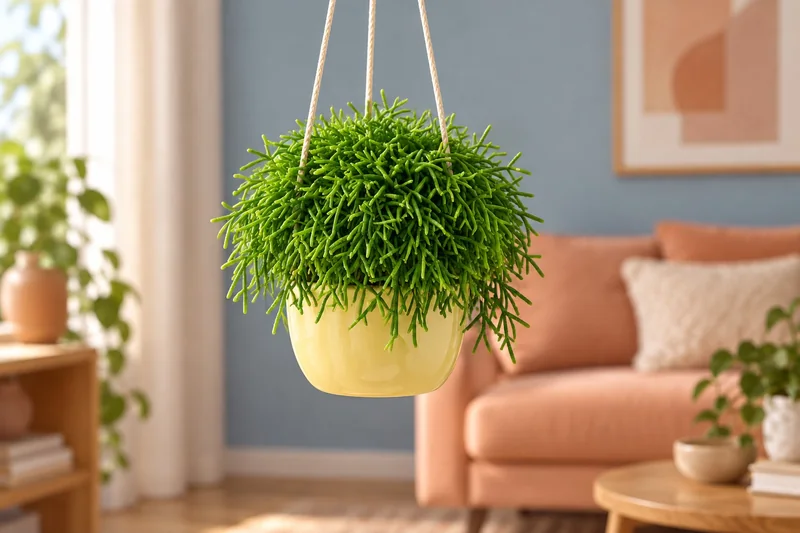
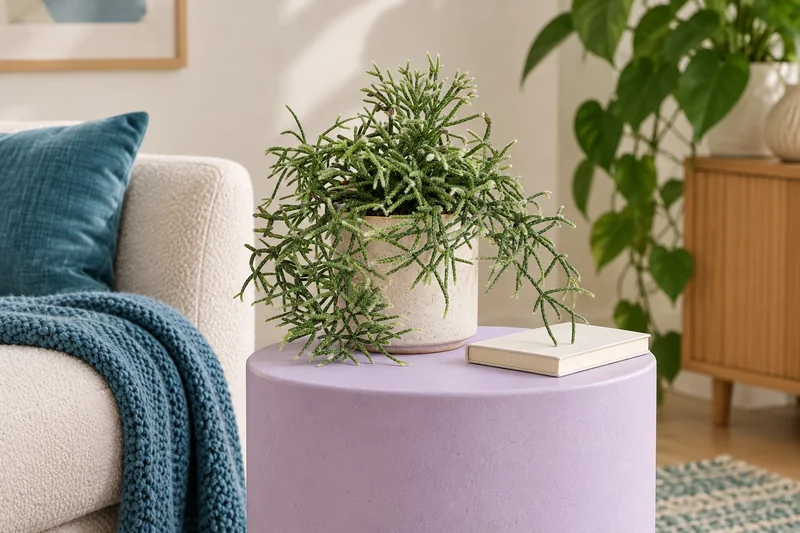
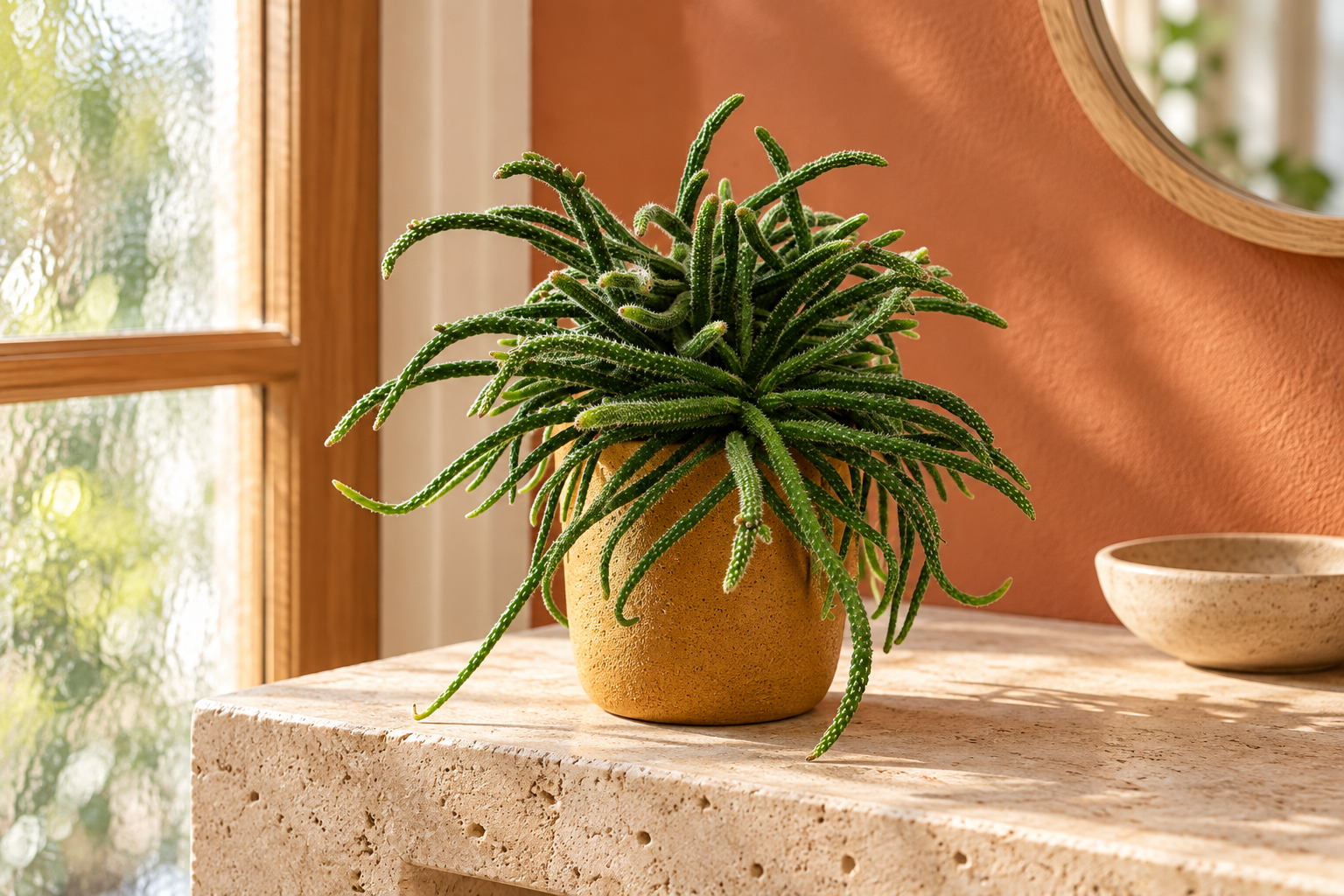
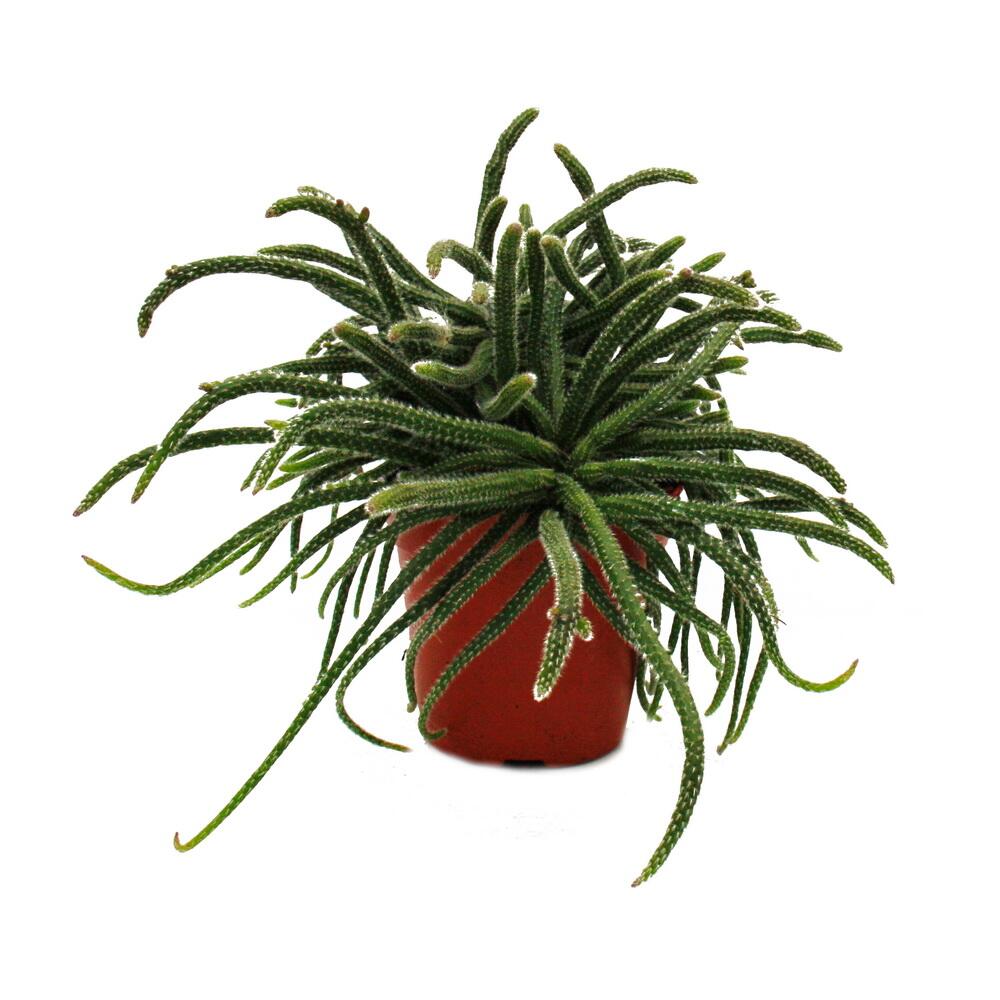
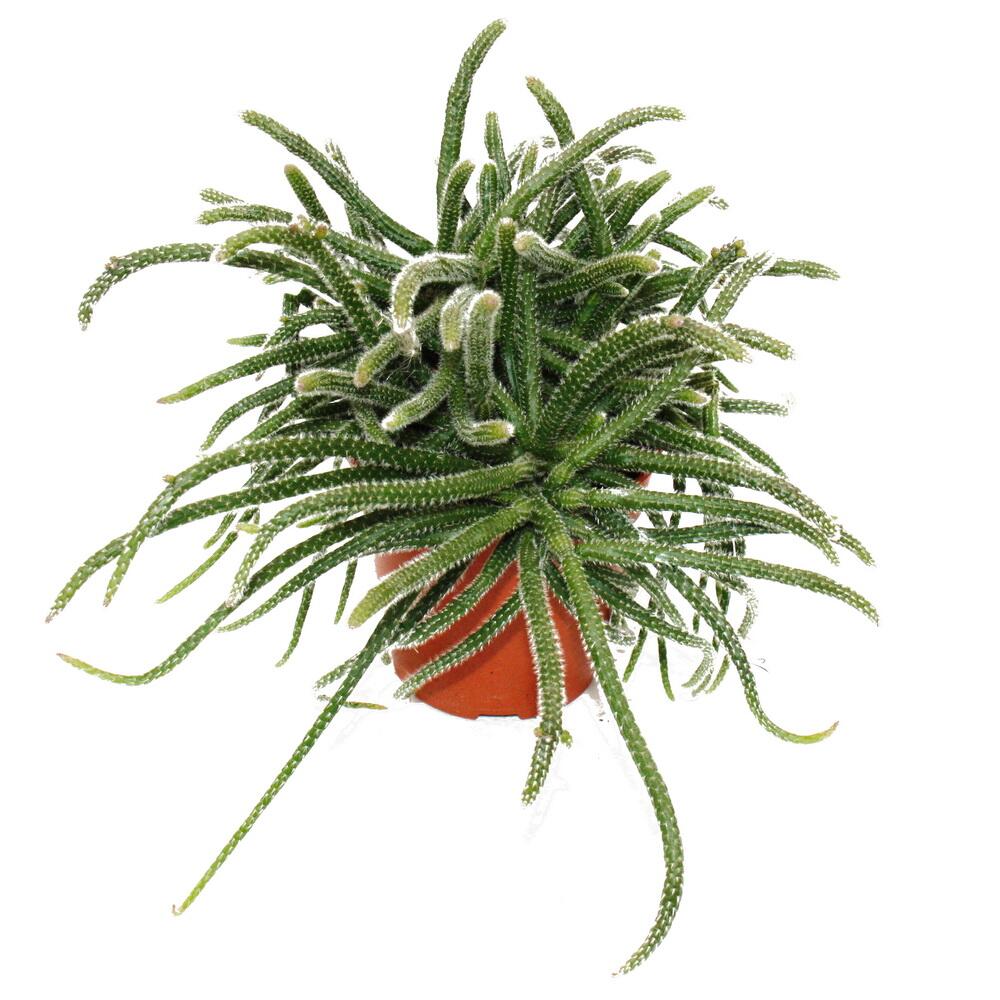
From a distance the small plant looks like a dense green mesh. Up close, slender ribbed stems bearing tiny pale bristles become visible. They give the surface a different expression from the smooth green threads of some related Rhipsalis species. Young parts tend slightly upwards, while longer branches curve sideways and over the pot rim. This fine texture is easy to see against a calm wall or on a bright console. These are cactus stems, not the leaves of a small perennial grass. The decorative effect comes from real branching and surface, not an artificially evenly trimmed cushion.
Horrida is a special form of Rhipsalis baccifera
The shop calls the offer Rhipsalis baccifera horrida. Botanically the subspecies is listed as Rhipsalis baccifera subsp. horrida. It originates in Madagascar, where it grows on trees and rocks among other places. The small bristles belong to this form and may remain visible. The plant offered here comes in a 12-cm pot at about 15 to 20 cm total height. These measurements describe the young plant including its container, not the eventual spread of its branches. As it grows, it needs clear space sideways too. A larger container alone does not immediately make the plant adult; new stems develop with suitable cultivation and time.
Filtered light for a forest cactus
Choose a bright spot with filtered daylight. Behind hot glass in suddenly strong midday sunshine, young stems can be stressed. After shipping, stronger light is therefore increased gently. An open bright console may suit it, while a dark niche permanently offers too little light. Lower trailing parts should receive light as well. A warm room environment with air exchange is preferable to hot dry air directly above a radiator. At a new position, check not just the decorative effect but the light at the plant. Forest cactus care begins with recognising the actual conditions.
Supply the small container attentively
Before watering, feel the upper compost and check the pot’s weight. After slight drying, water slowly and thoroughly, then let the inner pot drain completely. A twelve-centimetre-wide pot may become lighter faster during a warm growing phase than on short winter days. The next watering time therefore comes from the root ball, not the weekday. If stems shrivel, check the compost first: dryness and already damaged roots in wet compost need different measures. The fine bristles say nothing about the water level. Misting is not a complete supply for the root ball either and does not make standing water in the decorative pot harmless.
Combine humus-rich compost with free drainage
This Rhipsalis needs an airy root space. Loose, humus-rich forest cactus compost with structural bark and mineral components retains moisture without permanently enclosing the roots in a heavy wet mass. The pot needs clear drainage holes. When densely rooted during a growth phase, give a little more space and support the root ball. Do not pull the stem cushion to release the plant from its container. Feeding is moderate according to the label and actual growth only. Pre-fed compost is included in the calculation. The small delivered plant particularly needs understandable supplies, not heavy feeding as a replacement for light or poor compost.
Handle bristles and branches gently
The fine bristles are not brushed off. When moving or repotting, they and the thin branches can be damaged by a firm grip. Gentle contact with the container is better than squeezing the plant together. Remove clearly dead or broken parts with clean tools and let healthy trailing stems keep their shape. Suitable healthy sections can be used for a cutting trial, allowing their cut ends to dry briefly first. Then place in airy compost and keep bright and protected. Young roots are not forced by constant wetness. A loose piece after mechanical damage differs from progressive softening at the bases of several shoots.
Do not switch to a desert rhythm in winter
Keep a bright frost-free position. Slower growth reduces water consumption; still check the root ball and do not impose months of complete dryness. Place the plant neither against cold glass nor directly in a hot heating-air stream. Dry tips, bleaching patches and soft dark bases are different signs. Look between branched stems and check for unusual new deposits. Do not confuse the existing small bristles with a newly developed woolly infestation. Change the visibly unfavourable factor and observe healthy new growth. This keeps the characteristic fine surface part of a living plant that continues to grow.
One plant, several views

Good to know
Are the fine pale bristles normal?
Yes. Fine bristles at the areoles belong to this subspecies. Unusual new deposits are assessed separately.
Does horrida grow like a desert cactus?
No. It is a forest cactus from Madagascar. Filtered daylight and an airy, regularly checked root ball suit it better.
Is 15 to 20 cm its eventual final size?
This is the delivered plant’s total height including the pot. Branches may later lengthen and trail further.
Do I need to remove the bristles?
No. Do not rub or brush them off; they belong to the stems’ surface.
What compost does it need?
Loose, humus-rich forest cactus compost with good pore space and drainage. Not heavy, constantly wet soil.
Should I stop watering entirely in winter?
Keep checking the root ball. Less growth reduces demand but does not mean a long completely dry rest.
Sources and editorial note
- Exotenherz: offer and original photographs (02.10.2026)
- RHS: Rhipsalis baccifera subsp. horrida; name and classification (02.10.2026)
- Rhipsalis.com: subspecies horrida according to specialist botanical descriptions (02.10.2026)
- NC State Extension: Rhipsalis baccifera; cultivation of the associated species (02.10.2026)
Shop offer, product number, GTIN, availability and original images checked directly on 02.10.2026. Specialist sources read directly. Subspecies status read directly at the RHS; distinctive bristly morphology and origin confirmed in a specialist description. Not created merely as another size of the general Rhipsalis portrait, but as a distinct subspecies with its own surface and care observations.