This plant at Exotenherz
Check the shop offer for current availability, price and what is included.
Product and delivery details are given in the individual offer.
Your care table
| Topic | What to do | Why it helps |
|---|---|---|
| Light | Let abundant indirect daylight reach the whole crown. | New sunny positions require gentle acclimatisation. |
| Water | Check top soil and remaining moisture below. | The small ball should stay supplied without constantly being wet. |
| Drainage | Empty saucer and outer container after watering. | Water must actually be able to leave the pot. |
| Warmth | Keep warm year-round without cold airflow. | The offered young specimen is intended for protected indoor cultivation. |
| Compost | Use structured potting compost with good drainage. | Moisture and air should reach roots simultaneously. |
| Repotting | Give only slightly more pot space when needed. | Much unrooted compost remains unnecessarily moist for long. |
| Nutrition | Feed restrainedly during active growth according to label. | The small delivery plant needs no strong single doses. |
| Leaf care | Leave folded growth untouched, cleanly cut dead foliage. | Young fans should open undamaged. |
Check the compost and pot weight. The care table explains how far the compost may dry.
Water only when needed. The water should reach the root ball without spilling over the rim.
Remove surplus water from the saucer or cachepot. Then return the plant to a suitable position.
A small fan opens in light
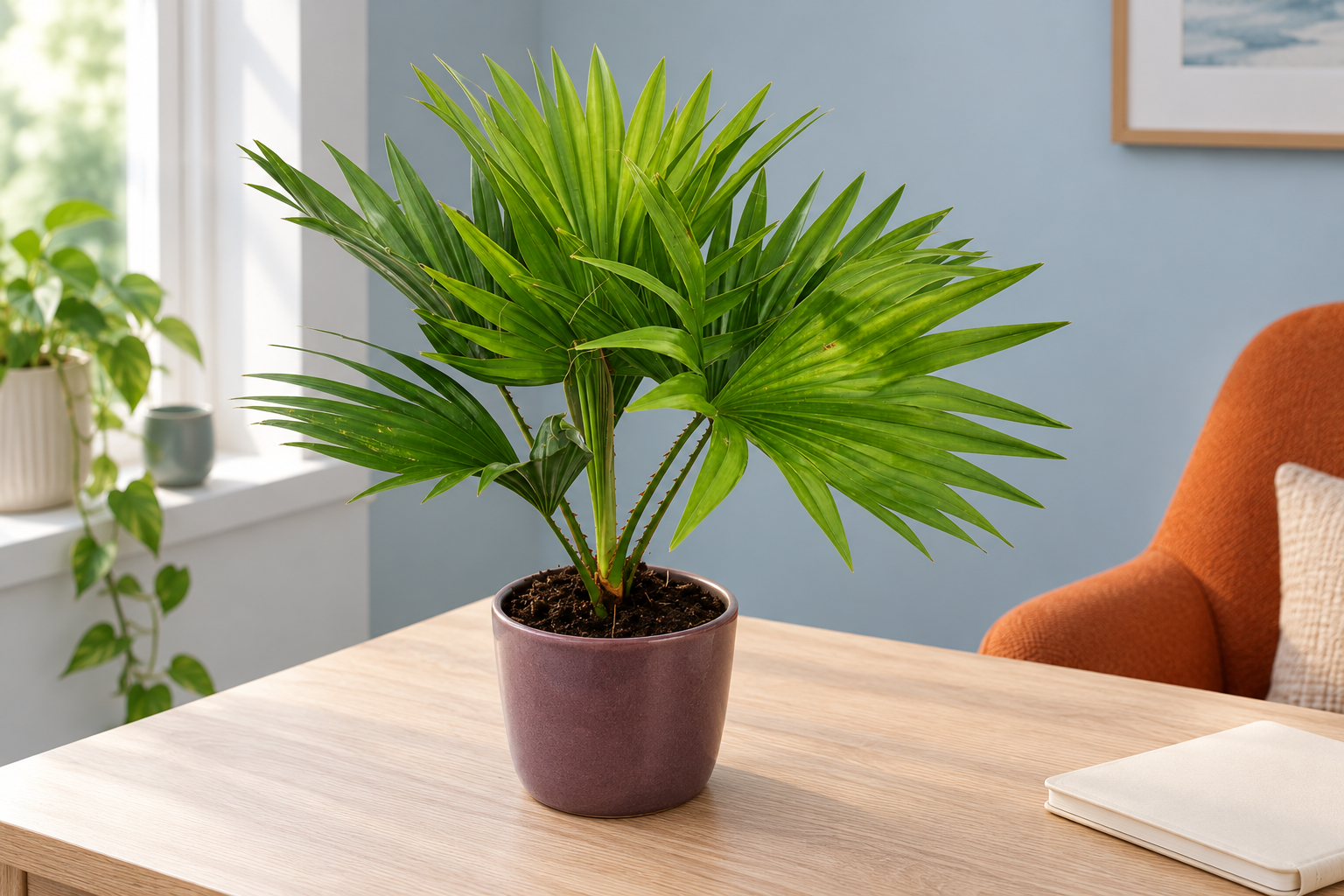
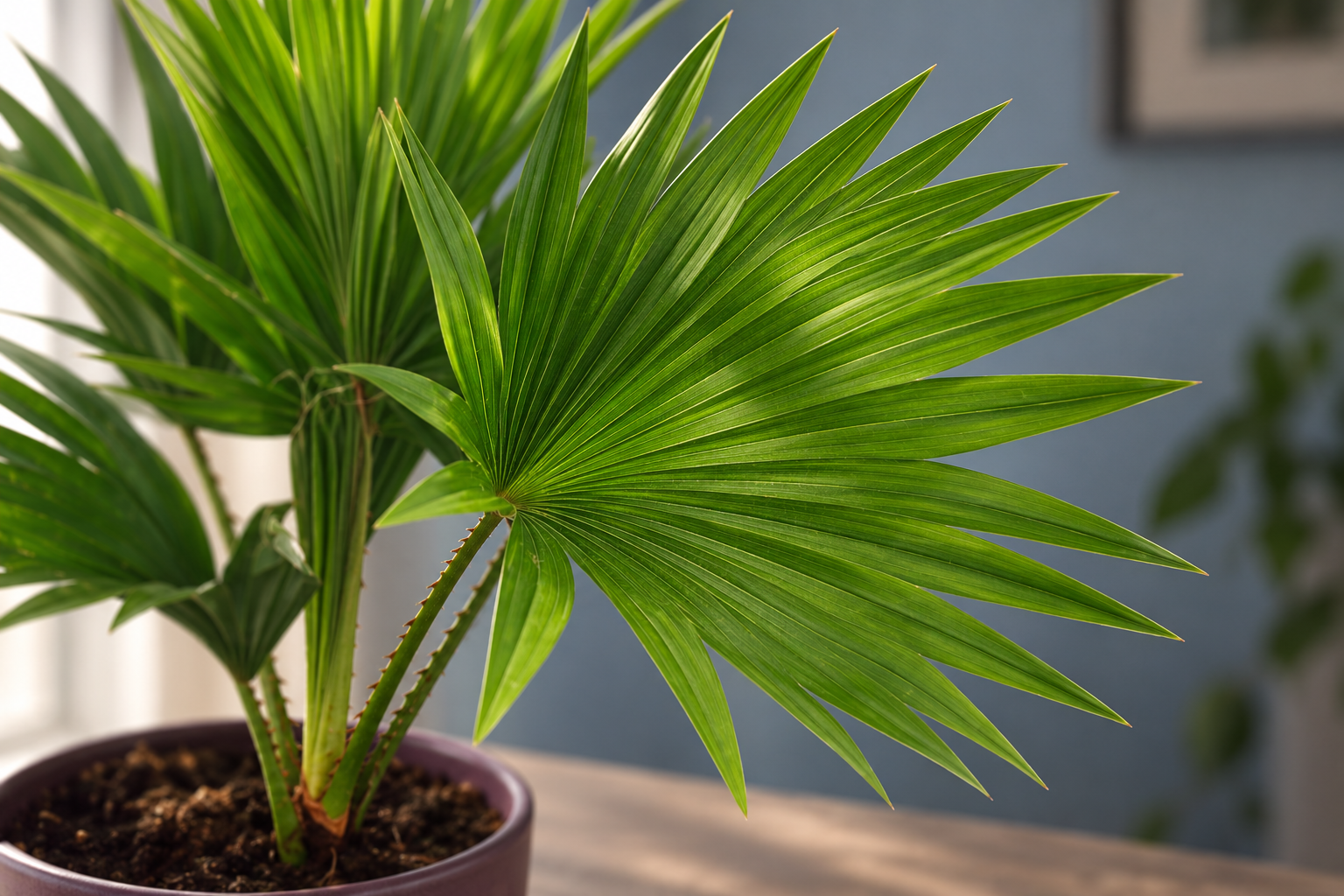
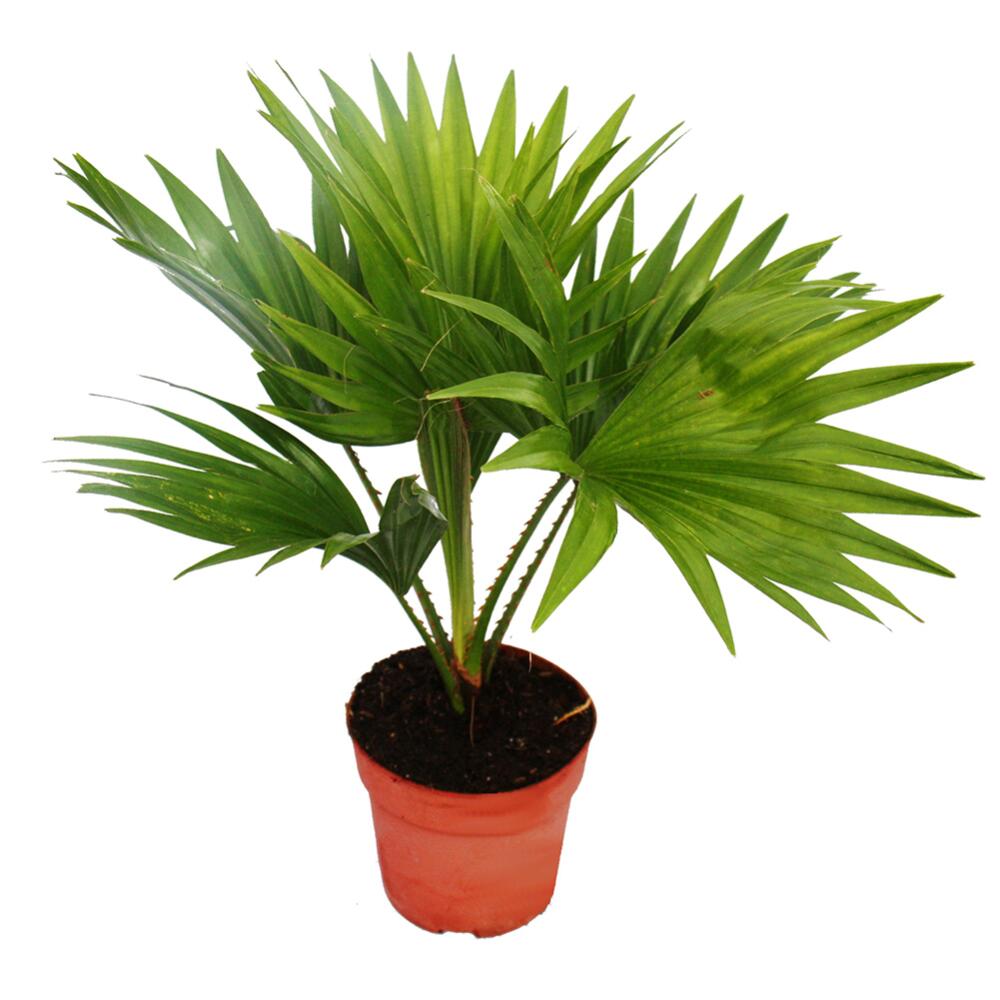
Saribus rotundifolius looks distinctive even young. Several green fans stand on long narrow leaf stalks in the original. Blades have clear folds; outwards they divide into pointed segments. New growth initially stays narrowly folded. This structure invites side viewing: one fan stands almost front-on, another shows only its narrow edge. Slight green differences belong to living foliage. This young format suits a bright shelf provided fans remain free rather than constantly pressed against a wall.
Livistona rotundifolia is the familiar trade name
Botanically the palm belongs to the palm family. Saribus rotundifolius is today’s accepted name; Livistona rotundifolia denotes the same species. The shop uses shortened spelling rotundifola. Its natural background is moist tropical regions from Borneo to New Guinea and adjacent islands. There it may develop a tall single trunk. Indoors we accompany a young potted plant whose future size depends on light, root space and cultivation. The specific offer gives a 12 cm pot and approximately 35–50 cm total height. This delivery size measured including pot describes its present stage, not a fixed later indoor height.
A bright workplace with a free crown
While unpacking carry the palm by container and carefully release packaging from fans. Fine teeth along stalk edges deserve attention. A warm place with abundant indirect daylight is a good beginning. Shop recommendation for this indoor version is at least 18 °C year-round. A desk plant also depends on conditions after work: if the room cools sharply, the window side stays draughty or files hide foliage, adapt its position. Initially protect from intense sunshine through glass after transport. A bright room needs to transmit brightness to the entire leaf crown.
The ball remains supplied and can drain
Check soil below the surface and pot weight. Slightly dried top soil prompts closer inspection whereas a heavy moist ball initially needs no extra water. When watering supply roots evenly and drain excess freely. Then check saucer or outer pot. The ball should neither parch for long nor stand in water. Less winter daylight often slows consumption. A palm beside heating may nevertheless lose water then too. Actual moisture and small-pot conditions matter, not an unchanging weekly amount.
Gently expand root space and nutrition
Structurally stable houseplant compost with good drainage eases supply. Coarse mineral parts can support permeability without turning soil into a completely dry gravel bed. Repot only when roots clearly use available space or the ball can no longer be supplied evenly well. A slightly larger container remains easy to monitor. Keep roots together while releasing where possible and retain planting depth. Feed moderately during visible growth according to label; fresh pre-fed soil already counts. More fertiliser is no sensible response to poor positioning or damaged leaf tips.
Fans unfold at their own pace
Do not spread the central folded growth with fingers. Let the young leaf develop its own shape. A soft damp cloth removes dust from older foliage while the second hand supports the blade gently. A fully dead older leaf can be removed at the stalk with clean tools; do not forcibly pull it from the base. Healthy fans are not cut to matching lengths. Thorny stalks are also no suitable carrying handle. The detail enlarges folds, parallel veins and pointed segments. Neither flowering nor fruit is promised on the offered young indoor plant.
Tips and undersides tell different stories
Brown tips may develop with unsuitable watering or dry air; mechanical position damage is also possible. Do not consider the leaf end alone. Also check ball, undersides and stalk bases for fine webs, fixed small shields or cotton-like deposits. Already brown areas do not turn green again even if new fans later grow healthily. In winter the palm stays bright and warm away from direct heating air. Adapt water and nutrition to growth. A bright place with undisturbed fans makes the small crown accessible daily and lets changes be noticed in time.
One plant, several views
Good to know
Are Saribus and Livistona different plants?
Saribus rotundifolius and Livistona rotundifolia are names of the same species. Accepted name is Saribus rotundifolius.
How large is the specific delivered plant?
The offer gives a 12 cm pot with about 35–50 cm total height including pot. The palm develops further afterwards.
Can I open a folded fan faster?
Let the young leaf unfold itself. Pulling apart can damage sensitive folds and segments.
Does it always need the same water quantity?
Check the ball anew. Light, temperature and growth change use; standing residual water is removed.
How do I handle thorny stalks?
Carry by container and work gently between fans. Gloves can ease handling during cutting.
When is a larger pot sensible?
When roots clearly use space or supply in the old pot becomes harder. Choose a slightly larger container with drainage.
Sources and editorial note
- Exotenherz: directly checked offer and delivery measurements (accessed 03.10.2026)
- Kew POWO: accepted species, natural distribution and synonyms (accessed 03.10.2026)
- NParks: complete species profile, fan form and tropical development (accessed 03.10.2026)
- RHS: directly read indoor palm growing guidance (accessed 03.10.2026)
- Colorado State University Extension: watering and container culture (accessed 03.10.2026)
Product and specialist sources directly read on 03.10.2026. Current own shop HTML evidence with identifiers, availability and cart retained; older search copies may differ. Source expertise, original and AI images checked separately. Website and publication acceptance handled centrally.