This plant at Exotenherz
Check the shop offer for current availability, price and what is included.
Product details, availability and delivery information in the shop.
Your care table
| Topic | What to do | Why it helps |
|---|---|---|
| Light | Bright; acclimatise slowly to gentle sunshine. | Young shoots can burn behind hot glass. |
| Water | Water according to need after the compost starts to dry. | Active growth needs regular supply. |
| Drainage | Remove residual water. | Permanent wetness is not forest-cactus care. |
| Compost | Loose mix for epiphytic cacti. | Roots need moisture and air. |
| Temperature | Warm and reliably frost-free. | Cold is not a reliable shortcut to flowering. |
| Fertiliser | Moderately during growth; stop during rest. | Adjust nutrients to actual growth. |
| Growth | Later provide sufficient space and a strong support. | The young hanging plant can grow on vigorously. |
| Winter | Very bright, less water; do not leave completely dry for prolonged periods. | Lower light reduces water use. |
Check the compost and pot weight. The care table explains how far the compost may dry.
Water only when needed. The water should reach the root ball without spilling over the rim.
Remove surplus water from the saucer or cachepot. Then return the plant to a suitable position.
A young cushion of green shoots
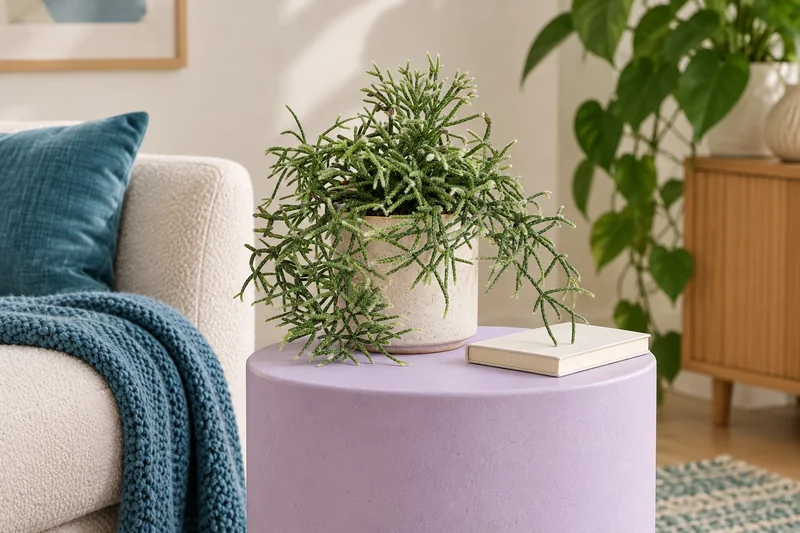
Numerous slender green angular shoots grow from the 14 cm hanging pot. Some stand upright, while others spread sideways or hang slightly over the edge. The listed total height is approximately 25 cm excluding the hanger. The scene therefore shows a young specimen. No large white flowers or ripe pink fruit are generated into it: the shop explicitly delivers without buds, flowers or fruit. The young stems are already interesting enough.
The familiar fruit has climbing origins
Selenicereus undatus is the currently accepted name for the cactus formerly called Hylocereus undatus. Kew lists Mexico to Honduras as its natural background. The species belongs to the cactus family and grows epiphytically or by climbing. Its green stems carry out photosynthesis; aerial roots may later help it hold on. The small hanging plant is an initial stage. Over time, it may need considerably more room and a strong support.
Bright light without immediate blazing heat
A very bright, warm position with mostly gentle light suits the young plant. Acclimatise slowly to gentle sun, but avoid sudden hot midday sun behind glass after transport. A dark corner produces thin, weak shoots. In summer, a warm sheltered outdoor position is possible. Hang the pot so the upper area receives light too. As it grows larger, a stable support may be useful; ties must not constrict the fine existing shoots.
Water differently from a resting desert cactus
During active growth, water according to need after the compost starts to dry. The compost should stay airy and excess must drain. Prolonged complete dryness is not sensible long-term cultivation for this vigorously growing epiphytic cactus. A permanently full outer pot is equally unsuitable. A loose mix for epiphytic cacti holds some moisture and lets oxygen reach the roots. Water less during the darker part of the year, but do not leave the root ball bone dry for long.
Guide growth and care for the root ball
When needed, move to a pot with a drainage hole only moderately larger. Protect sensitive stem joints while lifting it out. Sparing feeding according to the label supports active growth; stop during winter rest. Overlong or damaged shoots can be selectively removed with a clean tool. Healthy sections suit careful rooting after the cut dries. New aerial roots are not automatically a deficiency sign; they can be part of the climbing lifestyle.
Flowers and harvest need more than patience alone
Sufficiently developed plants may produce large flowers that open at night. Whether these become fruit depends, among other things, on flowering maturity, light and successful pollination. Depending on the clone, suitable pollen from another plant may be necessary. A young indoor hanging plant is therefore not a guaranteed crop plant. Overwinter in bright, warm, frost-free conditions; for straightforward home cultivation, a position around 15 °C or warmer is easier to monitor than a forced cold period. Reduce water according to falling use. Inspect soft, dark shoots in a wet root ball more closely for rot.
One plant, several views


Good to know
Does the plant arrive with dragon fruit?
No. The offer is delivered without flowers, buds or fruit.
Why are some offers called Hylocereus?
That is the former genus name. The species is now classified under Selenicereus.
Is a cold winter rest enough to produce fruit?
No. Flowering maturity, light, clone and pollination also matter.
Are aerial roots a problem?
Not inherently. They belong to the climbing lifestyle and can help it hold on.
Sources and editorial note
- Product and delivery contents: Exotenherz
- Royal Botanic Gardens, Kew: botanical classification
- Royal Horticultural Society: plant and care information
Sources checked: 16 September 2026. Product information and the contents of delivery follow the linked shop offer. Care advice was checked against the cited specialist sources and should still be adapted to the plant’s condition, position and season.