This plant at Exotenherz
Check the shop offer for current availability, price and what is included.
Check the shop for the current price, availability and offer contents.
Your care table
| Topic | What to do | Why it helps |
|---|---|---|
| Light | Grow very bright to sunny and gradually increase intense sun after shipping. | Light supports the compact sphere; sheltered greenhouse plants still need acclimatisation. |
| Water | During growth, water only after substantial rootball drying and allow drainage. | Segments store water; a permanently wet root zone increases rot risk. |
| Compost | Use gritty, freely draining cactus compost. | A mineral surface alone tells nothing about moisture beneath. |
| Pot | Choose a stable container with clear drainage and avoid unnecessarily large repotting. | Later segments increase weight; a large damp soil mantle does not help a young cactus. |
| Repotting | In spring if needed, work at the rootball and do not use segments as handles. | Connections between later segments may break easily. |
| Feeding | Give cactus fertiliser sparingly according to its label only during visible growth. | Rest requires no extra nutrient supply. |
| Winter rest | Bright, cooler frost-free position; very little or no water during resting growth. | At low activity the cactus uses little water and poorly tolerates sustained wetness. |
| Checks | Inspect areoles, base and pot rim without squeezing for pests or soft spots. | An almost spineless appearance does not make the surface insensitive. |
Check the compost and pot weight. The care table explains how far the compost may dry.
Water only when needed. The water should reach the root ball without spilling over the rim.
Remove surplus water from the saucer or cachepot. Then return the plant to a suitable position.
Unpack the little sphere slowly
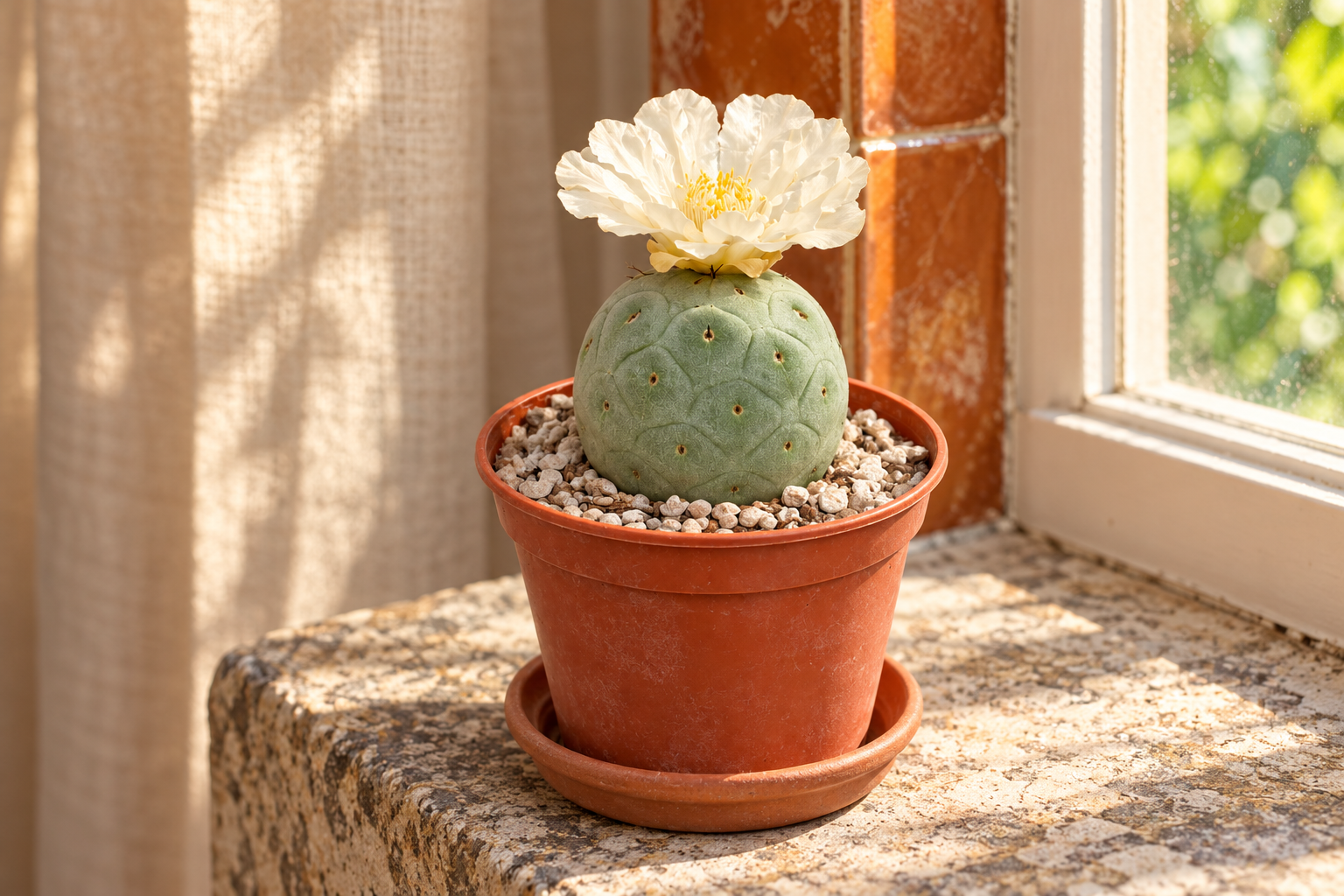
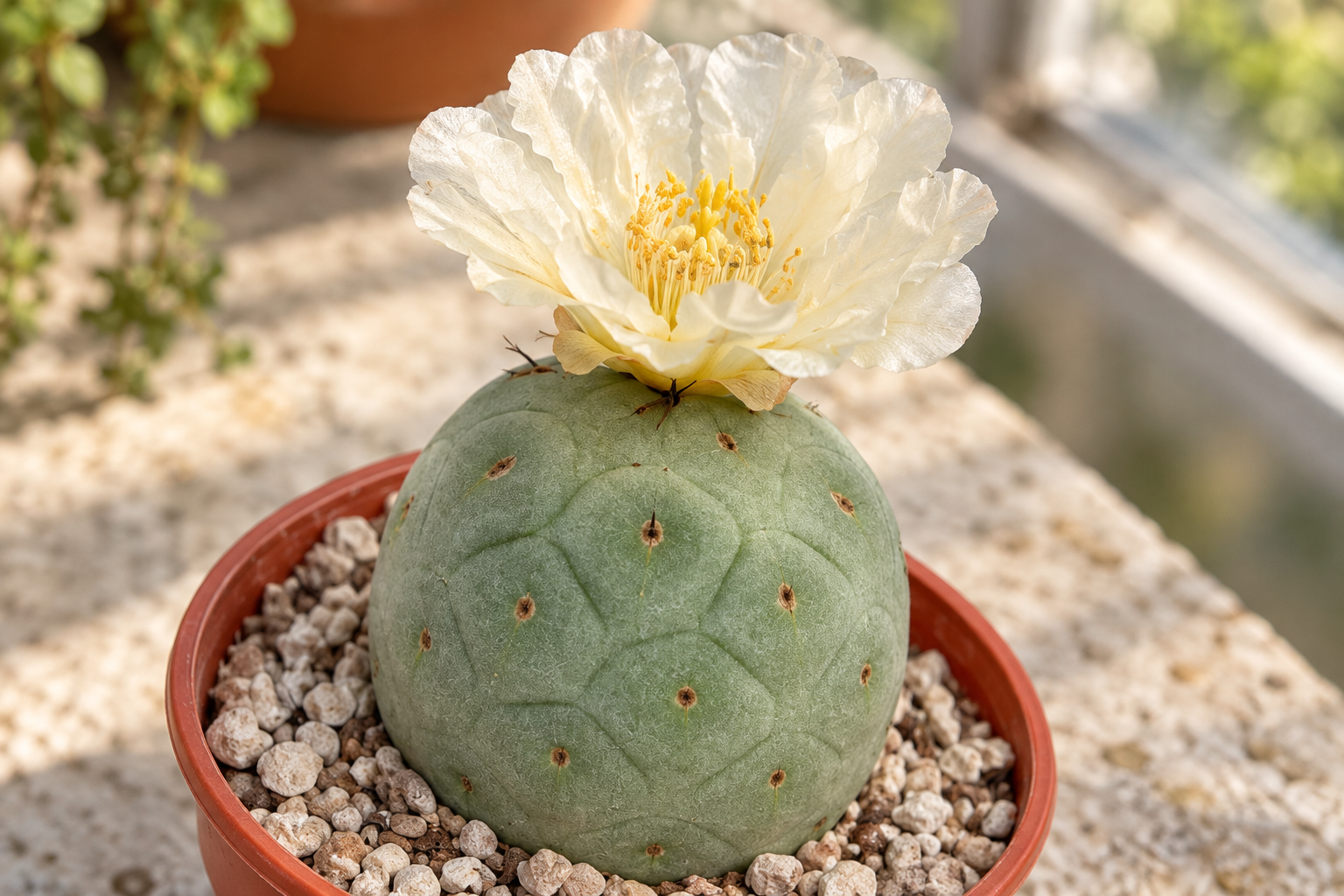
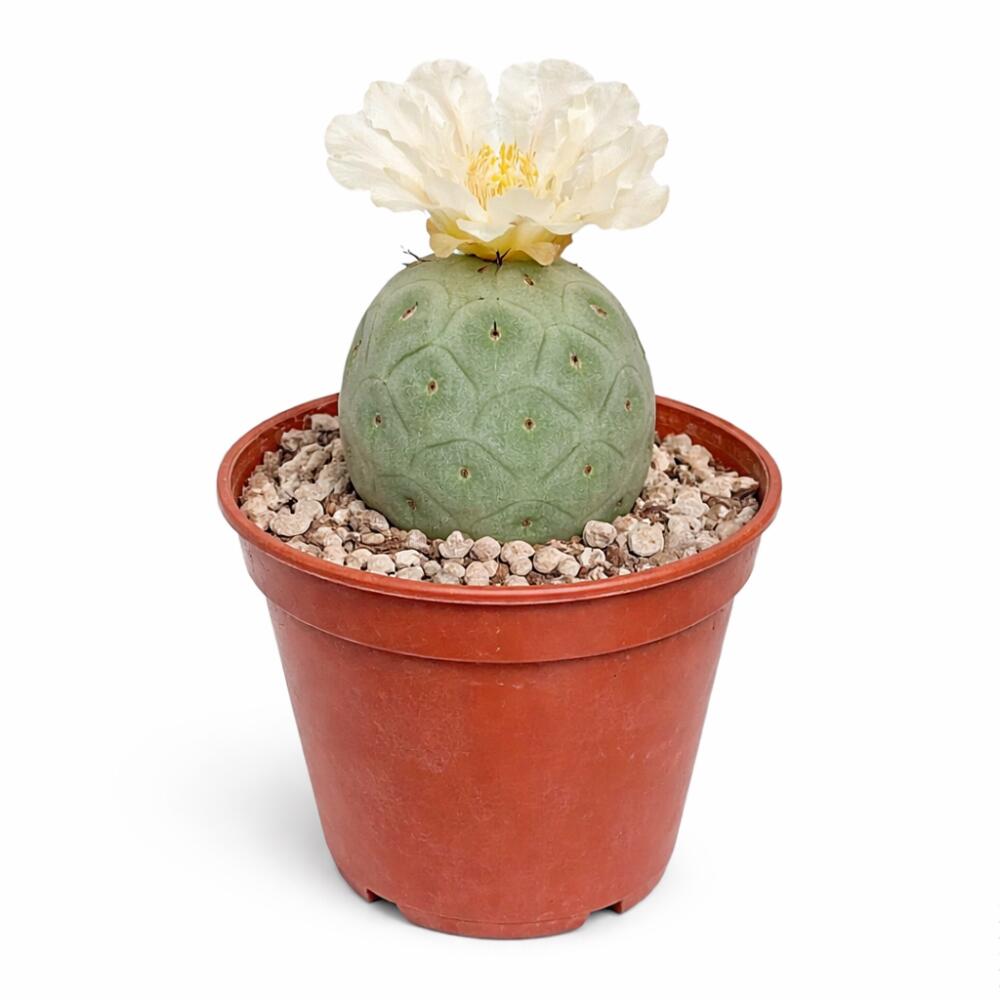
The clean original shows a single grey-green body in a red nursery pot. Small areoles lie in shallowly bounded areas on its surface; the lines look geometric without forming sharply cut edges. A large pale flower with a yellow centre is already present at the top. The plant is offered in a 6.5 cm pot at about 15 cm total height. This manageable size helps when unpacking: hold the container securely and pull wrapping sideways away without pressing on the cactus. Even a nearly spineless sphere is not an object to grip by its surface. Then check the rootball is secure and drainage open.
A name for a species with segmented growth
Tephrocactus geometricus belongs to the cactus family and comes from Catamarca in north-western Argentina. In other classifications it also appears as Tephrocactus alexanderi subsp. geometricus; this portrait follows Kew’s accepted name Tephrocactus geometricus. Further spherical stem sections may appear with age and branch above the first segment. The single body in the original is therefore an early development stage. Number, later height and speed depend on the specimen and cultivation. No exact mature height is claimed for this shop form; stated total height describes the offered plant including pot.
Light preserves its compact character
Give the cactus a very bright, preferably sunny position. A window area with unobstructed light or a bright conservatory helps maintain compact structure. Initially moderate strong direct sun after shipping and sheltered pre-cultivation. The matt grey-green surface does not protect against every sudden stress. A warm rain-sheltered outdoor summer place may suit it if the small pot stands safely and no wet cold days are approaching. Do not constantly move it between a dark room and blazing midday sun. Prepare a bright frost-free winter place early. A cactus from a dry natural habitat is not automatically suited to an unprotected German winter in a nursery pot.
The real rootball lies below the pale stones
The original pot’s mineral dressing looks dry and tidy. It is not a reliable indication of moisture deeper down. Check pot weight and rootball before watering during active growth. Water only after substantial drying and remove excess. Constant small sips or a full saucer keep the base unnecessarily damp. The spherical body stores water but still needs a living root system during bright growth. Slight shrinking invites observation; soft dark tissue and wet soil instead call for damage checks before watering again.
Repot with sensitive connections in mind
While the delivery rootball has enough room and dries well, it can stay in its container. Spring is a good time for later repotting. Choose free-draining gritty cactus compost and a pot only slightly larger with clear drainage. Work with container and rootball, not by pulling the body. Especially in older specimens, connections between spherical segments detach easily; this belongs to their structure and demands care. A stable pot is then more useful than unnecessarily large soil volume. Do not set the green base deeper than before. Sparse feeding follows visible growth and fertiliser instructions.
Winter is a time of reduced activity
With shorter days the cactus receives less water. A bright cool frost-free room and a largely dry rootball suit actual rest. Watering can stop entirely during resting growth; if kept warmer, continue checking body and compost without imposing a rigid calendar. Wetness and low activity are an unfavourable combination. In spring, do not suddenly raise provision to summer levels, but adapt it to increasing light and visible growth. The pictured flower proves the photographed specimen’s ability to flower, neither permanent flowering nor a promised flowering date after delivery. Good cultivation comes before expecting a specific date.
Enjoy the flower without forcing new segments
The species can produce white to pale pink flowers. The original flower is pale cream; both AI motifs retain this visible stage. A young plant need not look the same every year. After flowering, light, the rootball and new structure matter more than frequent moving or extra fertiliser. Shaping cuts are not useful for this small spherical cactus. Healthy detached segments can in principle propagate after the break dries, but are not hastily removed from a still-small plant. Occasionally inspect areoles and base for new sticky or woolly areas. This keeps care calm and precise, fitting a cactus whose changes become visible slowly.
One plant, several views
Good to know
Will the cactus definitely arrive flowering?
The original shows a pale flower on the photographed specimen. It does not promise the current flowering state of every delivery.
Does the young plant already have several spheres?
The associated original shows one segment. More may develop later; no fixed number is promised.
Why does a later segment detach easily?
Connections can be sensitive. Hold the pot when moving and do not pull an upper segment.
Is dry gravel enough to judge watering?
No. Check moisture deeper in the rootball and pot weight too.
Why does a label sometimes say Tephrocactus alexanderi subsp. geometricus?
An alternative classification places the species as a subspecies of Tephrocactus alexanderi. This portrait follows Kew’s accepted name Tephrocactus geometricus.
Can I leave the species outside?
A warm rain-sheltered summer position is possible after acclimatisation. In winter keep the small pot bright and frost-free.
Sources and editorial note
- Exotenherz: specific variant, measurements, identifiers and availability (03.10.2026)
- Kew POWO: species, origins and taxonomic alternatives (03.10.2026)
- Giromagi: directly read species profile and segment structure (03.10.2026)
- RHS: cactus cultivation, compost and rest (03.10.2026)
Shop offer and directly read specialist sources compared on03.10.2026. Identity, synonyms and SKU checked against Canon642, central new and isolated parallel portraits. Kew accepts geometricus and documents alternative placement under alexanderi; synonyms deduplicated. Giromagi morphology directly read in full, general pot culture from RHS. Original flower faithfully shown without a flowering or fixed body-count promise.