This plant at Exotenherz
Check the shop offer for current availability, price and what is included.
Check the shop for the price, current availability and what is included.
Your care table
| Topic | What to do | Why it helps |
|---|---|---|
| Position | Bright with filtered light and free air movement. | The base must dry after watering. |
| Water | Thoroughly wet leaves with low-lime water. | Fine scales absorb moisture. |
| Base | Do not soak for long or push into wet material. | Close leaf sheaths may trap water. |
| Draining | Gently tilt the rosette after watering. | Hidden water can escape. |
| Warmth | Keep warm and protected from cold draughts. | Cold wetness stresses the plant. |
| Feed | Occasionally use suitable feed very moderately. | Heavy salt supply is unnecessary. |
| Pups | Separate only stronger daughter plants. | Small offsets develop more reliably together. |
| Shape | Do not straighten curved leaves. | Their curvature belongs to natural growth. |
Take the tillandsia off its support. Do not rub the leaves; preserve the delicate silvery scales.
Use low-lime water at room temperature. The care table explains whether thorough misting or a short soak is suitable.
Gently shake off the water. Tilt rosettes downwards, hang loose strands without bunching them together and allow them to dry with good airflow.
Each leaf draws its own line
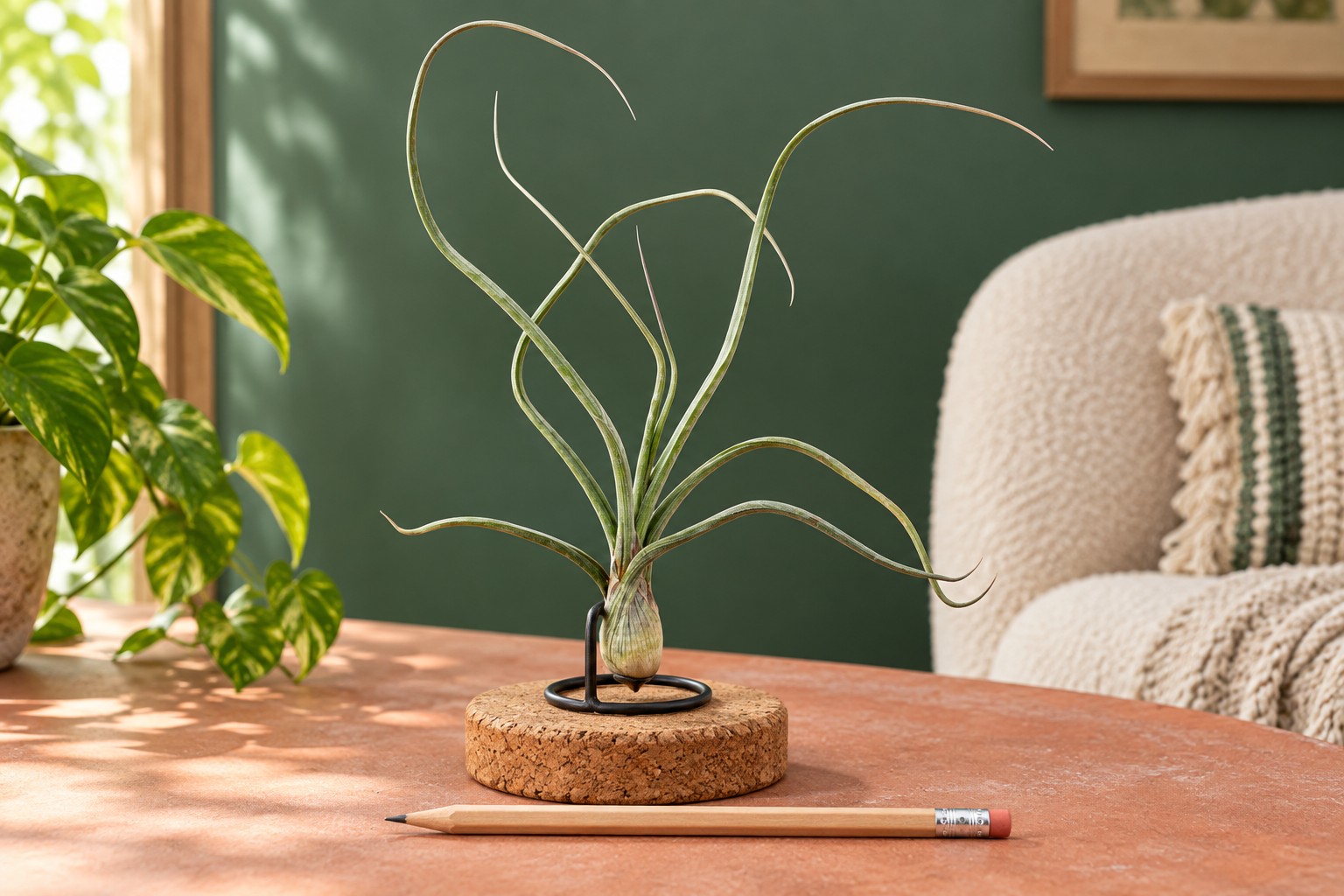
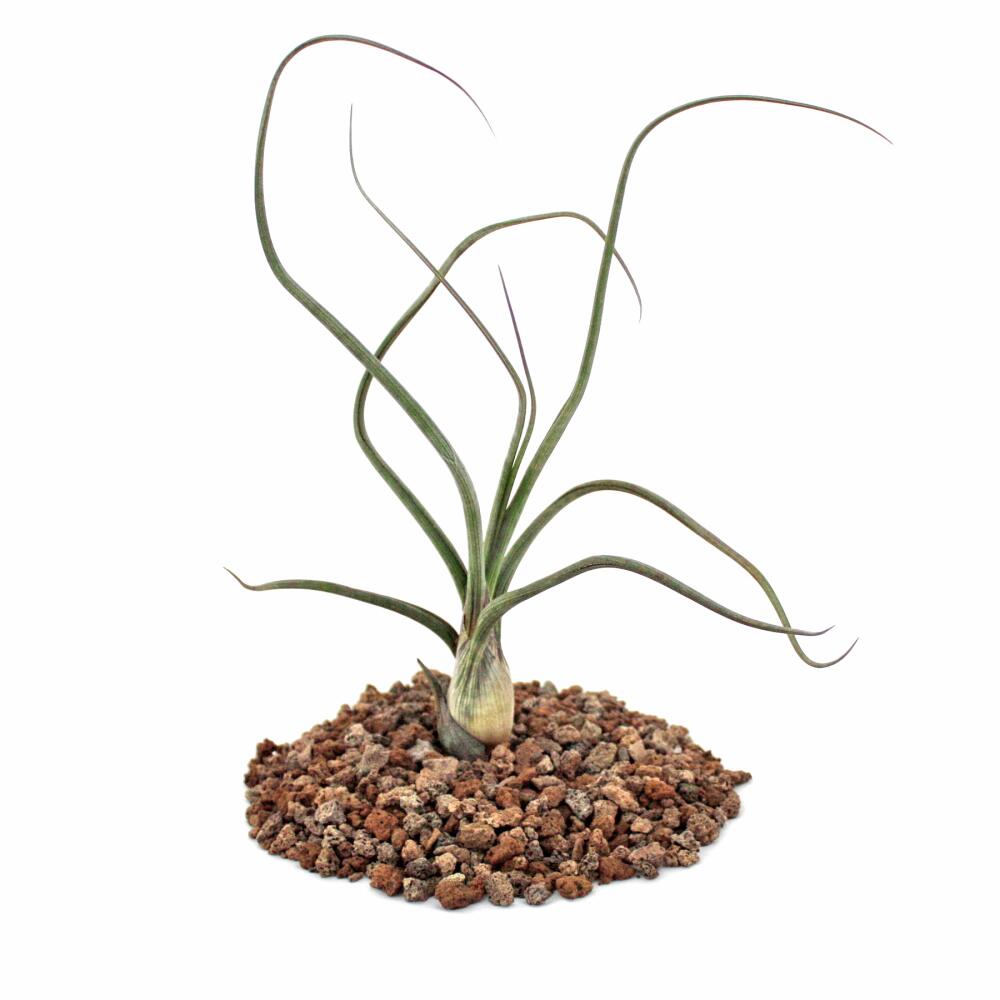
Narrow grey-green leaves bend and twist out from a thickened base. This base consists of closely arranged leaf sheaths and is not an ordinary flower bulb. Natural curvature is part of the plant’s character. Do not try to straighten every leaf or bend them into a symmetrical shape. An open holder makes their lines clearly visible. The plant belongs to the bromeliads and grows as an epiphyte without taking nutrients from its support like a parasite.
Do not guess origin from a trade name
The offer is listed as Tillandsia baileyi. The narrowly defined botanical species comes from southern Texas and north-eastern Mexico. Similarly named plants farther south have partly been distinguished as Tillandsia pseudobaileyi. The shop’s Guatemala statement therefore cannot simply be adopted as the reliable origin of true T. baileyi. Without further supplier details, this individual plant is not reidentified from its photo. This portrait describes its visible growth and care appropriate to the offered commercial form.
An exposed base makes care easier
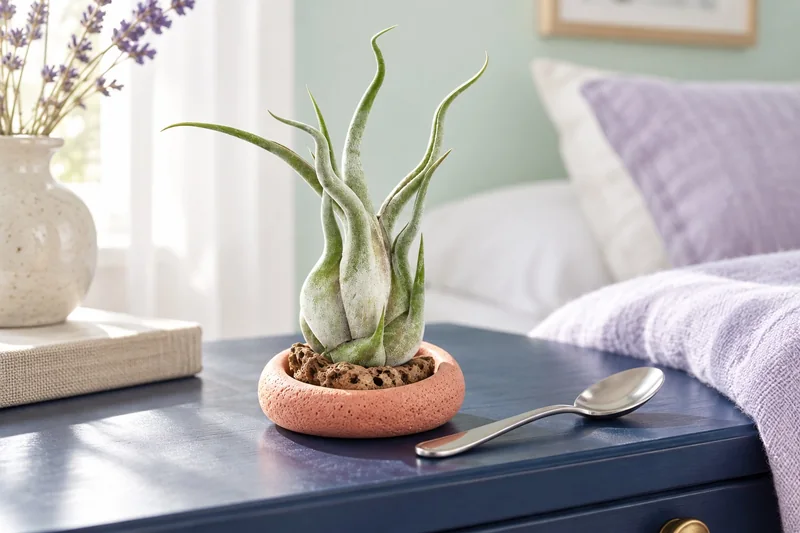
The loose plant is offered at approximately 15 to 20 cm in size. A pot is not included. Our scene shows it in an open holder; this is a display example. Do not press the base deeply into soil, sand or constantly wet moss. A suitable loose support is enough. The rosette must be removable for watering without pulling its leaves. A bright position with filtered daylight suits well. Hot direct sunshine and a position immediately above a radiator are unsuitable.
Wetting and draining belong together
Use clean low-lime room-temperature water and thoroughly wet the leaf surfaces. Do not soak the thickened base for long, as water can remain between leaf sheaths. After watering, gently tilt it and allow proper draining. Air movement helps the surface become dry again afterwards. Warm dry rooms may require more frequent watering than cooler winter conditions. Do not use leaf curvature alone as a thirst indicator: this form also has pronounced curves when healthy.
Accompany development over time
Warm indoor conditions and a consistent care routine support new growth. During active development, occasionally use suitable tillandsia or bromeliad feed very moderately according to its label. Too much feed may remain as salts on the leaves. A mature rosette may flower and produce daughter plants. The shop guarantees no flowering condition here, so the scene shows no additional flowers. Initially let pups grow with the clump and separate carefully only at sufficient size. Do not remove the mother rosette prematurely simply because an inflorescence has faded.
Distinguish healthy firmness from rot
The base should not become soft, slimy or smell rotten. Such changes require checking wetness and ventilation. Old dry outer leaf sheaths can instead be part of development and should only be removed gently. Do not pull strongly on inner leaves when inspecting. Dry tips together with rapid drying suggest checking water supply and an overly hot position. An air plant is not a maintenance-free home accessory: it needs regular care even without an ordinary flowerpot.
One plant, several views
Good to know
Is the thickened base a bulb?
It is formed from leaf sheaths and is not an ordinary flower bulb that needs burying in soil.
Does true Tillandsia baileyi come from Guatemala?
The narrowly defined species comes from southern Texas and north-eastern Mexico. The trade name alone does not resolve the differing origin statement.
Do curved leaves always mean thirst?
No. The offered form naturally has curved leaves. The condition of the whole plant matters.
Can it remain in a dish of water?
No. After wetting, the plant must drain properly and dry in airy conditions.
Sources and editorial note
- Product and delivery contents: Exotenherz
- NatureServe: botanical distinction and distribution
- Bromeliad Society of Australia: botany and commercial forms
- Royal Horticultural Society: plant and care knowledge
Sources checked: 15 September 2026. Product information and delivery contents follow the linked offer. Care has been checked against the stated specialist sources and remains subject to plant condition, position and season.