This plant at Exotenherz
Check the shop offer for current availability, price and what is included.
Check the shop for the current price, availability and offer contents.
Your care table
| Topic | What to do | Why it helps |
|---|---|---|
| Arrival | Lay the loose rosette out bright and airy. | Base and leaves should stay accessible. |
| Light | Bright filtered light rather than hot midday sun. | Red colour is no reason for an abruptly hot sunny place. |
| Watering | Thoroughly wet with rainwater or soak temporarily. | Fine mist and humidity do not replace leaf watering. |
| Drying | Drain upside down and shake out drops. | No constant wetness between overlapping leaf bases. |
| Holder | Open and removable for care; do not plant in soil. | Leaves supply the plant; air must reach the base. |
| Feeding | Use suitable fertiliser during growth according to instructions. | More fertiliser does not reliably intensify red colour. |
| Winter | Keep very bright and warm; observe drying. | Less warmth lengthens drying time. |
| Offsets | Initially allow strong growth on the mother. | About one third of mother size is a guide for separation. |
Take the tillandsia off its support. Do not rub the leaves; preserve the delicate silvery scales.
Use low-lime water at room temperature. The care table explains whether thorough misting or a short soak is suitable.
Gently shake off the water. Tilt rosettes downwards, hang loose strands without bunching them together and allow them to dry with good airflow.
A red leaf phase on a compact rosette
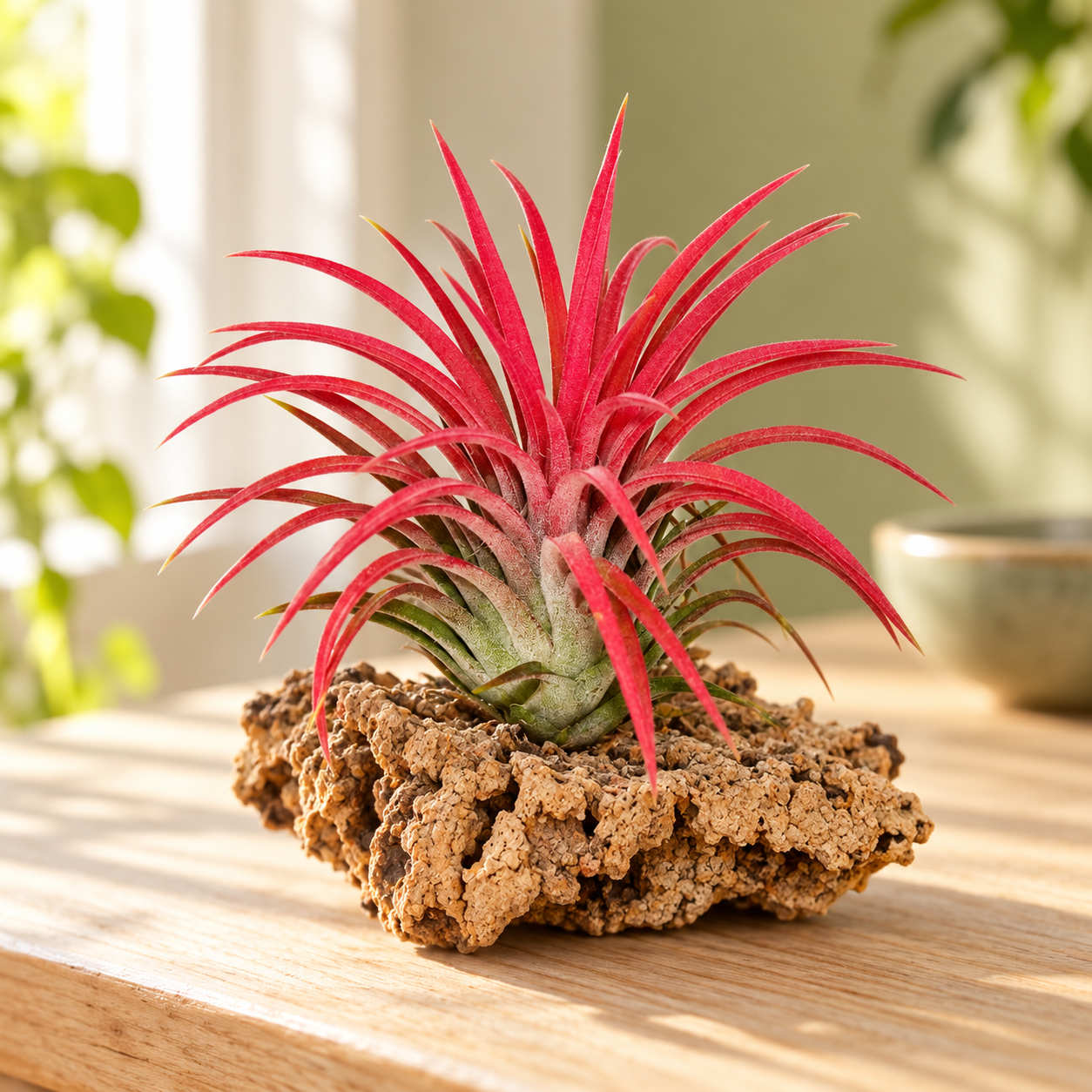
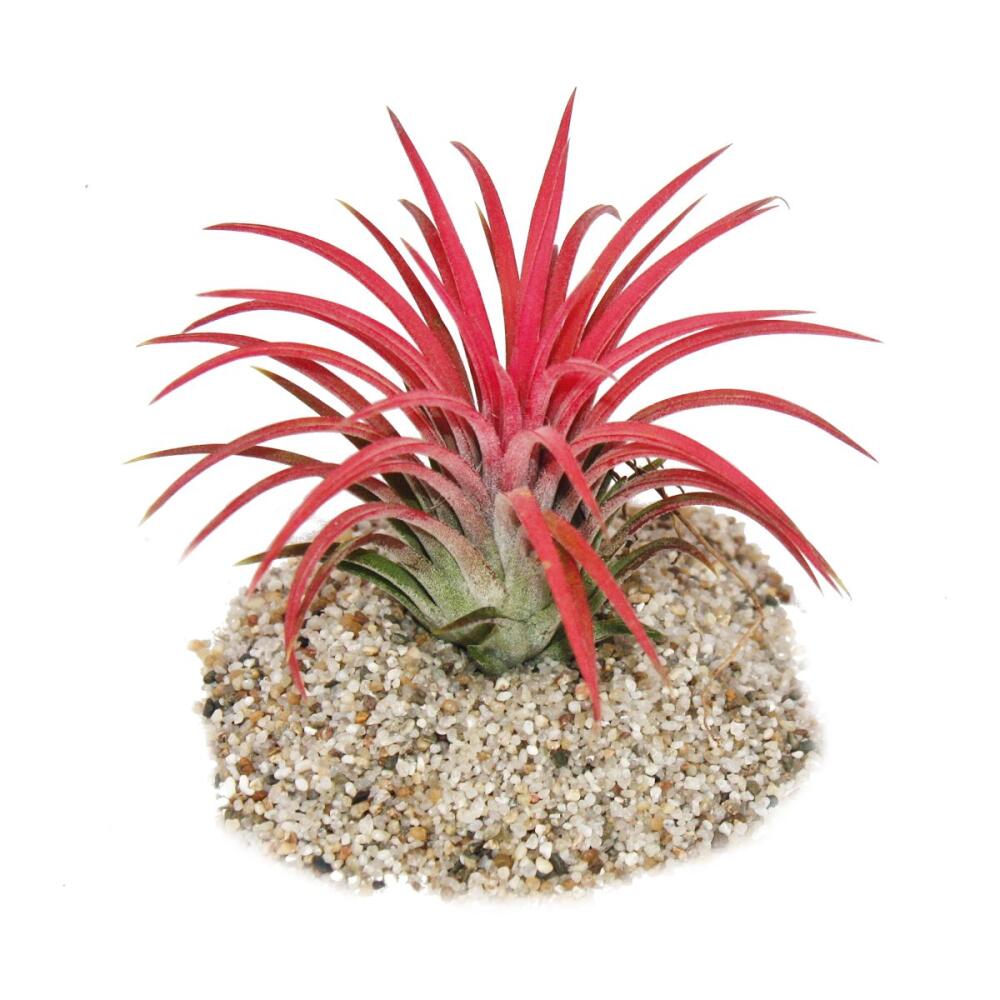
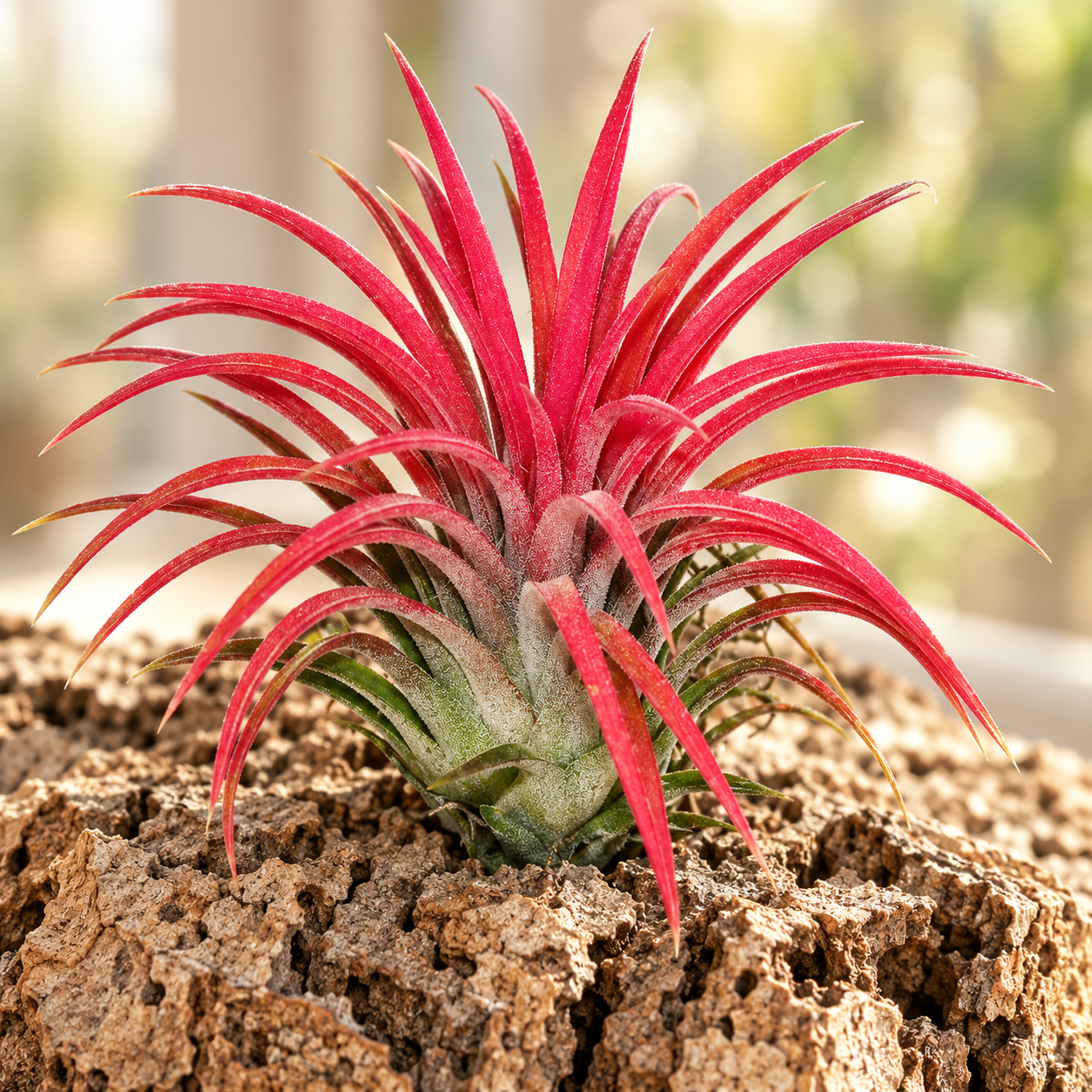
The small Fire rosette opens its pointed leaves in all directions. Grey-green finely scaled leaf bases overlap, while upper leaves in the specific shop original appear strongly pink-red. Fire is a horticultural trade designation within Tillandsia ionantha. A specialist producer lists the same selection as Fire and the Spanish name Fuego and describes particularly intense reds in connection with flowering. Colour is therefore a development phase, not a promise of permanently red leaves. A greener plant can also belong to this profile. The original shows no open flower: compact shape, fine leaf surface and transition from green base to red upper leaves are the focus.
The loose air plant gets an open place
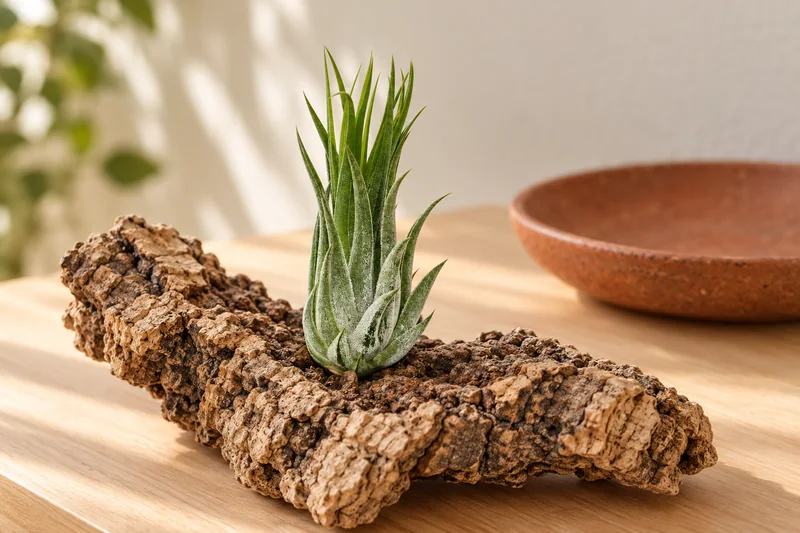
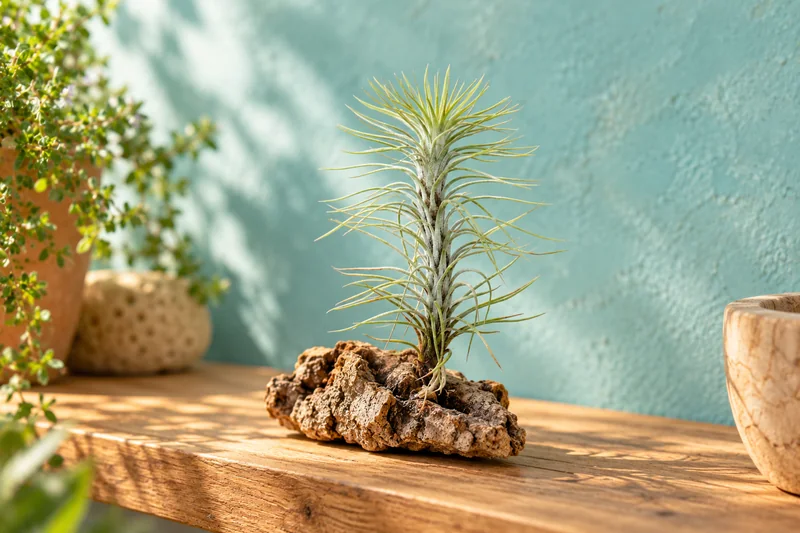
The offer specifies about 8–10 cm plant size. Fire arrives as a loose tillandsia without a nursery pot; holder, cork and scene decoration are not supplied. After unpacking, the whole rosette can lie freely with air reaching its base. In this cultivation the roots mainly anchor it, while leaves absorb water and nutrients. Potting compost is unnecessary. Choose an open, preferably removable holder or small piece of dry cork. Do not clamp leaves or deeply conceal the base. Check when arranging that you can remove the entire plant for watering. An accessible little rosette is easier to supply reliably than permanently installed decoration.
Bright filtered light supports leaf colour
A bright position with filtered light supports the compact rosette. Accustom the plant gently to stronger lighting after moving. Hot direct midday sun behind glass can damage fine leaves; red colour is no reason to place it deliberately in such heat. A light-rich window position with good air movement is practical. A humid bathroom only suits it if also sufficiently bright and well ventilated. A closed glass with a constantly wet base is less suitable. In warm summer phases a sheltered outdoor place with filtered light is possible. Bring Fire back inside before cool nights. Observe visible colour rather than forcing it through abrupt moves.
Thorough wetting is needed, not fine mist alone
Leaf surfaces must actually receive water. Use room-temperature rainwater and thoroughly wet the whole plant; temporary soaking can reach overlapping leaf areas too. Frequency depends on warmth, dry indoor air and air movement. Check leaf condition and site conditions several times a week. Brief fine mist can supplement care but is often insufficient as the sole provision in a dry living room. Higher air humidity does not automatically replace watering either. After every thorough application, let Fire drain upside down. Gently shake out remaining drops and let the rosette dry completely in an airy place before returning it to its holder.
The scaled base needs air and stays clean
Fine pale scales are an important part of the leaf surface. Polishing, leaf shine and vigorous rubbing therefore do not belong in care. Hard water can leave deposits; rainwater is appropriate for regular leaf watering. Watch concealed basal areas especially: water remains there longer than at exposed tips. Do not leave the plant on wet cork after watering. During visible growth, suitable tillandsia or orchid fertiliser can occasionally be added to the care water according to instructions. More fertiliser does not reliably make leaves redder. An open holder remains a care decision even for a brightly coloured plant, since it determines access to the whole rosette.
Assess winter and unusual leaf areas together
Keep Fire as bright and warm as possible in winter. With less warmth the rosette dries more slowly; the next watering follows this actual course. Cool dark storage is unsuitable. If several leaves curl strongly and tips become brittle, check for inadequate supply in dry warm air. A soft dark base or new black areas in the centre instead require checks for standing water and insufficient air movement. Additional water alone would not solve this problem. Distinguish greener colour in older leaves or those developing after flowering from such tissue damage. Look at firmness, leaf position and base before intervening over one colour change.
Offsets can continue after flowering
An individual tillandsia rosette flowers once during its lifetime. Young basal rosettes can then continue development while the mother slowly declines. The bright leaf phase does not announce a reliably scheduled date; this specific offer does not assume an open flower. Initially leave offsets on the mother to grow strong. About one third of the mother’s size is a horticultural guide for later separation. You can also leave the group together as long as every rosette receives enough light and air and dries well after watering. Healthy leaves need no shaping cut. Carefully remove completely dead mother parts without injuring young plants or their shared base.
One plant, several views
Good to know
Does Fire stay red permanently?
No. The producer describes intense reds in connection with flowering. A greener base and later greener leaves are not automatically care damage.
Is a flower supplied?
The specific shop original shows red leaves but no open flower. No flowering date is promised.
Does Fire need a pot or soil?
The loose tillandsia is kept openly. Roots primarily anchor it, while leaf surfaces absorb water and nutrients.
Is fine mist enough?
Often not in dry living rooms. Thoroughly wet or temporarily soak the whole rosette, then let it dry completely.
Which water suits it?
Room-temperature rainwater. Hard water can leave deposits on fine leaf surfaces.
Why must the base dry?
Overlapping leaf bases hold drops longer. Drain upside down, gently shake and bring air to the entire rosette.
Can I separate offsets?
Let them first grow sufficiently strong; about one third of mother size is a guide. The group can initially continue together too.
Sources and editorial note
- Exotenherz: directly read offer, delivery measurements and actual original photograph (03.10.2026)
- Dötterer: Fire/Fuego, leaf colour, growth and cultivation (04.10.2026)
- RHS: specialist air-plant cultivation (04.10.2026)
Source-bound separately offered horticultural commercial form; no formal varietal rank or proof of a stable individual clone claimed. Actual originals checked against complete canonical portraits and directly read producer profiles. Fire/Fuego linked in the same directly read Dötterer offer. Colour is phase-dependent. Independent commercial-form evidence and compact offered shape, not red colour alone, support horticultural placement. Publication/browser acceptance only by Root.