This plant at Exotenherz
Check the shop offer for current availability, price and what is included.
Check the shop for the current price, availability and offer contents.
Your care table
| Topic | What to do | Why it helps |
|---|---|---|
| Light | Display brightly with filtered daylight. | The substantial base cannot replace a sufficiently lit position. |
| Water | Thoroughly supply the leaves with suitable soft water. | This large loose air plant also needs targeted watering. |
| Drainage | Remove the plant for watering, then let it drip sideways or upside down. | The overlapping leaf sheaths can hold water in cavities. |
| Display | Choose an open support; favour a sideways or tilted position for long-term cultivation. | Free drainage helps keep water out of the pseudobulb. |
| Support | Do not embed the base in soil, sand or permanently wet moss. | A pseudobulb is not an organ to bury. |
| Fertiliser | During growth, feed very weakly according to a suitable fertiliser label. | Nutrients should not remain as concentrated residues on the foliage. |
| Checks | Check all sides of the base for new soft dark patches. | Hidden wetness cannot be reliably recognised from the leaf tips above. |
| Winter | Keep bright and frost-free; consider dry room conditions and slow growth together. | Supply depends on position and drying, not simply on season. |
Take the tillandsia off its support. Do not rub the leaves; preserve the delicate silvery scales.
Use low-lime water at room temperature. The care table explains whether thorough misting or a short soak is suitable.
Gently shake off the water. Tilt rosettes downwards, hang loose strands without bunching them together and allow them to dry with good airflow.
A plant with an unusual centre of gravity
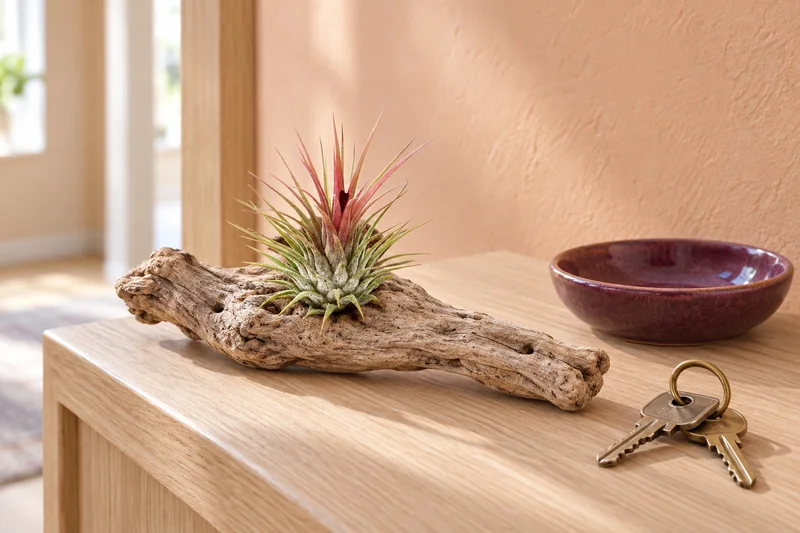
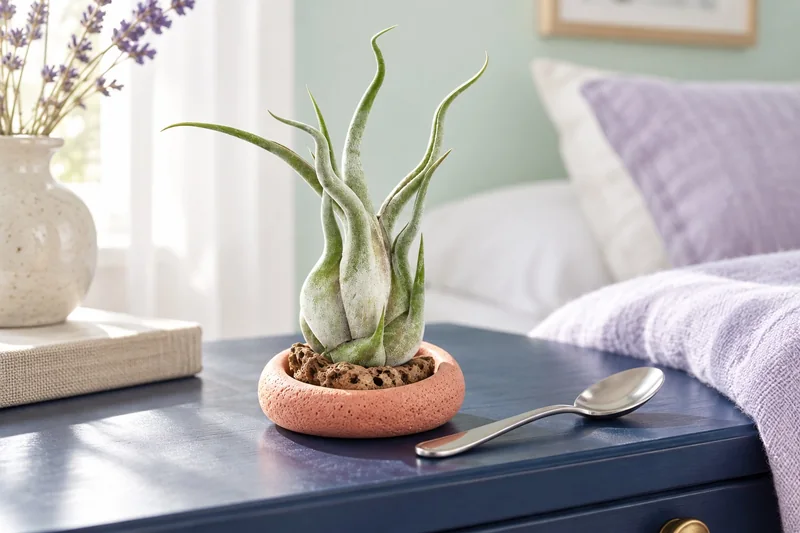
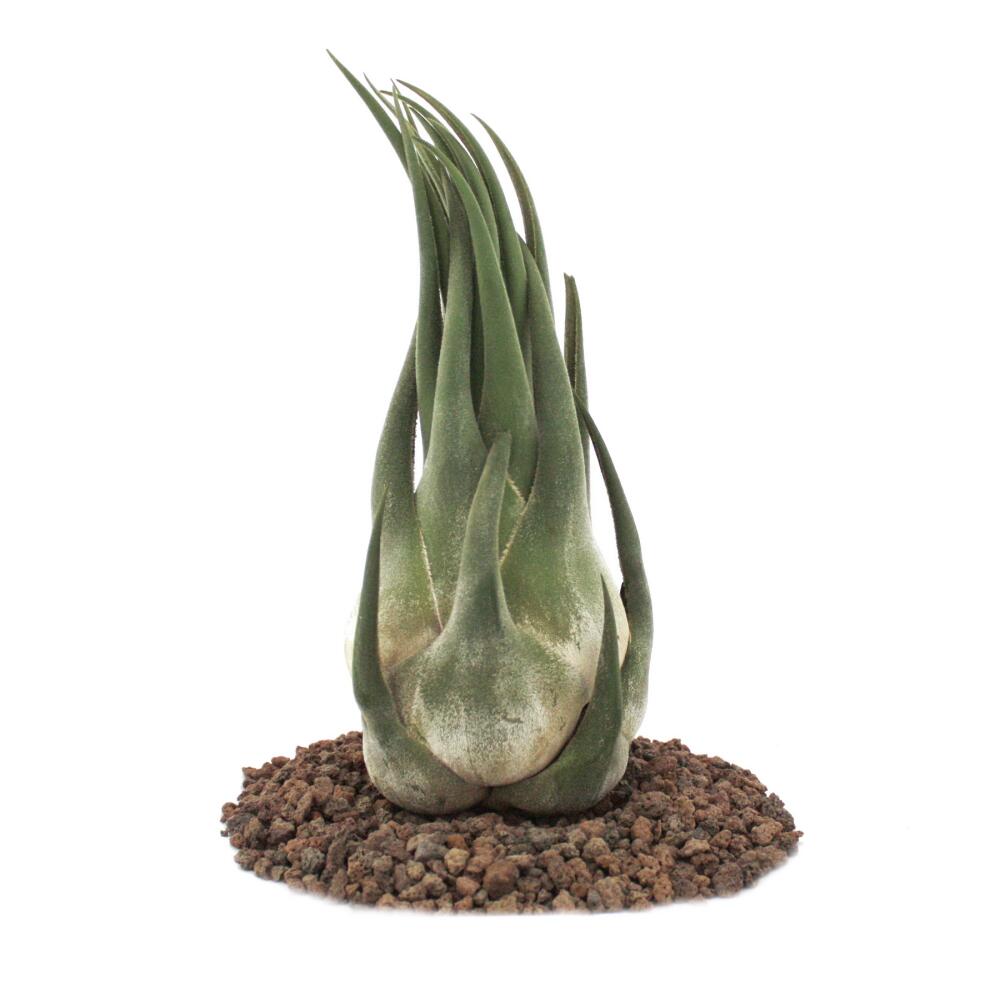
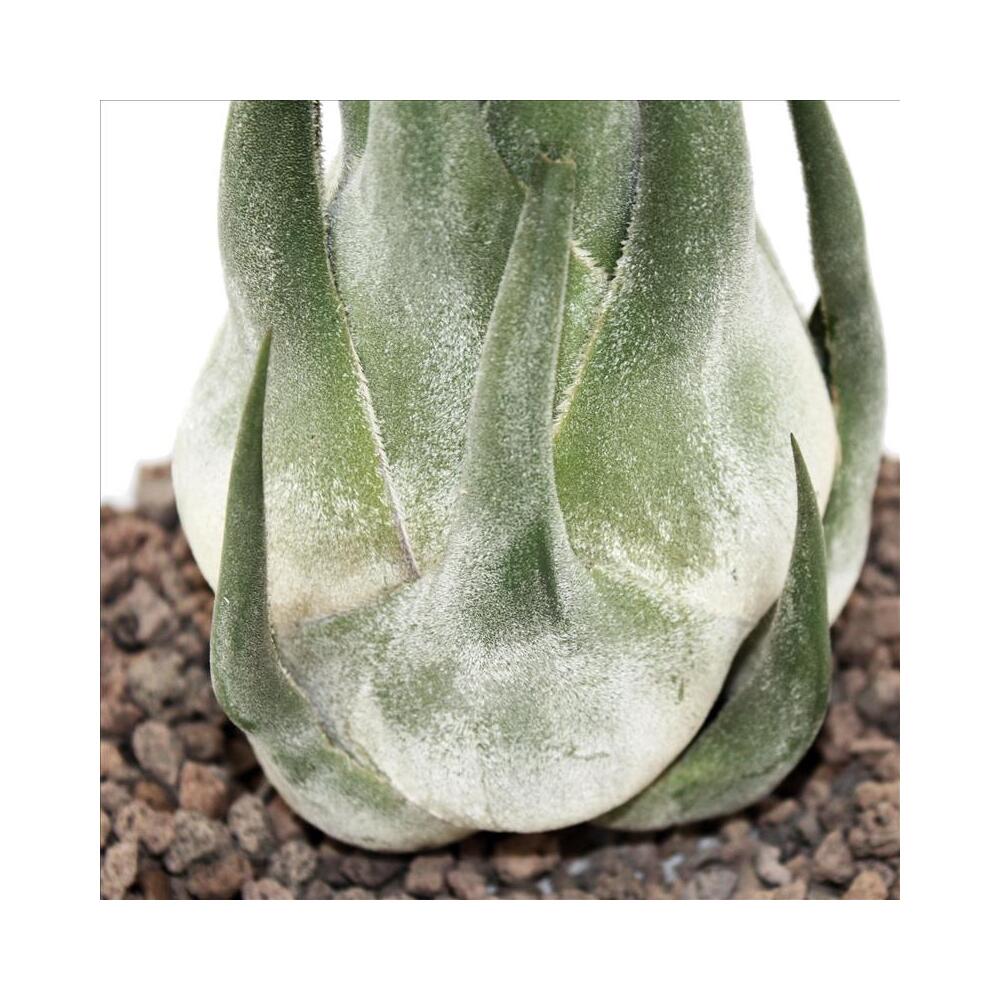
Tillandsia seleriana first draws the eye to its base. Overlapping leaf sheaths form a substantial, slightly pear-shaped body, above which the leaves narrow and twist upwards. The pale green-grey coating gives this form a soft surface, although its silhouette looks very clear. We like displaying it alone against a quiet background. The base should remain visible rather than disappear among other decoration. The original photograph already shows that this plant is structured differently from an evenly open small tillandsia rosette with many thin leaf threads.
The thick swelling is not an underground bulb
The offer specifies a loose plant about 18 to 22 cm in size and describes a thick swelling. Botanically this thickened base is a pseudobulb formed from leaf sheaths. It is not planted in soil like a flower bulb. Our scene shows the form openly on cork; the support is a display example, not a guaranteed accessory. Actual size can naturally vary. When lifting it, gently support the plant at its more stable base, without squeezing the leaves together or pulling individual tips. A large body still belongs to a living, sensitive plant.
A bright position with air around the base
Filtered daylight and good air exchange suit an open display. A bright position on a sideboard can be attractive if neither a dark shelf nor a curtain constantly blocks the light. Avoid hot direct sunshine behind glass after shipping and introduce stronger light gradually. Do not position it directly above a heater. Air must be able to reach around the thickened base. A small suitable holder therefore makes more sense than a large decorative container into which the entire lower part of the plant is tightly sunk.
Watering with the cavities in mind
The leaves are thoroughly supplied with suitable soft water. A removable plant is easier to check when watering. After wetting, carefully let it drip sideways or upside down; a permanent water reservoir must not form inside the pseudobulb or leaf bases. Then dry freely in an airy place. This form in particular can look dry outside while water still sits inside. A surface-only check is therefore insufficient. Look at the whole structure with every water application and observe drying. The interval before the next supply follows actual conditions.
Its position can support drainage
For long-term cultivation, a sideways or tilted holder is helpful so water drains more easily from the leaf bases. The upright scene shows its silhouette; the position is adjusted accordingly before and after watering. Do not wrap the base in soil or wet moss. Check cork, wire or the resting surface too: nothing should cut in, retain water or block new shoots. A loose, stable fastening allows care without force. We prefer to arrange the display properly once, rather than having to pull the leaves out of overly tight decoration every time later on.
Take changes at the base seriously
Retain the natural silvery coating without polishing it. Individual older dry leaf parts are assessed differently from new soft, dark areas. If these appear, first look for water accumulation, lack of air and a support that stayed wet for a long time. An extra watering is then not automatically helpful. During visible growth, suitable tillandsia fertiliser can be applied very weakly according to its label; avoid salt residues and constant heavy feeding. Photographs of the same sides help with comparisons. This striking base can thus be observed over weeks without pulling healthy leaf sheaths apart as a precaution.
A mature rosette continues developing
Later flowering is possible but is not guaranteed with this delivery. Healthy offsets can continue the plant’s development and remain attached initially until they are strong enough. Keep its winter position bright and frost-free. Short days can slow growth, while warm, dry indoor air may still influence water needs. Check both together. For us, this tillandsia’s particular attraction lies in its unusual structure. When the base remains free and each water application can drain properly, the little botanical sculpture combines with straightforward, understandable care.
One plant, several views
Good to know
Is the thick base a true bulb?
No. The pseudobulb consists of overlapping leaf sheaths and is not buried in soil.
Does 18–22 cm mean pot height?
No. The offer describes a loose plant and its plant size, not a pot.
Why favour a sideways or tilted position?
This makes it easier for water to drain from the leaf bases. Free drainage is particularly important for this thickened form.
Can it stand upright in a bowl permanently?
A tight wet bowl is unsuitable. Display openly, remove for watering, let drip thoroughly and dry in an airy place.
What should I do about a soft dark base?
Check water accumulation, drying and air exchange. Do not automatically keep watering or pull healthy leaf sheaths apart.
Is the cork included in delivery?
The checked offer describes a loose plant. Cork and furnishings in the scene show only a possible display.
Sources and editorial note
- Exotenherz: offer and original photographs (02.10.2026)
- Tropiflora: Tillandsia seleriana (02.10.2026)
- Tropiflora: tillandsia care (02.10.2026)
- Dötterer nursery: tillandsias and pseudobulbs (02.10.2026)
Shop offer, article number, GTIN, availability and original photographs checked directly on 02.10.2026. Specialist sources read directly. Loose plant size not reinterpreted as a pot measurement. Scene shows the upright form; a tilted position for long-term cultivation and thorough drainage are explicitly explained. No promise of ants, flowers on delivery or a fixed flower colour.