This plant at Exotenherz
Check the shop offer for current availability, price and what is included.
Check the shop for the current price, availability and offer contents.
Your care table
| Topic | What to do | Why it helps |
|---|---|---|
| Light | Very bright and gradually acclimatised to sun. | Compact rosettes need abundant light. |
| Water | Let the rootball dry substantially and assess growth. | Storage leaves bridge pauses; roots need air. |
| Drainage | Allow free drainage after watering. | Residual water must not stay in the outer pot. |
| Compost | Gritty, mineral and with little organic matter. | Fine wet compost dries poorly in a small pot. |
| Nutrition | Feed rarely and weakly according to label only during growth. | The little clump needs no large nutrient reserve. |
| Winter | Bright and frost-free, water more sparingly according to activity. | Cold and constant wetness do not suit the small potted plant. |
| Repotting | Only slightly larger and at the same level. | A large unrooted volume of compost remains damp for long. |
| Surface | Do not rub bumps away; gently check rosettes and base. | Natural leaf structure should remain undamaged. |
Check the compost and pot weight. The care table explains how far the compost may dry.
Water only when needed. The water should reach the root ball without spilling over the rim.
Remove surplus water from the saucer or cachepot. Then return the plant to a suitable position.
Little rosettes bear a pebbly surface
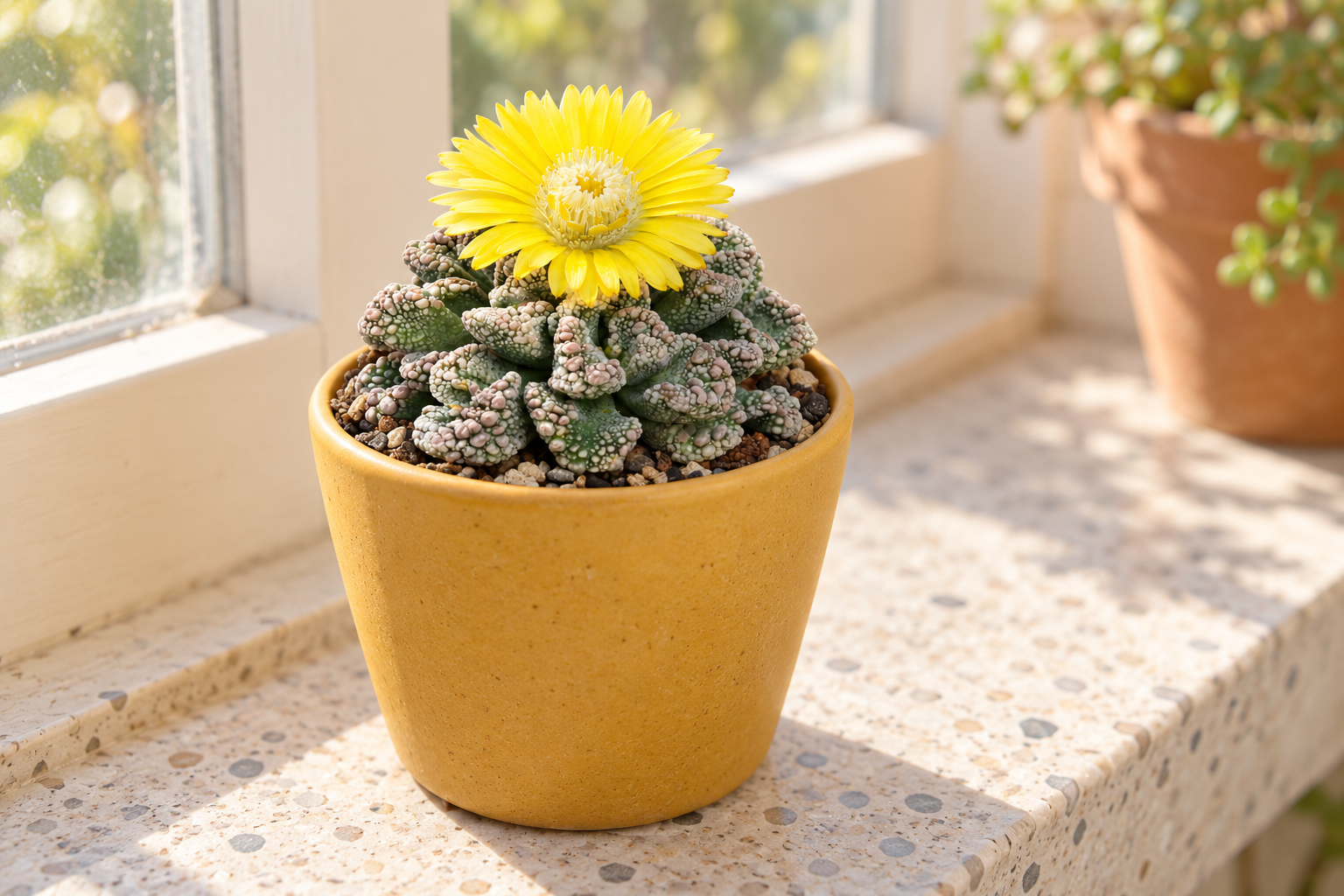
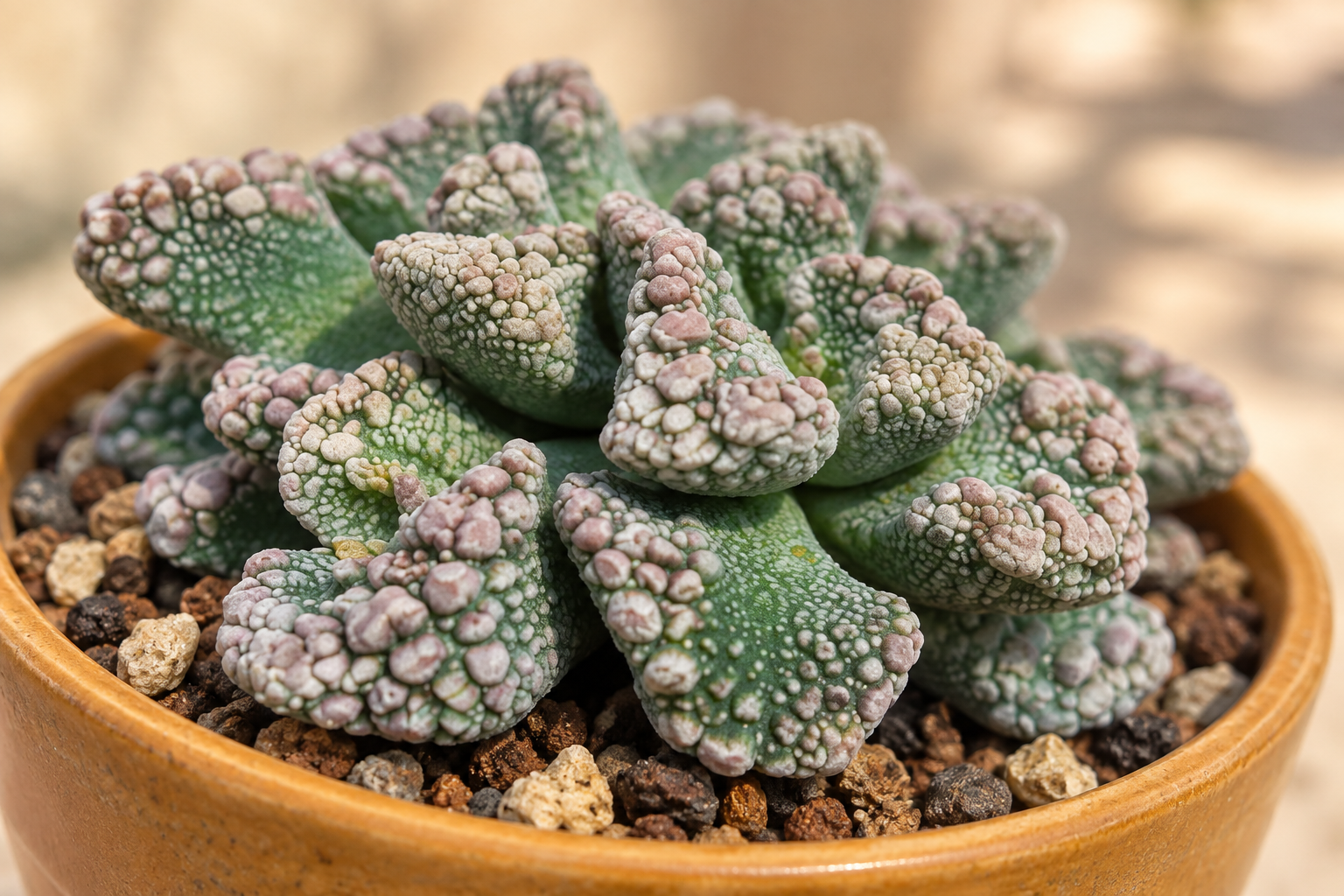
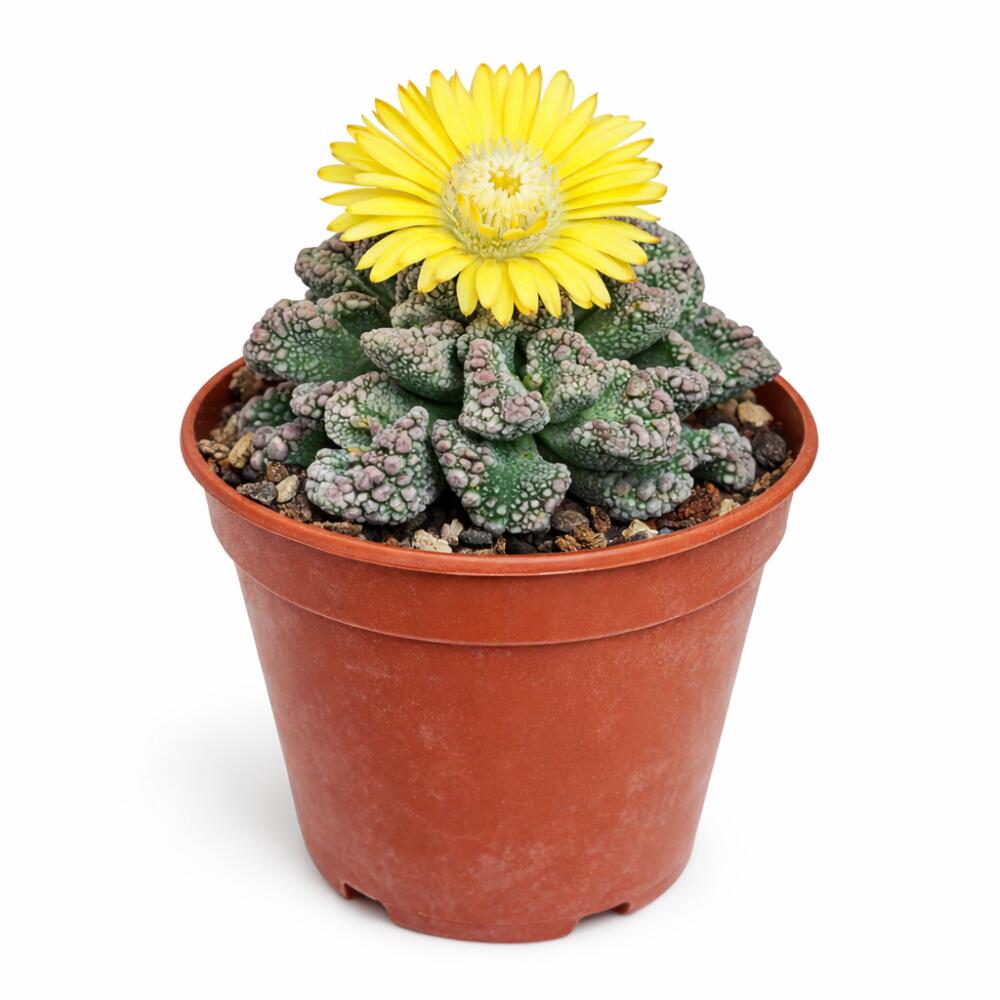
Titanopsis calcarea rewards a close look. Short thick grey-green leaves end bluntly, almost like small flattened spoons. Irregular pale bumps sit on their upper surfaces, with beige and pink tones recalling fine gravel. Several rosettes stand close together. Despite the unusual surface, it is a leaf-succulent ice plant, not a cactus. Its small storage leaves form a low clump. The specific offer states a 6.5 cm pot and about 15 cm total height including container and a possible flower stem. The low plant body itself is therefore not described as a 15 cm column.
A bright position reveals small outlines
A bright sheltered window surface makes leaf structure easy to follow. The species needs abundant light; a permanently dark shelf poorly suits compact rosettes. Accustom it to stronger sun gradually after shipping and sheltered raising. An abrupt move to hot midday sun behind glass stresses even a light-loving succulent. The scene shows a very small plant on a light window surface with side light. Mustard-yellow outer pot and surroundings are furnishings, not part of the offer. Keep the little plant accessible so decorative objects do not hide moisture checks.
Leaves store water, roots need air
Fleshy leaves bridge dry phases, while the root zone must dry again after water. Check the mixture and weight of the little inner pot together. A dry surface alone tells little if fine wet compost remains beneath. During active growth with a substantially dried rootball, water sparingly but deliberately into the compost. Let excess drain freely and remove it from the outer pot. Daily misting does not supply the plant. Soft leaves above wet soil call for root checks, not hasty additional watering.
Mineral structure keeps the little clump dry enough
Sandy gritty succulent compost with little organic matter suits this small ice plant. Appropriate particle size creates air pores and reliable drainage; heavy fine garden soil stays moist too long indoors. Calcareous mineral ingredients can belong in a suitable mixture. A thin gravel dressing does not replace the draining rootball below. Repot only when root space or compacted old compost requires it. The new container gets a drainage hole and only a little more volume. Replant rosettes at the same level and press no compost between paired leaves.
Yellow flowers briefly change the view
The clean original shows an open yellow flower above low rosettes. Many narrow petals surround a pale centre, almost like a little sun above pebbly foliage. The species can produce yellow to orange flowers, often later in the year. The scene’s flower stem illustrates this feature visible in the original. It guarantees neither a flower at delivery nor a fixed yearly date. Even outside flowering, irregular leaf surfaces remain the main decoration. Let a faded flower dry fully before gently removing its remains.
Read the yearly cycle from actual growth
Titanopsis is not watered by calendar alone. New leaves or flowers alter consumption and provision; during rest, reduce water substantially. Short days, cool conditions and a still-moist rootball call for particular restraint. A bright frost-free winter place is the dependable choice for the small potted plant. It belongs neither in cold continuous rain nor on an exposed outdoor winter windowsill. During growth, rare weak feeds according to the label are enough. Dense nutrient reserves and constantly wet soil do not usefully advance a compact clump.
Keep the leaf surface intact during checks
Bumps belong to leaf form and are not dirt to rub away. The enlarged detail makes their different shapes clearer, not a scale reference. Hold the pot when moving rather than compressing rosettes. Inspect gaps in good light for aphids, cottony nests and dead material. Firm leaf structure matters more than identical colour everywhere. Dark soft basal areas require a closer rootball and drainage check. Seed propagation is possible; vigorous older clumps can be continued using suitable rooted parts. Let a fresh little specimen develop quietly first.
One plant, several views
Good to know
Is Titanopsis a cactus?
No. It belongs to the ice plant family and stores water in leaves.
Are pale bumps dirt?
No. Pebble-like bumps belong to its natural leaf shape.
Does the rosette itself grow 15 cm tall?
About 15 cm is the offer’s total height including container and any flower stem. The clump grows low.
Must it be misted daily?
No. Water the dried rootball when needed and let excess drain freely.
Will it definitely arrive with the yellow flower?
Current flowering is not promised. The clean original and scene show a possible flower view.
Should I follow a fixed winter watering schedule?
Assess light, temperature, actual growth and rootball moisture. Reduce supply strongly during rest.
Sources and editorial note
- Exotenherz: directly checked offer and delivery measurements (03.10.2026)
- RHS: complete species profile with growth and culture (03.10.2026)
- NParks: leaf features, flowers and mineral root space (03.10.2026)
- SANBI: taxonomy and South African origins (03.10.2026)
- RHS: complete indoor succulent guide (03.10.2026)
Product and specialist sources directly read03.10.2026. Current own shop HTML evidence with identifiers, availability and cart preserved; older search copies may differ. Source expertise, original and AI images separately checked. Website and publication acceptance centralised. Internally: only unchanged clean Original2 with suitable Titanopsis morphology. Originals1 and3 explicitly show labelled Faucaria tuberculosa and are completely excluded; gallery conflict documented for final acceptance.