This plant at Exotenherz
Check the shop offer for current availability, price and what is included.
Product and delivery details are given in the individual offer.
Your care table
| Topic | What to do | Why it helps |
|---|---|---|
| Light | Bright position with filtered light. | Leaf colours and compact new growth require enough light. |
| Watering | Let the upper soil layer begin to dry, then water thoroughly. | Roots should be supplied without staying permanently wet. |
| Drainage | Remove excess water from the decorative pot. | Hidden waterlogging damages the root ball. |
| Soil | Loose houseplant compost with a stable structure. | Roots need moisture and air together. |
| Feeding | During active growth, moderately according to product instructions. | New leaves need a supply, not an excess. |
| Winter | Bright and frost-free; adjust water to slower consumption. | Short days change how moisture develops. |
| Pruning | Shorten long or damaged shoots selectively with clean tools. | The natural structure is preserved instead of being shorn indiscriminately. |
| Handling | Wear gloves when cutting. | Sap can irritate sensitive skin. |
Check the compost and pot weight. The care table explains how far the compost may dry.
Water only when needed. The water should reach the root ball without spilling over the rim.
Remove surplus water from the saucer or cachepot. Then return the plant to a suitable position.
Colour that changes as you walk past
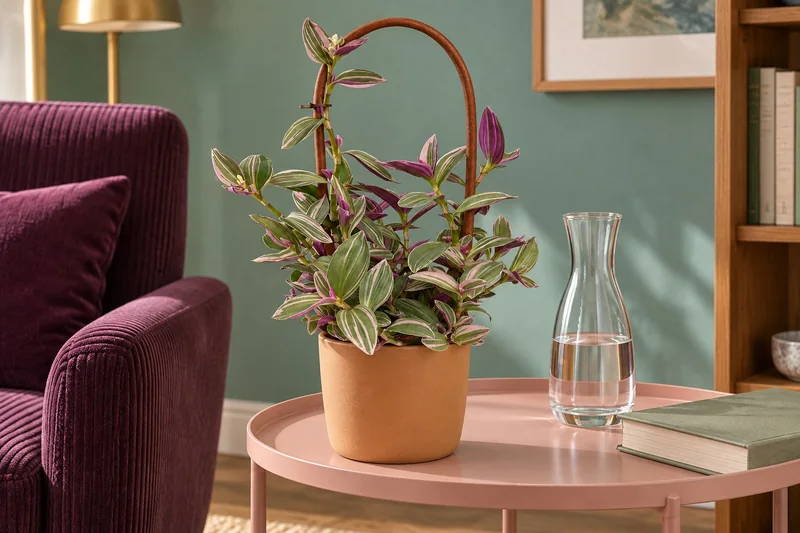
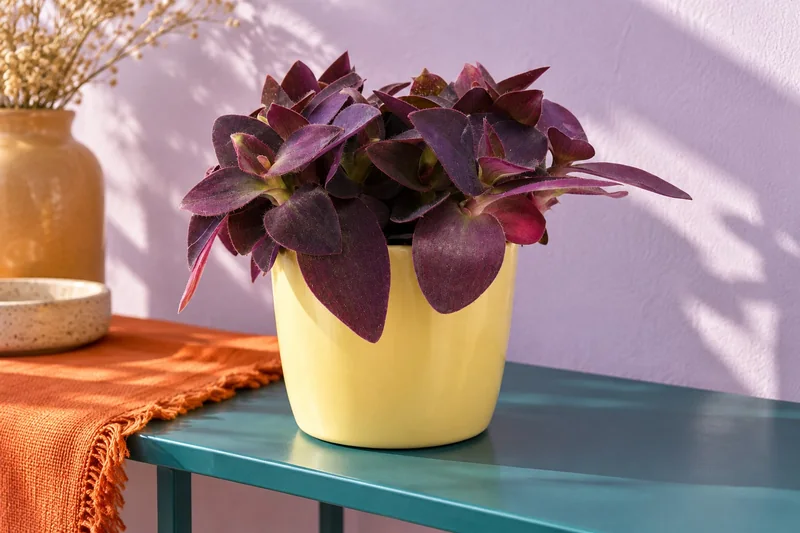
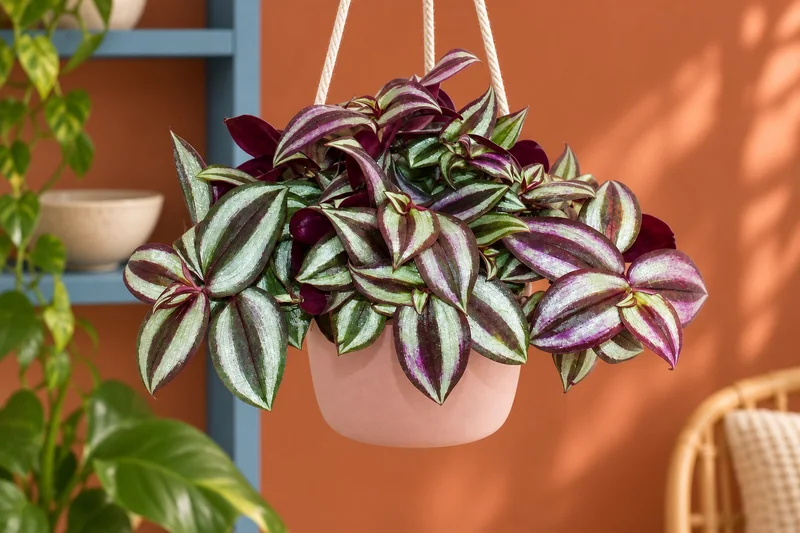
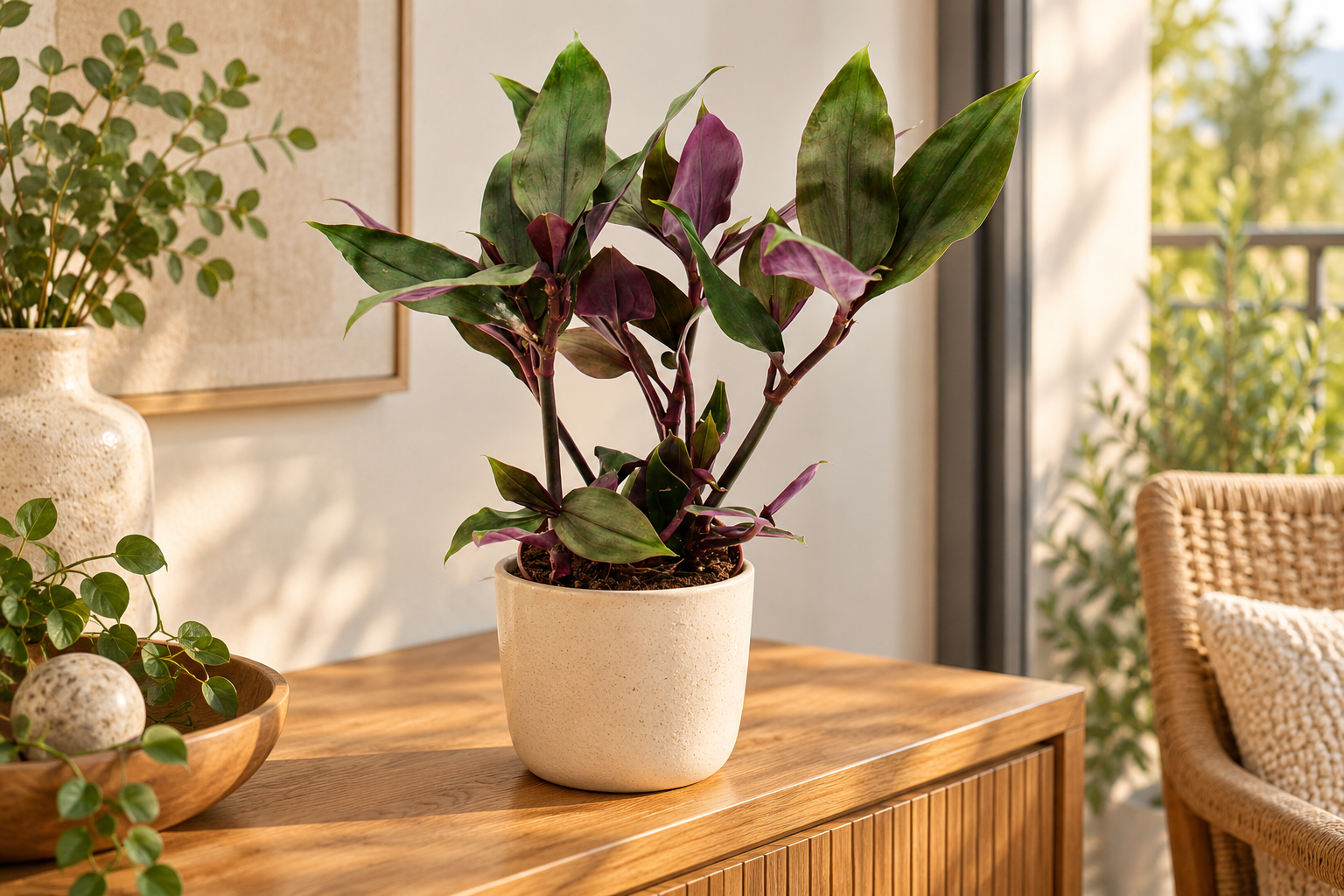
Tradescantia ‘Roxxo’ shows its colour from two viewpoints. From above, the foliage looks green; beneath the leaves, a strong purple tone appears. The shoots give the leaves different angles, so the plant looks lively even without flowers. The shop offers it as Tradescantia spathacea ‘Roxxo’; this portrait follows the specific branched commercial form shown. The 12 cm pot carries a plant with an overall height of about 25 to 35 cm. A bright position makes the undersides visible and gives new growth good conditions. Colour alone does not make a dark shelf suitable, however.
Light as the basis of the leaf display
Bright filtered light is a good starting point. Gentle sun may suit after acclimatisation, while hot midday sun directly behind glass stresses the leaves. After transport, examine new growth especially. If it looks loose, long and weak, first check the amount of light. A decorative corner deep in the room is rarely as bright as a photograph suggests. On a sideboard near a good light source, the plant is easier to observe. Large neighbouring plants should not cover it. Green and purple are then carried by living leaves rather than simply by an attractive position label.
Settling in without immediate major work
Carefully remove packaging and release compressed leaves. A small crease or damaged tip is possible after transport and says little about subsequent cultivation. First check the root ball before watering. With moist soil, leave the watering can aside. A decorative pot may be added if water drains controllably and the inner pot can be removed. Immediate repotting is unnecessary when roots and substrate work well. Give the plant a few quiet days. New leaf growth is a better measure of the current position than every older leaf already present.
Watering until the roots are supplied
As soon as the upper soil layer has begun to dry, moisten the root ball thoroughly. Excess water drains away rather than remaining in the decorative pot. Heavy soil that is still moist needs no extra portion, even if the surface looks a little lighter. We assess hanging or yellow leaves together with the roots: dryness and persistent wetness can both cause problems. Consumption rises in a bright warm summer and usually falls with shorter days. Small daily sips make water management harder to understand. A complete watering followed by a controlled pause is often the clearer approach.
Consider root space and feeding together
Loose houseplant compost with a stable structure retains moisture without the root ball compacting densely. When roots fill the previous pot, we choose a container that is only moderately larger during favourable growing conditions. The plant is set at roughly its previous depth. Much new unrooted soil remains wet for a long time and does not simplify the rhythm. During active growth, feed moderately according to product instructions. A bright position and healthy roots remain more important than a high dose. Leaf colour need not be perfectly identical on every new leaf for the plant to be well supplied.
Shorten shoots selectively
If a shoot grows awkwardly or the plant becomes loose over time, shorten it selectively with a clean tool. The remaining shape may stay natural. Wear gloves when cutting because sap can irritate sensitive skin. Remove a damaged leaf gently without pulling at the whole plant. Dust can be carefully removed from undamaged leaves; leaf-shine products are unnecessary. Also check undersides and shoot bases. Identify unusual webbing or sucking pests first rather than treating every colour change as the same care mistake.
A steady position through winter
‘Roxxo’ stays frost-free and as bright as possible. When winter growth slows, reduce water and fertiliser accordingly. Avoid cold draughts from an open window and hot dry air directly above a radiator. Continue checking the root ball instead of imposing a rigid dry rest. Its cared-for form develops from enough light, healthy roots and selective pruning when needed. Over time, you learn which leaves show their purple side especially well. Those small changing views are precisely what make it a living foliage display that is pleasant to keep beside you in everyday life.
One plant, several views

Good to know
Why does Roxxo look green at times and purple at others?
The upper surfaces are green and the undersides purple; leaf angle and light change the visible effect.
Is the shop name retained in the portrait?
Yes. The offered Tradescantia-spathacea commercial form Roxxo is expressly named.
Can it stand on a dark shelf?
Unsuitable as a permanent position. Compact growth needs enough light.
Why do leaves turn yellow?
Check root-ball moisture, roots, light and temperature changes; do not immediately add more water.
May I shorten long shoots?
Yes, selectively with a clean tool; wear gloves when cutting.
Does it need no water at all in winter?
It does. With less growth, water more sparingly according to root-ball moisture.
How large is the delivered plant?
Overall height about 25–35 cm in a 12 cm pot; later development depends on cultivation and pruning.
Sources and editorial note
- Exotenherz: offer and original images (01.10.2026)
- RHS: Tradescantia spathacea – cultivation and skin contact (01.10.2026)
Shop offer, SKU, GTIN and availability checked live on 01.10.2026. Original photograph unchanged. Our own researched gardening texts and individually approved scene. Roxxo commercial identity and habit directly from the specific shop variant; no fixed rosette form inferred from the general species description is promised.