This plant at Exotenherz
Check the shop offer for current availability, price and what is included.
Product and delivery details are given in the individual offer.
Your care table
| Topic | What to do | Why it helps |
|---|---|---|
| Light | Choose a bright sheltered position. | Consider container heating behind glass. |
| Winter | Plan frost-free cultivation. | Do not infer garden frost hardiness from the species name. |
| Water | Use a low-mineral reserve. | Avoid salt-rich additions. |
| Moisture | Check an accessible small water reserve beneath the pot. | Do not wait for limp flower stems. |
| Substrate | Choose a suitable unfertilised carnivorous-plant mixture. | Do not adopt ordinary pre-fertilised potting compost. |
| Nutrients | Do not routinely use houseplant fertiliser. | The small specialist culture stays nutrient-poor. |
| Handling | Carry the container and preserve fine stems. | The flower outline bends easily. |
| Life stage | Document emerging growth, flowers and any seed capsules. | Do not promise infinite permanent culture for an annual species. |
Check the compost and pot weight. The care table explains how far the compost may dry.
Water only when needed. The water should reach the root ball without spilling over the rim.
Remove surplus water from the saucer or cachepot. Then return the plant to a suitable position.
These flowers are discovered by coming closer
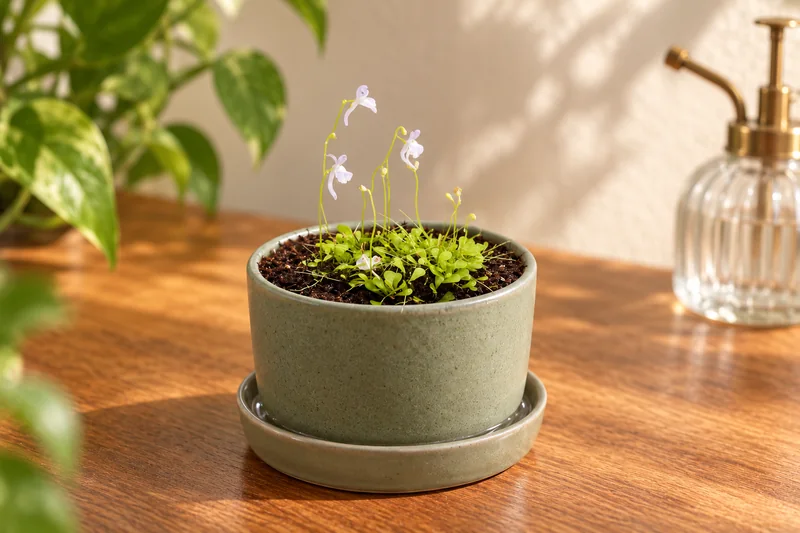
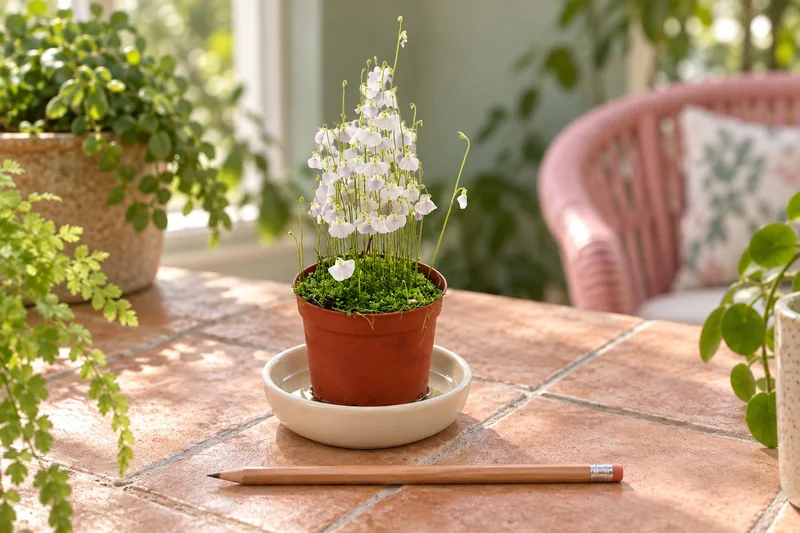
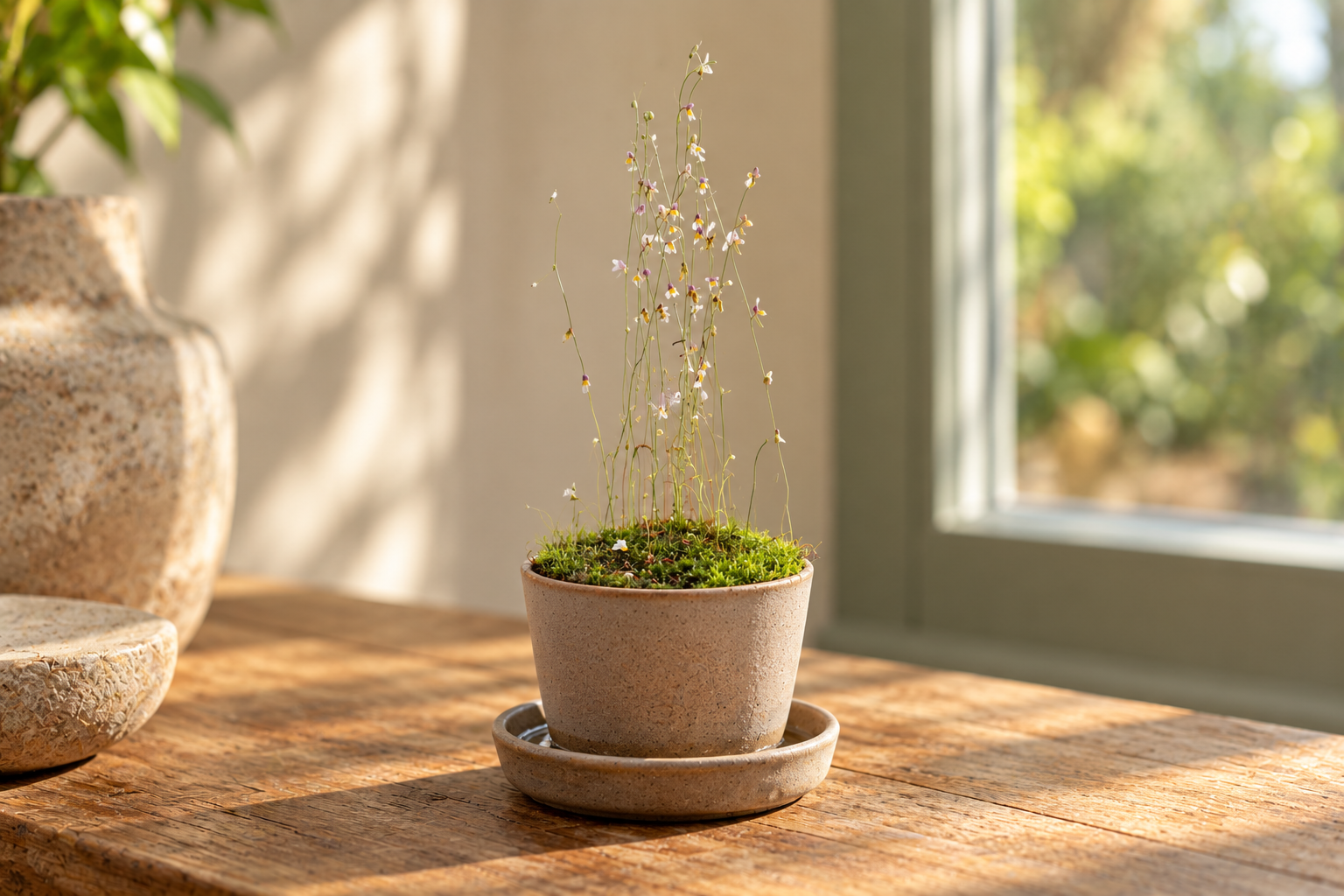
From a distance, Parthenopipes almost looks like a fine drawing above the pot. Thin stems carry tiny pale flowers with small violet and yellowish parts. The green surface underneath remains low and can initially be inconspicuous among accompanying moss. Precisely this second look makes the plant appealing. A close-up reveals delicate details while the whole scene makes its genuine small dimensions understandable. Flowers are not enlarged into large decorative orchid surfaces. The original remains the reference for form and colour mood.
The 9-cm pot becomes a small observation area
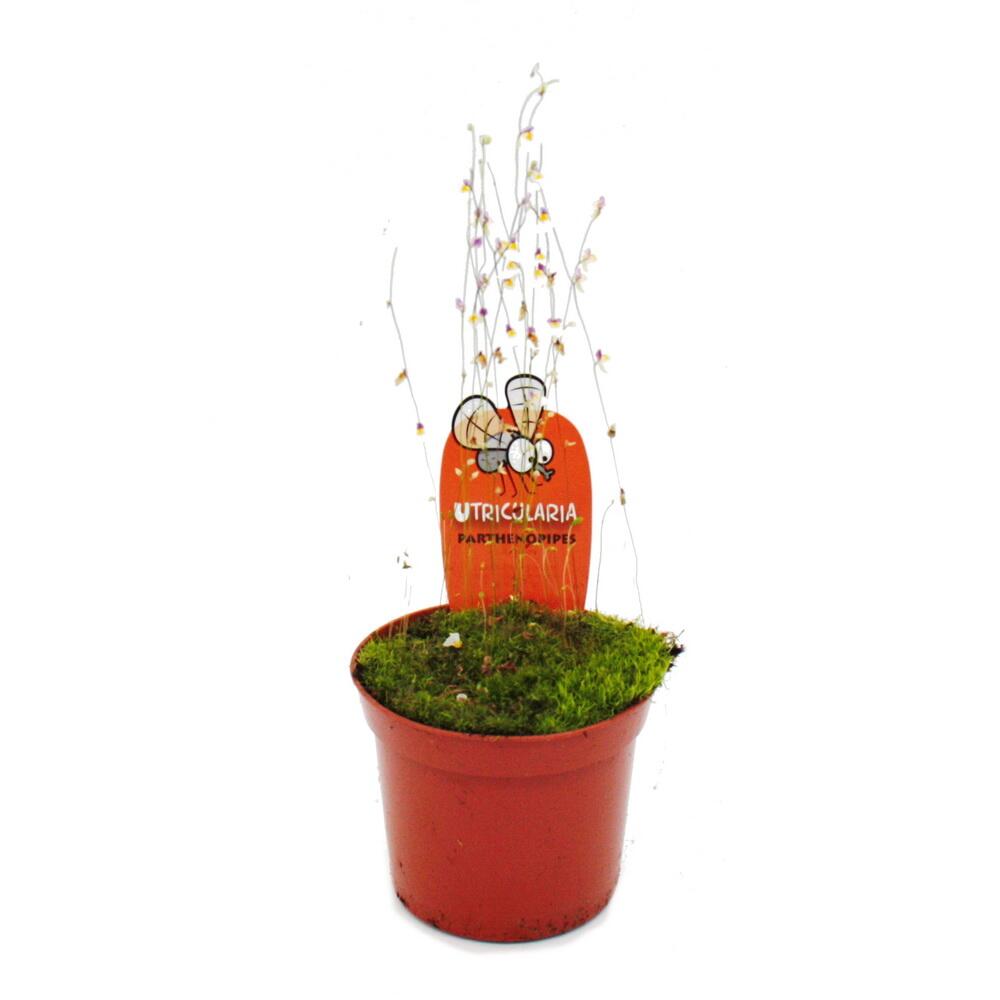
The shop states a 9-cm pot without fixed delivery height. An enlarged image is therefore no extra height measurement. Place the plant on an accessible bright surface where water level and top can be seen. A heavy container deep between books would be harder to check than a clear small plant spot. Do not use fine stems as handles. Even one bend changes the delicate overall drawing. A clean name label helps identify it clearly within a collection of similarly small bladderwort species.
The real carnivorous story lies beneath the green
Utricularia parthenopipes is a terrestrial species. Trapping happens through tiny suction traps in substrate, not large snapping leaf surfaces. Small organisms can be caught there. The tiny pot plant is therefore described neither as a fly exterminator for the room nor an ordinary floating aquarium plant. Kew lists it as a species from Bahia in Brazil. This implies no special certification or exact origin for the shipped pot. Botanical origin and shop goods are different information.
A small damp culture remains manageable
Keep substrate reliably damp and check a small accessible water reserve beneath the pot. Low-mineral water avoids unnecessary salt supply. If the reserve runs empty, do not wait for visible changes in extremely fine stems. A bright sheltered position and frost-free conditions suit cultivation planning. Consider heating behind a strongly sunlit pane. These care movements count when choosing the position: the most attractive shelf helps little if it must be cleared completely every time you check. Small plants remain easier to watch in a simple accessible place.
Fresh surface rather than strong feeding
Choose suitable unfertilised carnivorous-plant substrate. Ordinary nutrient-rich potting compost and routine houseplant feed are not adopted. In a developed culture, a small colonised substrate portion can gently be continued in fresh suitable mixture. Let a new plant arrive first and observe its condition. Accompanying moss can conceal small shoots; a green surface alone therefore does not prove bladderwort condition. Look specifically for its fine leaves and stems. A close-up in the plant book supports this distinction without constantly taking the culture apart.
Document life stage without inventing permanence
Kew describes parthenopipes as annual. The portrait does not turn it into an indefinitely permanent indoor cushion. Observe development and separately record any seed capsules present. Sowing requires actually obtained and identified seed; flowers alone are not reliable seed evidence. An annual natural life form is not interpreted as a fixed deadline for every cultivation experiment either. The personal plant book records concrete growth and flowering dates. This small species rewards precise observation more than a long list of sweeping carnivorous-plant rules.
One plant, several views

Good to know
Are the white dots large flowers?
No. The original shows tiny pale flowers on very thin stems.
Why does a close-up look much larger?
It is enlargement for observation, not a depiction of delivery height.
Is the entire green surface Utricularia?
Accompanying moss may be present; inspect the actual shoots and flower stems separately.
Does it catch flies for the entire room?
This is not promised. Small traps work in the substrate zone.
Is permanent perennial culture guaranteed?
No. Kew describes the species as annual; the individual culture is observed and documented.
Sources and editorial note
- Exotenherz: offer and original photographs (03.10.2026)
- Kew – Utricularia parthenopipes, life form and species range (03.10.2026)
- ICPS – terrestrial bladderworts, nutrients and cultivation (03.10.2026)
- ICPS CPN – Hanrahan, historical guidance on moist cultivation and renewal (03.10.2026)
Shop offer, article number, GTIN, availability and original images checked directly on 02.10.2026; specialist acceptance 03.10.2026. Specialist sources read directly. SKU, pot reference, original photographs and orderability checked in the shop on 03.10.2026. Delivery height separated from species development. Specialist sources actually read; six individual sections, eight care points and five FAQs editorially compared. Currently not orderable: knowledge portrait without purchasing link or social sending permission. No tool, Wawi or server changes. Currently not orderable: knowledge portrait without purchasing link; social drafts not cleared for sending.