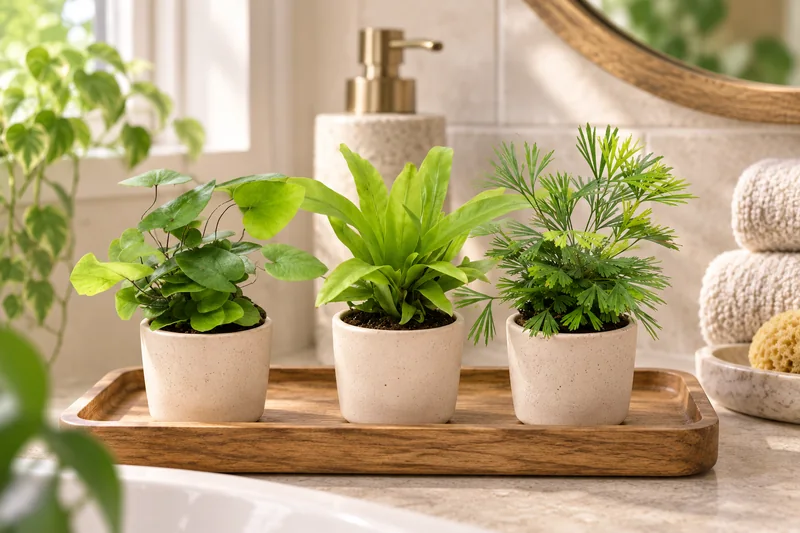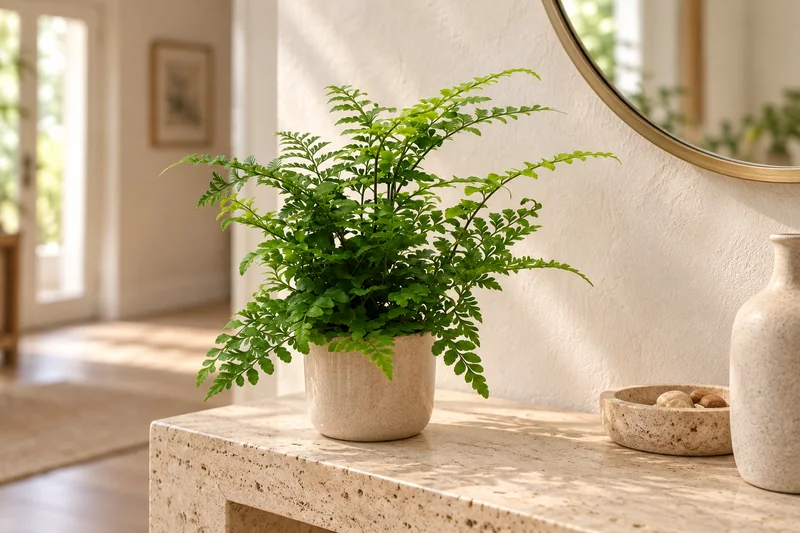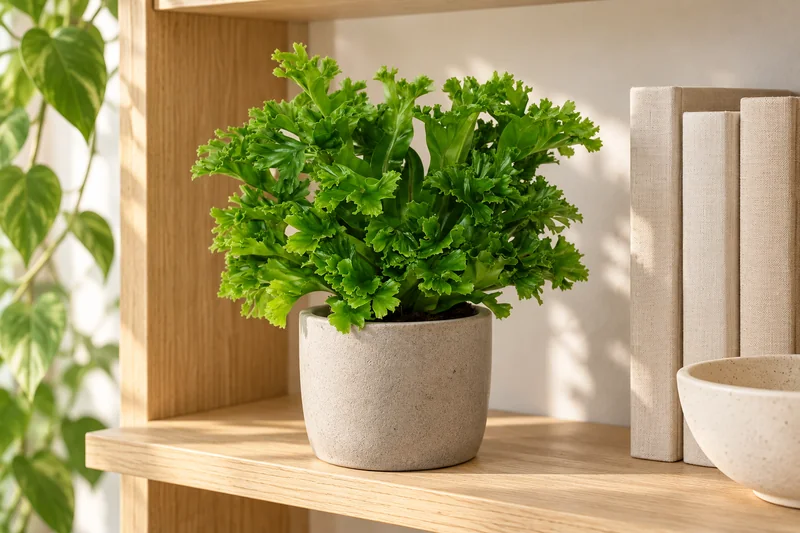
This plant at Exotenherz
Check the shop offer for current availability, price and what is included.
Product and delivery details are given in the individual offer.
Your care table
| Topic | What to do | Why it helps |
|---|---|---|
| Light | Choose bright indirect daylight. | Young whole fronds must not stand in hot midday sun. |
| Moisture | Keep roots slightly moist and check regularly. | The small pot has little soil volume as water reserve. |
| Watering point | Water soil slowly at the rosette edge. | Water must not remain in the sensitive centre. |
| Drainage | Let excess drain and empty the decorative pot. | Moist substrate still needs air-filled pores. |
| Substrate | Use a humus-rich porous fern mix. | Retain moisture without constantly soaking roots. |
| Nutrients | Feed weakly according to label during new growth. | Allow for pre-fertilised soil and small pot size. |
| Frond care | Let new leaf rolls unfold undisturbed. | Pulling or hard rubbing can injure sensitive tissue. |
| Winter | Keep sheltered and frost-free; assess light and heating air together. | Lower water consumption and dry room air can occur simultaneously. |
Check the compost and pot weight. The care table explains how far the compost may dry.
Water only when needed. The water should reach the root ball without spilling over the rim.
Remove surplus water from the saucer or cachepot. Then return the plant to a suitable position.
The leaf centre stays clear
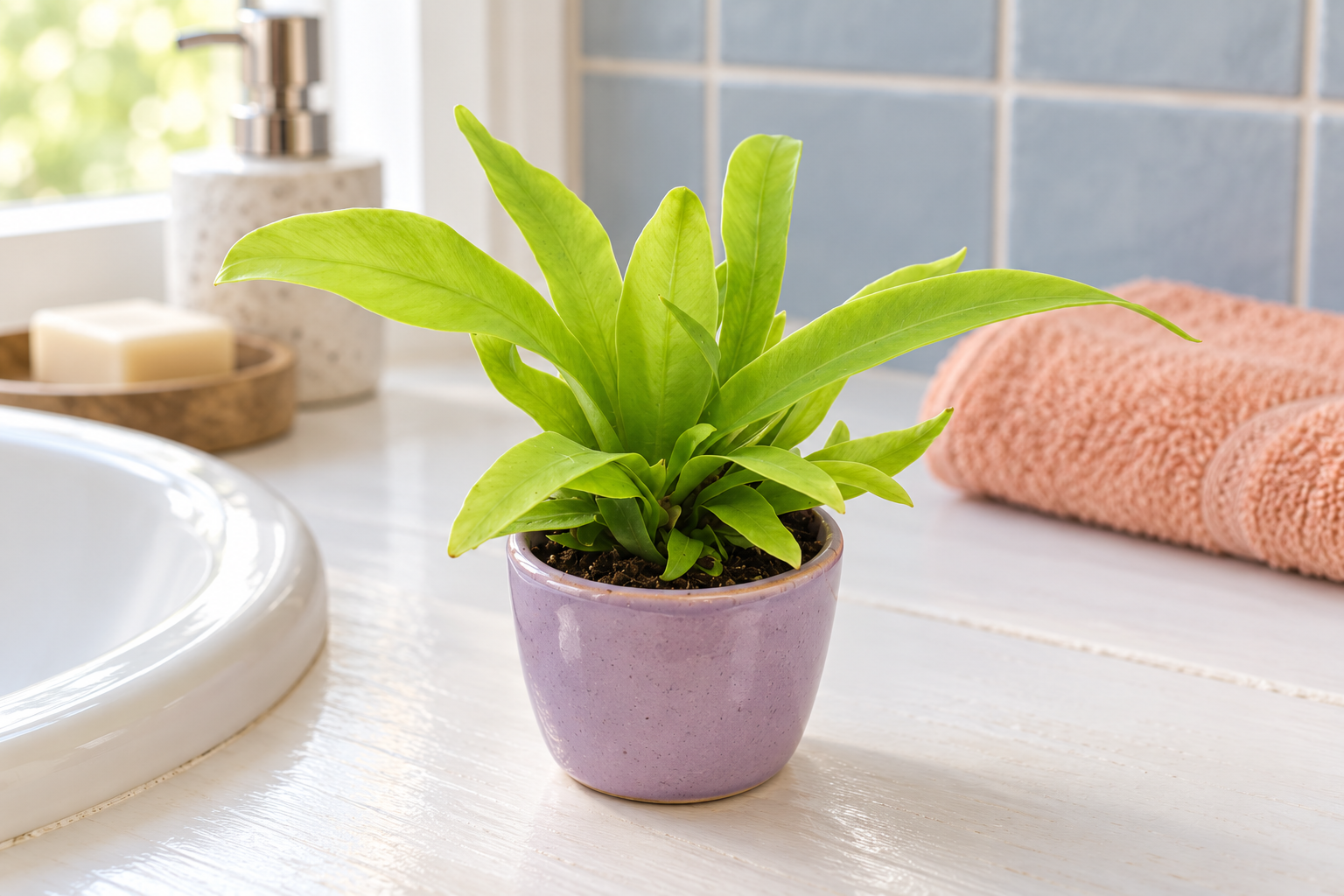
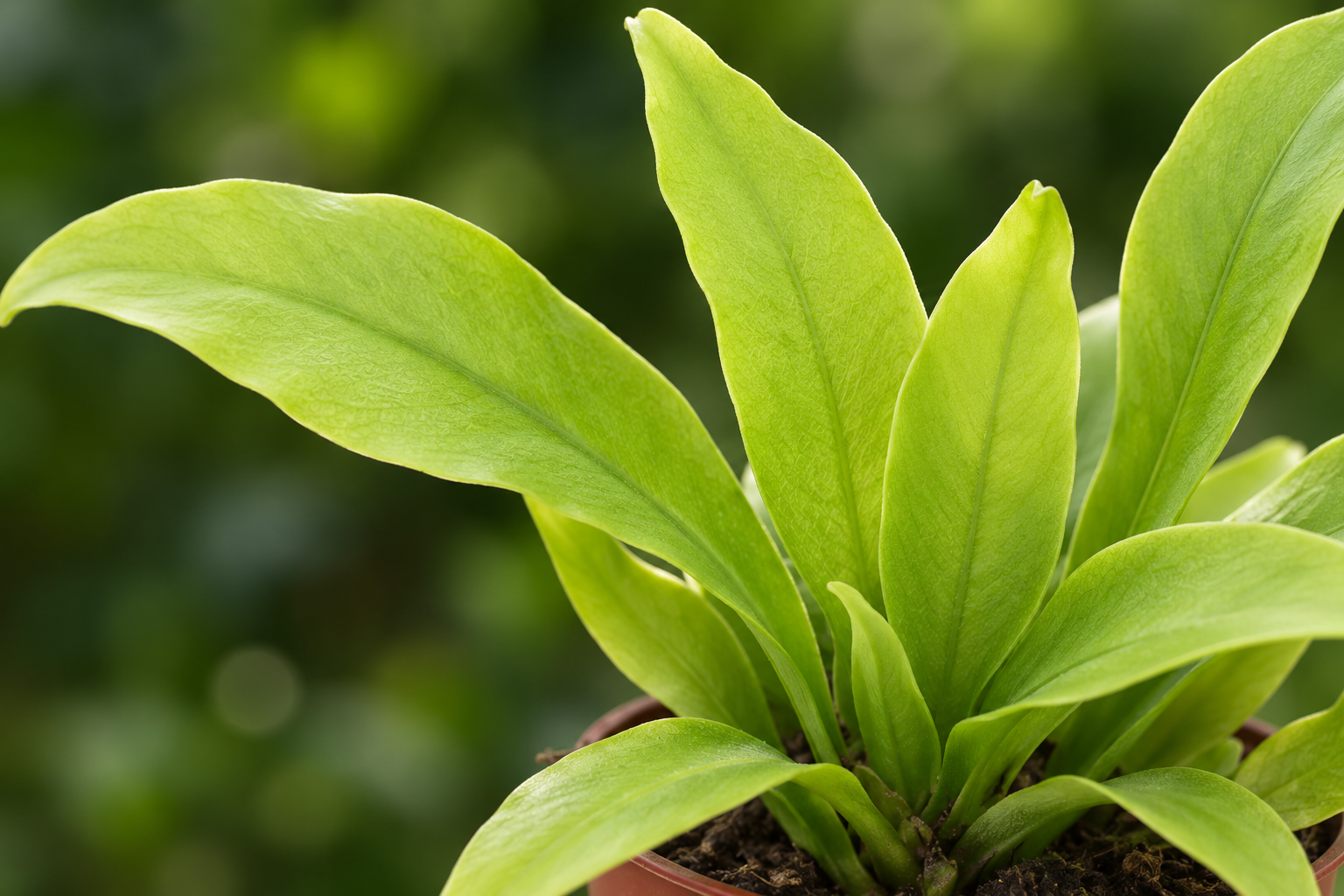
Asplenium antiquum already resembles a small green nest as a young plant. Whole pale-green fronds meet at the base and open outward. Edges have slight waves and tips are simply pointed. Its foliage looks especially beautiful as side daylight crosses the surfaces. The fern needs neither showy flowers nor a dense arrangement of other plants. Its next shoot develops centrally; keep that area undamaged when handling and positioning. A bright shelf beside a washbasin lets you view the little rosette well. Keep splashing water and care products away from soil and foliage.
A small beginning, not a permanent miniature size
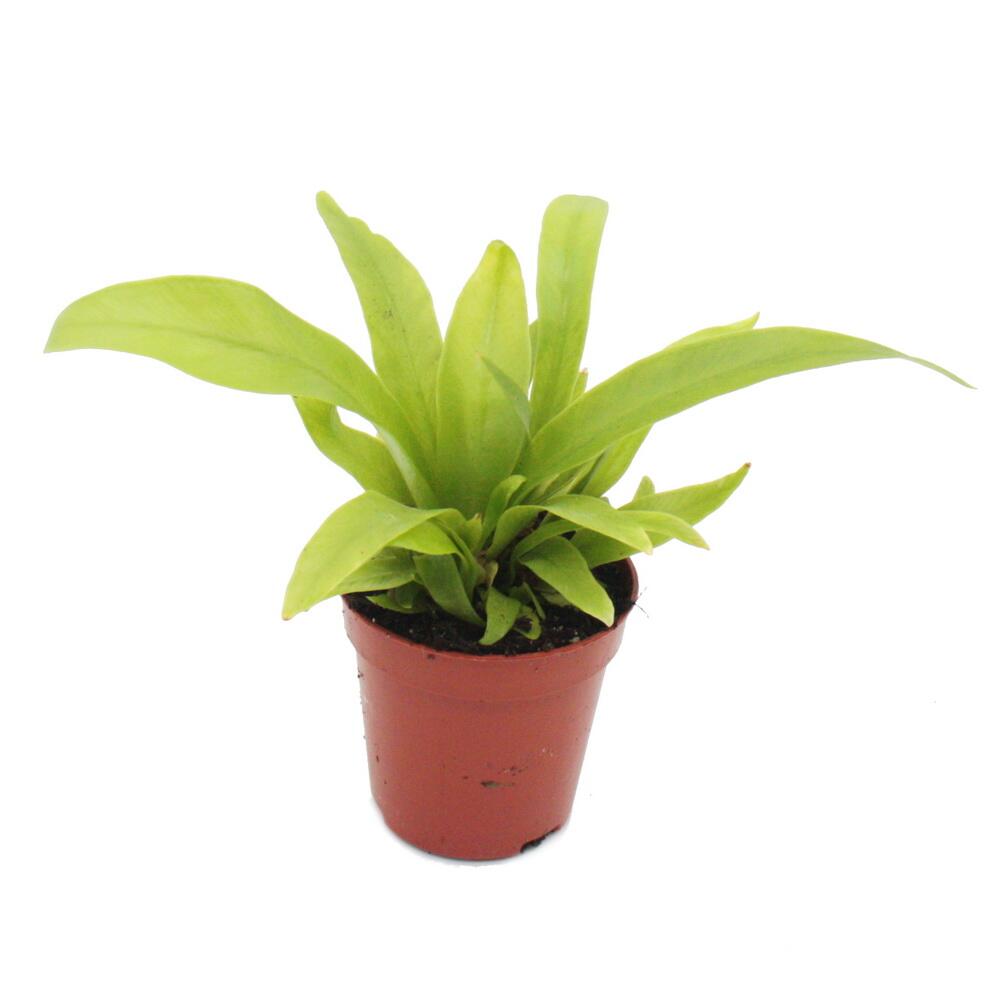
The offer gives a 5.5-cm pot and about 10–12 cm total height including pot. This young plant has little root space and correspondingly little soil as a water reserve. Asplenium antiquum belongs to Aspleniaceae with natural background in East Asia, including China, Japan, Korea and Taiwan. The perennial species can later form a much larger rosette. Developed plants may reach about 60–90 cm; this is species cultivation guidance, not a promise for the young delivery fern. Older fronds gain a more pronounced brownish midrib. In the original image, veins in pale young leaves are still delicate.
Check bathroom light before the place looks attractive
A bathroom may offer suitable humidity but also needs enough daylight. Choose a bright indirect position and keep young fronds out of hot midday sun. Humidity alone does not make a windowless shelf suitable. A small open plant table or bright kitchen shelf is also possible if neither hot appliances nor cold air act nearby. After unpacking, let the little nursery pot settle without continually moving between rooms. The rosette gradually develops leaf position. A decorative pot should remain removable so soil and drainage can still be checked well.
Look regularly at the small root ball
Keep soil evenly slightly moist and do not repeatedly dry the young root ball completely. Feel gently at an accessible point to see if the upper layer is starting to dry, and lift the pot to compare weight. A heavy wet pot needs no extra water. When watering, supply soil slowly at the rosette edge and let all excess drain. No puddle should remain in the centre. A very small pot can dry faster in warmth than a larger fern beside it; a common weekly schedule would be unreliable. An open planted bowl needs suitable neighbours with similar moisture requirements and controllable drainage.
Roots receive moisture and air
A loose humus-rich fern mix retains moisture without becoming a dense wet block. The nursery pot needs clear holes. When well rooted with new foliage, gently give more room, preferably in spring. A large pot jump leaves much persistently moist unrooted soil. Support roots below while working and keep the previous planting depth; do not bury the centre. During active growth feed weakly and moderately with suitable liquid fertiliser according to label. Count fresh pre-fertilised soil. A tiny pot cannot tolerate a large precautionary nutrient reserve merely to make leaves grow larger faster.
Watch new fronds rather than pulling them into shape
Young tips unfold by themselves from the centre. Do not pull them apart or shorten healthy fronds to an even dome. Fully dead outer leaves can be removed with a clean tool without striking new growth. Gently remove dust on older surfaces; hard rubbing and leaf shine do not suit the young rosette. Ferns produce spores instead of flowers and seeds. Regular brown lines on mature undersides may be spore-bearing sori, then requiring no pest treatment. Do not tear apart a single small rosette to propagate. Spore growing is slow work for experienced fern enthusiasts, not a quick routine for the newly delivered plant.
Review the winter shelf
The nest fern remains indoors sheltered and frost-free. With less daylight and growth, roots often use less water while heating may dry frond edges. Check those separately. Brown tips do not automatically call for topping up an already wet pot. Assess dry air, sun exposure, root moisture and feeding; the species can also suffer scale insects. Distinguish fixed irregular deposits from regular spore lines. Move the fern out of cold ventilation airflow. A healthy fresh frond eventually tells more about a suitable position than trying to make an old damaged leaf flawless again.
One plant, several views
Good to know
Will this fern stay miniature?
The 10–12 cm is young total height including a 5.5-cm pot. With suitable culture, the species can develop a much larger rosette.
Does a bathroom need a window?
Yes for a naturally lit position. Air humidity does not replace required indirect daylight.
Should water go straight into the green nest?
No. Direct it slowly onto soil; excess drains and does not stay centrally.
Must I water every day?
Check roots instead of a fixed interval. The small pot can dry quickly, but should equally not remain continually soaked.
Are brown lines below older fronds pests?
Regular lines may be spore-bearing sori. Irregular fixed deposits and other changes are checked separately for pests.
Can I divide the little rosette for more plants?
A single young rosette is not torn apart. Spore growing needs time and experience; healthy leaf development comes first.
Sources and editorial note
- Exotenherz: directly checked offer and delivery measurements (accessed 03.10.2026)
- RHS: Asplenium antiquum, fronds, developed species size and indoor culture (accessed 04.10.2026)
- Kew POWO: accepted species, family and East Asian distribution (accessed 04.10.2026)
- RHS: potted ferns, drainage, protected centre and spores (accessed 04.10.2026)
- UF/IFAS: bird’s-nest fern rosettes, young fronds and gentle repotting (accessed 04.10.2026)
Directly checked public product page dated03.10.2026 bound unchanged by hash; specialist sources and original/image state read and checked04.10.2026. Delivery height including pot distinguished from developed species size. General nest-fern advice supplements exact RHS species profile; no species measurements transferred from nidus.