This plant at Exotenherz
Check the shop offer for current availability, price and what is included.
Check the selected shop offer for price, availability and delivery contents.
Your care table
| Topic | What to do | Why it helps |
|---|---|---|
| Position | Bright indirect daylight without hot sun patches. | Young broad foliage needs light without overheating. |
| Warmth | Warm indoors year-round; not below 15 °C according to the offer. | Cold draughts and hot dry air stress the small plant. |
| Water check | Check edge moisture and weight of the small pot. | The limited root zone may dry differently quickly at a new position. |
| Watering | Pour slowly onto substrate at the edge when needed. | Light root-ball moisture remains without constantly wetting leaf surfaces. |
| Drainage | Let excess drain and empty the decorative container. | Persistent wet removes air from the young roots. |
| Air and leaves | Provide gentle air exchange and accessible bases. | Tightly arranged wavy foliage should not remain dripping wet. |
| Substrate | Humus-rich airy mix and only a slightly larger draining pot. | A large wet soil reserve makes miniature moisture management harder. |
| Feeding | Feed sparingly during visible growth according to the label. | The small plant needs no strong continuous feeding. |
| Shoots and inspection | Plan pruning by growth; check nodes and undersides for pests. | Healthy leaves remain and changes become visible early. |
Check the compost and pot weight. The care table explains how far the compost may dry.
Water only when needed. The water should reach the root ball without spilling over the rim.
Remove surplus water from the saucer or cachepot. Then return the plant to a suitable position.
Small leaf wings with moving edges
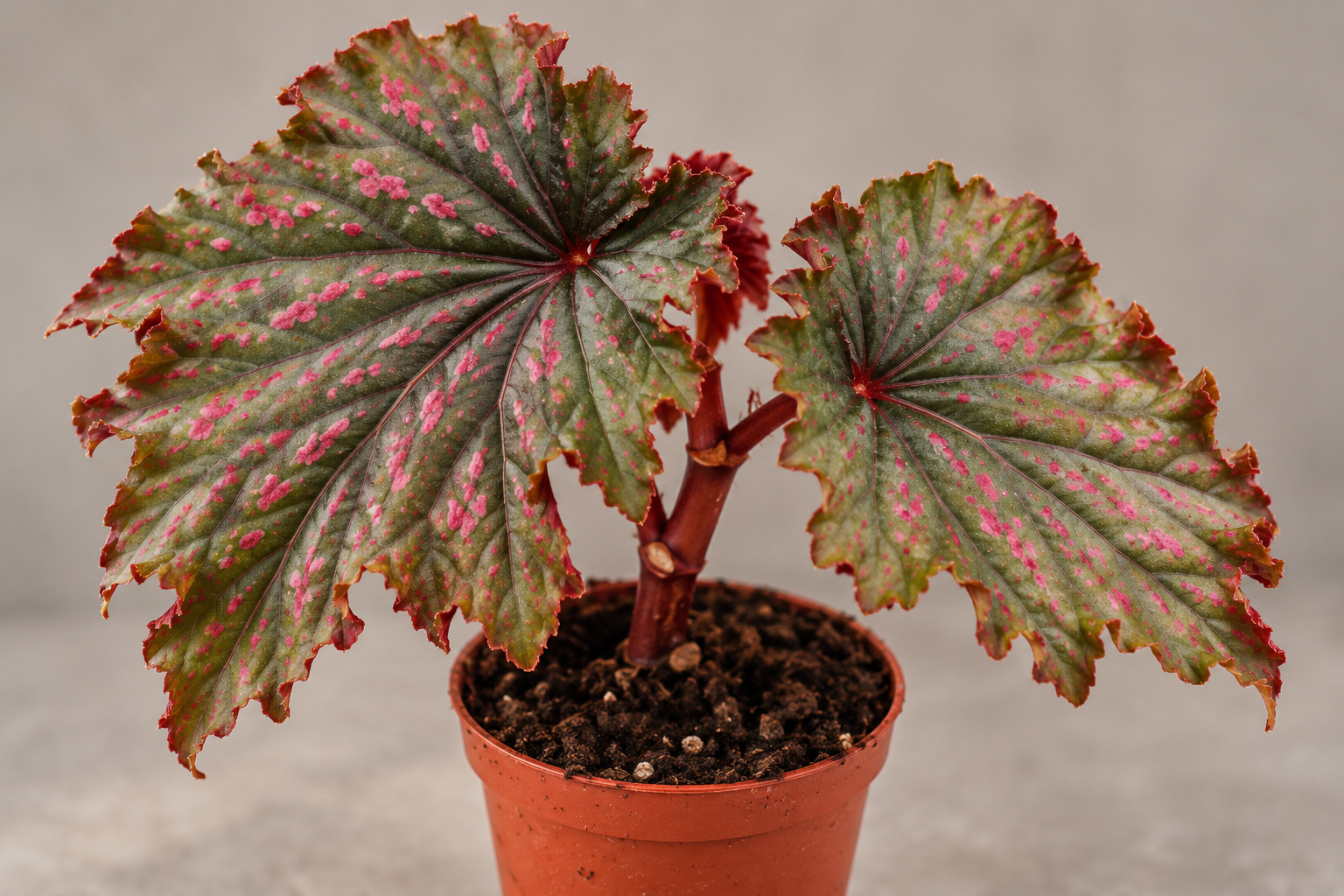
Our photograph shows a young begonia with strikingly broad leaf surfaces. Bronze green and darker veins form the background to irregular pink speckles. Leaves are asymmetrical, slightly lobed and strongly wavy at the edge. Red tones appear on margins, undersides and short stems. Unlike a smooth surface, this relief catches changing side light. A small bright potting table permits close viewing of waves and veins. The plant remains a genuinely small subject. Just a few leaves give character; a dense mature crown is not needed. The pattern may distribute differently on new leaves.
Understand Angel Wings as a trade form
Angel Wings is used in the plant trade for begonias with wing-like foliage. The material shown here is presented as a red-leaved commercial form of cane type. Upright jointed stems with leaves arising at nodes are characteristic. The broad bronze pink-speckled form belongs to our photograph. The name does not denote an additional confirmed particular variety here. Nor is a specific parent cross or historic breeding assigned to the delivered plant. Cane begonias include many forms with different leaf surfaces and patterns. This portrait therefore focuses on the specific offered young material and its observable features. Shared cane culture supplies the framework for the warm indoor position.
Let the miniature offer arrive gently
The pot measures five and a half centimetres; stated overall height is approximately ten to fifteen centimetres including it. Leaf wings may extend sideways beyond that. Support the little pot and root ball while unpacking, rather than pulling soft leaf stalks. The offer notes that these plants normally ship without flowers or buds. The AI scene therefore shows a young foliage plant rather than a flowering adult. Outer pot, writing materials and book are decoration. A close-up enlarges leaf relief rather than measuring size. Initially place the small begonia where pot weight, new growth and leaf bases can be checked comfortably instead of hiding it behind larger plants.
Sheltered light reaches the young leaves
A bright indoor position with indirect daylight supports leaf development. The begonia should avoid warm sun patches heating its broad surfaces. Small leaf wings especially should not sit directly against hot window glass. Soft side light displays relief and makes observation easy. The offer specifies year-round indoor cultivation and temperatures not below fifteen degrees. Avoid cold airflow and a constantly hot dry position above heating. More humid air is helpful if gentle exchange remains. A tightly closed constantly dripping glass container is not automatically suitable for a begonia. Assess light, warmth and leaf surfaces at the actual position and again after moving.
Supply the small root ball specifically
Moisture can change quickly in the tiny pot. Check edge soil and weight carefully before watering. Keep the root zone lightly moist without complete drying or persistent wet. Once the surface grows drier and the pot lighter, water slowly onto an open part of the substrate. As little water as possible should remain on the wavy leaves. Let excess drain and inspect the decorative container afterwards. A rigid weekly plan does not suit every position: warmth, light and air movement change consumption. If the pot stays heavy and wet, investigate the cause first. Frequent topping-up from concern for the little plant can reduce root-zone air.
Follow roots and shoots step by step
A loose humus-rich mix with free drainage suits cane culture. Keep the young root ball together as far as possible when moving it and choose a new pot only a little larger. Much unrooted damp soil around a little plant makes moisture harder to assess. During clear growth, supply suitable nutrients sparingly according to the label and account for existing feed. Jointed stems can later lengthen and develop side shoots. If pruning becomes needed, plan it by actual growth and preserve healthy young foliage. A general hard cutback by calendar is not intended for this mini begonia. Suitable stem cuttings with nodes are a possible propagation route for cane begonias; first the offered plant can become stronger.
Observe leaf relief and identify problems early
Pink speckles and darker veins belong to the normal leaf display. Checks therefore focus on new changes: soft bases, dry edges or small pests between leaf stalk and shoot. Regularly inspect undersides for mealybugs, thrips or spider mites too. Air exchange and accessible bases make observation easier. Remove only truly dead parts carefully with a clean tool. With dry edges, assess light, warmth and root-ball moisture together instead of immediately feeding more. Soft stems in persistently wet soil instead require root and drainage checks. Suitable cane begonias may flower later, but neither colour nor date is promised for this young trade material. A fixed eventual size is not prescribed either.
One plant, several views

Good to know
Is Angel Wings one confirmed variety?
Here Angel Wings denotes a red-leaved cane trade form. No additional particular variety or specific parent cross is promised.
How large is the offered plant?
5.5 cm pot and approximately 10–15 cm overall height including pot. Broad leaves may extend sideways.
Does the young begonia arrive flowering?
The offer normally specifies delivery without flowers or buds. Images therefore show the young foliage profile.
Are pink speckles normal?
Yes. In our photograph they form part of the pattern over bronze-green leaves. Their distribution may vary on new leaves.
How do I water the small pot?
Check moisture and weight, water slowly onto soil when needed and allow excess to drain. The root ball should neither dry completely nor remain constantly wet.
Should I hard-prune the mini plant immediately?
No. Follow its development first. Later pruning is planned according to actual stem growth.
Are cuttings possible?
Cane begonias can be propagated with suitable stem cuttings bearing nodes. A small newly arrived plant can become stronger first.
Sources and editorial note
- Exotenherz: own offer and original (4 October 2026)
- NC State: complete cane begonia features and care (4 October 2026)
- Chicago Botanic Garden: complete Angel Wings group description and cultivation (4 October 2026)
Shop offer, originals and specialist sources checked on 4 October 2026. Check current shop availability.