This plant at Exotenherz
Check the shop offer for current availability, price and what is included.
Check the selected shop offer for price, availability and delivery contents.
Your care table
| Topic | What to do | Why it helps |
|---|---|---|
| Position | Choose a sheltered, bright to partially shaded outdoor position. | The young plant needs neither a dark corner nor constant hot sunshine. |
| Water | Keep evenly slightly moist. | A small pot must not dry out completely. |
| Water quality | Use low-lime water. | The tea plant prefers an acidic root area. |
| Compost | Suitable acidic compost with good drainage. | Lime-rich, compacted compost is unfavourable. |
| Nutrition | During growth, feed suitably for acid-loving plants. | Moderate nutrition is more helpful than frequent strong doses. |
| Repotting | Increase modestly if needed. | A manageable rootball is easier to supply evenly. |
| Harvest | Establish the young plant first and harvest very sparingly. | The small shrub needs its leaves for growth. |
| Winter | Bright, cool and frost-protected; keep checking moisture. | Potted roots are more sensitive than an established garden shrub’s. |
Check the compost and pot weight. The care table explains how far the compost may dry.
Water only when needed. The water should reach the root ball without spilling over the rim.
Remove surplus water from the saucer or cachepot. Then return the plant to a suitable position.
A little tea plant with real glossy leaves
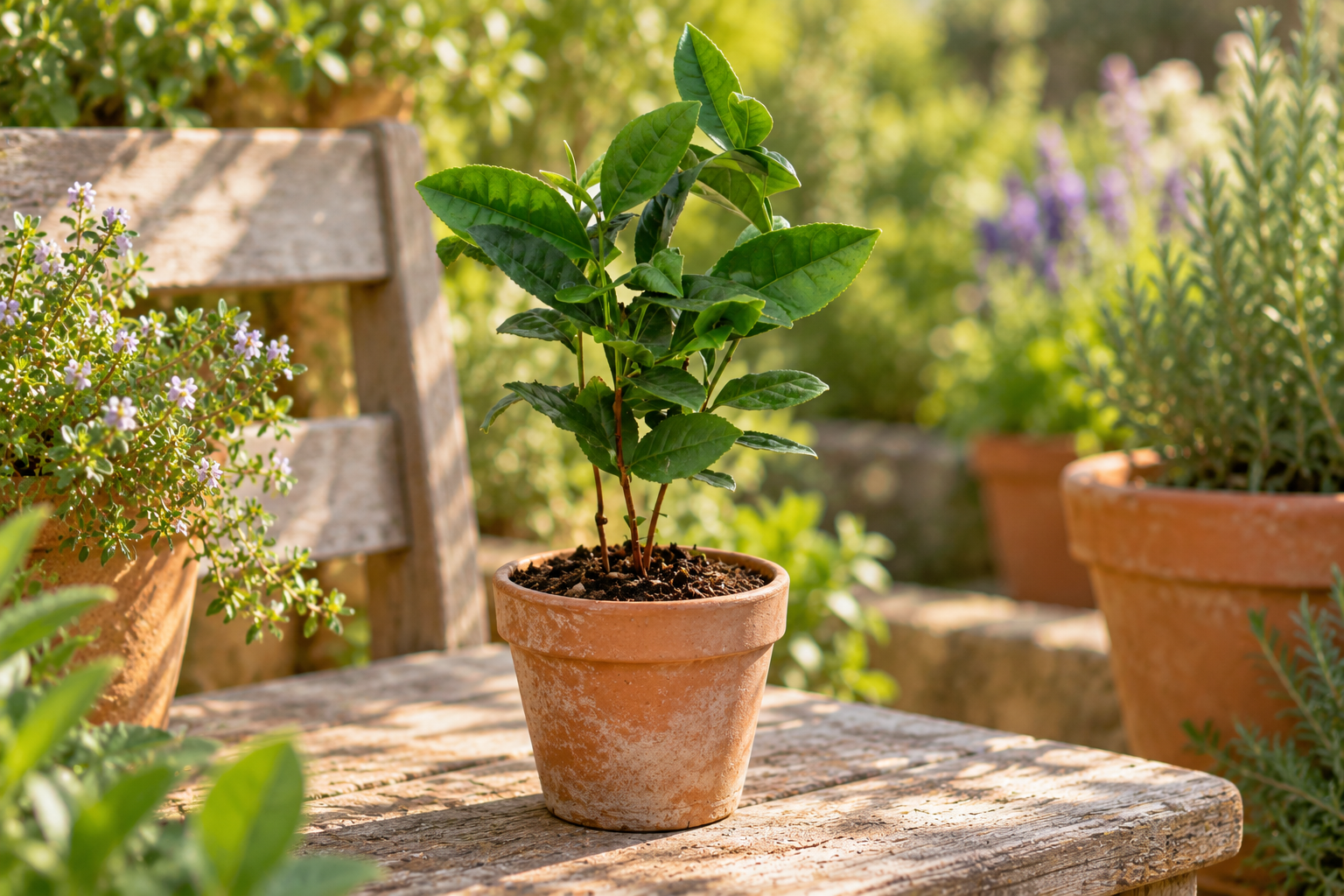
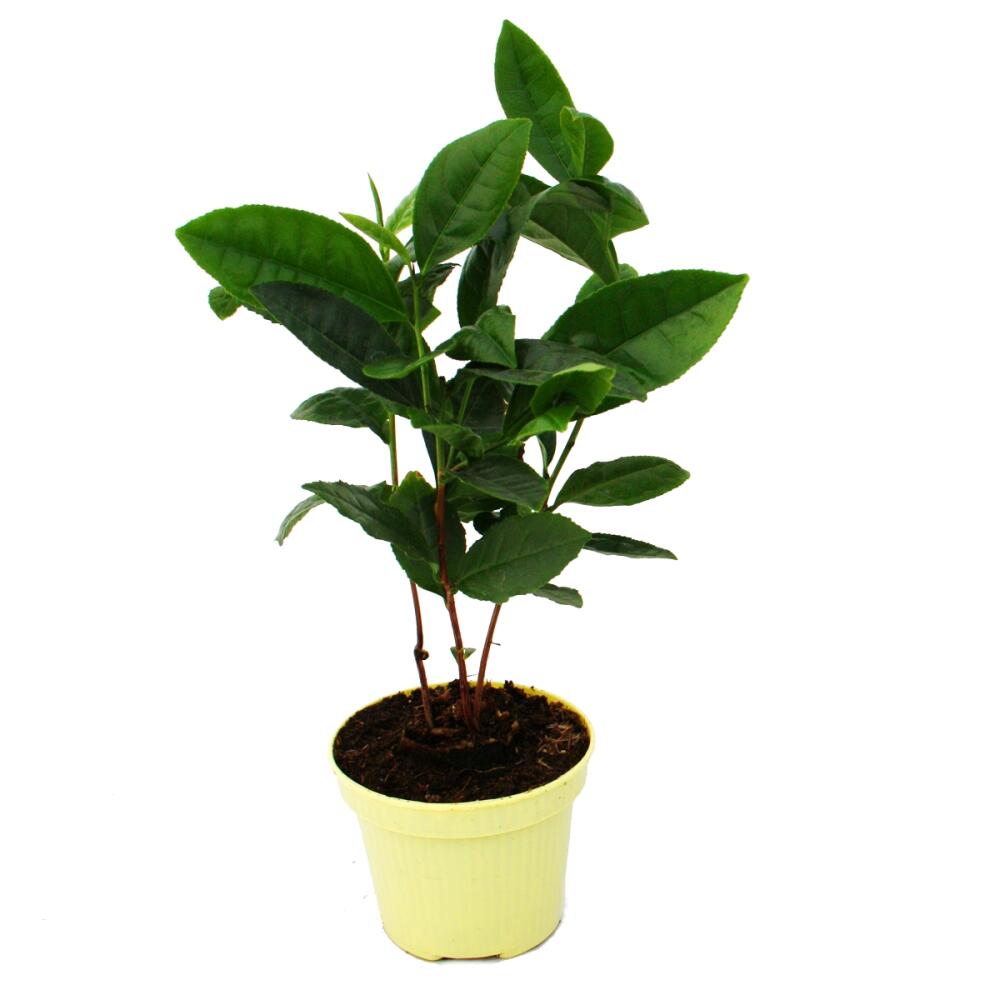
Camellia sinensis carries firm green leaves with finely serrated edges. Even the young plant looks like a little shrub and arouses curiosity about the origin of tea. The offer states approximately twenty to thirty centimetres of height and a ten-and-a-half-centimetre pot. I first give it a sheltered place where the small rootball is easy to monitor. The scene deliberately shows a young plant on a garden bench, not a large, heavily harvested tea bush. Before thinking of personal harvests, it may root well. Healthy new growth is more valuable at the beginning than an immediately filled little teapot.
Green and black tea begin with the same species
The true tea plant is botanically Camellia sinensis and is related to familiar camellias. Green and black tea differ mainly through the processing of harvested leaves, not through simply choosing between two completely different houseplants. The species is a perennial evergreen woody plant and may become considerably larger under suitable conditions. White flowers with yellow stamens are possible, particularly in autumn and winter, but are not guaranteed on a young delivered plant. I first guide its leaf and root development. A small pot makes later use tangible at the beginning but replaces neither suitable compost nor an appropriate winter position.
A sheltered outdoor place for the warm season
A bright to partially shaded place protected from strong wind suits the tea plant. Mild sunshine may be good; strong hot midday sun on a small newly arrived rootball is initially avoided. Once acclimatised, it stands outdoors in an accessible place, such as a sheltered terrace edge. A deep dark corner is no useful alternative to sunshine. I observe whether leaves and pot heat up strongly during the day. A small pot then loses moisture quickly. In spring, it is not planted outside before a forecast frosty night; for young container cultivation, weather and the actual temperature at the position remain decisive.
Acidic compost is not a minor detail
The tea plant prefers an acidic, humus-rich and well-drained root area. Suitable compost for acid-loving plants is easier to manage than a lime-rich mixture whose properties constantly need correcting later. Watering water is considered too: low-lime water helps retain the right soil character. I check the upper compost and keep the inner rootball evenly slightly moist. Excess drains away. Constant waterlogging is as unsuitable as completely drying the small pot. Yellowish leaves are not answered with more fertiliser alone; compost, water quality and root condition belong together in the assessment.
Build growth before harvesting heavily
During growth, the plant receives moderate, suitable nutrition. An oversized new pot is no quick route to a strong shrub because unused compost may stay wet for a long time. When strongly rooted, it is therefore repotted into a modestly larger pot. For later tea experiments, only leaves certainly suitable for food use and cultivated accordingly are used. The young plant should first be well established; large regular harvests would remove important leaf area. Individual young shoot tips may be taken cautiously with strong development. I view this beginning as an experience with a plant, not a promise of soon producing all one’s own tea needs.
Perennial does not mean carefree in a little pot
The frost tolerance of an established shrub cannot be transferred unchanged to a young plant in a small pot. For winter, I therefore plan a bright, cool, frost-protected place. A constantly very warm, dark living room is a less suitable replacement. The rootball stays controllably slightly moist while consumption may be substantially lower. Remaining water is still removed. Protected cultivation makes the first winter easier without giving a blanket temperature guarantee for every garden. If planted out later, local climate, soil and winter protection are reassessed. Even then, soil should be neither lime-rich nor permanently waterlogged in winter.
Accompany the little woody plant attentively
I occasionally inspect new shoots and leaf undersides for unusual coatings or pests. Individual damaged leaves do not yet prove a fundamental cultivation fault. What matters is whether the shrub develops healthy new growth and roots remain well supplied. Gentle later shaping may support branching but is not imposed on a weakened, newly arrived plant. Camellia sinensis connects plant care with everyday knowledge: tea begins with a living leaf that needs light, water and suitable compost. Quietly watching this development is already a pleasure long before a drink is actually made from a few leaves of one’s own.
One plant, several views
Good to know
Is this the plant for green and black tea?
Yes, both are obtained from Camellia sinensis; processing of harvested leaves differs.
What compost does it need?
Acidic, humus-rich, well-drained compost suitable for acid-loving plants.
Should water be low in lime?
Yes. Water quality and acidic compost should match.
Can I immediately harvest lots of tea?
No. Let the young plant establish first and take only very little suitable young leaf material with strong development.
When may it flower?
White flowers are possible with suitable development, usually autumn to winter; flowers at delivery are not promised.
Is the small pot winter-hardy outdoors?
Plan a bright, cool, frost-protected place for the young potted plant. A garden shrub and a small pot do not withstand the same conditions.
How large is it at delivery?
The offer states approximately 20–30 cm tall in a 10.5 cm pot; further growth is distinct from this.
Sources and editorial note
- Exotenherz: offer and original photographs (01.10.2026)
- RHS: Camellia sinensis (01.10.2026)
- RHS: growing your own tea plant (01.10.2026)
Shop offer, SKU, GTIN and availability checked live on 01.10.2026. Original photograph unchanged. Independently researched gardening texts and an individually reviewed scene.