This plant at Exotenherz
Check the shop offer for current availability, price and what is included.
Check the shop for the current price, availability and offer contents.
Your care table
| Topic | What to do | Why it helps |
|---|---|---|
| Light | Place very brightly and increase strong direct sun gradually. | Well-lit shoots stay denser; sudden hot light can damage leaves. |
| Water | Let the root ball dry out partly between thorough waterings. | Small fleshy leaves store water while roots need air. |
| Drainage | Use an inner pot with drainage holes and remove excess water. | Hidden wetness in a cachepot threatens the fine roots. |
| Soil | Choose loose, permeable succulent compost with mineral components. | Moisture must escape again even beneath dense foliage. |
| Nutrients | Feed moderately during visible growth, following the fertiliser label. | A small succulent does not need heavy continuous feeding. |
| Repotting | When well rooted, give a little more pot space; handle shoots gently. | An oversized pot dries more slowly and makes moisture checks harder. |
| Shape care | Shorten individual long shoots that get in the way rather than tightly shearing the entire plant. | Low trailing growth is part of its character. |
| Winter | Keep in a bright frost-free position and water more sparingly with little growth. | Darker days slow consumption; a fixed calendar would provide too much water. |
Check the compost and pot weight. The care table explains how far the compost may dry.
Water only when needed. The water should reach the root ball without spilling over the rim.
Remove surplus water from the saucer or cachepot. Then return the plant to a suitable position.
A small pot full of colour nuances
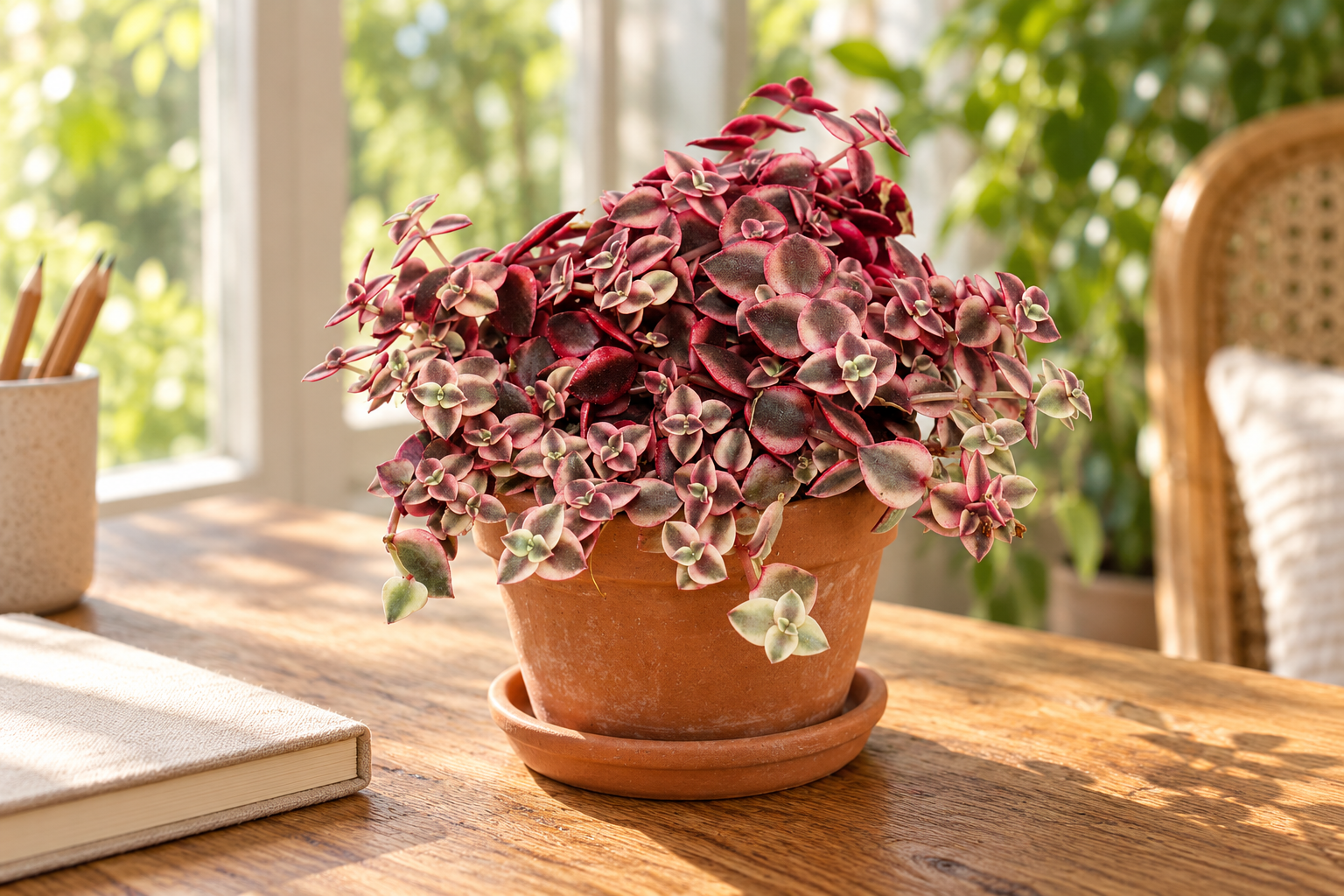
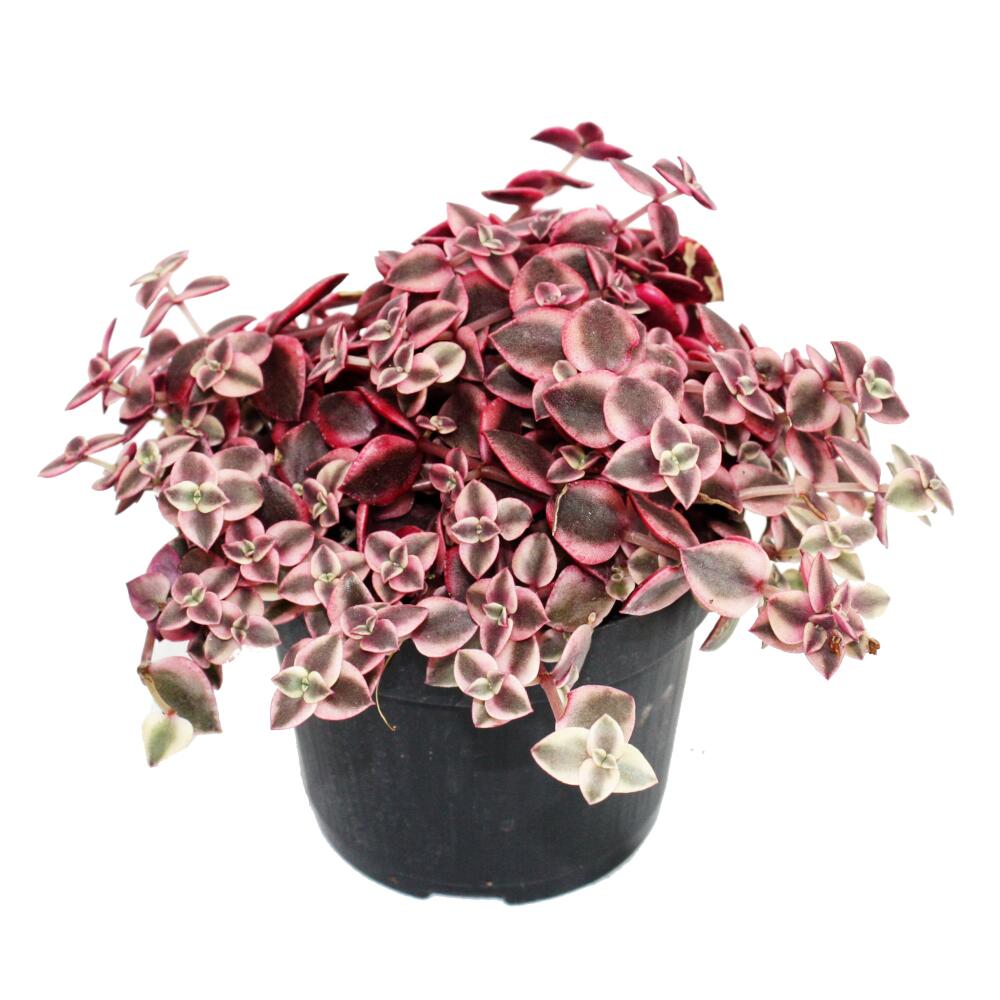
This crassula is best discovered close up. Small fleshy leaves sit in opposite pairs on reddish shoots. Their surfaces alternate between green and pale areas, with edges glowing pink to red. The low habit resembles a loosely growing cushion rather than a tree-shaped jade plant. Individual branches can sink over the container’s edge and give the little pot movement. On a bright desk, every new tip can be observed. What matters is real daylight reaching the plant, not just an attractive lamp above the workspace.
Keep the supplied plant separate from its later shape
The offer is named Crassula marginalis and describes a 12 cm pot with about 14 to 18 cm total height. The shop states an age of three to four years; that is an offer specification, not a prediction of growth speed in your home. The low height does not rule out longer trailing shoots later. The original image shows the offered leaf shape and colouring. As it grows, the little plant can spread more widely over the container’s edge. Choose a position where young tips remain free and do not end up beneath objects when you open a book or water.
Combine brightness with gentle acclimatisation
Start with a very bright position and increase stronger sun slowly. After shipping, the leaves must not immediately be pressed against a heated windowpane. A well-lit table edge or open shelf near a large daylight source may suit it if lower branches receive enough light. Watch fresh growth: if gaps between leaf pairs become much longer and branches very loose, review the brightness. Colour intensity also changes with development and cultivation; sudden drought stress is no substitute for additional sun. Healthy leaf surfaces matter more than the reddest possible photograph.
Really look beneath the dense foliage
The fleshy leaves can store water, but the small pot still needs an understandable supply. Before watering, gently move a shoot aside, check the soil and lift the inner pot. The root ball can dry out partly between waterings. Then water slowly until water emerges below and let it drain completely. A little water every day keeps the surface constantly moist without reliably supplying the entire root ball. If the soil is still heavy and wet, wait. When shoots soften, do not conclude water shortage from the leaves alone: damaged wet roots can cause a similar appearance.
Soil and container should suit its low habit
A shallow-looking cachepot can display the trailing shape attractively, but a functioning inner pot with clear drainage holes remains important beneath it. Use loose succulent compost containing mineral components and adequate pore space. A densely rooted ball can receive a slightly larger pot during growth. Support the root ball when lifting it out rather than pulling the delicate branches. Do not heap new soil over the shoot bases. Feeding follows visible growth and the label; pre-fertilised soil already supplies nutrients. This keeps the supply manageable instead of greatly increasing water and fertiliser together.
Gently guide the trailing branches
Individual very long or damaged shoots can be shortened with clean tools. Healthy branches may retain their shape; a perfectly symmetrical edge is not a care goal. For a cutting trial, suitable healthy shoot sections can be used, allowing the cut ends to dry first. Then place the cuttings in freely draining compost in a bright sheltered position. Constantly wet soil does not force successful rooting. During cleaning and moving, watch the small leaf pairs: leaves mechanically torn off differ from gradual loss through unfavourable cultivation conditions.
Learn its winter consumption anew
A bright frost-free position remains important during short days. When hardly any new shoots form, the plant needs less water and not the same strong feeding. Moisture checks replace a fixed winter schedule. Check branch bases for whitish woolly deposits and look beneath dense areas where changes are easily hidden. Brown dry patches following a move into sun suggest a different cause from soft darkening shoot bases in wet soil. Assess light, moisture and progression together. Later, healthy new growth shows whether the chosen adjustment really helped the little crassula.
One plant, several views

Good to know
Is this a small jade plant?
It is a crassula, but the offered form grows low and trails. It is not renamed as a tree-shaped jade plant.
Must every leaf be strongly pink?
No. Colouring and pale areas vary with leaf age and cultivation. Care is judged by healthy growth, not maximum redness alone.
How do I recognise the next watering time?
Check soil and pot weight beneath the dense foliage. Water thoroughly only after noticeable partial drying, then remove excess water.
Is 14 to 18 cm its final size?
No. That is the stated total height of the supplied plant. Trailing shoots can lengthen further.
Should I tie the hanging shoots upwards?
That is unnecessary. They belong to its natural framework; shorten individual branches if space is limited.
Can it stay outdoors in winter?
This pot cultivation calls for a bright frost-free winter position. The offer is not treated as a hardy garden plant.
Sources and editorial note
- Exotenherz: offer and original images (02/10/2026)
- RHS: related coloured form of Crassula pellucida subsp. marginalis; cultivation comparison, no cultivar attribution (02/10/2026)
- RHS: growing succulents indoors (02/10/2026)
Shop offer, article number, GTIN, availability and original images checked directly on 02/10/2026. Specialist sources read directly. No unsupported Dark or Calico Kitten cultivar added. The RHS cultivar portrait is used solely as an explicitly identified cultivation comparison; the complete Kew retrieval was unavailable and is not claimed as read.