This plant at Exotenherz
Check the shop offer for current availability, price and what is included.
Check the shop for the current price, availability and offer contents.
Your care table
| Topic | What to do | Why it helps |
|---|---|---|
| Light | Very bright to sunny, slowly adapted after shipping. | Enough light supports compact growth with firm pairs. |
| Water | Water after rootball checks during growth; allow drying between doses. | Storage leaves buffer pauses as the root zone regains air. |
| Drainage | Empty outer pot or saucer after every watering. | Persistent wetness particularly harms lower stems and roots. |
| Soil | Well-drained granular succulent soil. | A large fine damp soil mantle complicates checking. |
| Feeding | Feed moderately during visible growth by instructions. | Nutrition cannot fix darkness or wetness. |
| Repotting | Give suitably more room in spring when root space is tight. | Young pots need no immediate move into large containers. |
| Pruning | If needed, cleanly shorten individual long shoots above a node. | Targeted cuts can organise older branching; regular pruning is optional. |
| Winter | Very bright frost-free; adapt water to lower use. | Little light and abundant moisture do not promote compact strong growth. |
Check the compost and pot weight. The care table explains how far the compost may dry.
Water only when needed. The water should reach the root ball without spilling over the rim.
Remove surplus water from the saucer or cachepot. Then return the plant to a suitable position.
Leaf pairs tell of a little woody plant
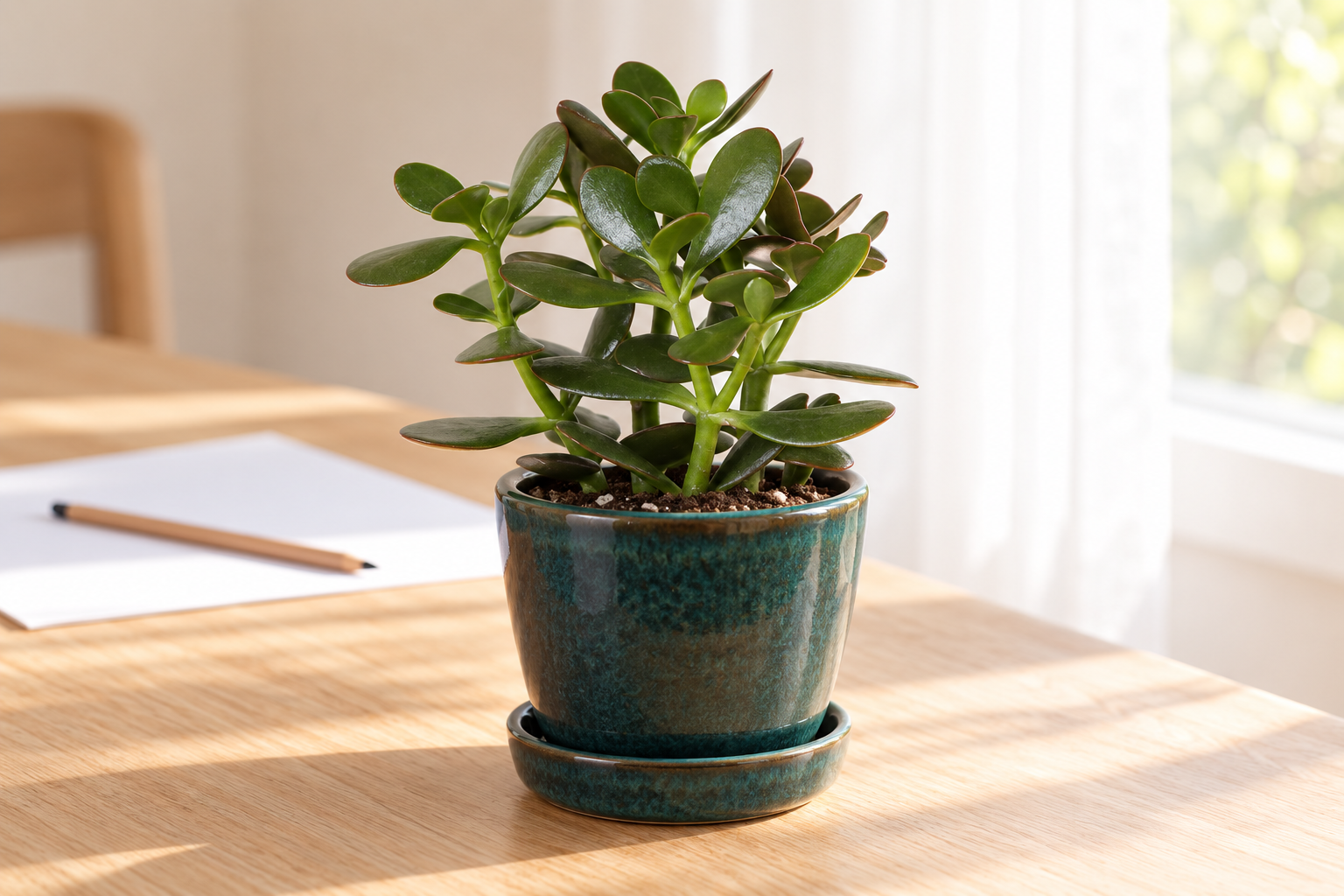
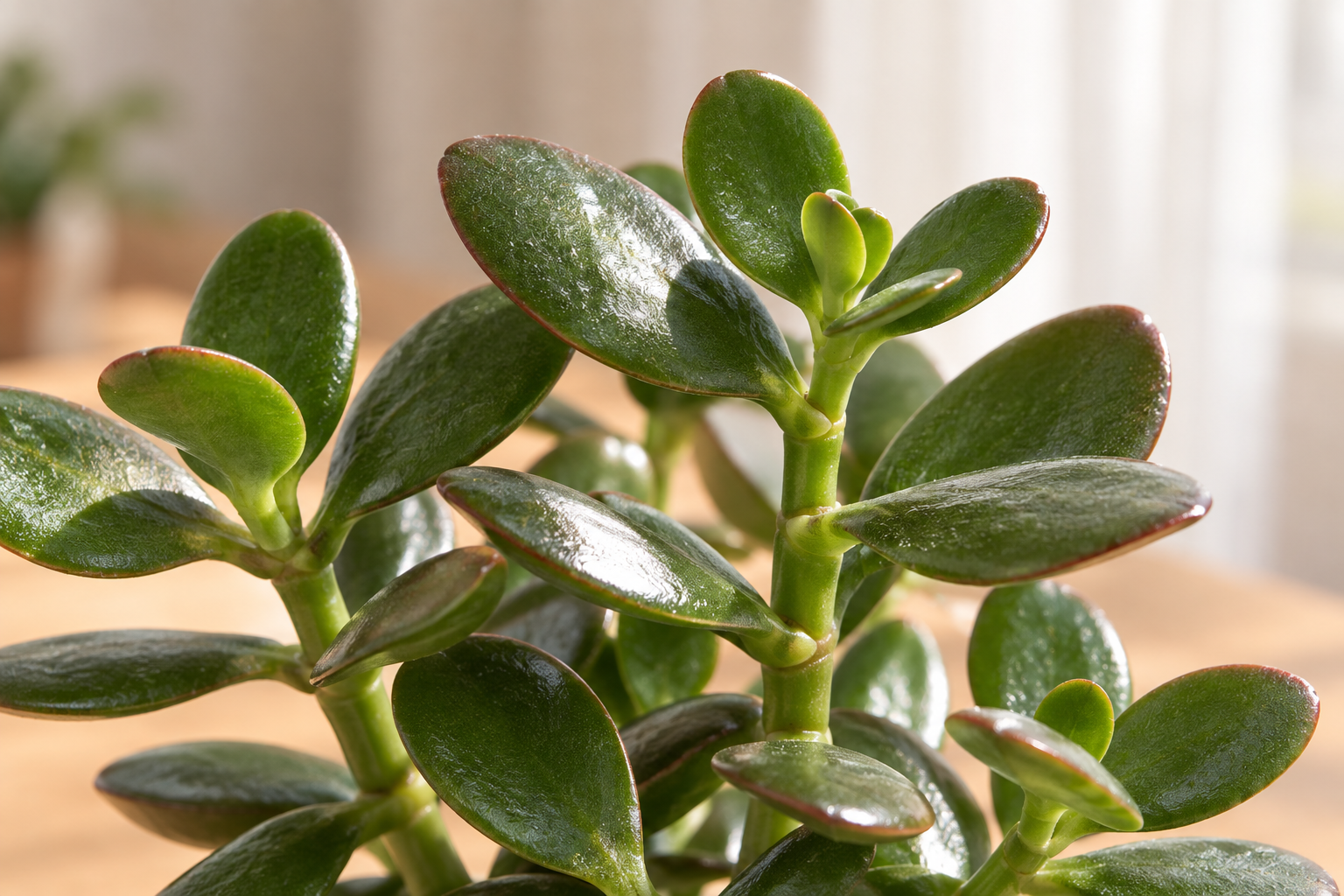
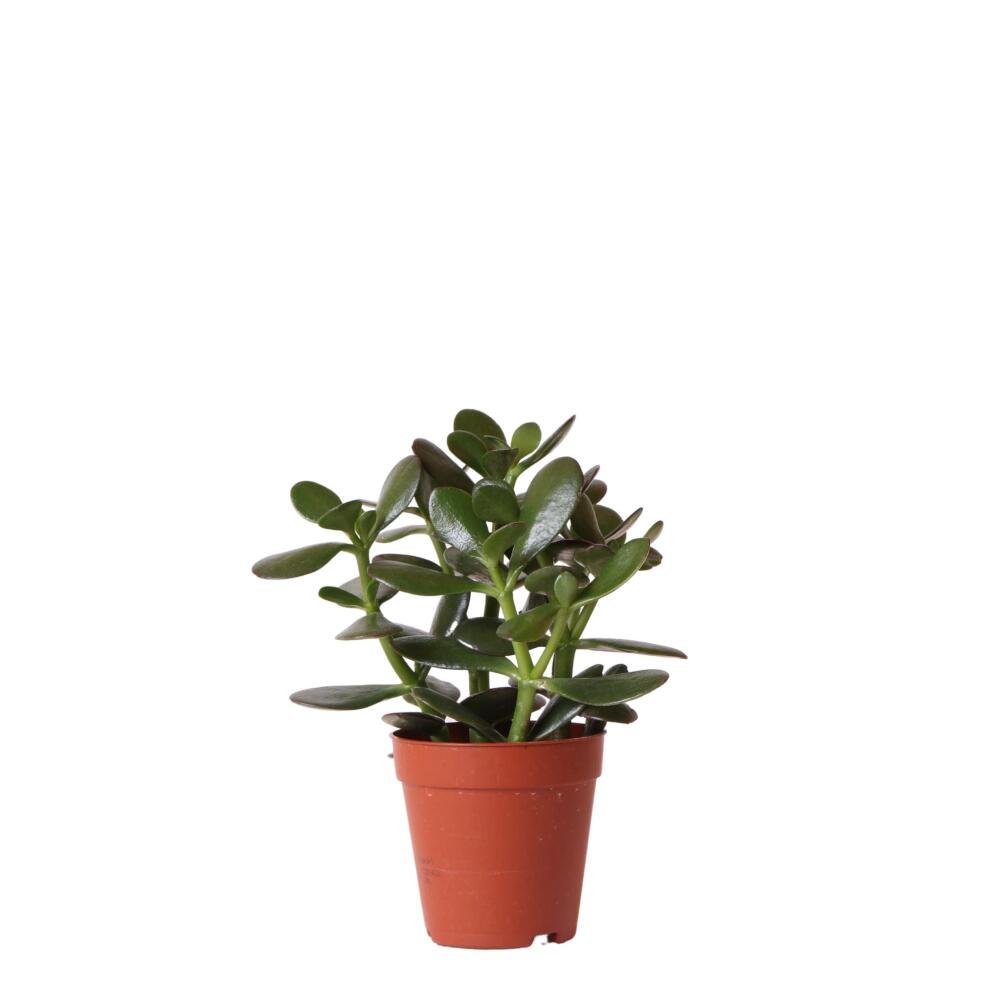
The clean original shows several short green shoots close together. Thick oval leaves sit in pairs, glossy tops catching light. Some edges look darker or slightly reddish. There is no mighty woody trunk yet; its interesting structure begins small. A very bright work table lets you observe new pairs and side shoots finding space. Place stably away from frequently moved objects. Hold the pot and protect leaves when unpacking rather than gripping the crown. A broken leaf differs from a soft dark shoot base.
Crassula ovata is the unnamed green species
The Kolibri offer at Exotenherz names Crassula ovata and a 9 cm pot without cultivar suffix or fixed height. The original producer also lists the green plant under the unsuffixed species. This portrait therefore treats that species without adding selection or cross names. Older names are Crassula portulacea and Crassula argentea. It belongs to the stonecrop family and comes from South Africa. Normal oval green leaves distinguish this structure from tubular or spoon-shaped named trade forms. Later species development is separate: under suitable conditions an old specimen can become substantial, while delivery here is a young pot plant.
The bright position determines its further structure
Choose excellent daylight and a sunny position after settling in. Fleshy leaves do not invite permanent darkness deep in a shelf. Low light may stretch shoots and widen gaps between pairs. After shipping or sheltered propagation, still increase sun gradually; suddenly hot midday sun behind glass may stress surfaces. Warm sheltered summer time outdoors is possible if the pot avoids prolonged rain. Consider stability: a growing crown increases weight above the pot. Before cold weather return to a suitable bright frost-free indoor place.
Watering starts by checking the rootball
Check moisture and weight before watering in bright growing conditions. The rootball may dry between doses, then receive water evenly with surplus removed. Residual water can stand unnoticed at lower roots in a decorative pot. Thick leaves store water but do not replace occasional provision during active growth. A rigid day count ignores warm sunny phases and a cooler winter position. If leaves wrinkle slightly and the rootball is dry, assess need. If soft with wet soil, check roots or bases first. Repeated little sips without checks are no useful solution.
Pot requirements grow with the crown
An intact delivery rootball can stay in its current pot. If roots later get tight or the mix loses drainage, spring suits repotting. Use granular well-drained succulent mix with an open hole. Enlarge according to the rootball; excessive surrounding soil otherwise stays wet longer. Do not deepen the base. An older heavy crown benefits from a stable container without greatly increasing soil volume. Moderate nutrients following instructions accompany new leaves and shoots. More feeding cannot replace missing light or damaged roots.
Patient branching instead of fixed shaping
The species branches and may become markedly woody over time. Routine pruning is not compulsory. Shorten an older long shoot selectively with clean tools above a leaf node. Do not rush to trim the young delivery into a miniature before seeing development at its new spot. Healthy cut shoots can later propagate; a drying cut and well-drained rooting space matter. Adult species plants may show small whitish to pale-pink star flowers. The actual original shows foliage, no flowers. Neither a date nor regular indoor bloom is promised.
Watch consumption and leaf bases in winter
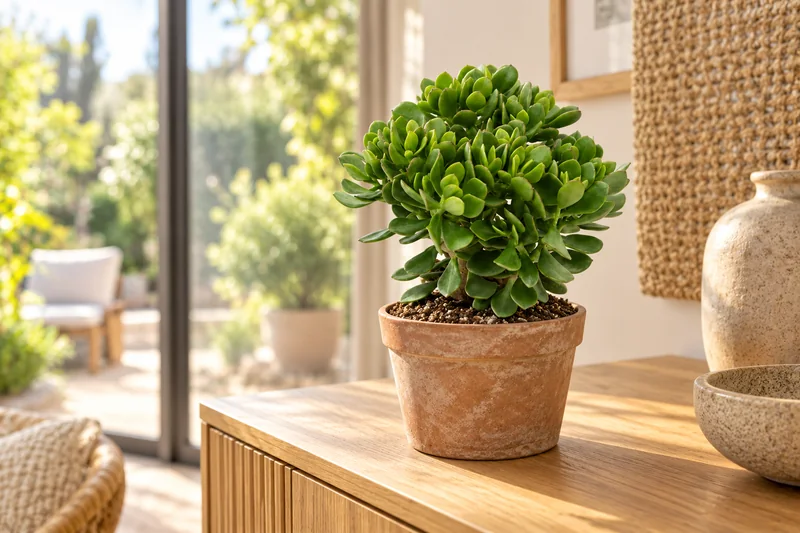
Keep bright and frost-free. Low activity gets much less water, not summer-abundant provision regardless of rootball condition. Observation gives the rhythm. Inspect bases, young forks and undersides for new sticky or cottony patches. A slowly ageing lower leaf differs from many sudden losses in permanently damp soil. Check the light position then too. New scenes preserve small green shoots and oval pairs from the original. They show possible indoor surroundings for this young species plant, not a mature crown or promised decoration or height.
One plant, several views
Good to know
Is a particular cultivar offered?
The selected description names Crassula ovata without a suffix. No named selection is added.
What dimensions are supported?
A 9 cm pot. The description gives no fixed delivery height.
Are Crassula portulacea and ovata different?
Portulacea is an older synonym used for Crassula ovata.
Will the small plant definitely reach two metres?
RHS describes possible developed species size, not a fixed indoor or delivery size for this specimen.
Must I prune regularly?
No. If needed, cleanly shorten individual long shoots above a leaf node.
What do soft leaves mean?
With wet soil check roots and bases first; with a dry rootball assess water need. The leaf alone does not decide.
Sources and editorial note
- Exotenherz: specific variant, dimensions, identifiers and availability (03.10.2026)
- RHS: directly read species profile, synonyms and cultivation (03.10.2026)
- Kolibri Company: original green species offer (03.10.2026)
- RHS: pot cultivation, water, pruning and repotting (03.10.2026)
Offer and directly read specialist sources compared on 03.10.2026. Identity, synonyms and SKU checked against Canon742, central new and isolated parallel portraits. Full RHS species profile and original Kolibri profile directly read. Canon has named Minor/Hobbit/Gollum/Sunset/Minova selections; no unsuffixed green species portrait. No selection invented from dimensions or green shade. No fixed delivery height, 9 cm pot only. RHS species size separated from offer. Clean single original actually viewed entirely.