This plant at Exotenherz
Check the shop offer for current availability, price and what is included.
Check the selected shop offer for price, availability and delivery contents.
Your care table
| Topic | What to do | Why it helps |
|---|---|---|
| Light | Place very brightly and acclimatise slowly to sun. | Leaf pairs remain more compact in good light. |
| Water | Allow compost to dry considerably, then moisten thoroughly. | Fleshy leaves store water. |
| Drainage | Remove all excess water. | Permanent wetness stresses the roots. |
| Compost | Well drained with mineral components. | An airy rootball that dries suits it better than heavy compost. |
| Feeding | Supply sparingly during growth. | The little plant needs no strong nutrient boost. |
| Pot | Increase modestly only when required. | Much unused compost stays moist unnecessarily long. |
| Shape | Shorten long healthy shoots if required. | Selective pruning may support a compact shape. |
| Winter | Very bright and frost-free, with considerably less water. | Consumption falls with reduced activity. |
Check the compost and pot weight. The care table explains how far the compost may dry.
Water only when needed. The water should reach the root ball without spilling over the rim.
Remove surplus water from the saucer or cachepot. Then return the plant to a suitable position.
Leaf pairs building a little tower
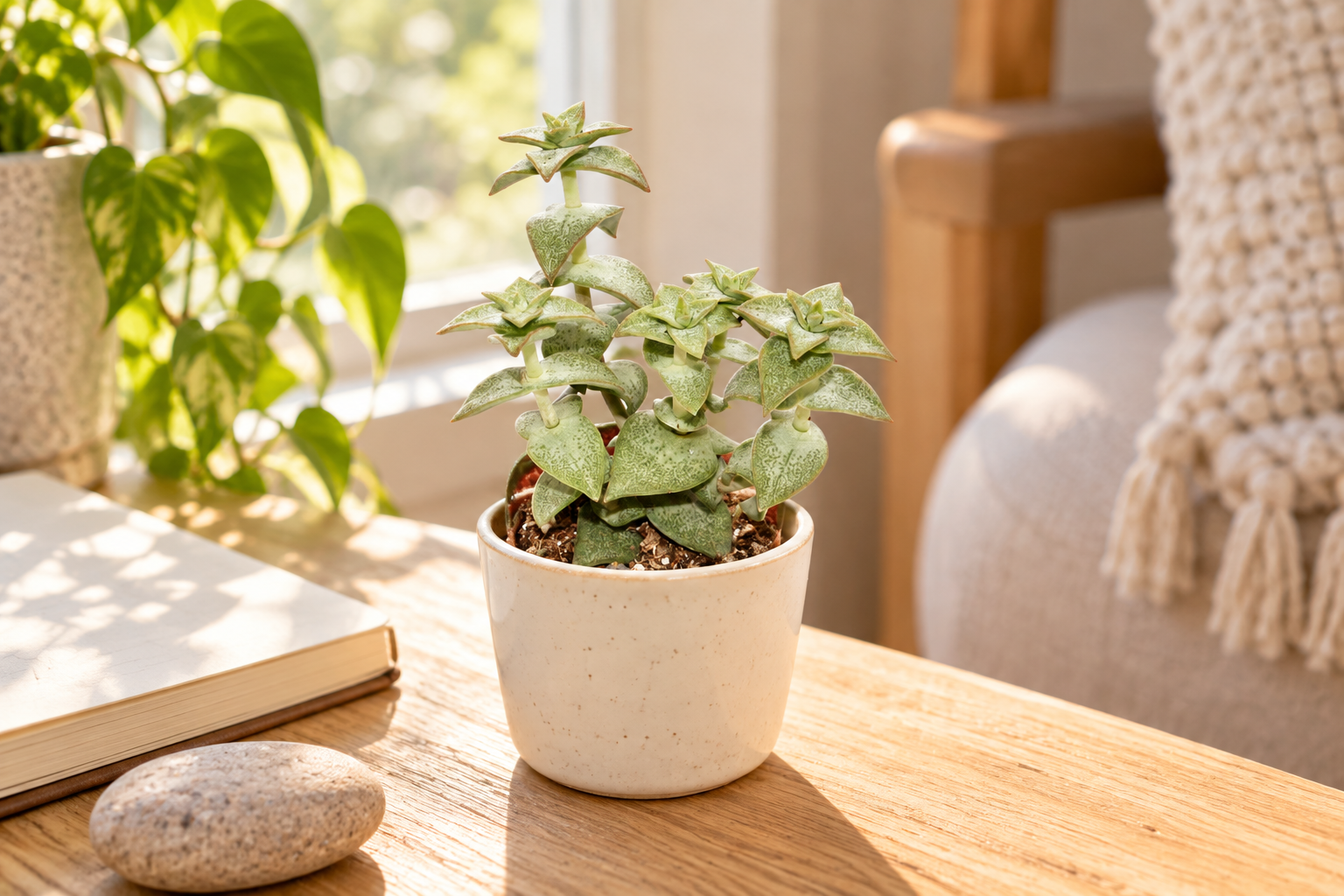
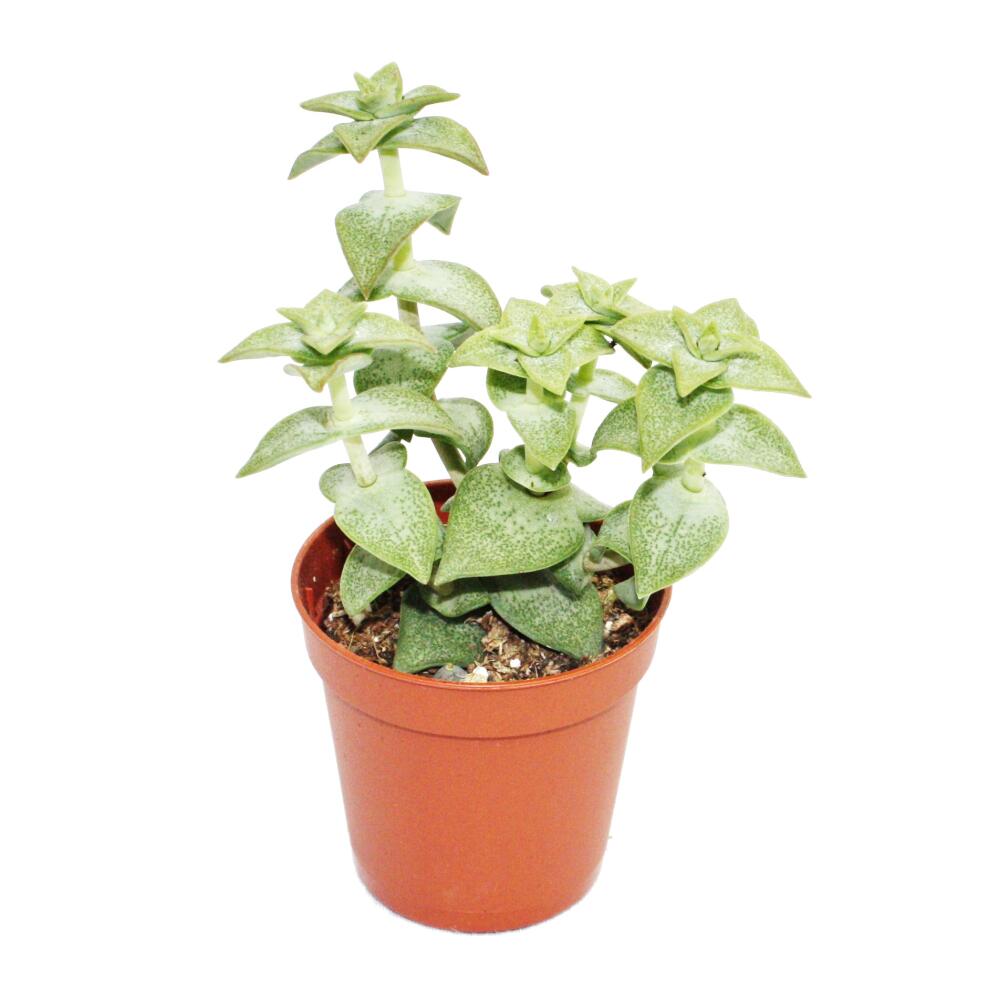
Crassula perforata arranges its fleshy leaves in opposite pairs around the shoots. The pairs are stacked in offset layers, recalling small threaded shapes. Delicate reddish tones may appear at the edges while leaf surfaces look green to grey-green. The offer describes a tiny young plant approximately nine to ten centimetres tall in a five-and-a-half-centimetre pot. I like showing this size beside a small unlabelled notebook or on a bright, narrow board. A tall mature collection plant would be misleading here. The young plant has its own charm precisely because every leaf pair can be recognised clearly.
A crassula grows with its light
The species belongs to the stonecrop family and holds its water reserves in fleshy leaves. Young shoots are initially more upright; with length and age they may lean. This development is not automatically a fault. If gaps between leaf pairs become noticeably large and the entire shoot weak, however, I examine the light position. I do not try to correct every natural change with a new support stick. Suitable cultivation maintains the structure better than constantly forcing a shape. Small pale flowers may appear later, but they are not a dependable delivery feature of this young plant.
A very bright position with gradual acclimatisation
Crassula perforata receives as much daylight as possible. Direct sunshine may suit it after careful acclimatisation; moving from protected cultivation into hot sun behind glass should not be abrupt. Otherwise the small plant is unnecessarily stressed. I observe where light arrives through the day and whether the cover heats up strongly. A deep, dark shelf position is less favourable even if the tiny size fits the compartment perfectly. For a summer place outdoors, it is also acclimatised slowly and protected from uncontrolled continuous rain. In winter, it remains bright and frost-free rather than being treated as a small garden perennial.
Allowing drying is part of watering
Before the next watering, I check whether the compost has dried considerably. Only then is it moistened evenly and excess allowed to drain. A closed cover is emptied afterwards. Regular small sips onto moist compost deprive roots of the necessary drying phase. At the same time, a tiny amount of compost must be checked more often on warm, bright days than a large succulent pot. I do not derive a fixed daily or weekly rhythm from this. The rootball and leaf firmness together provide better clues. Soft plant parts are checked particularly carefully because both water problems and damaged roots may be responsible.
Drainage starts in the small pot
A well-drained mixture with suitable mineral components suits the species. Compost should accept water and then be able to dry again. Heavy, permanently moist compost and a lack of drainage holes are unfavourable. When the rootball is densely rooted, the plant receives a slightly larger pot during active growth. An enormous container does not help such a small delivered plant. The new compost volume must match the existing root extent. Feeding is restrained and only during suitable activity. A heavy dose does not make leaf pairs tighter; without a good light position it is more likely to create further problems than the desired compact development.
Do not constantly handle the little leaves
Offset leaf pairs are best viewed rather than frequently moved between the fingers. When watering, I hold the pot rather than a delicate shoot. Longer healthy shoots may be shortened cleanly if necessary, leaving sufficient foliage on the plant. Cut surfaces and suitable cutting material are not immediately pushed into permanently wet compost. Gentle handling suffices for normal care. Mealy coatings, sticky areas or small pale insects between leaf bases call for closer inspection. A naturally matt surface is not mistaken for pests or removed by vigorous polishing.
Do less in winter and watch carefully
Reduced activity often lowers water consumption. Crassula perforata stays as bright as possible and frost-free, and compost may dry considerably between sparse waterings. A cold, wet rootball is particularly unfavourable. I therefore do not place the plant immediately beside a draughty winter windowpane. If a shoot later leans slightly, I assess light and firmness before cutting. The calm little structure need not remain unchanged to be attractive. With a suitable position, reliable drainage and some patience, new leaf pairs continue the characteristic rhythm of this little crassula.
One plant, several views
Good to know
How small is the offered plant?
Approximately 9–10 cm tall in a 5.5 cm pot. Delivered size is not equated with later development.
Why are the leaves paired?
This is the natural leaf arrangement of Crassula perforata. Offset pairs form its characteristic structure.
May it receive sunshine?
Yes, acclimatise to direct sun slowly. Avoid sudden hot sunshine behind glass.
When is it watered?
When the compost has dried considerably; then water thoroughly and remove excess.
Are leaning shoots a fault?
Not necessarily. Shoots may lean as they lengthen. Large leaf gaps, however, may indicate insufficient light.
Does it need a large pot?
No. Increase modestly if needed and use well-drained compost and drainage holes.
Can it overwinter outdoors?
No. Overwinter brightly and frost-free with sparing watering adjusted to activity.
Sources and editorial note
- Exotenherz: offer and original photographs (01.10.2026)
- RHS: Crassula perforata (01.10.2026)
- RHS: indoor cacti and succulents (01.10.2026)
Shop offer, SKU, GTIN and availability checked live on 01.10.2026. Original photograph unchanged. Independently researched gardening texts and an individually reviewed scene.