This plant at Exotenherz
Check the shop offer for current availability, price and what is included.
Check the shop for the current price, availability and offer contents.
Your care table
| Topic | What to do | Why it helps |
|---|---|---|
| Light | Choose a bright position without hot midday sun. | Compact growth does not make light dispensable. |
| Water | Let it dry slightly, then moisten through carefully. | A small root ball responds quickly to oversupply. |
| Drainage | Keep drainage holes clear and remove remaining water. | The tiny pot must not drown in its decorative cover. |
| Growing medium | Loose, freely draining houseplant compost. | Compacted soil keeps roots wet for too long. |
| Feeding | Feed sparingly when growth is visible. | The small delivered plant needs no strong nutrient dose. |
| Repotting | Choose one pot size larger only when necessary. | A large reserve of wet compost complicates care. |
| Leaves | Remove dust gently with a damp cloth. | The dense leaf bases should not be injured. |
| Winter | Keep bright and warm, reassess moisture. | Water consumption often decreases in darker weeks. |
Check the compost and pot weight. The care table explains how far the compost may dry.
Water only when needed. The water should reach the root ball without spilling over the rim.
Remove surplus water from the saucer or cachepot. Then return the plant to a suitable position.
A green tuft in miniature
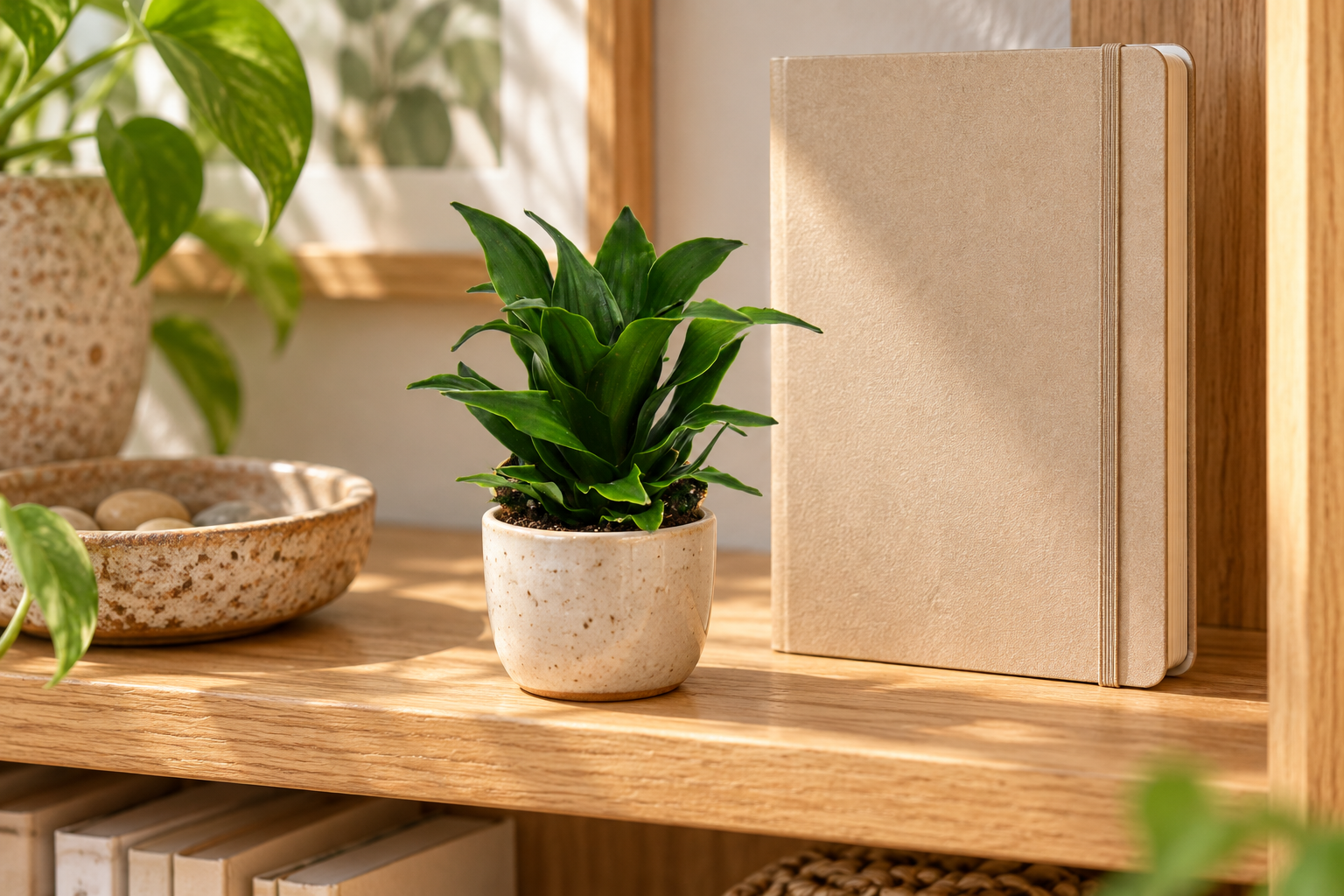
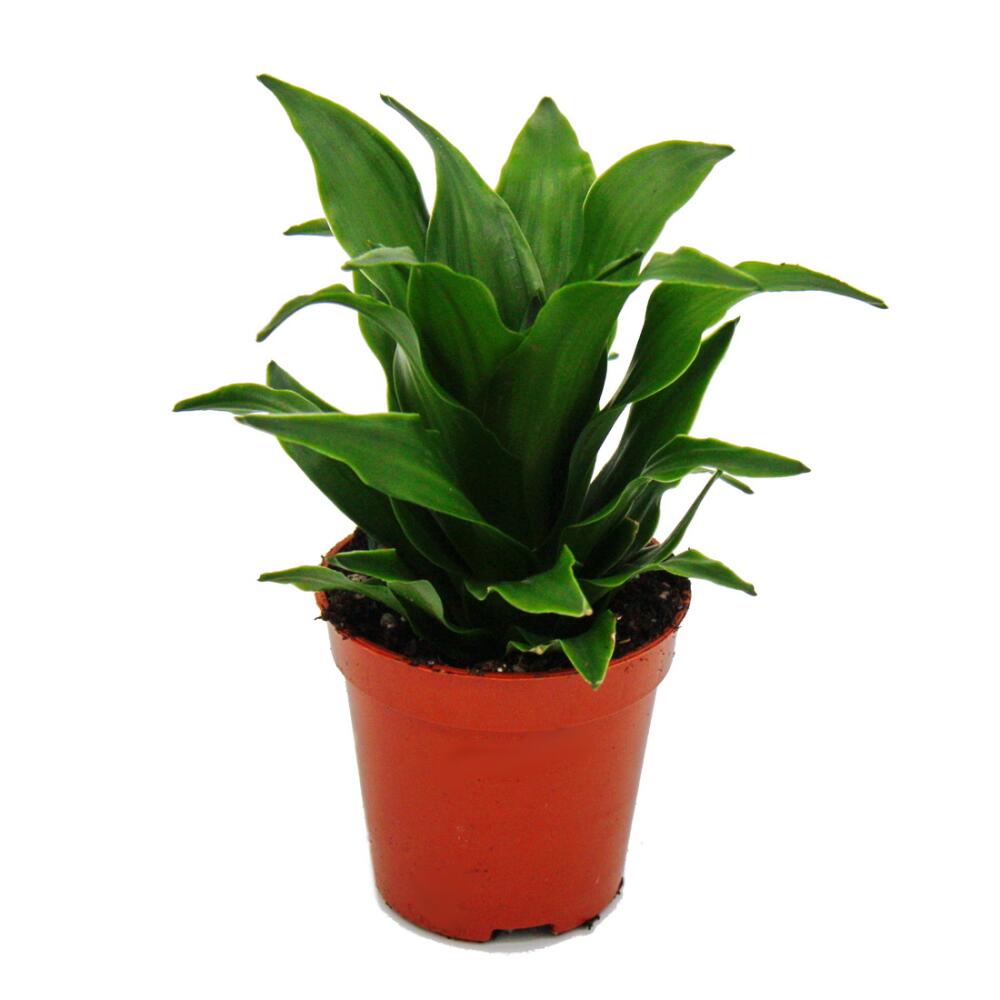
Compacta carries closely packed dark green leaves arranged in a small upright tuft. It looks tidy without being artificially shaped. The offer describes a particularly small young plant: about eight to ten centimetres high in a five-and-a-half-centimetre pot. On a bright desk, this size is easy to see beside a closed notebook or a shallow bowl. A tall dragon tree on several trunks is expressly not the delivered form here. What I like about this young Compacta is that its development can be followed calmly without immediately needing a large clear corner of the room.
Slow growth is not a care mistake
Compacta belongs to Dracaena fragrans and is listed within a group of especially dense-growing forms. Its leaves are arranged more compactly than in many looser dragon trees. Growth too may seem comparatively leisurely. Anyone expecting a distinctly larger specimen every month will want to drive the plant unnecessarily. I prefer to look at the condition of the centre and the firmness of existing leaves. A healthy young plant may take its time. Trunks and a larger crown can develop over the years; this does not imply a reliable height promise for a particular period in the living room.
A shelf position needs real daylight
A bright position with filtered light is a good start. Light shade is tolerated; a deep dark niche is not what this means. Especially on a shelf, I check whether light really falls on the leaves or only illuminates the front edge of the furniture. Hot sun directly behind glass can damage even a small tuft. After a move, I gradually accustom the plant to more brightness. It stays warm and does not stand in a cold draught. A window regularly opened in winter is therefore a less suitable immediate neighbour than a sheltered position beside it.
The small pot size makes a difference
A tiny root ball dries differently from a large houseplant pot. Compacta nevertheless needs no daily sips of water. I touch the upper compost and lift the pot before watering. Once the surface has lost some moisture, the root ball is moistened evenly. Excess must drain and is removed from a cover. If the plant stands in water for a long time, the roots lack air. Conversely, the small amount of soil must not be left unnoticed to dry completely. The right amount comes from observing the actual pot, not adopting the watering plan of a large plant in the same room.
Plant loosely rather than enlarge in advance
The growing medium should let water through and retain its loose structure. Usable houseplant compost with airy ingredients suits better than heavy compacted soil. I do not unnecessarily delay repotting when the root ball is well rooted, but neither do I do it solely because of the tiny sale size. A moderate increase is enough. A much too large pot contains wet soil for a long time even though the small tuft consumes little. During visible growth, feeding is restrained. A concentrated fertiliser solution does not turn Compacta into a large dragon tree faster and may stress sensitive roots.
Care gently for the leaf crown
Dust can accumulate between the closely arranged leaves. I gently clean accessible surfaces with a slightly damp cloth and do not pull the inner young foliage. When watering, water goes onto the soil, not constantly into the leaf centre. Individual old leaves at the lower edge may become unattractive over time. If several leaves become soft or yellow, however, I first check the root ball and possible remaining water. Brown tips may have various causes, including dry heating air or unsuitable water quality. They are no clear proof that the plant needs more fertiliser or more water.
Even a miniature needs a safe position
Compacta stays frost-free and as bright as possible in winter. With lower activity, watering is reduced without drying out the root ball according to a rigid calendar. A low small decorative pot stands safely and is easy to lift for checking. The plant is not edible greenery and belongs out of reach of nibbling pets and small children. I occasionally inspect leaf undersides and bases for unusual coatings or pests. These few actions are often enough to keep development understandable. Its appeal lies in the dense natural tuft and calm changes that can be observed well in a small space.
One plant, several views
Good to know
How large is the delivered plant?
About 8–10 cm in a 5.5 cm pot. The scene deliberately shows a small young plant.
Why does it grow so slowly?
Compacta often develops more slowly than loose dragon-tree forms. Check healthy foliage and suitable conditions rather than height gain alone.
Can it go on a dark shelf?
A bright to lightly shaded position is possible; a permanently dark niche is unsuitable.
How often must I water?
That depends on the small root ball. Wait for slight drying and remove excess.
Should it immediately go into a large pot?
No. Enlarge only moderately when needed and choose a pot with drainage.
What do brown tips mean?
Check heating air, water quality, moisture and nutrient supply. Tips alone do not allow a reliable diagnosis.
Is the dragon tree edible?
No. The plant is not intended for eating; protect it from nibbling pets.
Sources and editorial note
- Exotenherz: offer and original images (01.10.2026)
- RHS: Dracaena fragrans Compacta (01.10.2026)
- RHS: dragon trees (01.10.2026)
Shop offer, SKU, GTIN and availability checked live on 01.10.2026. Original photograph unchanged. Our own researched gardening texts and individually approved scene.