This plant at Exotenherz
Check the shop offer for current availability, price and what is included.
Check the shop for the current price, availability and offer contents.
Your care table
| Topic | What to do | Why it helps |
|---|---|---|
| Light | Place brightly with filtered daylight. | Striped foliage needs a good light position. |
| Watering | Water evenly after slight drying. | Compost should not remain constantly wet or completely dry. |
| Drainage | Remove remaining water from the cover or saucer. | The offered compost cultivation is not a water glass. |
| Water | Use suitable soft water at room temperature. | Unsuitable water may stress leaf tips. |
| Growing medium | Loose and draining, with humus-rich ingredients. | Air remains around the roots after watering too. |
| Food | Feed at a low dose during growth. | Oversupply is quickly reached in the tiny pot. |
| Repotting | Enlarge moderately when the root ball is well rooted. | A suitable pot simplifies moisture control. |
| Winter | Maintain warmth and brightness, top up less. | Lower consumption calls for adjusted watering. |
Check the compost and pot weight. The care table explains how far the compost may dry.
Water only when needed. The water should reach the root ball without spilling over the rim.
Remove surplus water from the saucer or cachepot. Then return the plant to a suitable position.
A small dragon tree with pale lines
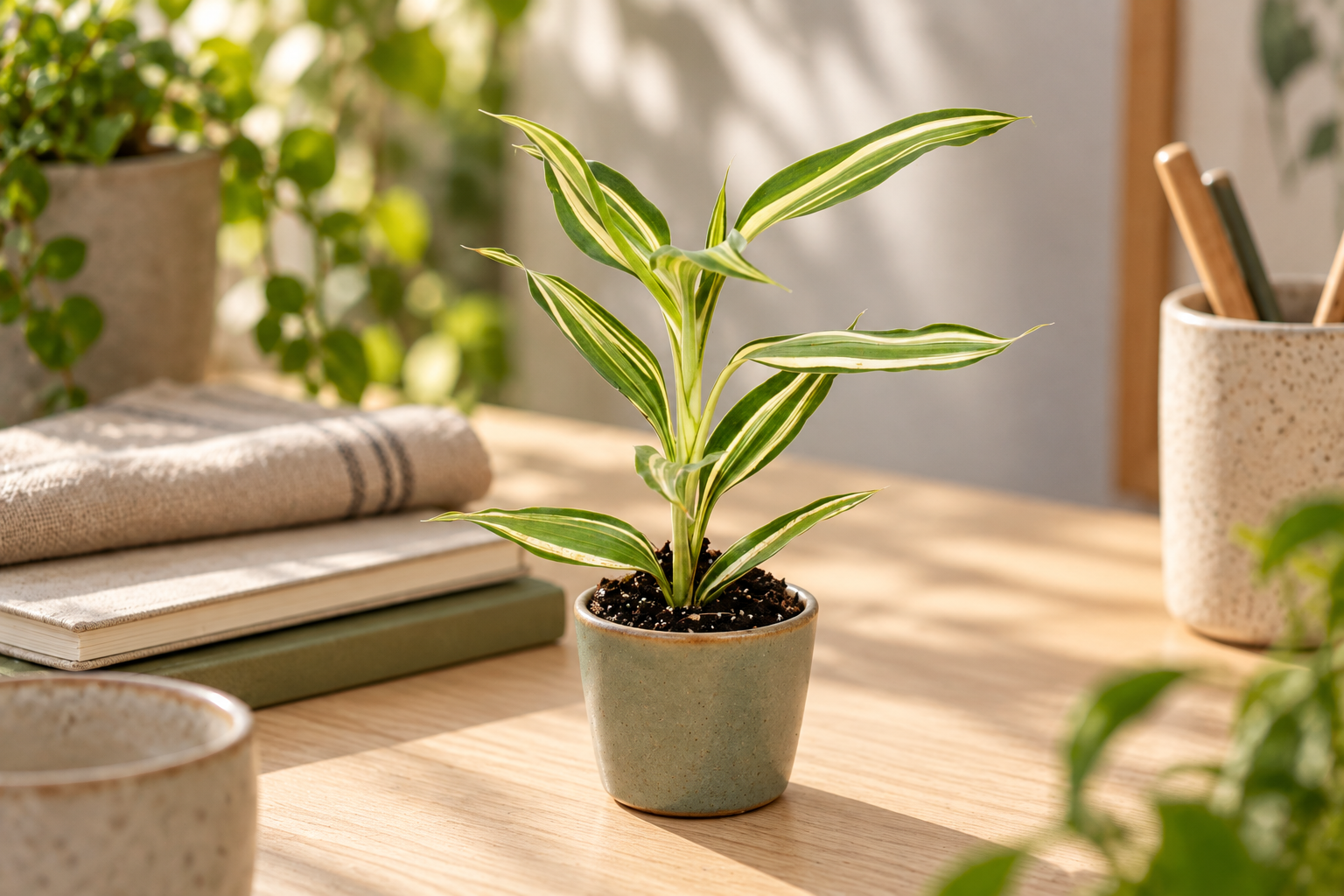
The narrow leaves of this Dracaena carry pale stripes between green areas. On the small young plant they look light and upright, without the rigid shape of a twisted decoration. The offer names a five-and-a-half-centimetre pot and a height of around fifteen to eighteen centimetres. This size fits a small bright side table where the fine leaf pattern remains clearly visible. I like placing it beside calm materials such as wood or unglazed pottery. A dense forest of tall canes is not delivered; it is a young living plant that will first continue developing in its new position.
It is not related to bamboo
Dracaena sanderiana is known as lucky bamboo but botanically belongs to the dragon trees. The trade name says nothing about how the particular plant was cultivated. This offer shows a leafy young plant in compost. I therefore treat it as a potted plant and do not transfer instructions for individual cut canes in a glass of water. The roots should work in the existing growing medium and receive air. A decorative vessel may serve as a cover, but needs a controllable inner bowl or a pot with drainage. Clearly distinguishing the delivered form saves unnecessary care problems with this often misleadingly named dragon tree.
Pale stripes need a light position
Filtered daylight supports calm, strong growth. I choose a position where the plant actually receives the bright room’s light rather than hiding it deep behind objects. Strong midday sun directly behind glass is less suitable for the young leaf group. If it is placed much brighter, acclimatisation is gradual. The pale stripes are natural leaf areas, not patches that can be intensified with especially large amounts of fertiliser. Even warmth helps. During winter airing, the small plant must not stand in the cold air stream even if its cover would look decorative on the windowsill.
Compost cultivation is watered by root-ball moisture
Before watering, I feel the surface and check the weight. If the upper layer has dried slightly, the root ball receives water evenly. Excess drains before the pot returns to its cover. A permanently filled decorative pot does not turn this soil-grown plant into suitable hydroponic cultivation. The roots may suffer from lack of air there. Repeated complete drying is also unsuitable because the small amount of compost loses water quickly. A fixed weekly rhythm does not always strike this balance. Warmth, light and pot size together determine how soon the next check and watering become necessary.
Consider water quality and compost together
If tap water is unsuitable for sensitive houseplants, appropriate low-lime water may help. It is used at room temperature. Simply leaving any water to stand does not guarantee that all problematic components disappear, however. A loose humus-rich mixture that reliably releases excess water suits the soil. Once the root ball is densely rooted, the plant is given a slightly larger pot when appropriate. I hold back from an oversized vessel: it stores more moisture than the small leaf group initially needs. Fresh compost and a suitable pot are more valuable than an immediate major repotting without a recognisable need.
A few actions for beautiful leaves
During active growth, a suitable houseplant fertiliser is supplied moderately. Dosage follows the product and is selected cautiously for this small delivered plant. Old damaged leaves can be removed cleanly; healthy shoots are initially left untouched. Dust is wiped off gently. Brown tips prompt me to check the interaction of heating air, water quality and moisture. They do not automatically prove water shortage. If leaf surfaces become soft or several leaves yellow quickly, I particularly check the lower root ball and decorative pot. A root problem cannot be fixed by extra food at the leaves.
Warm through winter and safe in everyday life
In winter, Dracaena sanderiana stays frost-free and bright. Water consumption may decrease even when room air seems dry. I therefore continue watering by the compost, not by the feeling that all plants must be thirsty during the heating season. The plant is neither edible bamboo nor food for animals. Its position is chosen so curious children or nibbling pets cannot reach the foliage. I occasionally inspect leaf undersides and bases. Under suitable conditions, the small striped tuft gradually becomes a larger dragon tree whose lines are beautiful enough without promises of luck.
One plant, several views

Good to know
Is this true bamboo?
No. Dracaena sanderiana belongs to the dragon trees; lucky bamboo is a trade name.
Should I put it in a glass of water?
The offered plant grows in compost. Keep it in this cultivation and remove excess watering water.
How large is it?
The offer names about 15–18 cm height in a 5.5 cm pot; later growth should be distinguished from this.
When is it watered?
After slight drying of the upper compost, without regularly drying the whole root ball completely.
Are the pale stripes a deficiency?
No, they belong to the leaf pattern. Unusual new damage is also checked against growing conditions.
Why do tips turn brown?
Possible factors include water quality, unsuitable moisture or dry heating air. Check them together.
Can my pet nibble it?
No. The plant is unsuitable as feed and should stand out of reach.
Sources and editorial note
- Exotenherz: offer and original images (01.10.2026)
- NParks: Dracaena braunii / sanderiana (01.10.2026)
- RHS: dragon trees (01.10.2026)
Shop offer, SKU, GTIN and availability checked live on 01.10.2026. Original photograph unchanged. Our own researched gardening texts and individually approved scene.