This plant at Exotenherz
Check the shop offer for current availability, price and what is included.
Check the selected shop offer for price, availability and delivery contents.
Your care table
| Topic | What to do | Why it helps |
|---|---|---|
| Light | Position brightly and initially filter strong direct sunshine. | The leaf markings need a well-lit place. |
| Water | Let the upper compost dry, then water thoroughly. | Roots should not remain permanently wet. |
| Drainage | Remove remaining water from the outer pot and saucer. | Waterlogging also stresses a strong trunk. |
| Compost | Loose and humus-rich with good drainage. | Air in the rootball supports a dependable supply. |
| Nutrition | Feed moderately during growth. | A heavy dose does not intensify yellow lines. |
| Leaves | Wipe dust off gently without bending the crowns. | Narrow leaves are easily damaged mechanically. |
| Repotting | Increase pot size modestly when heavily rooted. | Too much wet compost does not match current needs. |
| Winter | Maintain brightness and allow for slower drying. | Less light often means lower water use. |
Check the compost and pot weight. The care table explains how far the compost may dry.
Water only when needed. The water should reach the root ball without spilling over the rim.
Remove surplus water from the saucer or cachepot. Then return the plant to a suitable position.
Two crowns bring fine lines into the room
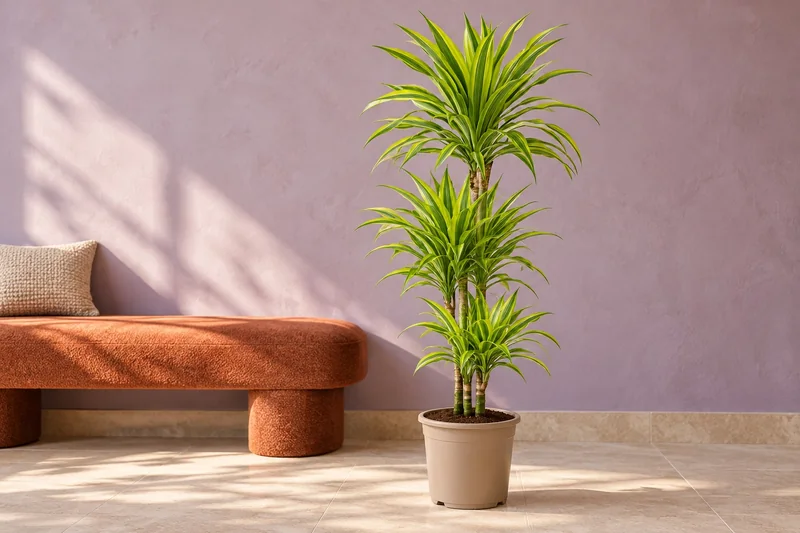
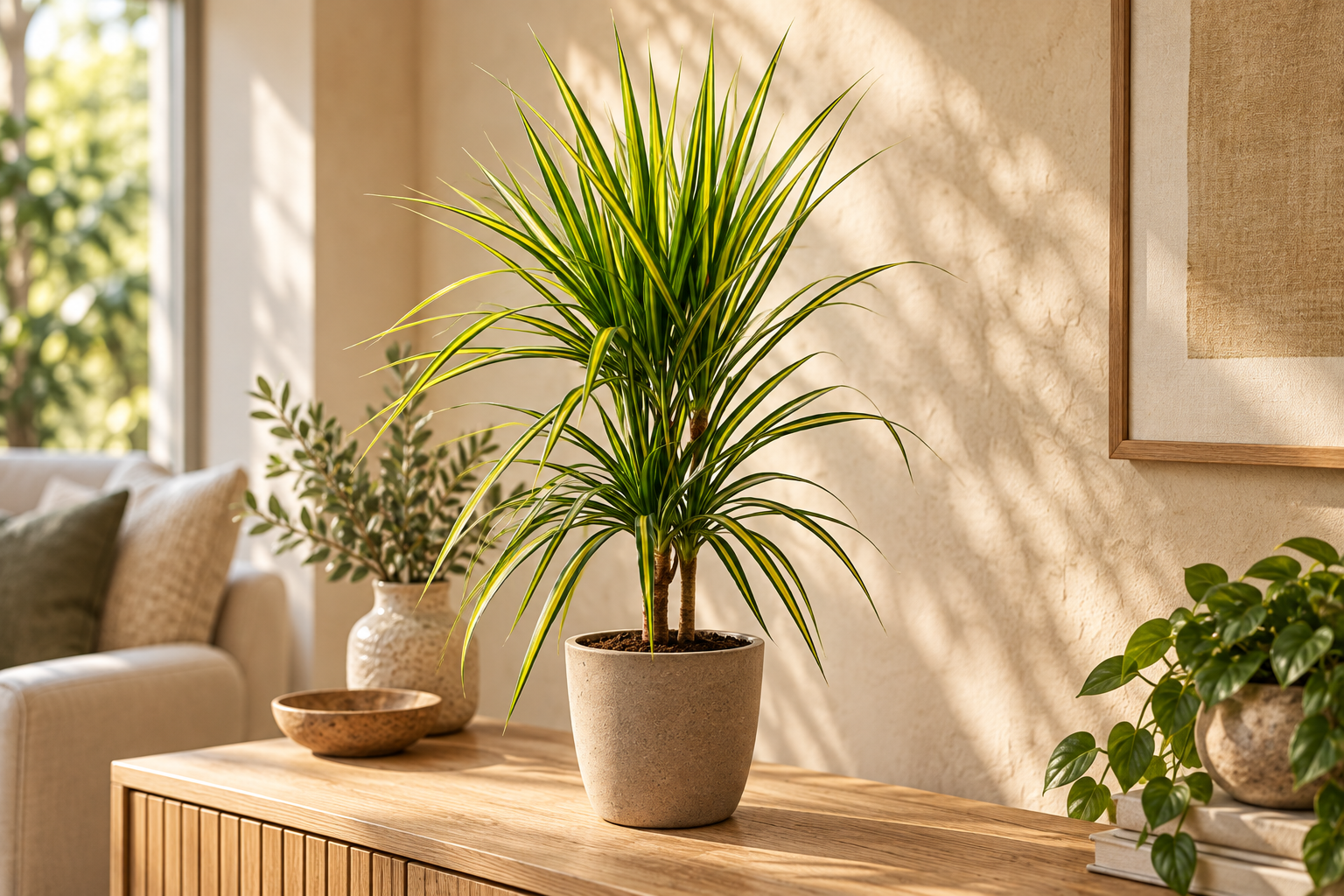
Sunray has long, narrow leaves in which green and yellow-green areas meet. The crown looks light without having to carry little foliage. Two trunks in the offered group stand together in one pot; two separate plant containers are not being described. The offer specifies approximately sixty centimetres of overall height and a seventeen-centimetre pot. I like placing this young group on a low piece of furniture where the narrow leaf lines gain a calm background. A widely spreading old dragon tree would be a different size. The manageable delivered form fits particularly well into an existing bright living space.
A trunked plant that keeps growing
Sunray is a variety of the narrow-leaved dragon tree Dracaena marginata. During growth, new leaves emerge at the tops of the crowns while older lower leaves may age over time. Visible trunks therefore do not mean that the foliage constantly needs rescuing. In indoor cultivation, the plant may grow larger and, if necessary, be shaped by planned pruning. I decide on that only when its development and available space require it. Its present delivered height is not a final measurement. Two crowns sitting at different heights already create an individual structure in the young group that looks attractive without additional shaping.
Brightness for pale leaf stripes
A bright indoor place with filtered daylight works well. The markings benefit from light, but strong unprotected sun behind glass may stress the narrow leaves. Following a marked change of position, the plant is gradually accustomed to the new brightness. A supposedly practical dark corner is less favourable for attractive long-term growth. I also check the depth of the position: on a sideboard, the front crown may be well illuminated while the rear one is already obscured. A little free space helps both. In winter, crowns and rootball stay outside cold draughts, such as when a balcony door is opened.
First the compost, then the watering can
Before watering, I check the upper layer and the condition of the entire rootball. When the surface has dried and the pot has become lighter, watering is even. Excess drains away and is removed from a decorative cover. A strong trunk does not protect permanently wet roots. Small daily sips onto already moist compost may be particularly unfavourable for this reason. But the rootball should not remain completely dry for weeks either. Its rate of water use depends on light, warmth and growth. Two trunks in the same pot do not automatically receive double the water; the shared root area is what matters.
Dose compost and nutrition appropriately
A loose, humus-rich growing medium with good drainage makes cultivation easier to monitor. If roots become cramped or the compost loses structure, repot into a modestly larger pot when convenient. An enormous pot for all future development stores too much water for the current plant. During active growth, suitable fertiliser is supplied moderately. Freshly pre-fertilised compost contributes to its nutrition too. More fertiliser does not solve insufficient light, brown tips or a wet rootball. With suitable low-lime water and a sensible nutrient supply, conditions remain easier to understand than with constantly changing supplements for every small leaf alteration.
Handle narrow leaves gently
Dust is removed carefully with a soft, damp cloth. I support the narrow leaf surfaces and avoid bending them at their bases. Individual old yellow leaves can be removed cleanly; young crowns are not pulled apart. Brown tips have several possible causes, including dry heated air, water quality or unsuitable rootball moisture. I therefore consider the whole plant. Firm healthy trunks and continuing foliage growth indicate something different from soft bases and rapid general leaf loss. Occasionally I look at undersides and leaf bases for sticky areas or small pests. This inspection remains a calm habit, not a reason for permanent preventive spraying.
A stable place through winter
Sunray stays warm and frost-free. During darker months, compost often dries more slowly even if heated air makes the room seem dry. I therefore adapt watering to the rootball and keep the dragon tree as bright as possible. The two crowns need a position where they are not constantly brushed by people passing. Plant parts are not intended for eating and are protected from nibbling pets. A secure cover and accessible compost simplify everyday care. The young group can develop calmly, showing its fine yellow-green lines even when the room already contains many other things.
One plant, several views

Good to know
Does a two-trunk group mean two individual plants?
The offer describes two trunks together in one 17 cm pot, not two separate pots.
How tall is the delivered plant?
Approximately 60 cm. Further growth may make the plant larger later.
Does Sunray need sun?
A bright place with filtered light is good. Shield hot direct sunshine initially and acclimatise slowly.
Must I water twice as much for two trunks?
No. Assess the shared rootball and remove excess water.
Why are lower leaves yellow?
Individual leaves may age. With rapid, heavier loss, also check roots, light and moisture.
What helps with brown tips?
Check heated air, water quality, rootball moisture and fertiliser. The cause cannot be read from the tip alone.
Is it suitable as animal feed?
No. The dragon tree belongs beyond the reach of nibbling pets.
Sources and editorial note
- Exotenherz: offer and original photographs (01.10.2026)
- RHS: dragon trees (01.10.2026)
- RHS Plants: Dracaena Sunray (01.10.2026)
Shop offer, SKU, GTIN and availability checked live on 01.10.2026. Original photograph unchanged. Independently researched gardening texts and an individually reviewed scene.