This plant at Exotenherz
Check the shop offer for current availability, price and what is included.
Check the selected shop offer for price, availability and delivery contents.
Your care table
| Topic | What to do | Why it helps |
|---|---|---|
| Light | Choose a bright place without hot midday sun. | White leaf areas need a good supply of light. |
| Water | Let the surface dry, then moisten thoroughly. | Pothos needs no permanently wet pot centre. |
| Drainage | Remove water from the hanging cover or outer pot. | Hanging containers should not form a hidden water reservoir. |
| Compost | Humus-rich, loose and well drained. | Roots and new shoots benefit from an airy foundation. |
| Nutrition | Feed moderately during active growth. | Overfeeding does not strengthen the marbling. |
| Trailing stems | Allow a clear route or guide along a support. | Shoots should not be squeezed or rubbed against sharp edges. |
| Pruning | Shorten above a suitable node if required. | The shape can be maintained and may branch. |
| Winter | Check rootball moisture and leaf undersides. | Less light often reduces water consumption. |
Check the compost and pot weight. The care table explains how far the compost may dry.
Water only when needed. The water should reach the root ball without spilling over the rim.
Remove surplus water from the saucer or cachepot. Then return the plant to a suitable position.
White islands between green leaf surfaces
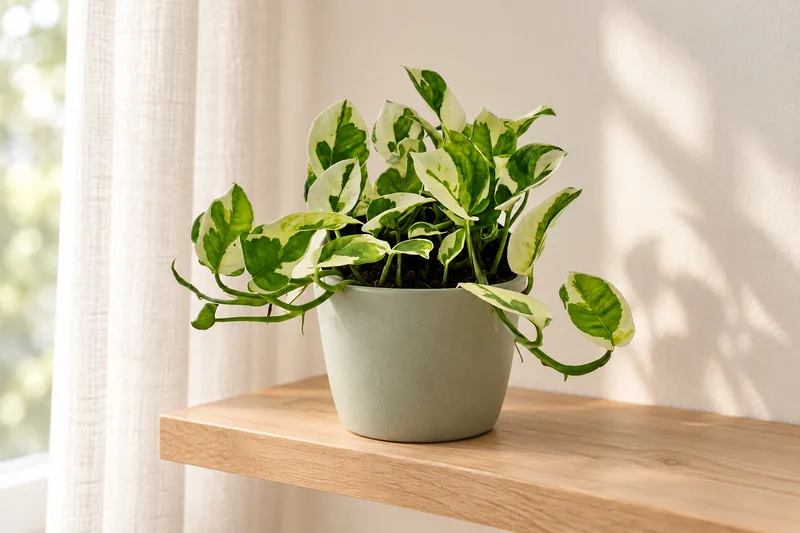
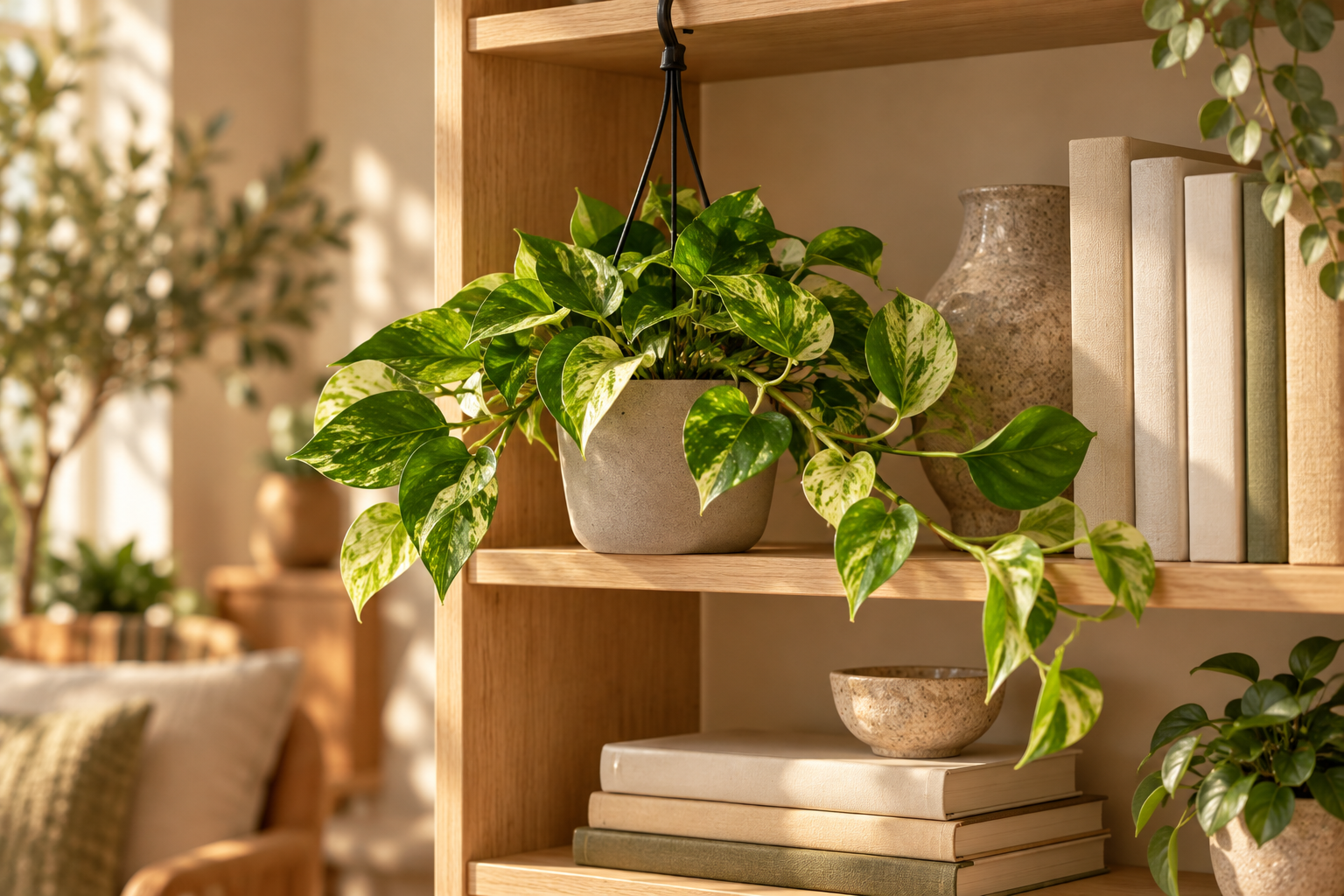
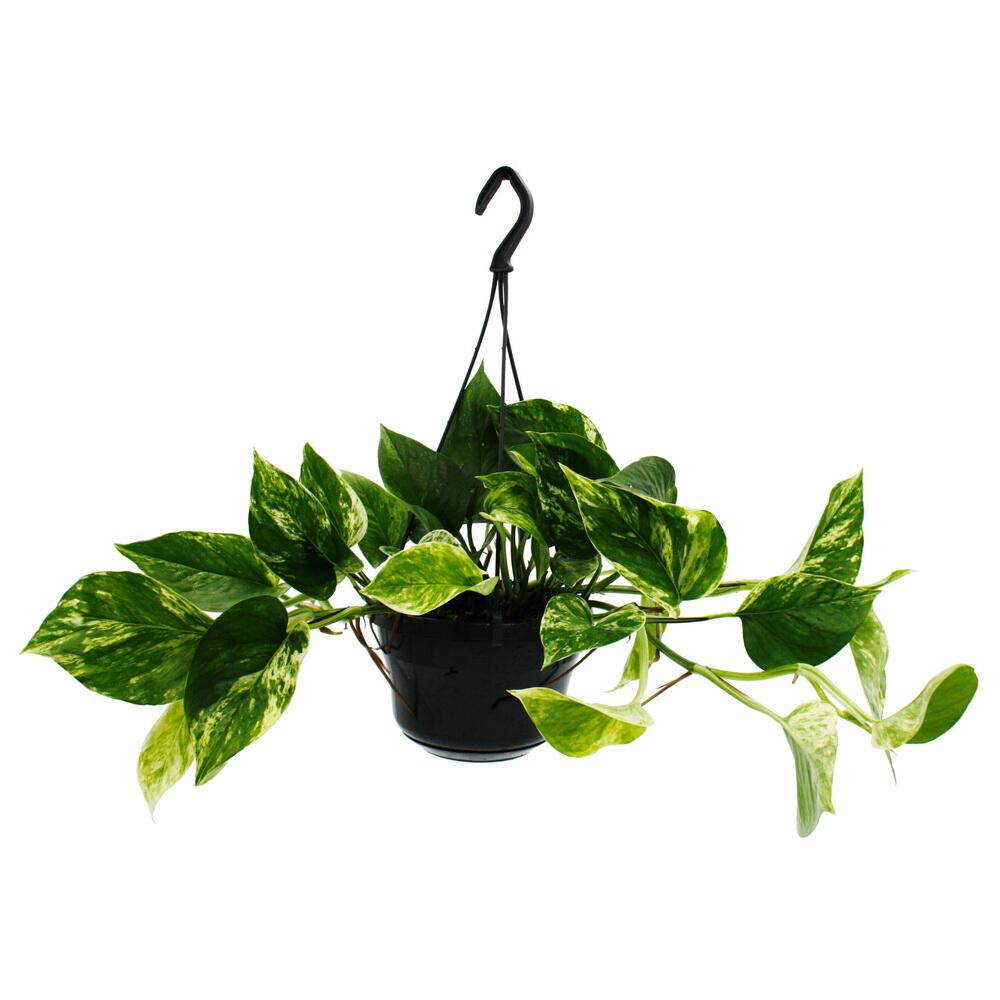
Marble Queen carries marbling that is distributed afresh on each heart-shaped leaf. Some areas are predominantly green; others have broad pale islands and fine speckles. The delivered plant’s short trailing shoots can be displayed well at the edge of a bright, open shelf or in an accessible hanging pot. The offer specifies a fifteen-centimetre hanging pot and around thirty centimetres of plant size. A long green curtain is therefore possible later development, not a characteristic that must be delivered immediately. I particularly like the young leaf group because its different patterns can be examined close up.
A pothos with its own leaf appearance
Botanically, Marble Queen belongs to Epipremnum aureum. It is neither ivy nor a philodendron, even if heart-shaped leaves and climbing shoots offer similar design possibilities. The plant can hang freely or use suitable support with its aerial roots. A climbing support is not essential for an attractive hanging plant. I decide according to available space and give the shoots a route where they are not constantly handled. The leaf pattern belongs to the variety; it is not discolouration caused by a deficiency. Completely identically painted leaves are neither expected in this living marbling nor necessary for quality.
Pale areas need a bright position
Marble Queen should receive enough filtered daylight. A dark-green pothos can cope better with some shadier spots than a strongly white-marked variety. This is no reason to place pale leaves in hot midday sunshine behind glass. I choose an open, bright area and observe it throughout the day. A shelf may look suitable in the morning and later heat up in direct sunshine. A slightly offset position then helps. If new leaves become noticeably small and the gaps between them longer, it is particularly worth examining brightness rather than only fertiliser.
A hanging pot can be taken down for watering
Before watering, I check the rootball. When the upper compost has dried and the pot becomes a little lighter, water is supplied evenly. Excess can then drain. A closed hanging cover is checked before being hung back up. Especially higher up, standing water otherwise easily goes unnoticed. Between waterings, the pothos should receive some air at its roots rather than remain continuously wet. Complete drying for weeks is not a care goal either. The right quantity depends on the actual pot, light and growth, not a general claim that climbing plants are always thirsty.
Airy compost and restrained nutrition
Loose, humus-rich growing medium with dependable drainage is a good foundation. If the surface becomes hard or the centre stays unusually wet for a long time, I examine the whole rootball. Heavily rooted plants can move into a slightly larger pot during growth. A large compost reserve for many future years offers the young hanging plant no immediate advantage. Feeding is moderate during active growth. White leaf areas do not thereby become greener or more productive; nutrients must suit the entire plant. If the compost is freshly pre-fertilised, this existing supply is considered rather than immediately adding another full dose.
Shape trailing shoots and retain healthy foliage
When shoots become too long, individual trailing stems can be shortened cleanly around suitable nodes. Cuttings can also be taken there if enough healthy material remains. I do not reduce the whole plant to a minimum at once. Remaining leaves maintain its supply and attractive appearance. Dust is removed gently. Very strongly white-marked leaves may react more sensitively; damaged areas are therefore first considered alongside light and water balance. Healthy trailing shoots are not guided over sharp edges. Even a freely hanging plant needs a secure hook and an accessible position for checks.
Attentive in winter and safe in everyday life
Marble Queen stays warm and frost-free. On darker days, the rootball often dries more slowly, so watering is adjusted accordingly. Yellow leaves may indicate different causes, including waterlogging, drought stress or natural ageing. Leaf colour alone does not replace checking the rootball. Plant parts must not be eaten, and emerging sap may irritate. I use suitable protection when cutting and keep shoots beyond children and pets that nibble. An occasional look at leaf undersides and nodes completes the care. The white-green hearts can then grow without turning the small hanging plant into an uncontrollable or hard-to-reach green curtain.
One plant, several views
Good to know
Is Marble Queen a philodendron?
No. It is a variety of pothos, Epipremnum aureum.
Why does every leaf have a different pattern?
The white-green marbling is irregular and belongs to the variety.
Can it stay in a dark place?
A bright place is better for this white-marked variety. Nevertheless, avoid hot direct sunshine.
When should I water the hanging pot?
After the upper compost has dried. Ideally take it down for watering and checking drainage.
Does it need climbing support?
No. It can hang freely or climb a suitable support.
May I cut long trailing shoots?
Yes. Individual healthy shoots can be shortened selectively at suitable nodes.
Is it suitable for animals to nibble?
No. Do not let plant parts be eaten; keep trailing stems beyond their reach.
Sources and editorial note
- Exotenherz: offer and original photographs (01.10.2026)
- NC State: Epipremnum aureum and varieties (01.10.2026)
Shop offer, SKU, GTIN and availability checked live on 01.10.2026. Original photograph unchanged. Independently researched gardening texts and an individually reviewed scene.