This plant at Exotenherz
Check the shop offer for current availability, price and what is included.
Check the selected shop offer for price, availability and delivery contents.
Your care table
| Topic | What to do | Why it helps |
|---|---|---|
| Light | Provide bright filtered daylight. | Leaf markings need light; hot midday sun can damage them. |
| Water | Allow the upper soil layer to dry slightly, then water each root ball thoroughly. | Three pots use different amounts of water even in the same position. |
| Drainage | Let inner pots drain and empty pot covers. | Roots should not remain enclosed in standing water. |
| Soil | Use airy well-draining houseplant compost. | New roots need air between waterings. |
| Growth direction | Let shoots trail or guide them gently on support. | The position determines where upcoming growth has room. |
| Pruning | Shorten above a suitable node if needed; wear gloves. | New growth may emerge at nodes; the sap irritates. |
| Nutrients | During visible growth, feed according to the fertiliser label. | Extra fertiliser does not replace a bright position. |
| Winter | Keep warm, bright and draught-protected; water more sparingly as needed. | Consumption usually falls with reduced growth. |
Check the compost and pot weight. The care table explains how far the compost may dry.
Water only when needed. The water should reach the root ball without spilling over the rim.
Remove surplus water from the saucer or cachepot. Then return the plant to a suitable position.
Three green tones change a shelf
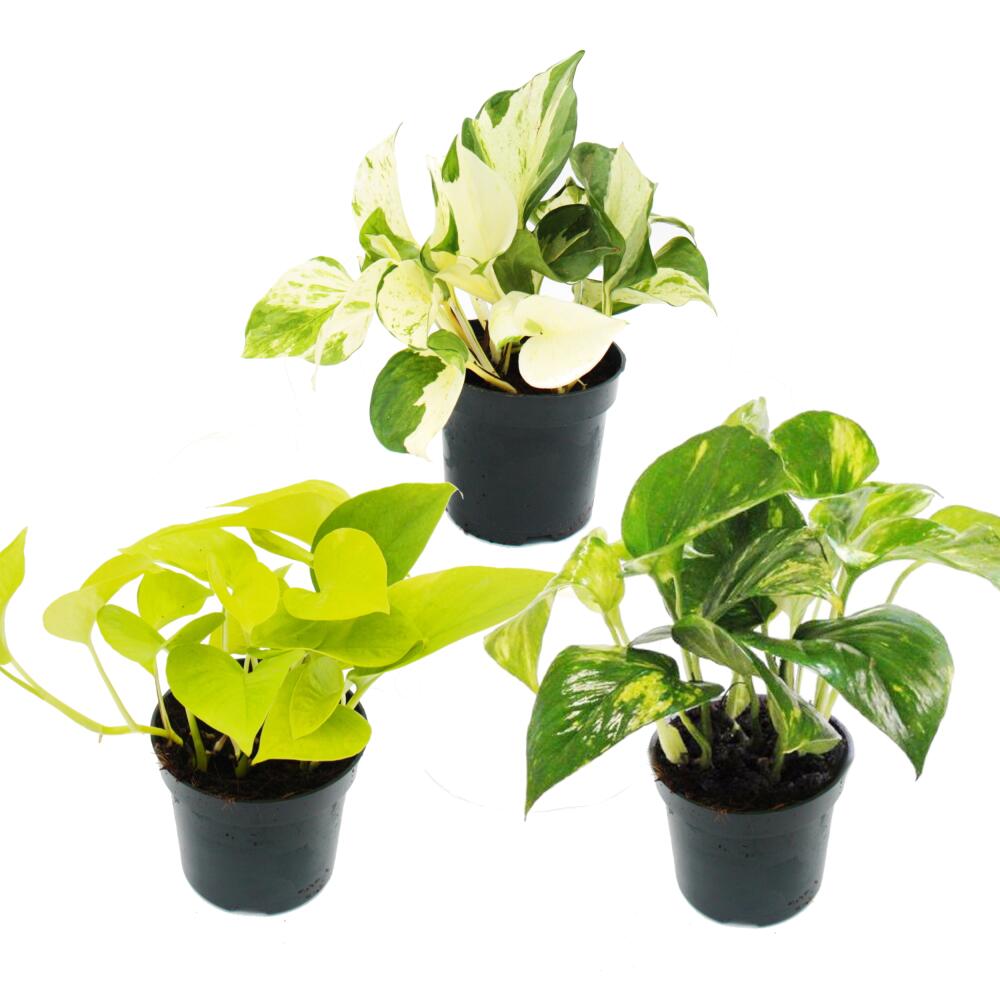
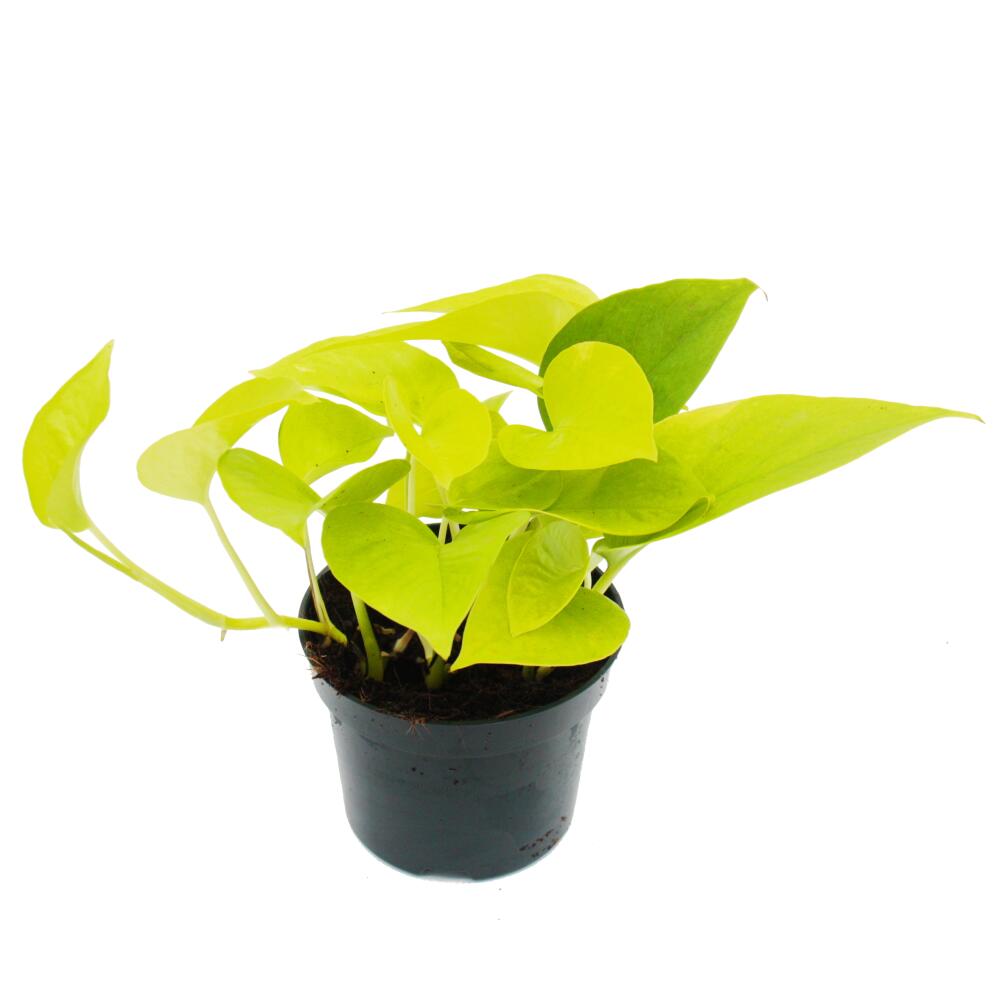
What we like about this trio is the comparison. One young pothos carries pale lime-coloured foliage, another shows green-yellow surfaces, and a third combines green with cream-white markings. Variety thus comes from similar leaf outlines. On a bright bookshelf, the three plants may keep some distance. Not every shoot has to hang over the edge already. The young pots first show the beginnings of a trailing shape. A little group may look calmer than a single plant whose long stems disappear everywhere between objects.
Distinguish commercial names from delivery contents
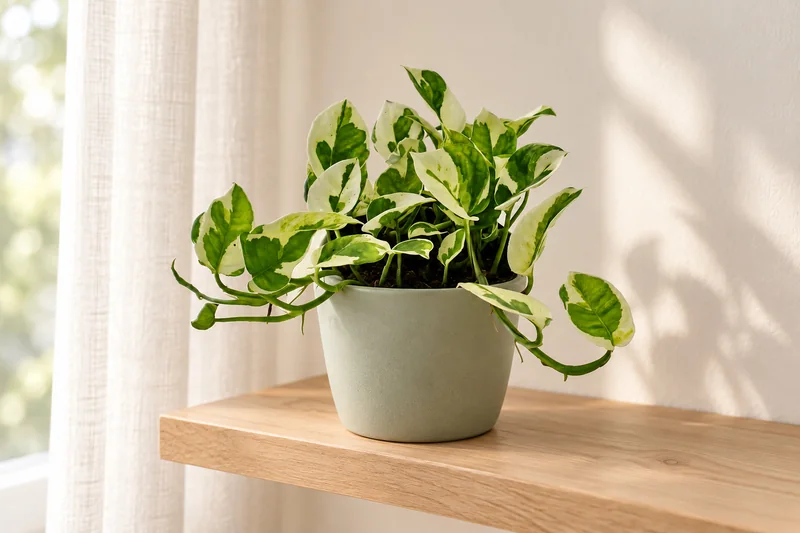
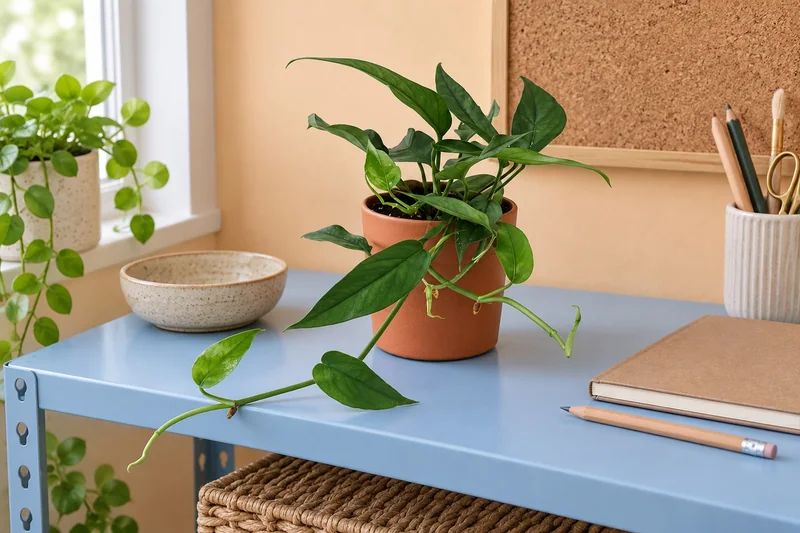
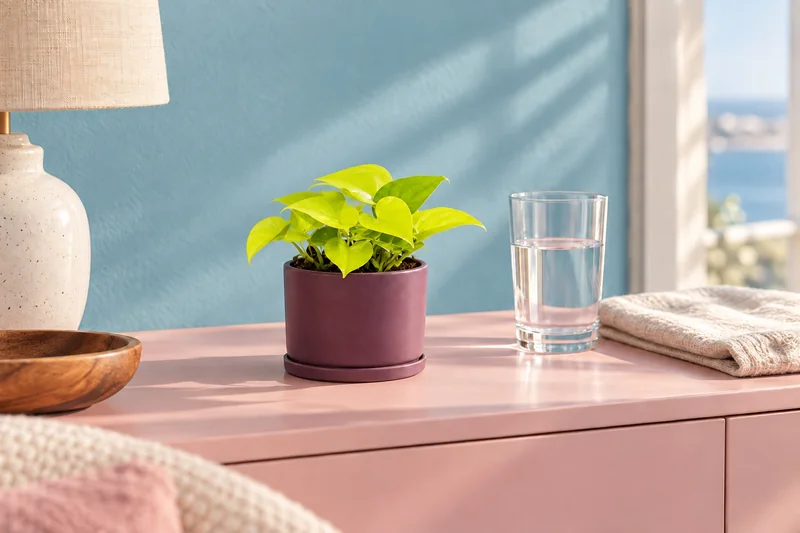
The shop describes Efeutute, Golden Pothos and Happy Leaf. Here these names designate the offered foliage and commercial forms; we infer no three clearly separate botanical species. Three individual plants are delivered, each in a twelve-centimetre pot and at about fifteen centimetres overall height. The original photograph shows their different foliage. Keep any existing labels. The decorative scene illustrates a possible shelf position; its decorative pot covers and furnishings are not part of the set. Delivery height is no measurement of later trailing-stem length.
A bookcase must receive daylight
Plenty of indirect daylight suits well. A bright leaf colour does not turn a deep room corner into a good plant position. Cream-white areas especially deserve a place where enough light reaches the plant. Assess hot midday sun behind glass slowly and carefully after transport. We look at new leaves and spacing along shoots. Long loose growth is a reason to check the position. Look at the placement of all three pots occasionally rather than only turning the prettiest side forwards and losing sight of new tips.
Each trailing stem starts in its own root ball
Before watering, feel the surface and lift the inner pot. Once upper soil has dried slightly, water thoroughly and allow excess to drain. Check pot covers afterwards for water. A pot with more fresh foliage may become lighter sooner than its neighbour. So do not simply give all three the same amount on the same calendar. If leaves become limp, look at the actual root ball first. Dryness and roots kept wet for longer may give similar signals. An easily reached shelf makes this check simpler and also protects furniture when pots are removed for watering.
Choose trailing or climbing consciously
Pothos can lead shoots over an edge or grow on suitable support. With a climbing aid, guide young tips gently without tying them tightly. The pot stands securely and stays accessible for moisture checks. A desired direction is no reason to cut all shoots strongly on a regular basis. If a trailing stem becomes too long, it can be shortened selectively at a suitable leaf node. Healthy sections bearing a node can be rooted. Wear gloves for these tasks and put cut pieces away immediately. A single leaf without a suitable stem node is no complete basis for a new trailing stem.
Roots and nutrients support the structure
A loose well-draining mixture is the foundation in the pot. When densely rooted, choose a suitable next container size without setting the little plant in a lot of unrooted soil. Check the trio individually: not every pot must move on the same day. During visible growth, feed according to the fertiliser label and consider pre-fertilisation already present. In winter, the position stays warm and bright; reduced growth usually calls for less water and nutrients. Cold draughts during ventilation or a tight spot above the radiator complicate care more than a missed extra feeding appointment.
Attractive foliage plants get a safe position
Pothos do not belong at an accessible nibbling height. Their parts can cause irritation when eaten and are unsuitable for children and pets. Clean hands after handling and use gloves when cutting. Remove dust gently from firm leaves and examine shoot bases for unusual signs. Old damaged patches do not become green again; new growth shows better whether a correction helped. A short note for each plant keeps an overview. Three small delivered plants thus become a collection whose different colours and directions of growth we can accompany attentively.
One plant, several views
Good to know
Are these three separate plants?
Yes. Three plants are offered, each in a 12 cm pot.
Are the shop names three clearly different species?
These names are treated here as commercial forms of the offered pothos; no unsecured separation into species is claimed.
Do the trailing stems stay fifteen centimetres long?
The figure describes young overall height including pot. The shoots continue to grow.
May the trio stand on a bookcase?
Yes, if sufficient filtered daylight reaches it and the plants stay easily accessible.
Must I water all of them alike?
No. Check surface moisture and the weight of each inner pot.
Are the leaves suitable for pets?
No. Do not eat and position out of reach of children and pets.
Sources and editorial note
- Exotenherz: offer and original images (02.10.2026)
- NC State Extension: pothos cultivation and safety (02.10.2026)
- RHS: houseplant cultivation (02.10.2026)
Shop offer, article number, GTIN, availability and original images checked directly on 02.10.2026. Specialist sources read directly. Efeutute and Golden Pothos not claimed as certainly separate species; Happy Leaf without unsecured pinnatum attribution. Specific delivery measurements from the set description.