This plant at Exotenherz
Check the shop offer for current availability, price and what is included.
Product and delivery details are given in the individual offer.
Your care table
| Topic | What to do | Why it helps |
|---|---|---|
| Light | Place in bright light and protect from suddenly hot midday sun. | Even very dark leaves need light for strong new growth. |
| Water | Water thoroughly after the top layer of soil starts drying, then let it drain. | A constantly moist root ball and water in the outer pot endanger the roots. |
| Position | Grow in even warmth, without cold draughts or a direct stream of heating air. | Sudden changes can trigger leaf loss. |
| Pot | Use a drained, stable container and loose houseplant compost. | The upright stem needs support and the root ball needs free drainage. |
| Leaves | Remove dust with a soft damp cloth while supporting the leaf. | Large smooth leaves gather dust; delicate attachment points should not be bent. |
| Feeding | During active growth, feed moderately according to the liquid fertiliser label. | More nutrients do not repair a lack of light or root damage. |
| Pruning | If necessary, prune in spring with clean tools and gloves. | The escaping latex can irritate; pruning changes the future structure. |
| Winter | Keep bright, check the root ball and water less often with reduced growth. | Less light lowers water use, but does not make a warm dark corner suitable. |
Check the compost and pot weight. The care table explains how far the compost may dry.
Water only when needed. The water should reach the root ball without spilling over the rim.
Remove surplus water from the saucer or cachepot. Then return the plant to a suitable position.
Dark leaves with a warm colour accent
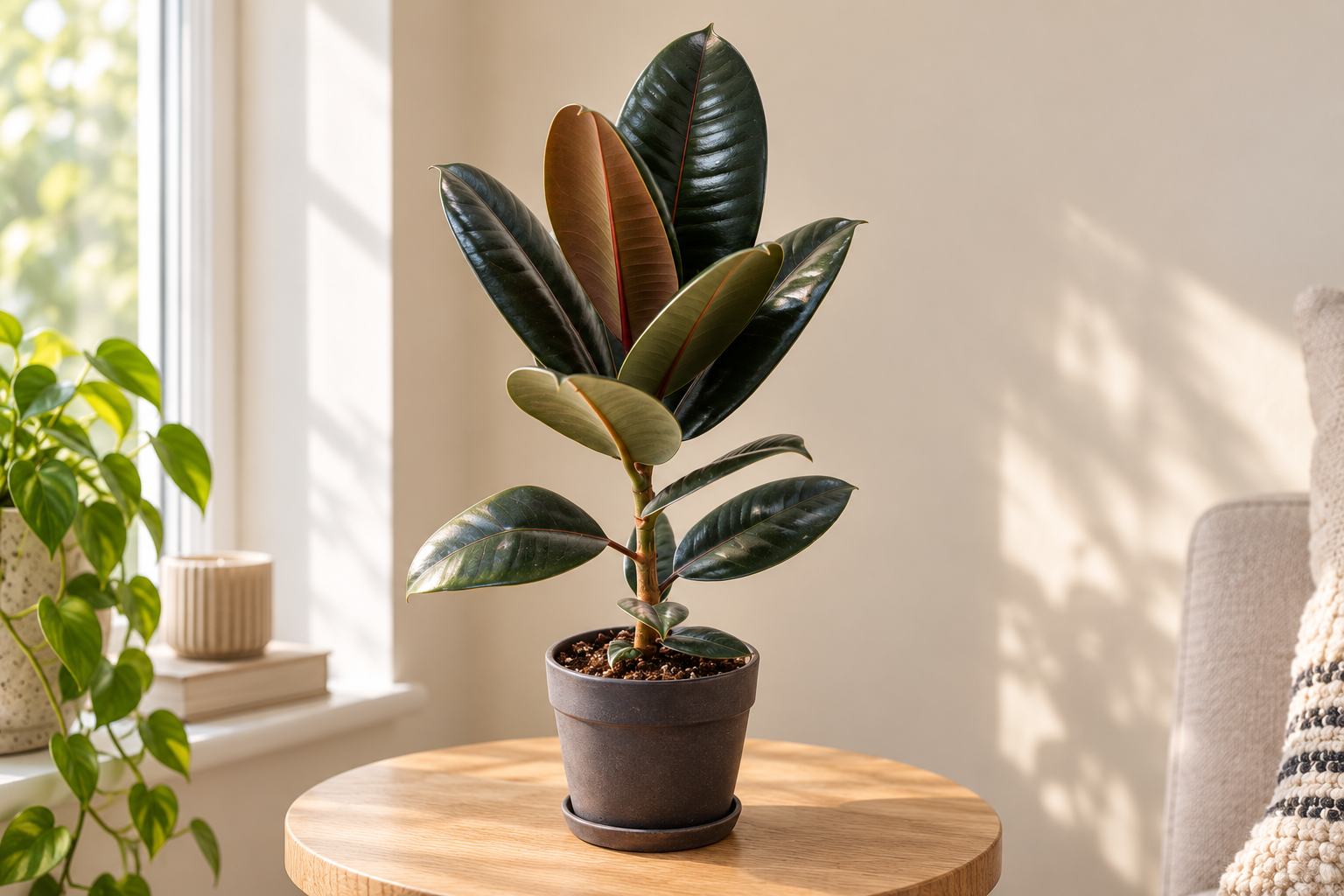
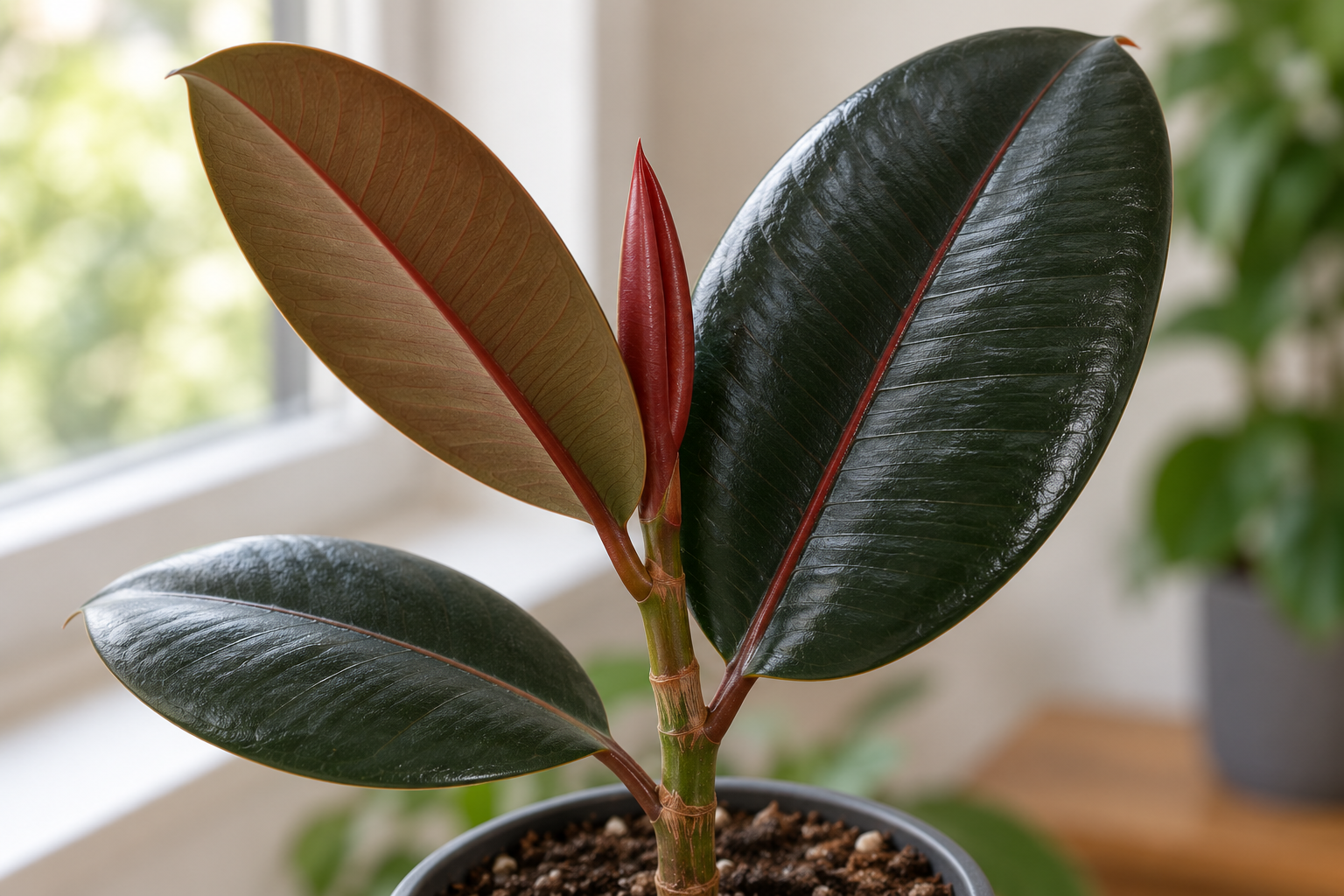
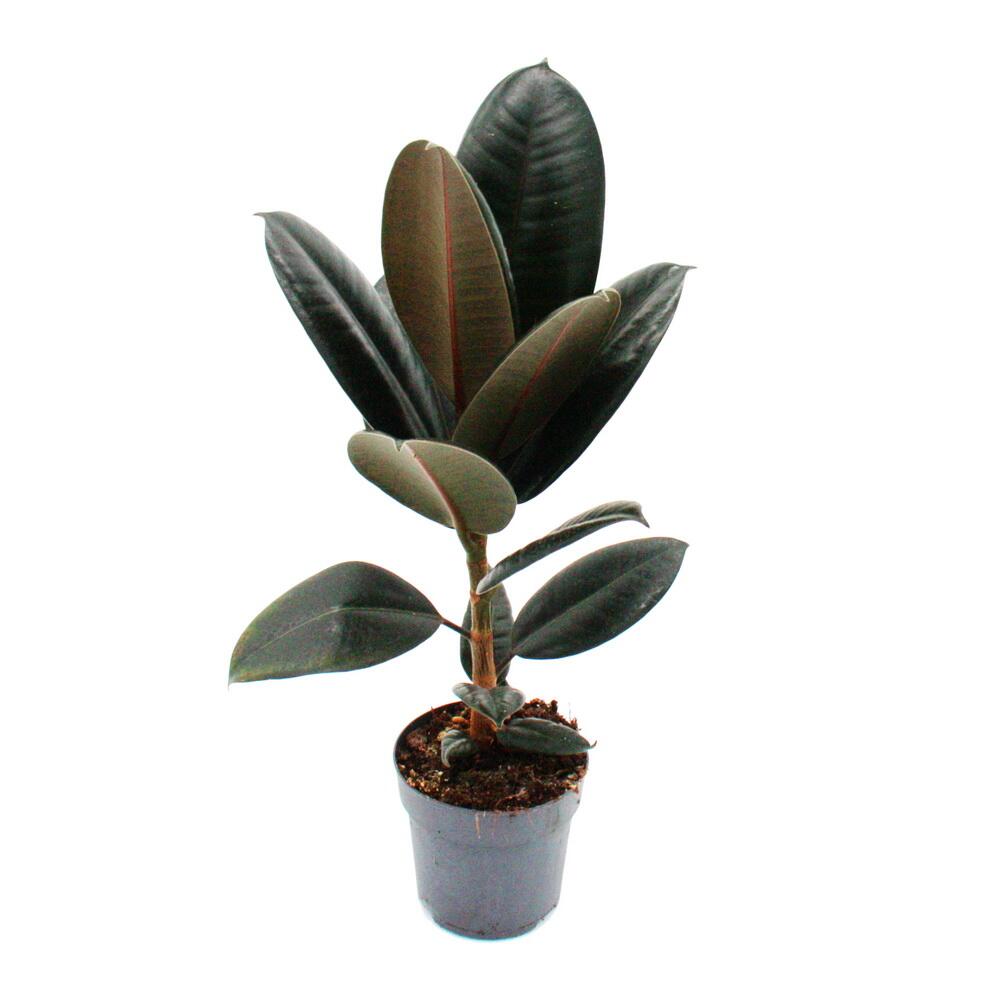
Abidjan comes alive through the combination of dark upper leaf surfaces and warm details. Its broad oval leaves shine very dark green; light from the side reveals the bronze underside and a dark red midrib. At the tip stands a slender red sheath from which the next leaf unfolds. This makes the plant look lively even without flowers, without needing a colourful pattern. The own original shows a young upright rubber plant with several strong leaves on one stem. Each new rolled leaf can be observed on a clear, bright surface. A light wall colour can show off the dark foliage well, but matters less for cultivation than the window light that actually reaches it. Do not force an individual leaf round to face the viewer. Its position belongs to the plant’s structure, and rough handling can damage the strong leaf stalk.
A named selection with room to keep growing
Abidjan is a horticultural selection of Ficus elastica in the mulberry family. The species comes from South and Southeast Asia. Black Prince is another documented name for this selection. Abidjan does not have the white-cream leaf margins of Tineke or the pink marginal variegation of Belize; its feature is a very dark smooth leaf surface with bronze-red details. The linked offer states an 11 cm pot and approximately 30 to 40 cm total height. These are offer measurements, not a promised mature size. Over the years, a rubber plant develops a taller woody structure and can branch. Plan a place early where it will not soon collide with a windowsill shelf or a narrow shelving space. Good cultivation and pruning if necessary can accompany its growth; a small delivery pot does not make it a permanent miniature.
Dark foliage also needs a bright position
Choose a bright place with filtered or indirect light. The dark leaf colour does not mean that Abidjan will keep growing strongly in a dark corner over the long term. In insufficient light, the spaces between leaves can increase and new leaves become weaker. After transport or a longer period in lower light, introduce stronger sunshine gradually. Suddenly hot midday sun behind glass can leave visible damage, even though a rubber plant generally likes a bright position. Keep it away from an icy windowpane and an open window with cold draughts. A direct stream of hot heating air is equally unfavourable. A calm, evenly warm place is more useful than frequent moves to try a different room decoration. If a change of position is necessary, observe the new growth and root ball afterwards rather than radically changing several aspects of care at the same time.
Let the root ball dry slightly and drain the water completely
Before watering, check the top layer of soil and the weight of the pot. When the soil starts to dry at the top, water thoroughly until excess water emerges from the drainage holes. Afterwards let the pot drain and remove water from the saucer or outer pot. This is particularly important with a small nursery pot whose condition can easily go unnoticed from outside. Neither complete lasting dryness nor constantly wet soil is the aim. A bright warm place with new growth uses more water than a dark winter position. This does not create a rhythm that is identical every week. If leaves turn yellow or fall, inspect the root zone before watering more. Wet soil in which the roots no longer work well can cause stress signs similar to dryness. An extra sip of water cannot distinguish between these situations; an actual root-ball check can.
A stable pot and an airy root zone
Loose houseplant compost and a container with free drainage suit Abidjan. The pot should also be stable enough for the upright stem. A closed decorative container can serve as an outer pot if the nursery pot can be removed for watering and no residual water remains inside it. If the roots are crowded in the current pot or the plant becomes top-heavy, spring is a good time to repot. Choose the next diameter to suit the root ball rather than immediately offering a large container of compost. A lot of unrooted soil stays moist longer. Lift the plant by the root ball and container, not by its large leaves or young red tip. During visible growth, moderate nutrient doses according to the label of a suitable houseplant fertiliser are sufficient. After repotting, account for any fertiliser already in the compost. With little winter growth, reduce or suspend extra applications accordingly.
Leaf care and pruning with respect for the latex
The large smooth leaf surfaces collect dust over time. When necessary, wipe them with a soft slightly damp cloth and support the leaf from underneath. Leaf-shine products and rough rubbing are not needed. Take the opportunity to check undersides and leaf bases for scale insects, mealybugs or fine webs. Do not pull off a healthy young red sheath simply to see the new leaf sooner. If the stem later becomes too tall, targeted pruning can influence its structure. Work with clean sharp tools and gloves, since the escaping latex can irritate skin. Also protect the work surface from drips. A cut does not guarantee symmetrical branching at precisely the desired point. Air layering is one option for propagating an already larger rubber plant; a single cut leaf, however, is not a reliable promise of a new branched tree.
Recognise winter rest and check individual stress signs
In winter, Abidjan stays in the brightest possible, evenly warm place. If it grows more slowly, the root ball often dries more slowly and consequently needs water less often. Continue to check its moisture rather than either watering unchanged or forgetting the plant for weeks. One old lower leaf may age; rapid loss of several leaves deserves a check of light, draughts, water and roots. Also look for a recent move or cold transport. Brown damaged leaf areas do not turn green again. A stable condition and healthy new leaves therefore guide subsequent care. Sticky deposits or webs call for closer examination and separation from other plants if necessary. Abidjan is an ornamental plant, not food. Place it out of reach of small children and nibbling animals so its dark glossy leaves can be enjoyed calmly.
One plant, several views
Good to know
Is Abidjan the same as Tineke?
No. Abidjan has very dark upper leaf surfaces with bronze-red details; Tineke has pale marginal variegation.
What does Black Prince mean?
The RHS documents Black Prince as another name for the selection Ficus elastica Abidjan.
Can this dark rubber plant stand in a dark corner?
Abidjan also needs a bright place for strong growth. Very little light is not equivalent long-term cultivation.
When should I water?
When the upper soil starts drying and the root ball is less moist. Then water thoroughly, allow free drainage and remove residual water.
Is 30–40 cm the final height?
No. This is the approximate total height of the linked offer; the woody rubber plant can grow considerably further.
Do I need to take care when pruning?
Use gloves and clean tools. The latex may irritate skin and should not enter eyes or mouth.
Sources and editorial note
- Exotenherz: complete own offer and unchanged original gallery
- RHS: Ficus elastica Abidjan, accepted selection and cultivation
- NC State: Ficus elastica, species description and practical indoor care
Sources compared: 4 October 2026. The complete own shop offer and clean original gallery were read and viewed. Offer measurements describe the young plant offered and are not its eventual mature size.