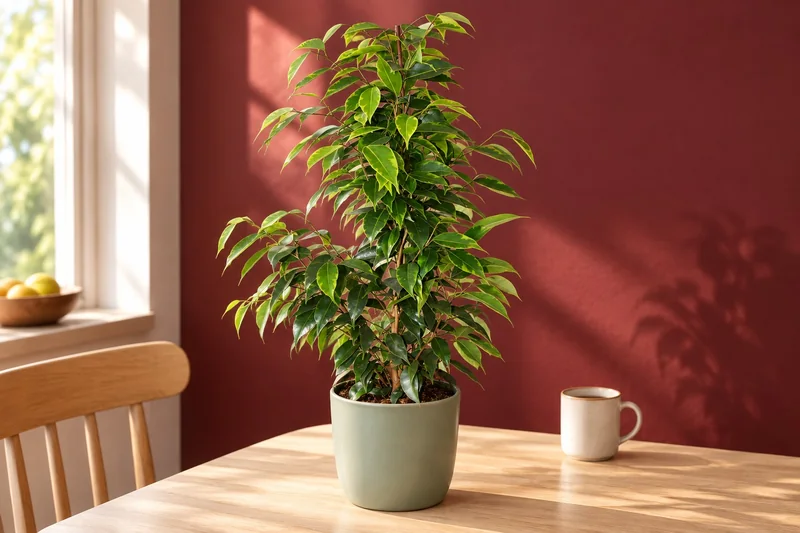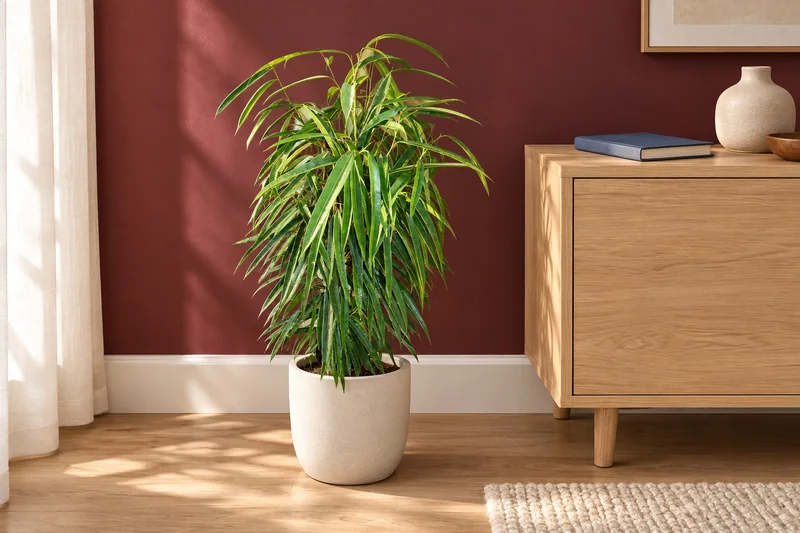
This plant at Exotenherz
Check the shop offer for current availability, price and what is included.
Check the selected shop offer for price, availability and delivery contents.
Your care table
| Topic | What to do | Why it helps |
|---|---|---|
| Light | Bright and protected from hot midday sun. | The small crown needs light reaching its inner branches. |
| Water | Water thoroughly after slight drying of the upper soil. | Neither dry the root ball completely nor leave it standing in water. |
| Soil | Loose houseplant compost; pot with drainage. | Moisture stays manageable this way. |
| Nutrients | During visible growth, feed sparingly according to the label. | Without fresh shoots, the plant needs no extra push feeding. |
| Room climate | Evenly warm; keep cold air away while ventilating. | Draughts and strong changes burden settling in. |
| Repotting | Choose a slightly larger pot only when the root ball is densely rooted. | A large reserve of unrooted soil holds water unnecessarily long. |
| Pruning | Shorten individual overlong branches selectively; wear gloves. | Milky sap can irritate skin. |
| Checks | Look at branch forks and leaf undersides too. | Scale insects and mealybugs are easily overlooked in dense foliage. |
Check the compost and pot weight. The care table explains how far the compost may dry.
Water only when needed. The water should reach the root ball without spilling over the rim.
Remove surplus water from the saucer or cachepot. Then return the plant to a suitable position.
The pleasure lies in the small leaves
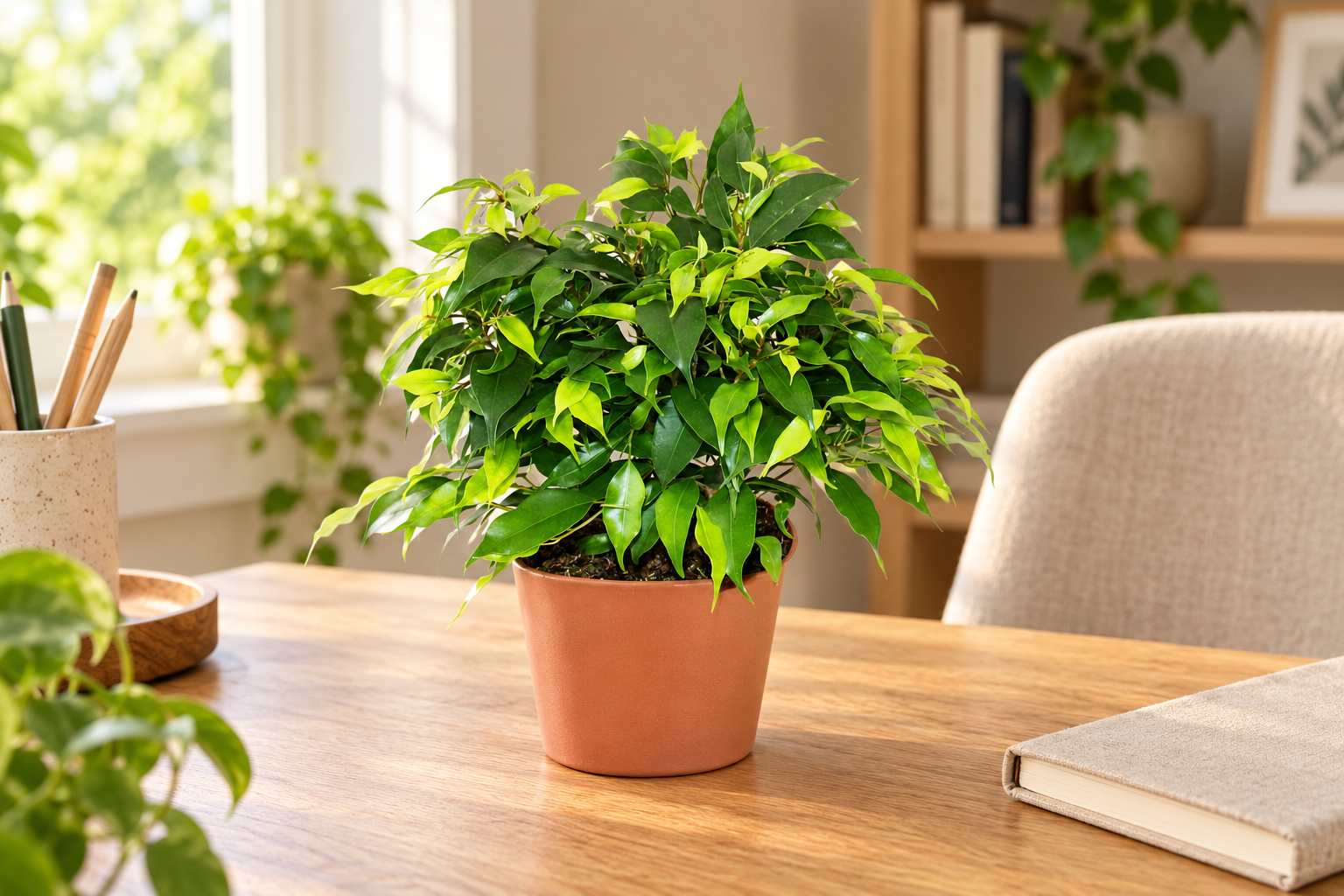
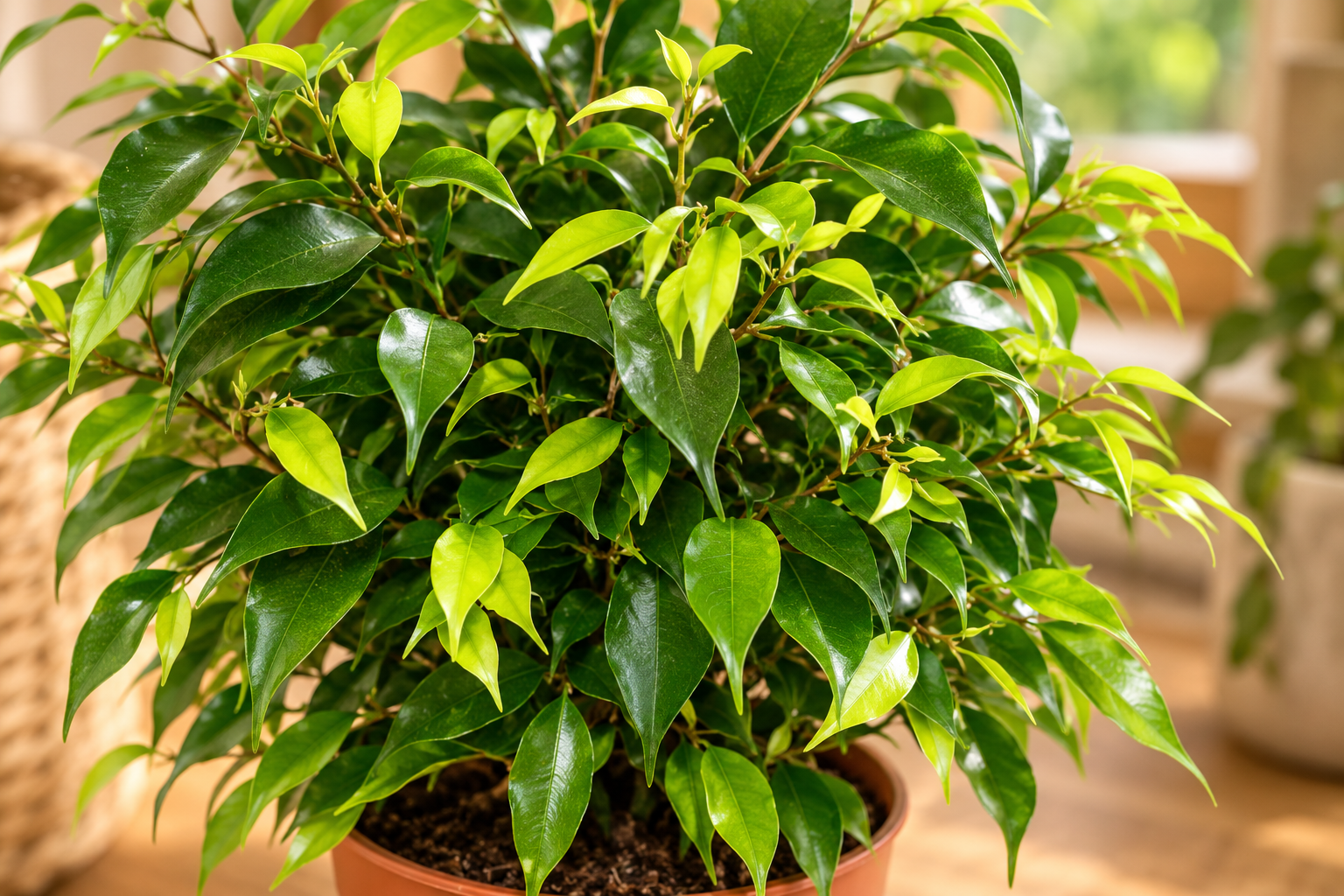
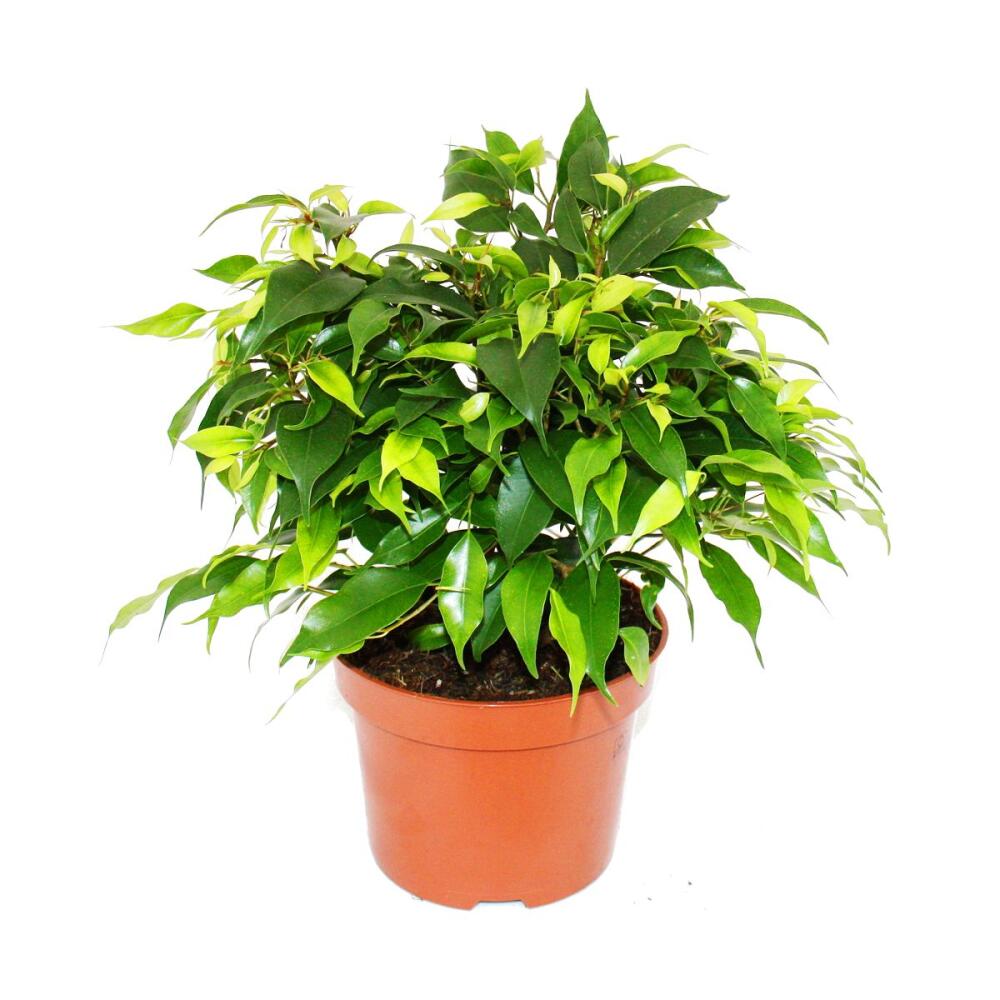
Kinky Green rewards a second look. Narrowly pointed leaves sit on fine branched shoots; young leaf tips stand out slightly paler than the older green. Unlike a large fiddle-leaf fig, this weeping fig lives through the interplay of many small surfaces. The original shows a compact young bush without a thick bonsai trunk. It thus looks lively on a bright desk or shelf without immediately occupying the whole space.
20–25 cm is the beginning
The offer includes one plant in a 12 cm pot at about 20–25 cm overall height. This delivery specification is no permanent growth limit. Leave some air around the crown so new branches do not immediately hit folders, wall or curtain. A stable decorative pot may hold the inner pot, but must remain accessible for residual-water checks at any time. Decoration in our scene shows a furnishing idea and is not part of the plant offer.
A well-chosen position saves many moves
Choose a bright warm place outside hot midday sun. The fine crown should face light freely; behind a row of other plants it quickly becomes shaded. What matters is not reinventing its position every day after arrival. Ficus benjamina can respond to a light change by dropping leaves. Therefore first observe new shoot tips and the root ball before moving it again because of a few fallen leaves. Cold draughts during ventilation can often be avoided by briefly moving it away.
Really get to know the small pot
Lift the inner pot before watering and check the upper soil. If it has dried slightly, water slowly so the root ball can absorb water evenly. Excess must drain; a dry surface crumb does not mean it is also dry below. Particularly with a densely leaved little plant, it is worth reaching carefully beneath the crown rather than deciding from foliage appearance. Set no fixed weekday initially, but learn how quickly this pot becomes lighter at its actual position.
Develop roots and crown together
After settling in, moderate feeding according to the fertiliser label suffices during visible growth. More fertiliser does not replace a suitable position. Repotting becomes sensible when the root ball is densely rooted and water supply in the current container becomes hard to manage. Choose loose potting soil and only a little extra room. Individual troublesome branches may be shortened selectively; before cutting, consider what gap this would create in the fine crown. Gloves, clean tools and a wipeable surface make handling escaping milky sap easier.
In winter, the position at the pot matters
When less light arrives and few new leaves form, water and nutrient needs usually decline too. This means no complete dry rest. Continue checking the root ball and reduce supply according to actual drying. A position directly above hot heating air or immediately against cold glass adds stress. Therefore check not only room temperature but also the little plant’s situation on its piece of furniture.
Read leaf fall as a clue
Individual older leaves and sudden strong foliage loss are different situations. With continuing leaf fall, check light changes, draughts, a dry or wet root ball and branch forks for pests in turn. Sticky patches, small firm shields or cottony deposits call for closer checks. Do not water more preventively when soil is already wet anyway. Kinky Green is an ornamental plant; leaves and milky sap do not belong in the mouth or eyes. Put it where children and animals cannot nibble it.
One plant, several views
Good to know
Does Kinky Green stay only 25 cm tall?
No. 20–25 cm is the overall height of the offered young article. The plant may continue to grow over time.
Is this the white-edged Kinky?
No. The specific offer and original picture show the green form Kinky Green.
What should I do after a few fallen leaves?
First check position changes, draughts and root-ball moisture. More frantic moves or extra water may worsen the situation.
May water remain in the decorative pot?
No. Check after watering and remove residual water.
Must I clip the crown round regularly?
Not necessarily. Individual overlong shoots can be shortened selectively, leaving natural branching clearly recognisable.
Can it stand on a dark shelf?
That does not suit a permanent position. Even the green form needs a bright place.
Sources and editorial note
- Exotenherz: offer and original images (02.10.2026)
- NC State Extension – Ficus benjamina (02.10.2026)
- RHS – Ornamental figs (02.10.2026)
- Ball Horticultural – Ficus Kinky cultivation guidance (02.10.2026)
Shop offer, article number, GTIN, availability and original images checked directly on 02.10.2026. Specialist sources read directly. Shop variant 174902112020 checked with the original picture, retrieved 02.10.2026. Green form separated from the white-edged form. No general species ultimate height transferred to the specific young plant. Sources read personally; grower cultivation figures not adopted as rigid room rules.