This plant at Exotenherz
Check the shop offer for current availability, price and what is included.
Product and delivery details are given in the individual offer.
Your care table
| Topic | What to do | Why it helps |
|---|---|---|
| Light | Choose sun or suitable partial shade. | Woodland edges also need enough light and monitoring of the soil. |
| Soil | Prepare free-draining soil. | Persistent waterlogging remains unsuitable even for vigorous growth. |
| Planting | Plant moistened rootballs at their previous depth and water in. | The young roots first need to grow into their new surroundings. |
| Water | Supply according to need during establishment and prolonged drought. | The drought tolerance of older plants is not a promise for newly planted young plants. |
| Spacing | Plan around 30–40 cm as a starting point for a group. | Bed shape, neighbours and later width may make other spacings useful. |
| Feeding | Feed moderately in spring if required. | Heavy feeding is unnecessary for this low foliage planting. |
| Pruning | Remove spent stems, damaged foliage and encroaching edges as needed. | Healthy growth does not require constant complete cutting back. |
| Winter | Maintain drainage and judge foliage according to weather. | Semi-evergreen does not mean unchanged foliage throughout every winter. |
For young plants, feel the soil directly at the root ball. The surface and deeper soil may have different moisture levels.
Water thoroughly after planting; later, water according to the soil, weather and establishment rather than a fixed calendar.
Avoid standing water. For plants in containers, also check that water runs out of the drainage hole.
A strong colour for early summer
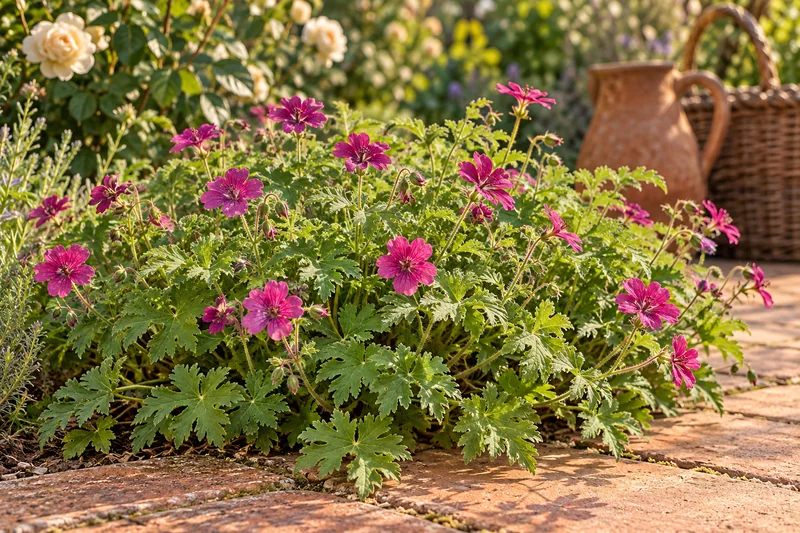
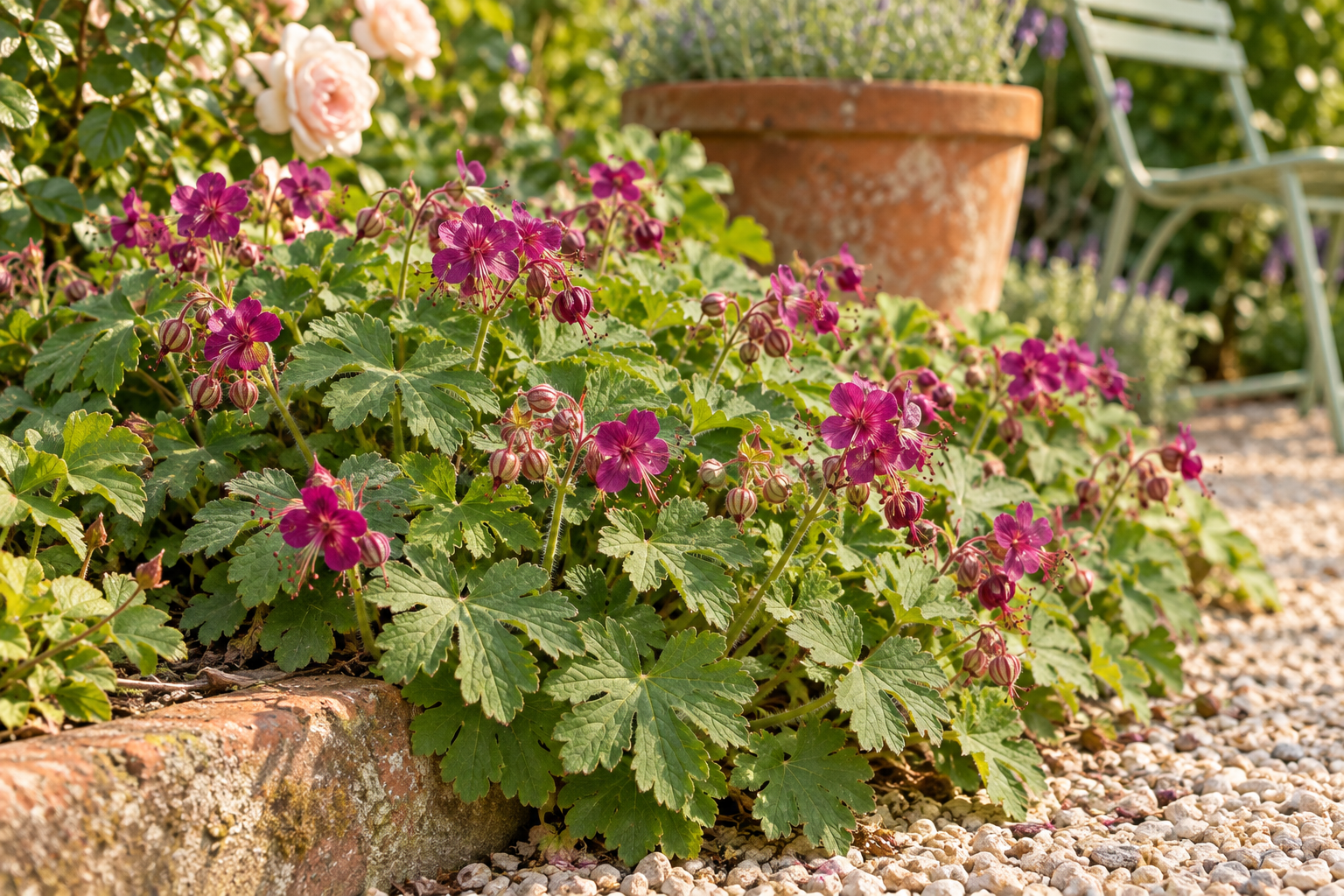
Bevans Variety stands out with a distinctly stronger flower colour than soft pink varieties of Balkan cranesbill. Its open, five-petalled flowers glow purplish pink to magenta. Reddish-brown calyces and prominently projecting stamens add depth. Underneath, rounded, lobed foliage forms a dense green base and releases an aromatic scent when touched. I like to use this variety as a calm, repeated group along a path. Its colour can stand out there without the entire bed having to be packed with flowers. The shop uses Bevans Variety; the botanical variety spelling is Bevan’s Variety. The portrait identifies both names as belonging to the same assigned variety rather than inventing a supposed difference between plants.
Design with later width in mind
Geranium macrorrhizum develops strong spreading shoots and can occupy a larger area over the years. Depending on its development, its height lies around thirty to fifty centimetres; its width requires separate long-term consideration. To start a group, I plan around thirty to forty centimetres spacing as planting guidance. This is not a quantity specification in the shop offer, nor a guarantee of immediately closed coverage. A different arrangement may suit the space between a narrow path and tall perennials than beneath a larger shrub. Smaller, weaker neighbours receive room so that they do not disappear within an already dense foliage group. Before planting, the pots are therefore arranged and the overall picture considered.
A sunny edge or light partial shade
Sun and suitable partial shade offer good possibilities. Drier woodland edges may also suit established growth, but that condition has to be reached first. Rain is distributed differently beneath tree canopies, and larger roots also consume water. I therefore check light and moisture together. A corner that looks green from outside can be very dry right beside the young roots. Permanently wet, compacted soil is the other unsuitable extreme. The ground is loosened gently and adequate drainage ensured. In very poor soil, a moderate humus-rich addition may help. The place should suit the perennial, rather than trying to cover up a fundamentally unsuitable situation with lots of fertiliser.
Give the set plants time to settle
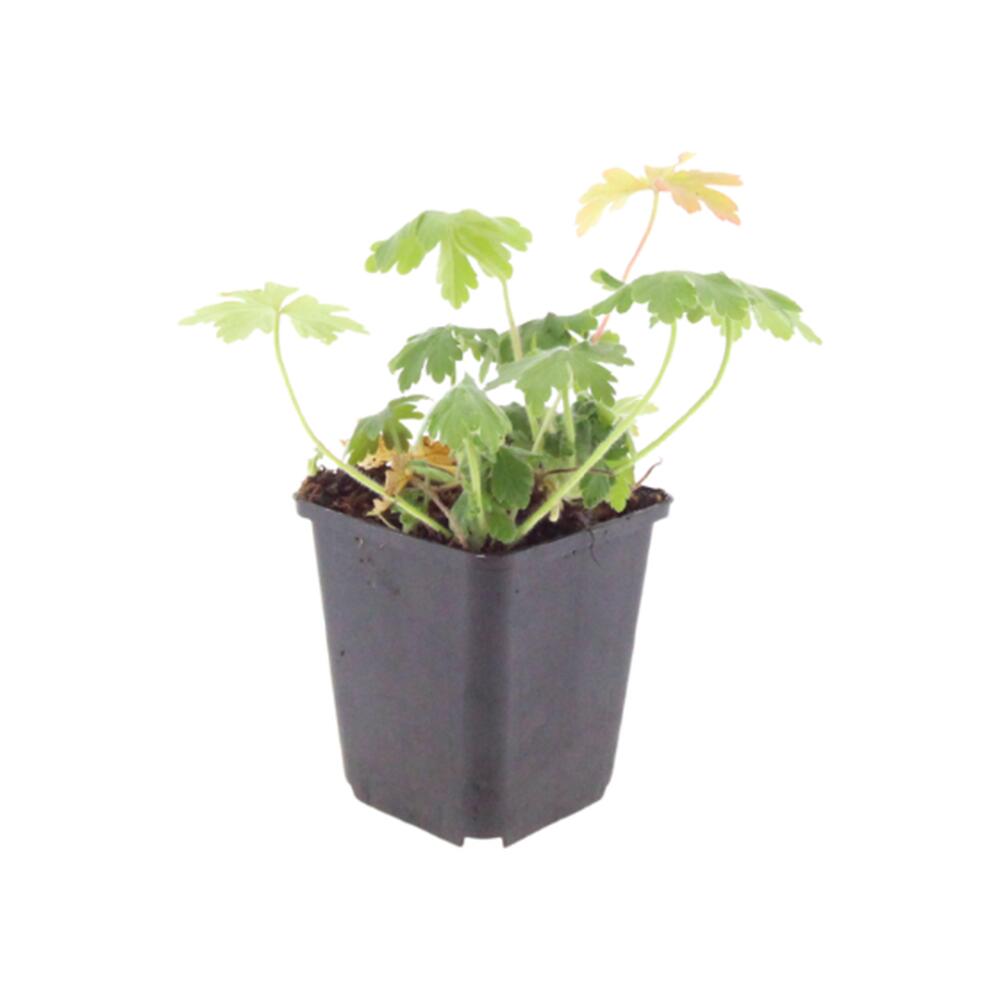
The offer specifies nine-centimetre pots and young plants around ten to twenty-five centimetres tall. Sets of six, twelve, twenty-four, forty-eight or sixty plants allow different areas to be planned. Each individual plant still needs a good start. I moisten the rootball, plant at its previous depth, firm the soil lightly and water in. Spring and early autumn are practical planting times in frost-free, workable ground. Hot, dry days demand particular attention or a more favourable date. The original rootball is checked in the following weeks. Moist soil around it helps little if watering repeatedly fails to reach the small pot rootball.
Water needs change with the roots
A vigorous, established Balkan cranesbill handles temporary drought better than freshly planted young plants. This development is a reason to adapt the care. Initially I observe more frequently, later mainly during longer dry periods and when the foliage looks unusual. I water according to the actual condition, without making a fixed weekday the rule for every position. Containers need their own checks because less soil volume is available. Moderate feeding is supplied in spring if needed. Unnecessarily lush, soft growth is not the aim. A balanced supply and enough time to root benefit the whole group more than ever-stronger doses of nutrients.
Follow flowers, autumn foliage and spring growth
The rich pink flowers appear mainly in late spring and early summer, often May and June. Spent stems are removed as required. Radical cutting back does not guarantee lasting further flowering; after the floral display, the planting can make its impact through foliage. Warm reddish to bronze shades may appear in autumn. Some foliage remains in mild conditions, whereas a harsher winter may bring greater leaf loss. Before new growth, I carefully remove damaged old parts. Unusual spots, feeding damage or a suddenly weakened whole plant are considered separately. Normal autumn colour and individual old leaves, however, are no reason to cut every healthy area right back immediately.
A living edging needs occasional care
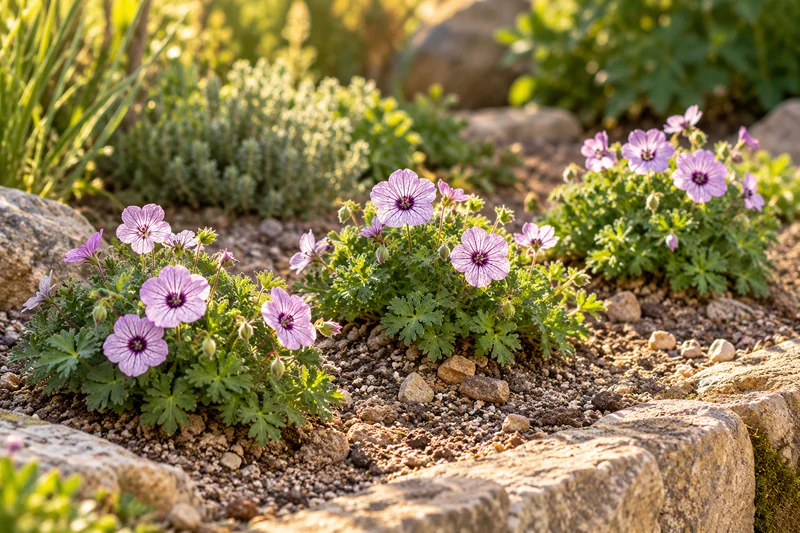
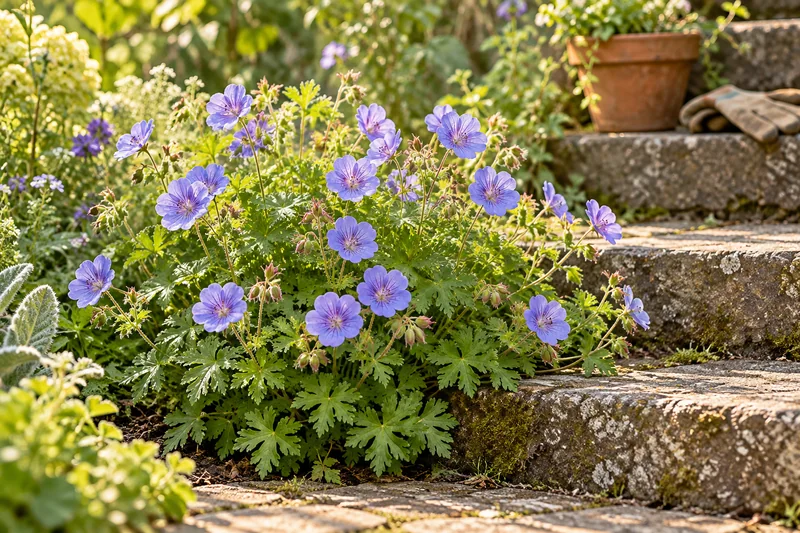
Where the group grows beyond its intended boundary, intrusive edge shoots are cut back. This keeps the path passable and preserves space for smaller neighbouring plants. Older, vigorous groups can be divided in spring if required. The new pieces are planted with enough roots and watered in again afterwards. I do not divide in intense heat simply because the area happens to be accessible. A well-developed planting can retain its own structure for several years. The unchanged original photograph shows the young green potted plant. The designed garden scene adds later foliage and the strong flower display based on the variety’s characteristics. It explicitly represents neither delivery size nor an already fully flowering set quantity.
One plant, several views
Good to know
What is the variety name?
Bevans Variety in the shop; botanically Bevan’s Variety. The portrait explains both spellings.
What colour are the flowers?
Rich purplish pink to magenta with reddish-brown calyces.
Is the plant perennial?
Yes. How much foliage remains in winter depends on the weather.
What spacing is useful?
Around 30–40 cm can be a starting point for a group. Allow for bed shape and later spread.
Do newly planted plants need water?
Yes. Only vigorous, established growth can bridge dry periods better.
Must the group be completely cut back after flowering?
No. Remove intrusive stems and damaged foliage as required.
What quantities were checked as available?
Sets of 6, 12, 24, 48 and 60 plants; the current individual shop offer remains decisive.
Sources and editorial note
- Exotenherz: offer and direct set variants (01.10.2026)
- RHS: Bevan’s Variety, flower characteristics and cultivation (01.10.2026)
- Morton Arboretum: Balkan cranesbill and varieties (01.10.2026)
- RHS: planting and caring for cranesbills (01.10.2026)
The shop name and direct child offers were checked individually live against SKU/GTIN. Unavailable sets are inactive in the register. Originals remain unchanged and without unverified advertising seals; scenes explicitly show later garden growth. Flowering, height, lifespan, planting time and spacing are separated from delivery size. Spacing of 30–40 cm is editorial planting guidance, not claimed as a shop specification.