This plant at Exotenherz
Check the shop offer for current availability, price and what is included.
Product and delivery details are given in the individual offer.
Your care table
| Topic | What to do | Why it helps |
|---|---|---|
| Light | Choose a partly shaded to shaded woodland edge. | The species suits these places; hot dry sun demands more attention. |
| Soil | Prepare moderately nutrient-rich soil without permanent waterlogging. | The perennial can use various soils but needs a functional root zone. |
| Planting | Set the moist root ball at its previous height and water in. | The young plant must root into garden soil. |
| Spacing | Allow roughly 25 cm between plant centres as an offer guide. | Later loose growth links individual planting spots. |
| Water | During the first year, check the original root ball for dryness. | Shade does not automatically mean moist soil. |
| Pruning | Reduce spent stems and unattractive foliage as needed. | This can make room for fresh growth and limit seed formation. |
| Feeding | Supply nutrients moderately in spring if needed. | A different positioning problem is not solved by extra nutrients. |
| Young plants | Remove unwanted seedlings early or retain suitable ones. | The species can self-seed in the garden. |
For young plants, feel the soil directly at the root ball. The surface and deeper soil may have different moisture levels.
Water thoroughly after planting; later, water according to the soil, weather and establishment rather than a fixed calendar.
Avoid standing water. For plants in containers, also check that water runs out of the drainage hole.
The small flowers reward a close look
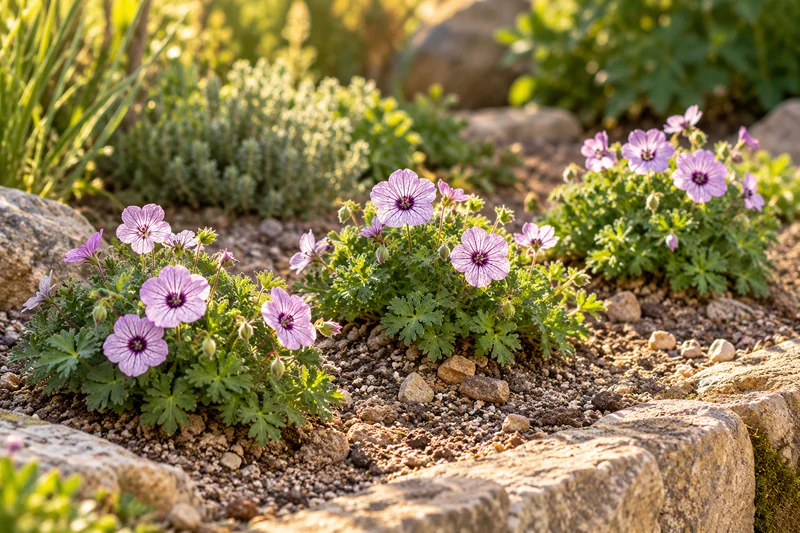
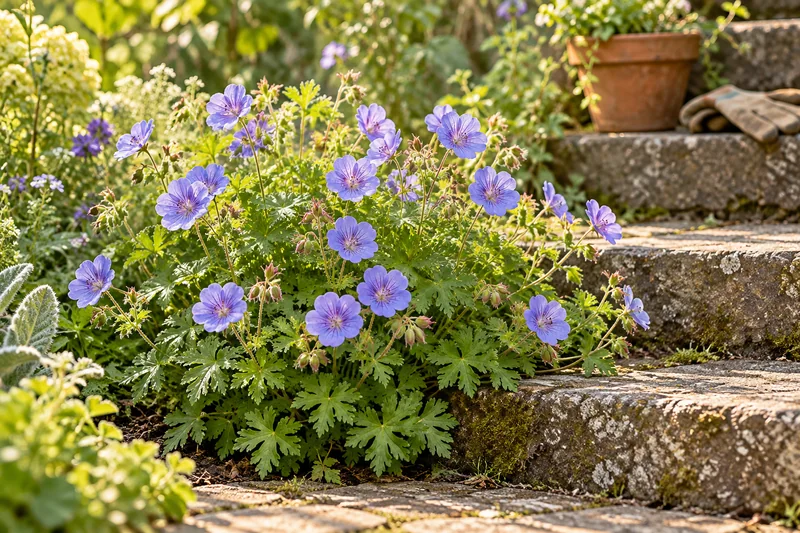
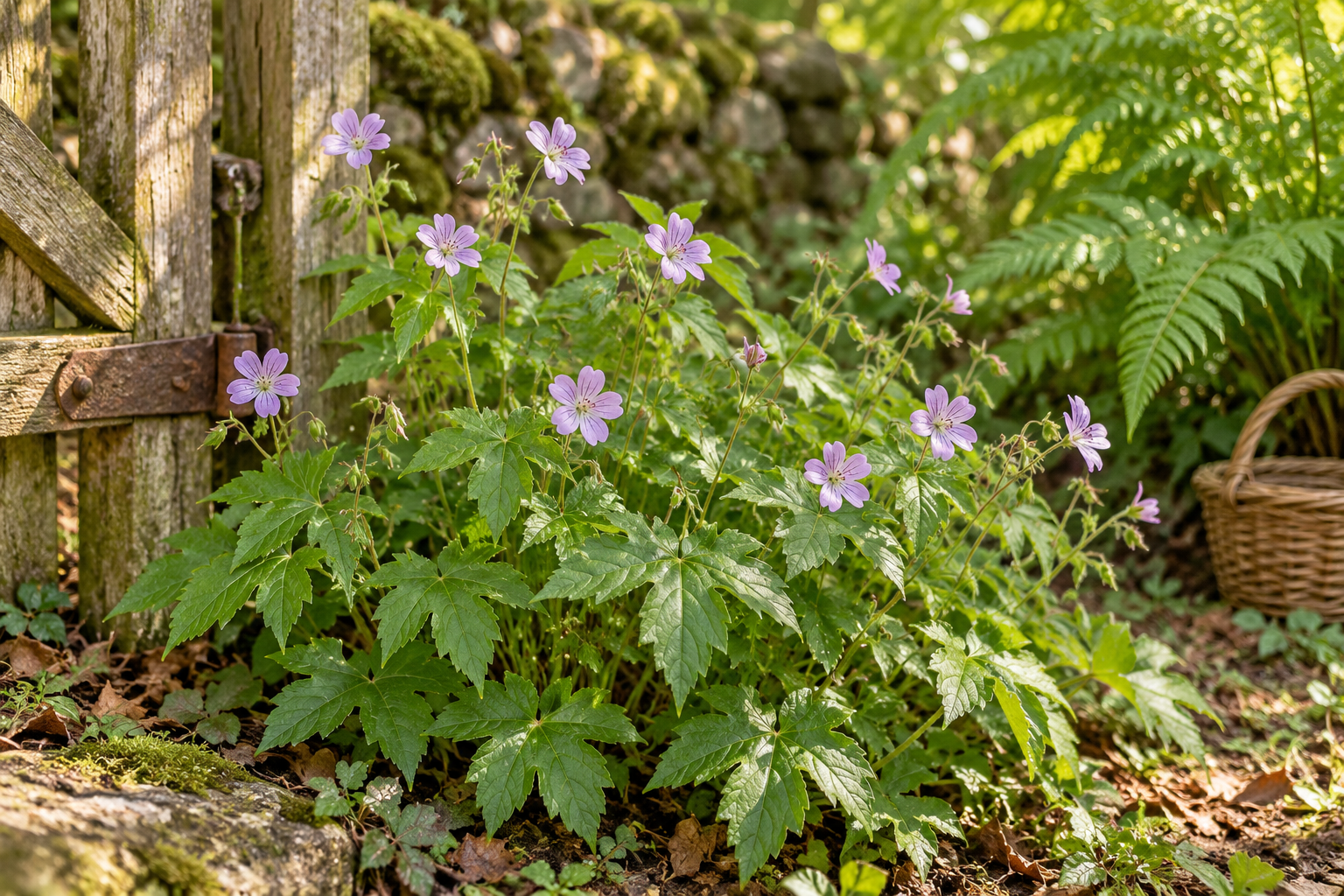
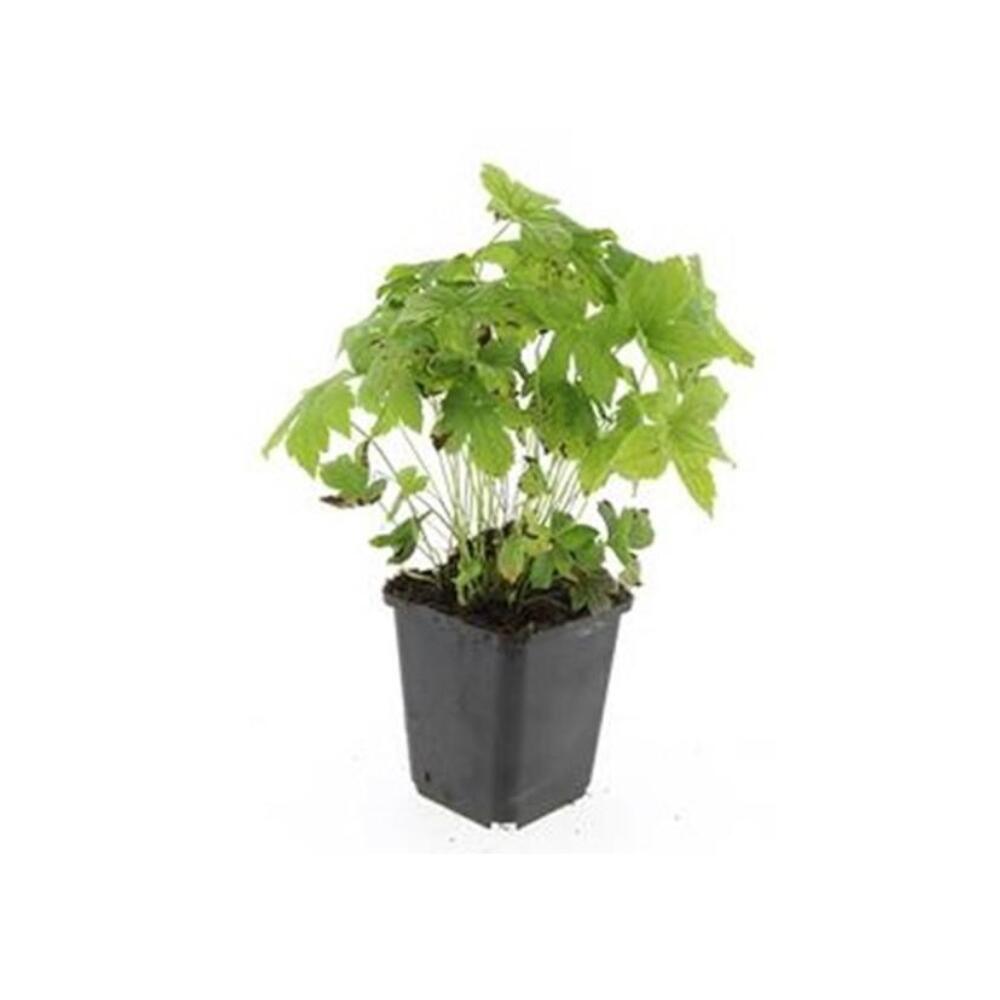
Knotted cranesbill has a quieter effect than a large flowering perennial. Its lilac to pinkish-violet flowers sit loosely above the foliage, and their darker veins are especially visible up close. The five petals can be slightly notched at their tips. Below are glossy leaves with usually three to five clearly recognisable lobes. Stems can be slightly thickened at branches; that contains the clue to its name. For me, the connection between these leaves and the finely marked flowers creates its appeal. The portrait describes the species Geranium nodosum, not a special cultivar identified as deeply dark.
Look at the whole position at the woodland edge
Partial shade to shade suits this perennial. It can accompany open woody planting or a woodland garden edge without every petal needing direct sun. Nevertheless, I do not inspect the position only from above. Beneath large trees, rain can be intercepted and their roots take up water. A cool-looking surface says little about the root ball of a newly planted specimen. Well-drained, moderately nutrient-rich soil is a useful starting point. I want to avoid permanent waterlogging. In a sunnier position, moisture and hot days become more important; shady use is therefore not decoration that can be interchanged arbitrarily.
Develop a loose area from small set plants
Young plants stand in 9 cm pots and are approximately 10–25 cm tall according to the offer. A developed planting can later reach about twenty to fifty centimetres. The right image is a loose perennial garden plant, not an immediately closed low mat. When laying them out, I use the stated roughly twenty-five centimetres spacing, or sixteen plants per square metre, as a guide. Paths, neighbouring perennials and the intended border edge remain visibly included in the plan. The actual child offers lead to six, twelve, twenty-four, forty-eight or sixty plants. A view of the later garden replaces neither that quantity choice nor information about the current flowering state of delivery.
The first season begins at the root ball
Before planting, the small root balls are moistened. I then plant at their previous height, let loosened soil fit well around them and water in. Spring or a suitable autumn are good starting points while soil remains frost-free and workable. During dry periods in the first year, I pay particular attention to the original planting spot. That is where it is decided whether new roots can grow into the surroundings. Give water slowly and then continue care according to condition and weather. If soil stays permanently wet, more watering is no support. Drainage and soil structure must be right first. This close observation helps more than a fixed number of waterings per week.
Consider a longer flowering season with natural pauses
Flowering can start in late spring and continue through summer, often between May and August. In garden cultivation, flowers are sometimes possible into early autumn too. Position, weather and development influence that course. This promises no continuous abundance of flowers every day. The small flowers can appear variously lilac or pinkish violet; their darker veins remain a characteristic detail. With a young plant, establishment comes first. I would therefore not immediately respond to weak flowering with extra fertiliser. First consider light, moisture and the planting’s development so far, then decide on moderate feeding.
New plants may appear, but need a place
Geranium nodosum can self-seed. In open woody planting, that is sometimes welcome when a small plant finds a suitable gap. At a strictly planned border edge, the same offspring can be disruptive. To limit spreading, reduce spent stems before seed ripens and remove unwanted seedlings early. Healthy older plantings can be divided in spring as needed; rooted pieces receive establishment care again. I want neither to remove every new plant as a matter of principle nor to surrender every free patch of ground to it permanently. Design and neighbours determine how much space this natural offspring can sensibly have.
Distinguish leaf change from genuine damage
The species is deciduous. In autumn, foliage can fade and die back while the perennial root area remains. Unattractive leaves and spent stems can be removed; during growth, this can encourage fresh shoots. With a suddenly wilting plant, however, I first look at moisture and root conditions. Feeding marks, unusual spots or a coating require closer consideration than a single old leaf. Not every change is a reason to apply water, fertiliser and hard pruning at once. In spring, new growth and the neighbourhood are organised. The planting is thus accompanied attentively and develops with the garden instead of having to fulfil an unchanging shape.
One plant, several views
Good to know
Is knotted cranesbill perennial?
Yes. The species is a perennial deciduous plant whose foliage can die back in winter.
What flower colour suits the species?
Lilac to pinkish violet, often paler with darker veins. No particular dark cultivar is assigned here.
How long can it flower?
From late spring through summer, often May–August; sometimes into early autumn in gardens. Weather and development influence this.
How tall does it grow?
Approximately 20–50 cm in a developed planting. Delivery plants are considerably smaller at about 10–25 cm.
Can it grow in shade?
Yes. Partly shaded and shady garden edges are suitable uses, provided soil is not permanently waterlogged.
What planting distance do I use?
The offer gives roughly 25 cm or sixteen plants per square metre as a guide.
How do I limit seedlings?
Reduce spent stems before seed ripens and remove unwanted offspring early.
Sources and editorial note
- Exotenherz: offer and five directly checked child products (01.10.2026)
- RHS: Geranium nodosum, flowering and cultivation (01.10.2026)
- InfoFlora: species characteristics, height and flowering period (01.10.2026)
- Hardy Plant Society: cultivation observations from the species collection (01.10.2026)
- RHS: caring for garden cranesbills (01.10.2026)
All five direct children 6/12/24/48/60 available with SKU/GTIN. Shop species and original with glossy 3–5-lobed foliage match. Generic shop statements of deep purple and spring/early summer contextualised against species characteristics: RHS pale pink with dark veins, late spring–early autumn; InfoFlora pale violet May–August. No specific dark cultivar claimed in the offer; species portrait lilac/pink with range, no exact delivery colour assigned. May–August flowering with possible continuation in the garden. Deciduous, self-seeding and its management explained. Original 6 unchanged and advertising-free; scene morphology compared with original and species description.