This plant at Exotenherz
Check the shop offer for current availability, price and what is included.
Check the selected shop offer for price, availability and delivery contents.
Your care table
| Topic | What to do | Why it helps |
|---|---|---|
| Light | Bright, filtered sun; no hot, closed display case. | The delicate leaves need light without overheating. |
| Water | Keep moderately moist during trapping-leaf growth, not permanently waterlogged. | Fine roots need both water and air. |
| Watering method | Water at the edge of the substrate and protect the rosette centre. | Water collecting between leaves can encourage damage. |
| Water quality | Use rainwater or suitable low-mineral water. | This limits unnecessary salt input. |
| Soil | Suitable unfertilised butterwort mix with an airy mineral structure. | The plant is not intended for heavy, nutrient-rich soil. |
| Fertiliser | Do not give ordinary houseplant fertiliser. | The trapping leaves provide access to additional nutrients. |
| Winter | Frost-free; water much more sparingly in a more compact resting form. | The actual leaf shape helps identify lower water use. |
| Leaves | Do not wipe, polish or force-feed. | The glandular surface should work undisturbed. |
Check the compost and pot weight. The care table explains how far the compost may dry.
Water only when needed. The water should reach the root ball without spilling over the rim.
Remove surplus water from the saucer or cachepot. Then return the plant to a suitable position.
A rosette that does more than look green
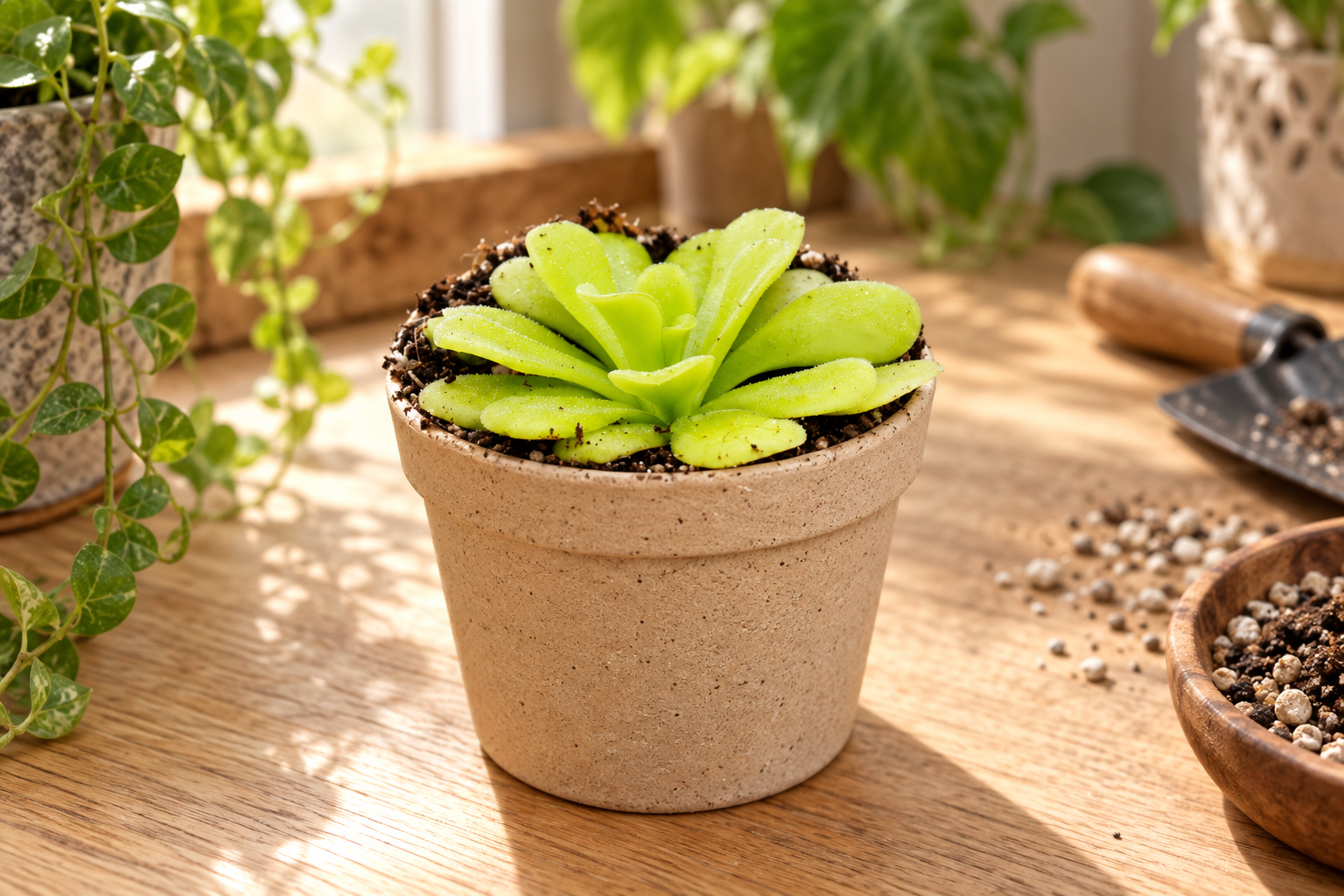
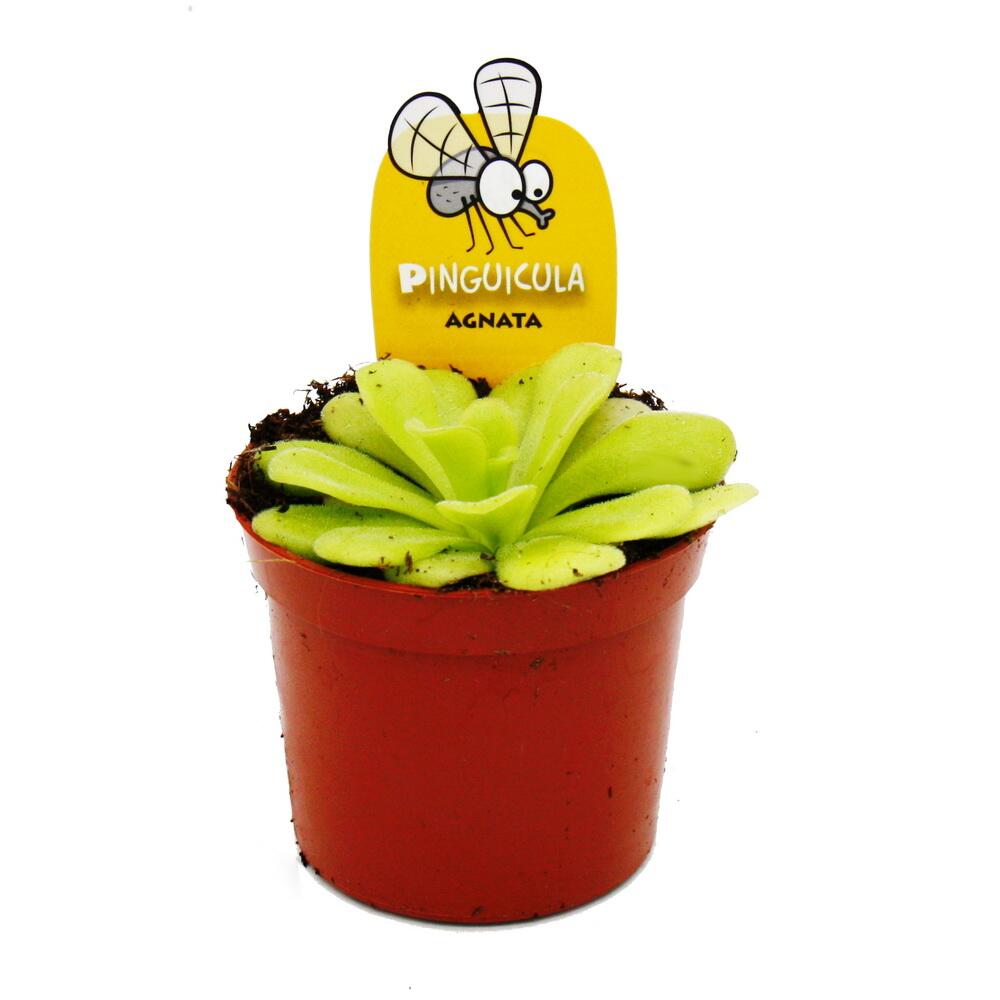
Pinguicula agnata rests on the substrate with its pale green leaves like a small, open rosette. The plant looks soft and unassuming. Its leaf surface is nevertheless a trap: small insects can stick to the fine, adhesive glands. This makes the Mexican butterwort different from a smooth-leaved succulent. Our offering is in a 9 cm pot; an exact delivery height is not specified numerically. We enjoy observing the small plant at eye level and give it a bright position that is easy to monitor. It is not regarded as a guaranteed solution to an insect infestation.
Being able to observe a small plant closely
A close look is worthwhile even during the first few days. Is the rosette centre firm, are new leaves appearing, and how damp is the soil? Unpack the butterwort carefully and touch the trapping leaves as little as possible. Their surface is not cleaned with a cloth or treated with leaf shine. Remove loose packaging remnants gently, without pulling the leaves. A decorative pot can frame the small rosette as long as the nursery pot remains accessible. You must be able to check water and substrate. A closed bowl with hidden standing water is not a good shortcut.
Bright light without hot air
A bright position with filtered sun supports growth. Strong midday sun behind glass is allowed only carefully and after acclimatisation; a small rosette can overheat quickly. Conversely, a dark desk far from the window is not a good permanent position. Air can move, but cold draughts should not strike the leaves directly. A completely closed glass dome is not automatically an improvement for normal indoor cultivation. It can accumulate heat and stagnant moisture. Observe the new leaf centre when assessing the effect of the position, and change conditions gradually rather than daily.
Mexican butterworts are not all the same marsh plant
Pinguicula agnata receives an airy, nutrient-poor mixture that holds moisture and drains excess water. Mineral components are helpful. Fertilised standard potting compost does not become suitable simply because the plant is in an ordinary pot. A fixed mixing ratio matters less than its actual behaviour under your conditions. The root ball should not become compacted and constantly wet. When repotting later, the rosette is held carefully, the fine roots are protected, and the centre is not covered with soil. Frequent repotting is unnecessary when the substrate works well.
Water according to the visible leaf phase
While the plant forms larger trapping leaves, we keep the root area moderately moist and allow it to dry slightly between waterings. Suitable low-mineral water helps avoid an unnecessary salt burden. Water onto the substrate at the edge, not into the middle of the rosette, and remove any excess. If the leaves become more compact and succulent, water requirements can drop significantly. In Mexican butterworts, this change is an important clue to the annual cycle. The specific conditions and forms differ; a rigid winter date therefore does not replace observing your plant. Constant wetness is avoided even during the growing phase.
Let the trapping leaves work undisturbed
The plant does not need ordinary houseplant fertiliser. Nor do we place large insects, pieces of meat or other food on its leaves. This can overload the small trapping surface and cause damage. A small insect caught by chance can remain. Butterwort replaces neither an investigation into the causes of fungus gnats nor targeted pest treatment among the other plants. This distinction makes caring for it straightforward: we first tend the living rosette. Whether it also catches prey depends on the position and its active leaves, rather than a fixed promise of how much it needs to catch or will catch.
Supporting changes thoughtfully
An older leaf can turn brown while the centre continues to grow healthily. That is different from a softening rosette base in persistently wet soil. Remove dead leaves only gently, when they come away. In winter, the plant remains frost-free and bright; water is adjusted to slower growth or a changed leaf shape. Flowers can appear, but their colour and timing are not firmly promised for the shop clone that is not named more precisely. The small rosette is already beautiful in its own right. With an attentive eye, suitable soil and steady moisture management, we learn its individual rhythm.
One plant, several views
Good to know
Is butterwort an ordinary succulent?
No. Pinguicula has trapping leaves with glands; some Mexican species temporarily develop more succulent resting leaves.
Can I use ordinary potting compost?
Heavy, fertilised potting compost is unsuitable. Choose an airy, nutrient-poor mixture for Mexican butterworts.
Does the pot have to stand in water all the time?
No. Moderate moisture and free drainage are a more easily monitored starting point.
May I wipe the leaves?
Not the trapping surfaces. Their glandular surface should be preserved.
Does the plant need food?
No force-feeding with meat or large insects, and no normal houseplant fertiliser.
Why is the rosette changing?
Leaf shape and water requirements can change through the year. Distinguish healthy, firm new leaves from damage.
Does it reliably control fungus gnats?
It can catch small insects, but does not replace investigating the causes and offers no guaranteed pest control.
Sources and editorial note
- Exotenherz: offer and original photographs (01.10.2026)
- A World of Pinguicula: Pinguicula agnata (01.10.2026)
- A World of Pinguicula: Mexican butterworts (01.10.2026)
- NC State: Pinguicula (01.10.2026)
Shop offer, SKU, GTIN and availability checked live on 01.10.2026. Original photograph unchanged. Independently researched horticultural texts and an individually reviewed scene.