This plant at Exotenherz
Check the shop offer for current availability, price and what is included.
Check the selected shop offer for price, availability and delivery contents.
Your care table
| Topic | What to do | Why it helps |
|---|---|---|
| Light | Choose brightness and gentle acclimatisation. | Avoid sudden harsh sun. |
| Water | Use low-mineral rain, reverse-osmosis or demineralised water. | Avoid unnecessary salts. |
| Growth | Keep active root space slightly moist. | Do not continually flood the rosette. |
| Rest phase | Reduce moisture during the compact succulent leaf phase. | Consider leaf state rather than calendar alone. |
| Substrate | Choose a nutrient-poor mineral-dominated mix. | Preserve air around the base. |
| Nutrients | No ordinary houseplant fertiliser as a standard supply. | Consider specialised carnivore cultivation. |
| Leaves | Do not polish or continually touch catching surfaces. | Preserve their sensitive surface. |
| Winter | Grow frost-free and observe the phase. | Mexican origin is not outdoor frost-hardiness. |
Check the compost and pot weight. The care table explains how far the compost may dry.
Water only when needed. The water should reach the root ball without spilling over the rim.
Remove surplus water from the saucer or cachepot. Then return the plant to a suitable position.
The rosette stays near the soil
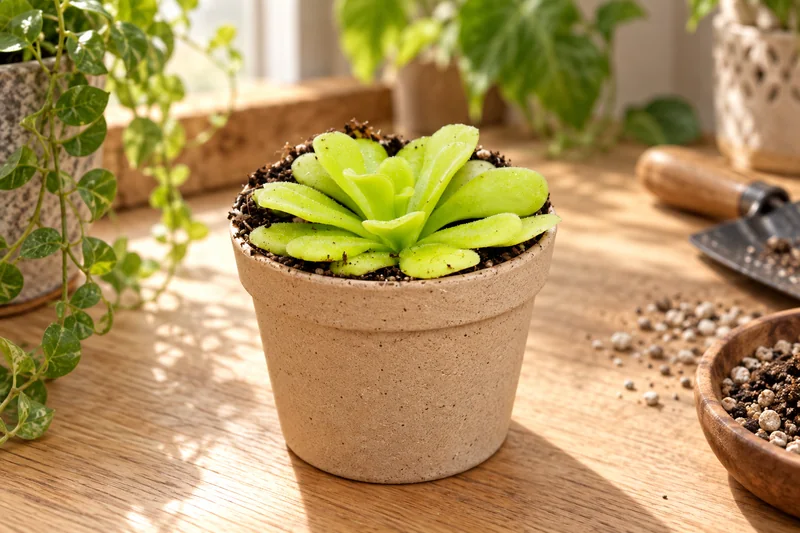
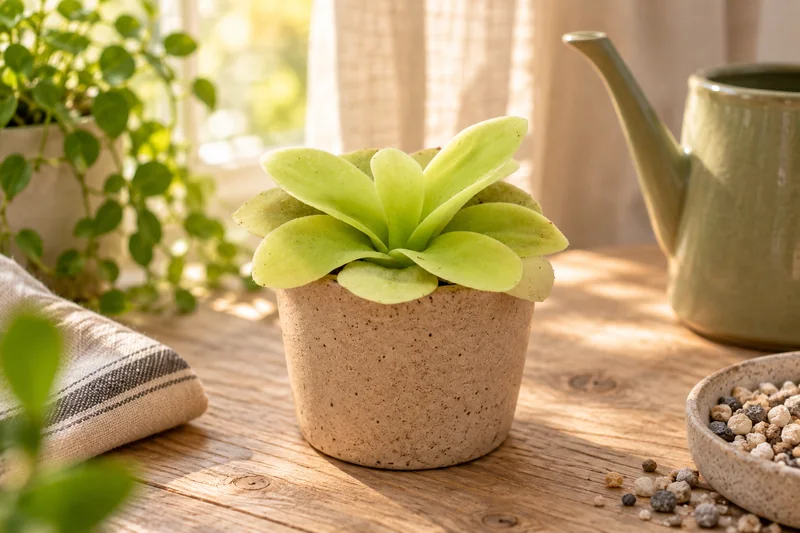
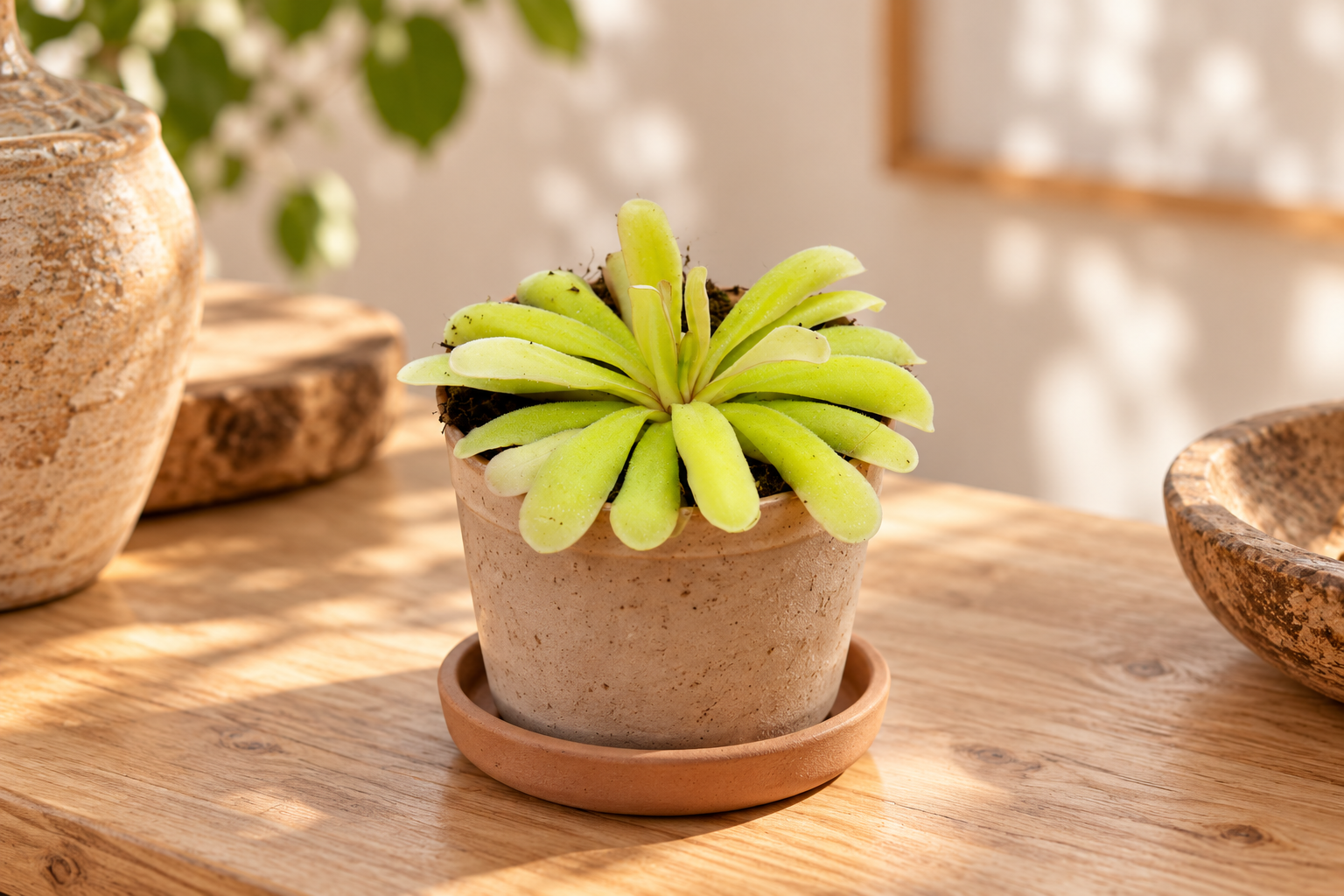
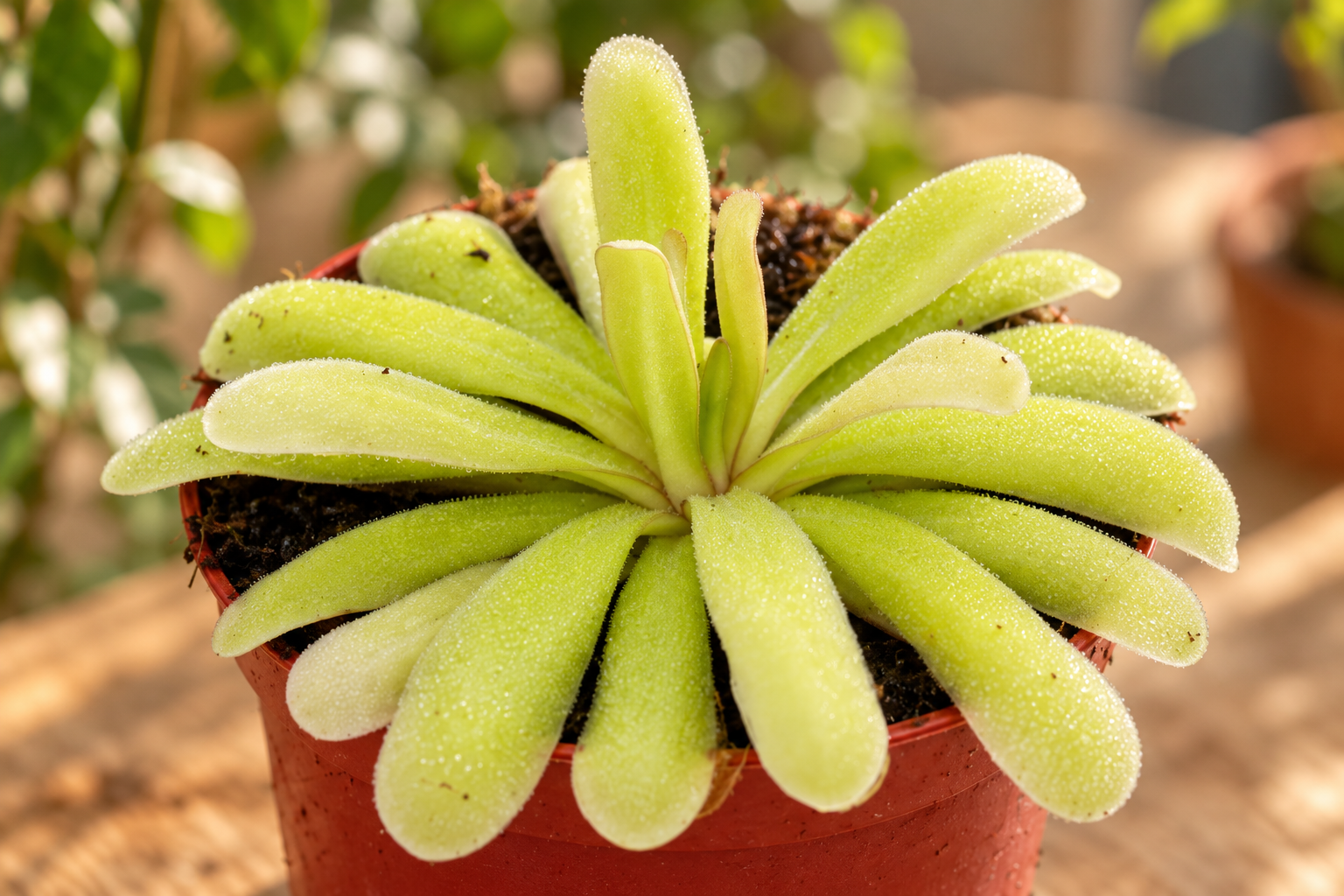
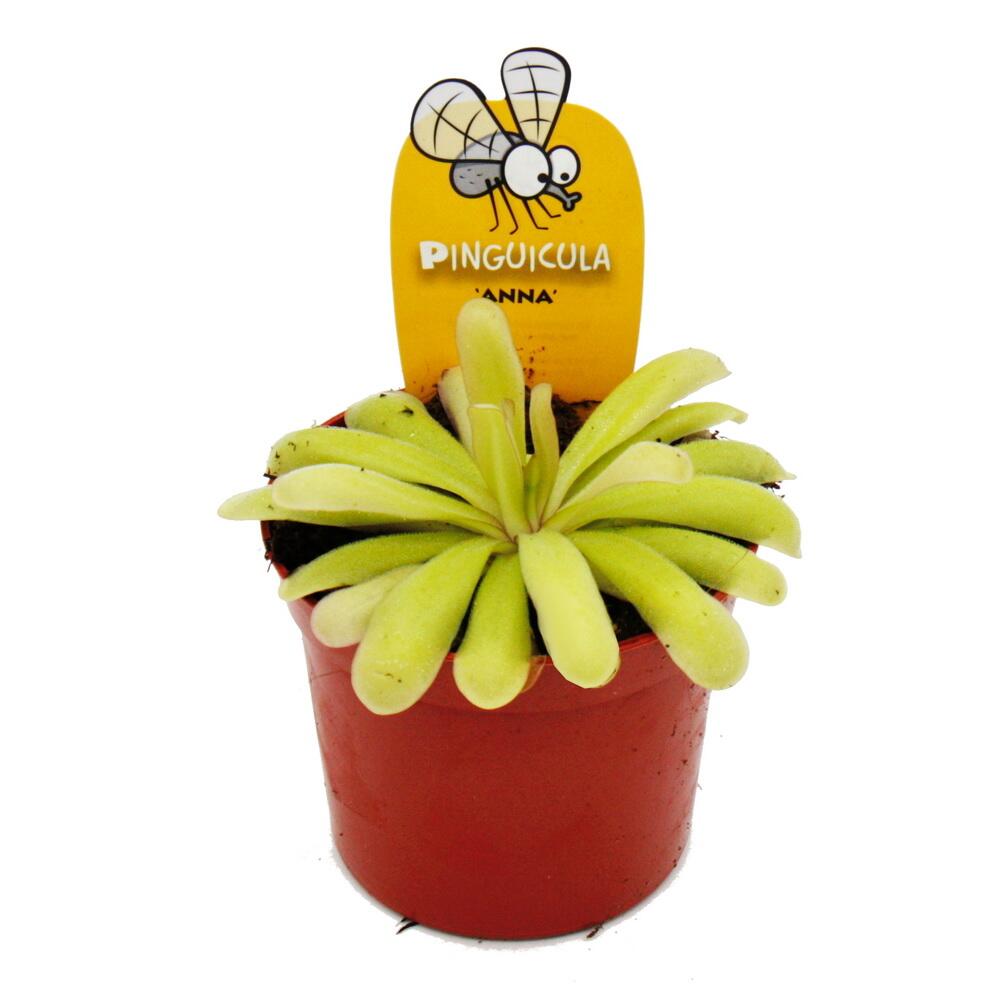
Anna arranges elongated pale yellow-green leaves flat over the small pot. Their surfaces overlap like a calm living rosette. Active catching leaves have a sticky surface that can hold small insects. Unlike a Venus flytrap, it does not snap shut. The original shows foliage without flowers; violet flowers are a possible later development, not promised at every delivery. Its low form makes a small clear shelf an interesting observation place.
A 9 cm pot is not a large insect catcher
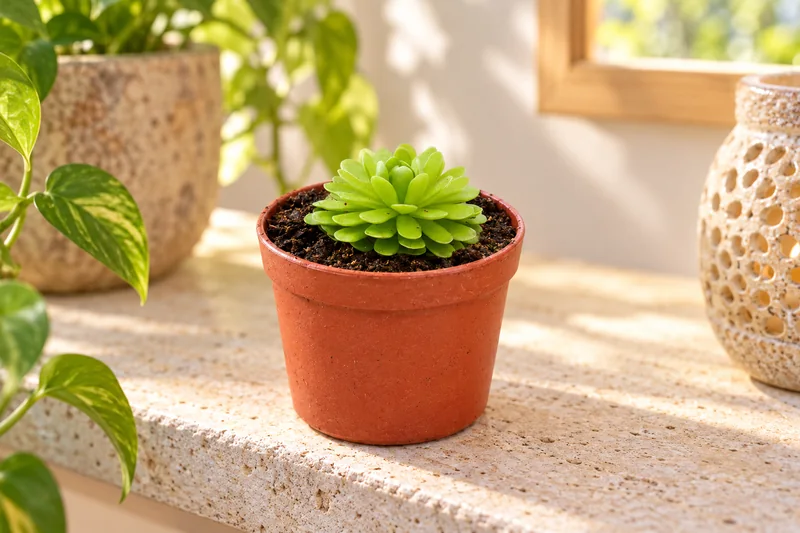
The range reference describes a small plant in a 9 cm container without confirmed delivery height. Its rosette stays accessible for handling. This decorative carnivore does not replace reliable whole-room pest control. Position where leaf surfaces can be seen and enough light arrives. Carry the container rather than squeezing fleshy leaves. An enlarged detail explains surfaces and arrangement, not a huge delivery plant. A delicate pot may already give room for a personal plant story.
Anna belongs to Mexican cultivation
Two specialist growers list Anna as a Mexican horticultural hybrid. No unconfirmed parent-species list is added. Brightness, airy mineral root space and moisture matched to leaf phase are important for this group. Choose a bright position and acclimatise carefully to stronger sun. A closed permanently wet glass is not an automatic standard solution. The rosette should receive enough air. Tropical or Mexican does not mean that the small plant tolerates German winter frost.
Low-mineral water instead of an ordinary fertiliser routine
Rainwater, suitable reverse-osmosis water or demineralised water keep unnecessary mineral salts out. During active growth, keep roots slightly and reliably moist without continually flooding the rosette. Supply gently at the pot edge or through a controllable reserve. Do not spray leaves forcefully or polish with a cloth. Ordinary houseplant fertiliser is not a standard supply for this carnivore. Even supposedly harmless household remedies such as cinnamon powder are not sprinkled preventively over the rosette.
Leaf phase determines winter care
Mexican butterworts can form more compact, less sticky succulent leaves. Temperature, light and the particular hybrid influence this transition. When it enters that phase, supply moisture much more cautiously. A calendar date alone does not require suddenly drying an actively growing plant completely. Regularly view the centre and existing leaves. Permanent standing water from a bog-plant routine does not suit every phase unchanged. A short plant-book note makes next year’s transition understandable.
Protect the sensitive centre when repotting
A suitable nutrient-poor carnivore mix with a high mineral share is a sensible start. The pot should suit the small rosette and maintain air around its base. Work gently; do not pull the plant from old soil by one fleshy leaf. Completely old parts can be removed carefully without damaging the active centre. Overall shape and a close view suffice for documentation. Preserve the fascinating surface by observing rather than continually testing its catching function with fingers.
One plant, several views

Good to know
Does Anna snap shut like a Venus flytrap?
No. Active catching leaves work through their sticky surface.
Is Anna a confirmed Mexican hybrid?
Yes, specialist growers describe it that way; unconfirmed parent names are not added.
Does it need permanent bog standing water?
Not universally. Especially in the compact succulent leaf phase it is grown markedly less moist.
Can I wipe leaves?
Do not polish or forcefully touch the catching surface.
Does it replace room pest control?
No. A small decorative rosette is not reliable treatment for an entire infestation.
Sources and editorial note
- Exotenherz – offer and original images, 03.10.2026
- ICPS – Mexican butterworts, substrate and leaf phases, 03.10.2026
- Carniflore – Pinguicula Anna, hybrid character and cultivation, 03.10.2026
- Les Dents de la Terre – Anna, light and adjusted winter moisture, 03.10.2026
Shop offer, article number, GTIN, availability and original images directly checked on 02.10.2026; specialist acceptance on 03.10.2026. Specialist sources directly read. SKU, pot reference, original photographs and orderability checked in the shop on 03.10.2026. Delivery height and species development kept separate. Sources actually read; six individual sections, eight care points and five FAQs editorially checked. Currently not orderable: knowledge portrait without a purchase link or social-send clearance. No tool, Wawi or server changes. Currently not orderable: knowledge portrait without a purchase link; social drafts not cleared for sending.