This plant at Exotenherz
Check the shop offer for current availability, price and what is included.
Product and delivery details are given in the individual offer.
Your care table
| Topic | What to do | Why it helps |
|---|---|---|
| Light | Bright and filtered; avoid heat behind glass. | The small rosette can overheat quickly. |
| Water | Moderately moist during trapping-leaf growth; let it dry a little. | The active plant needs supply without constant waterlogging. |
| Resting form | Keep much drier with small dense resting leaves. | The plant uses distinctly less water in this phase. |
| Watering | At the edge, not over the rosette centre. | Closely packed leaves should not hold a pocket of water. |
| Growing medium | Airy unfertilised mixture for Mexican butterwort. | Fine roots need nutrient-poor, draining conditions. |
| Fertiliser | No ordinary houseplant feeding. | Trapping leaves also contribute to nutrient supply. |
| Winter position | Bright and safely frost-free, without a rigid calendar change. | The actual leaf change indicates the phase better. |
| Handling | Touch the rosette and trapping surfaces little. | The small plant is easily mechanically injured. |
Check the compost and pot weight. The care table explains how far the compost may dry.
Water only when needed. The water should reach the root ball without spilling over the rim.
Remove surplus water from the saucer or cachepot. Then return the plant to a suitable position.
A very small leaf artwork
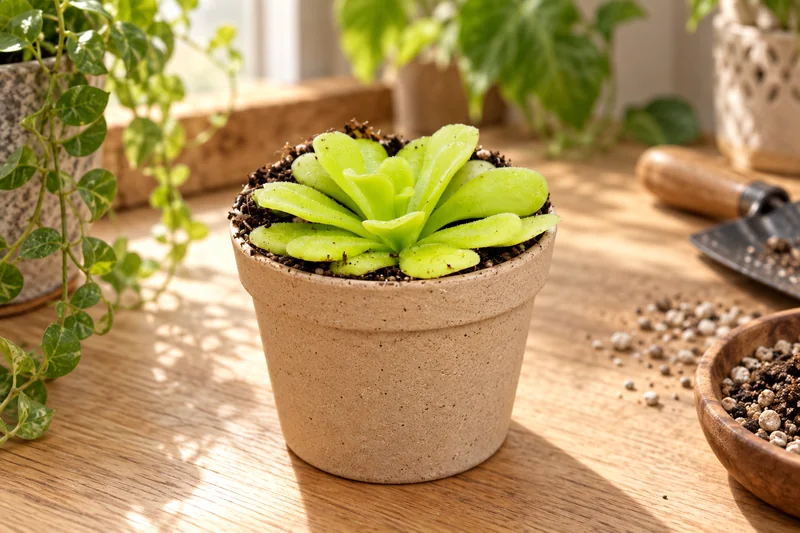
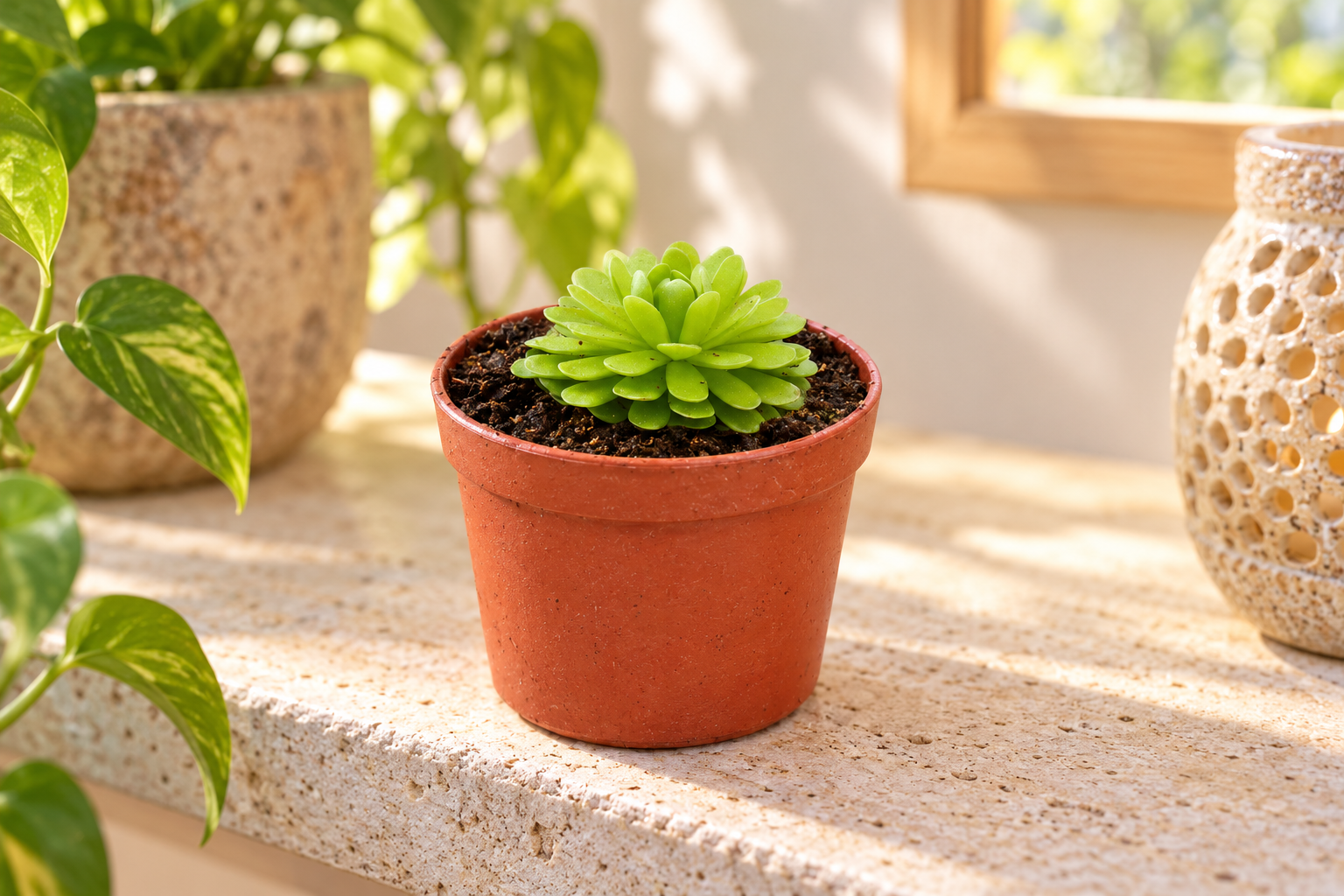
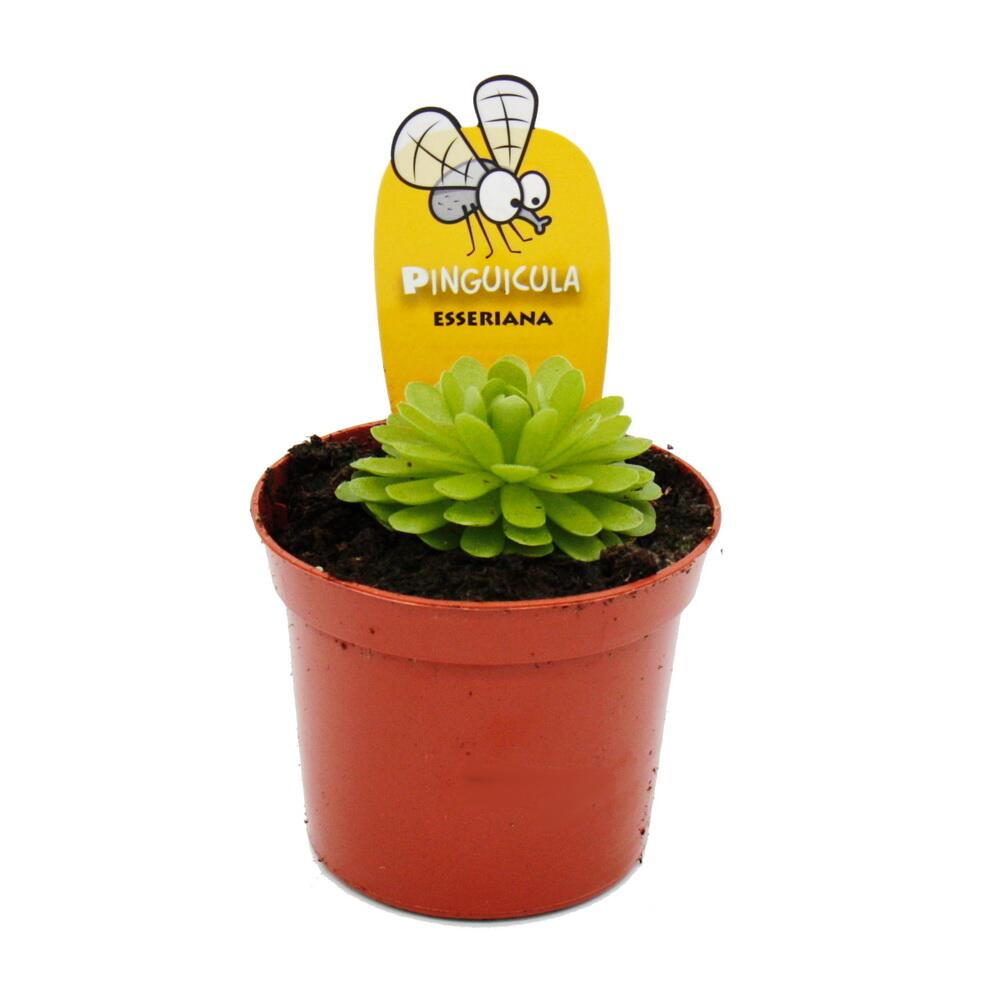
Pinguicula esseriana is one of the plants we most enjoy looking at closely. Its small rosette sets leaf tightly beside leaf and looks almost like a tiny green work of art in its 9 cm pot. It remains a Mexican butterwort with trapping leaves even if its compact appearance resembles a succulent. The offer gives no exact delivery height. Current leaf condition matters more: this species may form two clearly different rosettes through the year. Recognising this change helps one understand care better and avoids trying to reverse every reduction in size with more water.
Get to know both rosettes
During the active phase, larger leaves with trapping surfaces appear. During a quieter phase, smaller thicker leaves stand very close together. The plant then becomes more compact without automatically being ill. The transition depends on its conditions and cannot be placed on the same calendar day everywhere. Observe the centre from which new leaves emerge. A firm, neatly built small rosette differs from glassy-soft tissue. Note the change if helpful so the plant is easier to assess during the next annual cycle. Its changeability is part of its appeal.
A light position on a small scale
The butterwort stands well in bright filtered light. The small rosette should neither disappear in a dark niche nor bake directly behind hot glass. After transport, we introduce new light conditions gently. A bright plant table or light shelf is easy to check. Make sure larger neighbouring plants do not shade the rosette unnoticed. A closed glass dome may trap moisture and heat, so it is not necessary standard equipment. Air movement may be gentle; cold draughts are avoided. The plant remains safely frost-free even when it currently looks small and robust.
Moisture for the active leaf phase
When larger trapping leaves regrow, we keep the suitable growing medium moderately moist and let it dry a little between waterings. Water around the edge with suitable low-mineral water without filling the rosette centre. Excess water is removed. A permanently full deep saucer is not automatic butterwort care. Check pot weight and the internal course of moisture, because the small above-ground growth may sit over a relatively large soil volume. Few roots there use less water than a large leafy houseplant. Careful checking protects better than an unchanging watering plan.
The resting form needs restraint
When Pinguicula esseriana forms many small dense resting leaves, the water amount is clearly reduced and the growing medium kept drier. The plant then needs a different supply from its trapping-leaf phase. Keep it bright, airy and frost-free. Our home is not identical to a specialist greenhouse, so we observe condition and surroundings rather than adopting someone else’s calendar instruction unchanged. When larger trapping leaves begin again, we cautiously increase moisture. Development gives the direction. A softening centre is not dismissed as a healthy winter form but investigated more closely.
Leave compost and trapping surfaces undisturbed
An unfertilised airy mixture for Mexican butterworts suits the small plant. Mineral structure helps water drainage. Normal pre-fertilised potting compost and ordinary houseplant fertiliser are not the right choice. Trapping leaves remain unpolished and are not washed regularly. Pieces of meat or large insects are not placed on them either. The plant can process small accidentally captured insects itself. If fungus gnats appear around other pots, we address their cause there; a small butterwort rosette is not a guaranteed control method. Care and expected performance thus stay in a sensible proportion to the plant’s real size.
Through the year with little intervention
Repotting is sensible when the growing medium no longer works or the root space really needs changing. A healthy small rosette is held carefully, not pulled by its leaves. Old dead leaves are only loosened when this can be done without harm. The species may develop delicate flowers on slender stems above the foliage. Between flowering phases, the finely stepped rosette is worth a look. With attentive observation of new leaves, suitable moisture and an accessible shelf, Pinguicula esseriana remains a plant whose small changes can bring great pleasure.
One plant, several views
Good to know
Why does the rosette get smaller in winter?
The species can form a dense succulent resting form; firm healthy resting leaves are not automatically damage.
Must I water more to make it large again?
No. The resting form is watered much more sparingly. New trapping-leaf growth shows a return to higher demand.
Can it remain in frost?
Keep pot cultivation safely frost-free; the small resting form does not permit frost exposure.
Does it need a permanently full saucer?
Not as a general rule. Control moisture by leaf phase and avoid permanent excessive wetness.
Should I place insects on it?
No forced feeding with large insects or meat. Small accidental prey is enough as a possible supplement.
Can ordinary potting soil be used?
Use an airy, unfertilised mixture for Mexican butterworts.
Is delivery height precisely stated?
No. The checked shop names the 9 cm pot, not an exact overall height.
Sources and editorial note
- Exotenherz: offer and original images (01.10.2026)
- A World of Pinguicula: Pinguicula esseriana (01.10.2026)
- A World of Pinguicula: Mexican butterworts (01.10.2026)
- NC State: Pinguicula (01.10.2026)
Shop offer, SKU, GTIN and availability checked live on 01.10.2026. Original photograph unchanged. Our own researched gardening texts and individually approved scene.