This plant at Exotenherz
Check the shop offer for current availability, price and what is included.
Product and delivery details are given in the individual offer.
Your care table
| Topic | What to do | Why it helps |
|---|---|---|
| Light | Bright and filtered; introduce new sun slowly. | Young broad leaves should not suddenly overheat. |
| Watering | Keep moderately moist during active trapping-leaf growth. | The species is not forced into a completely dry resting period as a blanket rule. |
| Drainage | Remove excess and check the root ball. | Even moisture-demanding plants need air around roots. |
| Watering route | At the growing-medium edge; do not pour over the rosette centre. | Water should supply roots without standing between leaves. |
| Water | Use suitable low-mineral water. | Unnecessary salt entry into the small root zone is limited. |
| Fertiliser | Do not give usual houseplant fertiliser. | Trapping leaves supplement nutrient uptake. |
| Winter | Frost-free; water more cautiously with less light and growth. | Actual demand decreases without forcing the same leaf change everywhere. |
| Space | Consider later rosette diameter and accessibility. | Broad leaves should not rub against container edges. |
Check the compost and pot weight. The care table explains how far the compost may dry.
Water only when needed. The water should reach the root ball without spilling over the rim.
Remove surplus water from the saucer or cachepot. Then return the plant to a suitable position.
Large in name, young in the pot
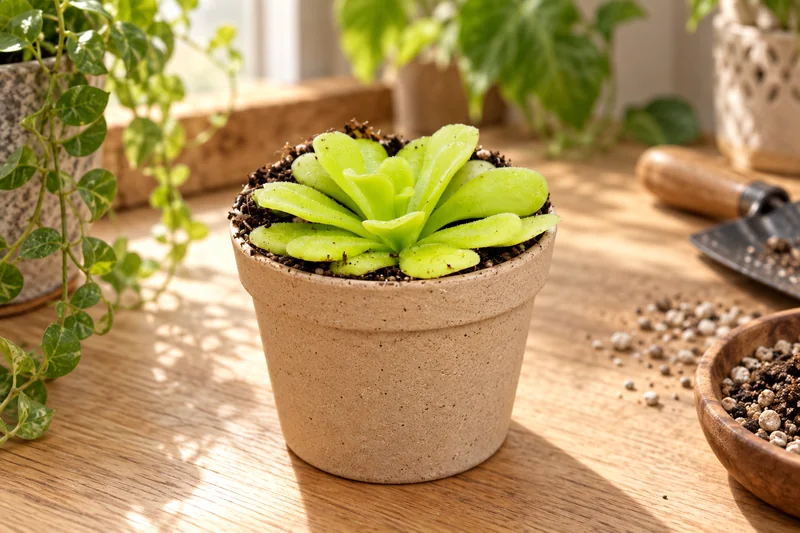
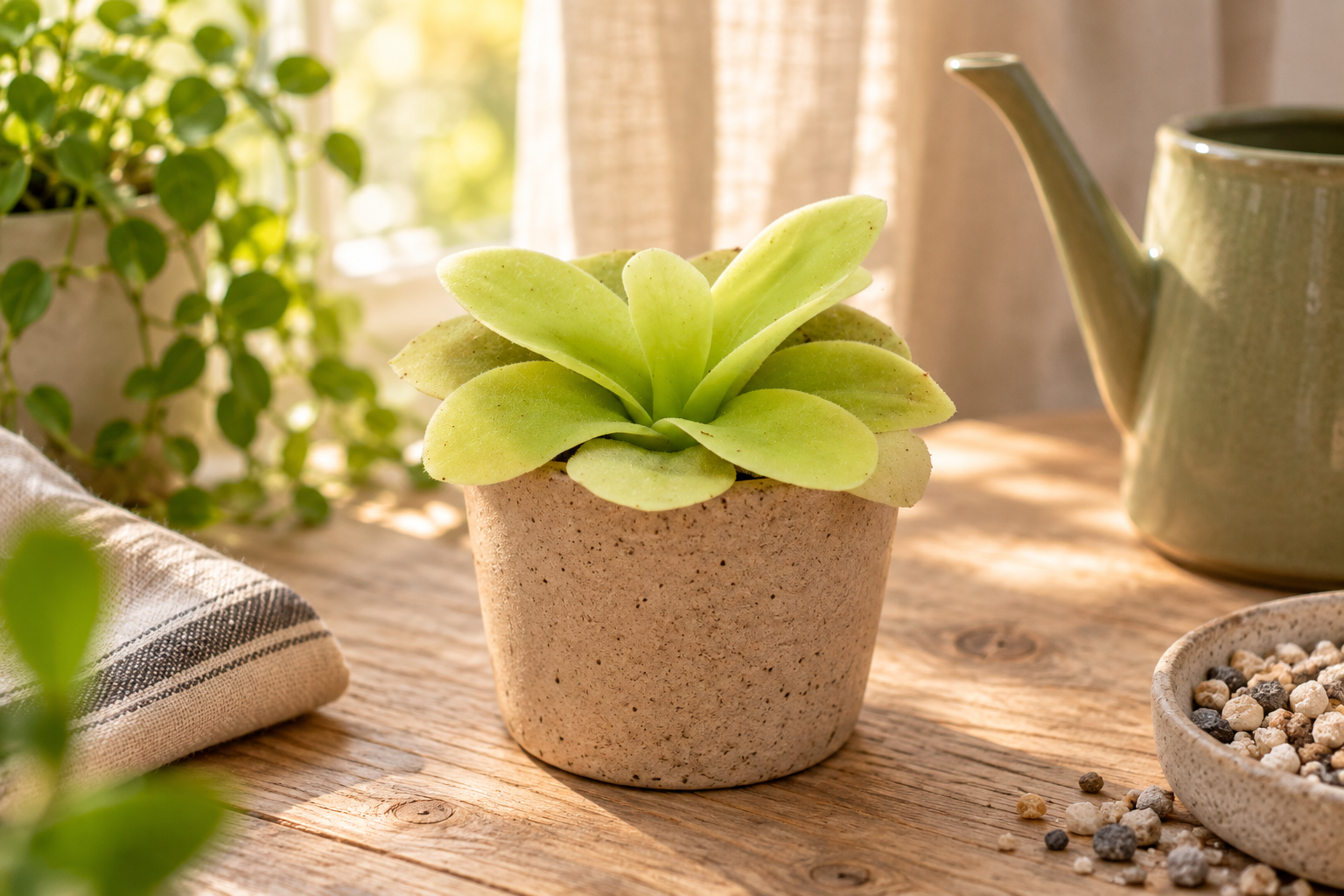
Giant butterwort does not start as a finished green plate. The young Pinguicula gigantea in its 9 cm pot first develops soft, broad leaves around a small centre. The offer gives no exact delivery height. With good cultivation, the rosette can become considerably larger, so plan enough lateral space too. The species has a special trapping surface: glands sit on both upper and lower leaf surfaces. We therefore view it carefully and leave its surface undisturbed. The name promises neither immediate giant size nor a particular number of captured insects, but describes a botanically remarkable plant.
Not every butterwort has the same resting form
Pinguicula gigantea is not simply dried out by the calendar like the small Pinguicula esseriana. It may retain trapping leaves through the year even when size and growth change. Under lower light or cooler conditions, its water needs still decrease. The practical question is therefore: is it forming new leaves, does the root ball stay moist for a long time, and how does the centre look? Rigid instructions for all Mexican butterworts would be too broad here. We manage the plant by its condition and keep it frost-free. A healthy firm leaf centre matters more than the month on the calendar.
A bright position that is easy to oversee
Bright filtered light is a good starting point for the young rosette. Sudden strong sun behind glass can stress its broad leaves. Accustom it slowly to the new position and avoid an overheated closed vessel. On a bright shelf, the surface can be observed well without touching the plant often. Larger neighbours should not shade it. As the rosette grows, it needs more lateral room and must not constantly rub against a narrow display case. Some air movement helps, but cold draughts directly from a winter window do not suit this pot cultivation.
Moisture and air belong together
During active growth, the appropriate growing medium is kept moderately moist and allowed to dry slightly between waterings. Suitable low-mineral water and easily controlled water management simplify care. Water the soil at the edge and remove excess from the decorative pot. A permanently deep water level does not make Mexican butterwort better supplied. Fine roots still need air. Check deeper in the root ball before judging the whole pot from a dry surface. At the same time, an actively leafy Pinguicula gigantea is not dried completely for months simply because other butterwort species show a more distinct resting form.
Nutrient-poor soil rather than rich potting compost
An airy mixture for Mexican butterworts creates a well-draining root space. Mineral ingredients may support the structure; pre-fertilised heavy houseplant compost is not a suitable standard choice. During repotting, we protect fine roots and do not bury the rosette centre. A pot only appropriately larger is easier to control than a large bowl full of unrooted growing medium. Ordinary houseplant fertiliser is left out. Trapping leaves can use small insects as an additional nutrient source. This justifies neither abundant fertilising nor placing large prey that would overwhelm the leaf surface.
Do not polish trapping leaves clean
The slightly sticky surface is functional and does not need cleaning like a glossy houseplant leaf. We do not wipe the leaves or put shine products on them. Small accidentally captured insects may remain. No meat or large insect is placed on them as supposed care. With fungus gnats elsewhere in the collection, the cause is still sought there; the butterwort is not a guaranteed control method. An attractive-looking trapping-leaf coating does not replace checking the rosette base either. With little touching, delicate leaf tissue is preserved best and its development can be followed undisturbed.
Connect winter and new growth attentively
In winter the plant stays as bright as possible and safely frost-free. With slow growth and a root ball moist for longer, we reduce water without forcing a harsh dry period out of habit. If older leaves turn brown, we remove them carefully only once they are dead. A softening centre together with wet growing medium instead calls for a closer look at cultivation. With new growth, supply cautiously rises again. Flowers are possible, but timing and exact colour of the unspecified shop clone are not promised. The broad rosette already offers enough to discover, particularly when we follow its actual development.
One plant, several views
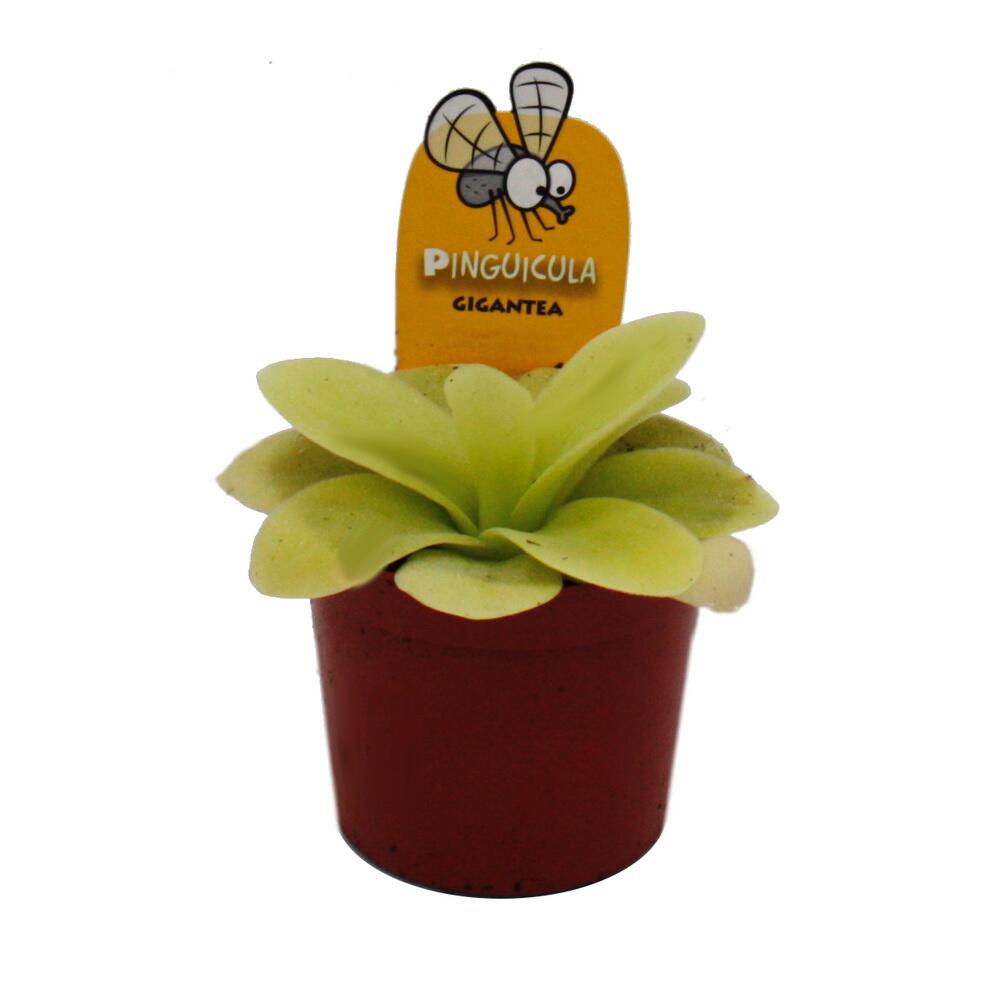
Good to know
Why is it called giant butterwort?
The species can develop a larger rosette. The young plant in a 9 cm pot is not already fully grown.
Is the leaf underside sticky too?
In Pinguicula gigantea, trapping glands on both leaf surfaces are a distinctive feature.
Must it stand completely dry in winter?
Not as a blanket rule. Observe growth and moisture, and water more cautiously when consumption decreases.
What soil does it need?
An airy, nutrient-poor mixture for Mexican butterwort, not heavy pre-fertilised potting compost.
Can I clean the trapping leaves?
Do not wipe or polish them; the glandular surface is part of their trapping function.
Is it a reliable fungus-gnat catcher?
It may catch small insects but does not replace identifying causes and offers no guaranteed control.
Why do individual outer leaves turn brown?
Older leaves may die. What matters is that centre and new growth remain healthy.
Sources and editorial note
- Exotenherz: offer and original images (01.10.2026)
- A World of Pinguicula: Pinguicula gigantea (01.10.2026)
- RHS: Pinguicula gigantea (01.10.2026)
- NC State: Pinguicula (01.10.2026)
Shop offer, SKU, GTIN and availability checked live on 01.10.2026. Original photograph unchanged. Our own researched gardening texts and individually approved scene. Species-specific annual cycle: no blanket complete winter dryness transferred from general butterwort rules.