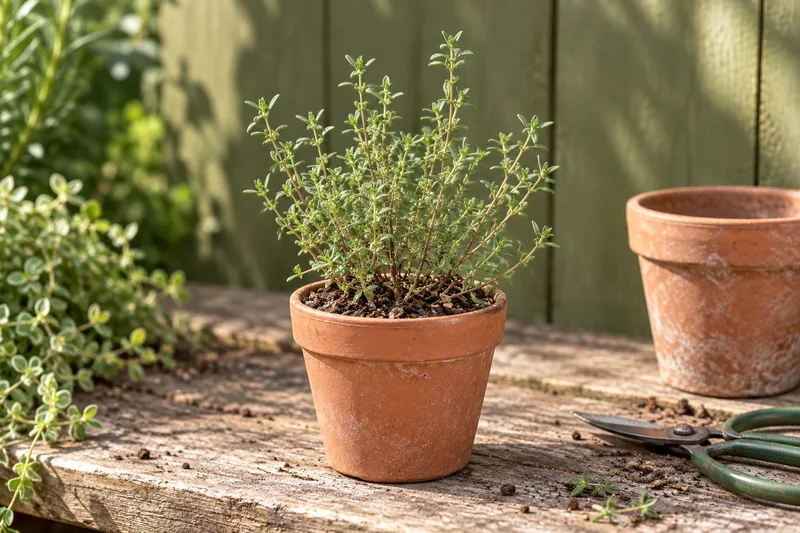
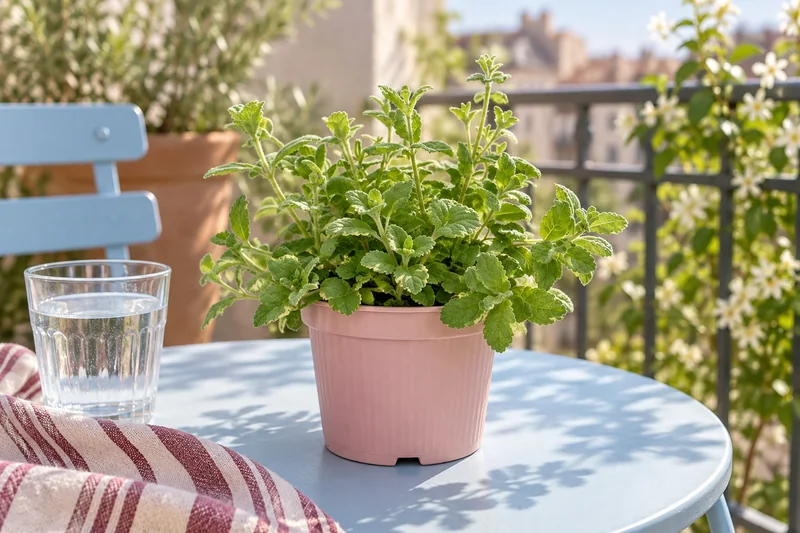
This plant at Exotenherz
Check the shop offer for current availability, price and what is included.
Check the selected shop offer for price, availability and delivery contents.
Your care table
| Topic | What to do | Why it helps |
|---|---|---|
| Sun | Choose an open, sunny garden position. | The Mediterranean herb form develops well in light. |
| Watering | Once established, water as needed; check pots more often. | A small container dries differently from established garden soil. |
| Drainage | Reliably avoid waterlogging. | Persistent winter wetness stresses the subshrub. |
| Soil | Well drained and not excessively nutrient-rich. | A loose foundation supports compact growth. |
| Nutrition | In pots, supply moderately according to growth and compost. | Strong frequent doses do not replace sunshine. |
| Pruning | After flowering, shape gently within leafy areas. | Hard pruning into bare old wood is riskier. |
| Harvest | Use a few young healthy leaves or tips. | The plant needs enough foliage for its development. |
| Winter | Ensure drainage and protect exposed pots and young plants. | Being perennial does not guarantee survival in every wet, frosty position. |
Check the compost and pot weight. The care table explains how far the compost may dry.
Water only when needed. The water should reach the root ball without spilling over the rim.
Remove surplus water from the saucer or cachepot. Then return the plant to a suitable position.
Fine foliage adds flavour to the herb bed
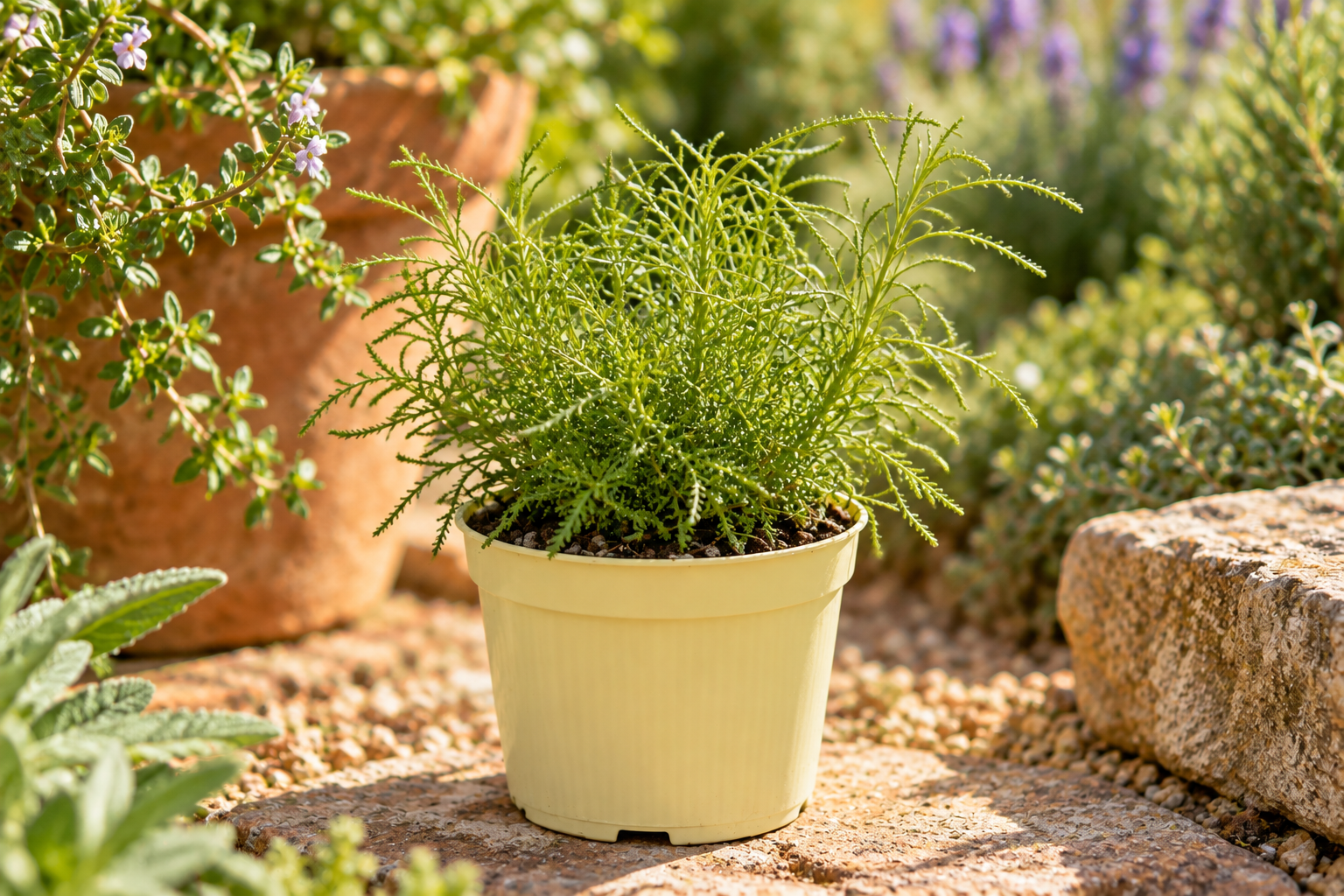
Olive herb forms a finely branched green cushion whose narrow, divided little leaves stand out even on close inspection. Their aromatic scent recalls olives without making the plant a little olive tree. The offer states a twelve-centimetre pot but no reliably specified delivered height. I distinguish this young potted size from later development. At a sunny herb-bed edge or in a well-drained terrace pot, it can have a place of its own. Its fine texture suits neighbours with larger leaves. The scene shows the young garden form and promises neither a large finished hedge nor an immediately abundant harvest.
A perennial subshrub with several names
The shop lists olive herb as Santolina viridis. The name Santolina virens also occurs in botanical and gardening sources. The plant belongs to the daisy family and develops woody lower parts over time. Under suitable conditions, its foliage stays green outside the main growing season too. Cultivation guidance states approximately forty to fifty centimetres of later height; position and pruning influence the actual structure. In summer, small yellow flower heads may stand above the foliage. I allow this development if it suits the design. Flowering and adult height are features of further cultivation, not a guaranteed state of the delivered young plant.
Sun and drying soil belong together
An open, sunny position is favourable for olive herb. Warmth alone on a dark indoor windowsill does not meet this need. I plan the plant outdoors in the herb area or a suitable container. The soil must release excess water well, especially in wet months. Heavy, permanently moist garden soil is not simply disguised before planting by a little hole full of loose compost; drainage of the whole position counts. A slightly raised area that dries may be more suitable. In containers, drainage holes and a permeable mixture prevent a heavy shower from remaining around the root collar permanently.
Plant with room for later growth
Spring, with warmed soil, is a good planting time. The rootball is moistened evenly beforehand and set approximately as deeply as it stood in the pot. For a loose group, forty to fifty centimetres of spacing can serve as a starting point. I adapt this to the intended design and development at the site rather than turning spacing into a rigid rule for every garden. Newly planted olive herb is dependably supplied while establishing. Only an established root area copes better with drier periods. A small young potted plant therefore needs different attention from an established subshrub in a bed.
Water and nutrition without unnecessary excess
I check the soil before watering. In containers it can dry quickly on sunny days; in beds the soil often retains moisture longer. Watering is thorough as needed, after which excess should drain. A permanently filled saucer is unfavourable. Nutrients are supplied moderately in pots according to growth and existing compost. Soil need not become particularly rich to carry aromatic foliage. Too little light or wet roots cannot be compensated with more fertiliser. I look for healthy compact new growth and existing branches. This structure reveals more about cultivation than a fixed number of extra fertiliser doses in the calendar.
Harvest and prune with respect for the foliage
A few young healthy leaves or shoot tips can be used in the kitchen. Their aromatic character suits, for example, a little fresh herb mixture with tomatoes or a homemade dip. I begin with little so the flavour suits the dish and the plant retains enough leaf area. Harvesting is not a radical trim of the entire young shrub. After flowering, its shape can be adjusted gently in still-leafy areas. Cutting deeply into bare old wood is avoided. Dead parts are removed cleanly. Branching, future harvest and the attractive fine structure thus remain in balance.
Being perennial needs a suitable winter position
Olive herb can grow for several years in a suitable garden. Position, establishment and especially winter soil moisture are decisive, however. An unprotected small potted plant on cold, wet ground is not equivalent to an established bed shrub. I shelter containers, leave drainage clear and protect young or highly exposed plants during unfavourable frosty periods as needed. Winter watering follows actual moisture only. Sun should still reach the position. With this attention, olive herb remains a herb whose scent and fine green foliage can be discovered over several seasons rather than requiring replacement every year because of an unsuitable wet corner.
One plant, several views
Good to know
Is olive herb an olive tree?
No. It is an aromatic Santolina subshrub; the name describes its aromatic character.
How tall may it become later?
Cultivation guidance states approximately 40–50 cm. Position and pruning influence actual height.
What colour are its flowers?
Small yellow flower heads may appear above the foliage in summer.
When should I plant it in a bed?
Preferably in spring in warmed, well-drained soil; supply the young rootball while establishing.
What spacing is sensible?
Approximately 40–50 cm is a starting point for loose groups. Adapt it to design and expected growth.
Can I use the foliage in the kitchen?
The offered olive herb is cultivated as a culinary herb. Use small amounts of healthy young leaves and leave enough foliage on the plant.
Is it hardy everywhere without protection?
No. Establishment, frost exposure and especially drainage count. Small exposed containers and young plants may need protection.
Sources and editorial note
- Exotenherz: offer and original photographs (01.10.2026)
- RHS: Santolina virens (01.10.2026)
- Blu: olive herb, uses and cultivation (01.10.2026)
Shop offer, SKU, GTIN and availability checked live on 01.10.2026. Original photograph kept unchanged internally; because of its advertising label, only the identified AI scene is public. Independently researched gardening texts and an individually reviewed scene. Delivered height not invented. Plant spacing is a gardening starting point, not a delivery feature. The manufacturer’s original includes an advertising label; the illustration clearly identified as an AI scene is used publicly instead.