This plant at Exotenherz
Check the shop offer for current availability, price and what is included.
Check the shop for the current price, availability and offer contents.
Your care table
| Topic | What to do | Why it helps |
|---|---|---|
| Arrival | Check root-ball moisture and firm anchoring; carry by the pot. | Do not pull small rosettes and their hairs apart while unpacking. |
| Position | Sunny and open outdoors; restrain taller neighbours. | Light and air keep the small cushion accessible. |
| Planting | Set the root ball at its previous level, leaving the centre clear. | Soil and grit do not belong inside the densely hairy centre. |
| Substrate | Provide mineral, freely draining soil and clear drainage holes. | Water must actually escape below the gravel layer. |
| Watering | Supply the root zone when needed; do not spray the surface daily. | Low water needs after establishment do not replace root-ball checks. |
| Feeding | Usually no extra feed in the ground; feed containers moderately during growth. | More fertiliser does not repair standing water. |
| Flowering | After pink summer flowers, gently remove the dead mother rosette later. | Healthy lateral offsets can continue the group. |
| Propagation | Carefully root well-developed offsets in spring. | Seed does not reliably preserve the named cultivar identically. |
| Winter | Use airy rain protection during excessive wetness; keep drainage clear. | Hairs do not protect a waterlogged root ball. |
For young plants, feel the soil directly at the root ball. The surface and deeper soil may have different moisture levels.
Water thoroughly after planting; later, water according to the soil, weather and establishment rather than a fixed calendar.
Avoid standing water. For plants in containers, also check that water runs out of the drainage hole.
Small rosettes under a silvery web of hairs
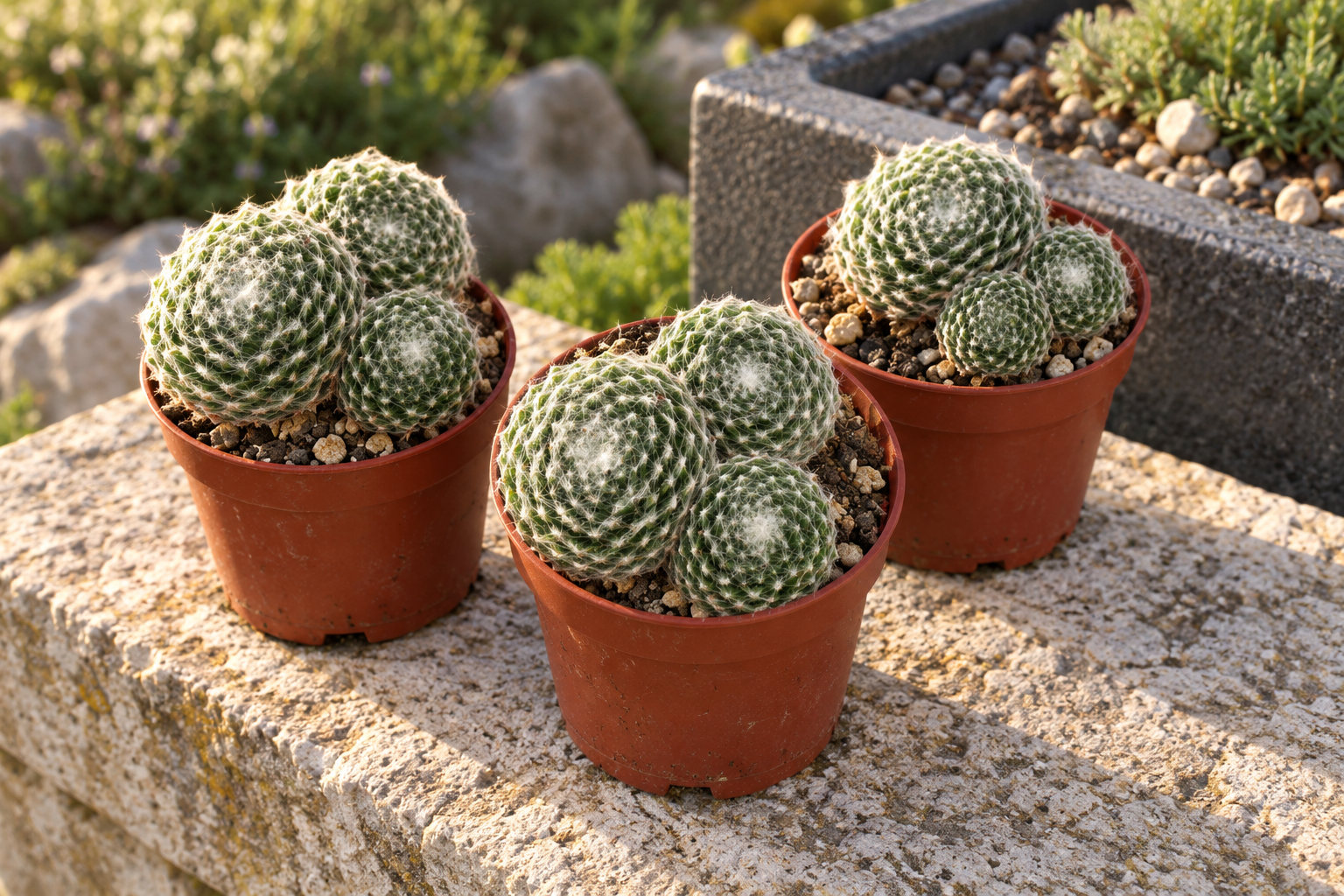
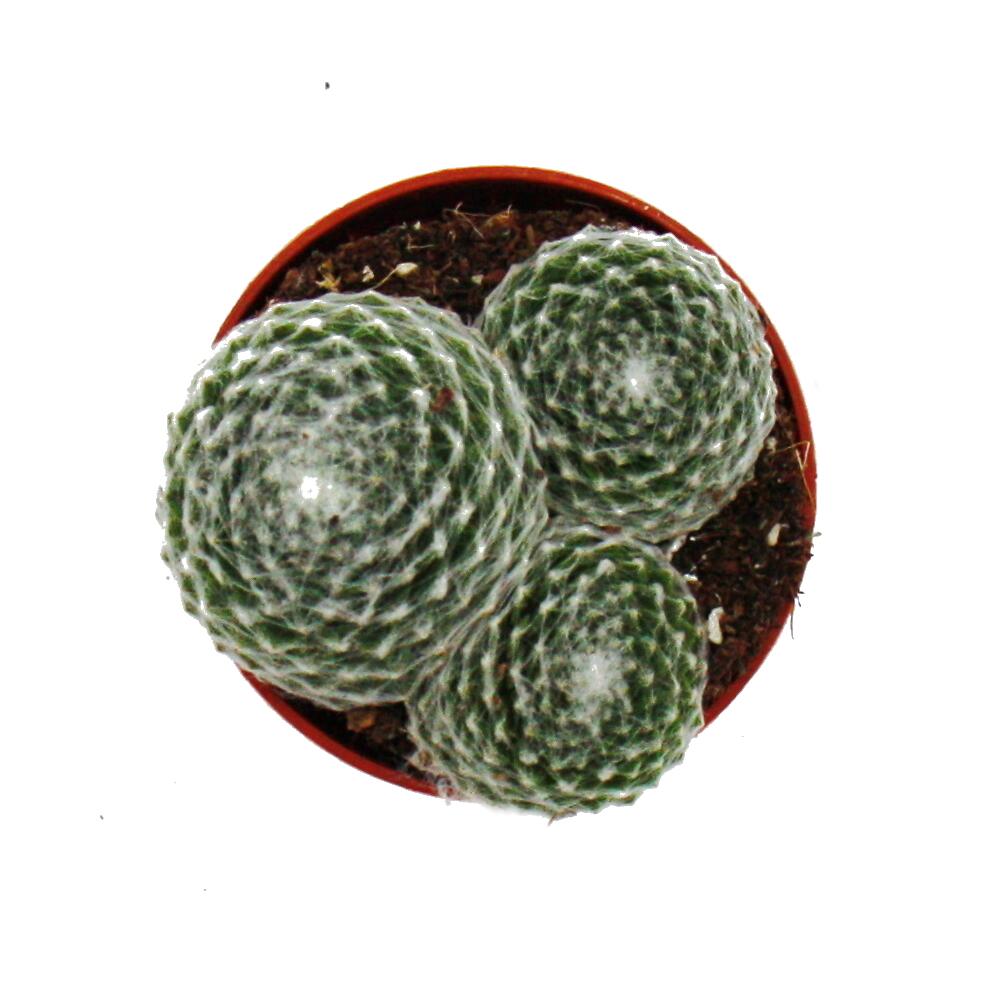
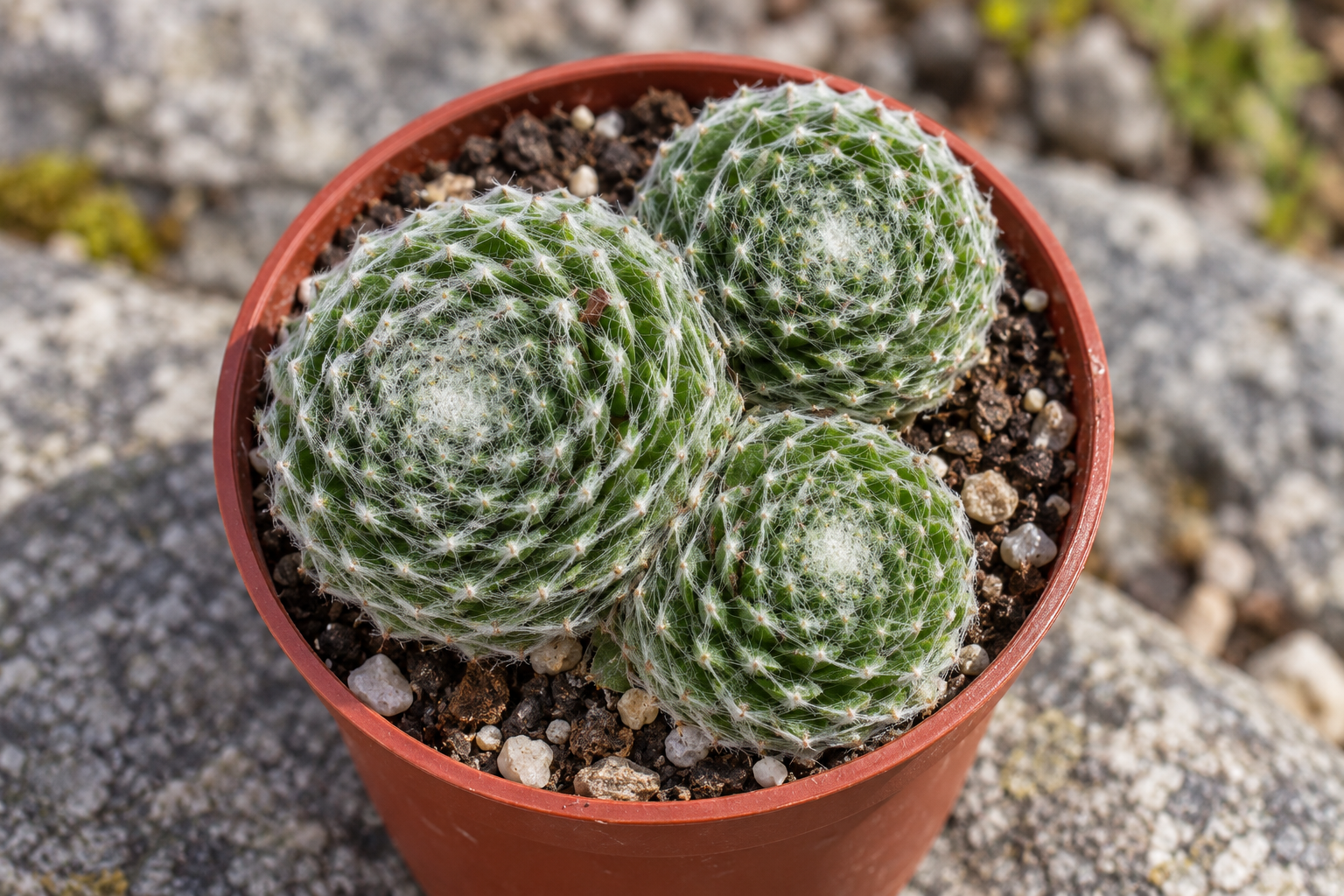
Shampoo first catches the eye with its pale surface. Beneath the silvery hairs, small green fleshy leaves are packed into round rosettes. The hairs connect leaf tips and make individual heads appear almost white. They belong to the plant and, on a healthy, evenly patterned rosette, are no reason to wash it or apply a pest treatment. Sempervivum arachnoideum Shampoo is a named cobweb houseleek in the Crassulaceae family. The first-hand description by its breeder Volkmar Schara identifies particularly small rosettes, at most about 2.5 cm wide, and freely produced offsets. Several heads can develop into a dense low cushion. The original shows precisely this compact green beginning with pale hairs. Different rosette sizes within a pot are normal: a small offset and an older head are at different developmental stages.
Unpack and check the three-plant set carefully
The offer comprises three plants of the same cultivar, each in a 5.5 cm nursery pot; the approximate 6–9 cm total height includes the pot. A container can hold several small rosettes without becoming a different set or a larger individual rosette. Later flower stems are not part of these delivery dimensions. Remove wrapping without needlessly snagging the white hairs and carry each plant by its pot. Check the soil and firm anchoring without pulling individual heads. A heavy wet root ball needs a different start from a completely dry one. Before planting, observe the small pots in a bright sheltered outdoor position. Later, small rosettes can be examined closely in a trough; in a design among coarse stones they can easily disappear. The pictures therefore enlarge details while the actual young plant remains small.
Open light and an accessible planting position
A sunny outdoor position suits Shampoo. Taller neighbours must not overgrow the low heads, and air needs to reach the surface after rain. A stone trough, suitable shallow bowl or freely draining rock-garden spot offers options. Warm dark indoor shelves and closed humid glass containers are unsuitable for permanent culture. Gradually acclimatise shipped plants to a strongly heated sunny position. The specialist range for later cushion width is about 10–50 cm; this is a long-term size range, not the immediate area of each pot. About 5–8 cm between small rosette groups can guide a loose initial arrangement. This spacing is derived from small rosettes and free margins, not a firmly tested cultivar row spacing. Leave gaps at first and watch offsets develop rather than immediately filling the trough completely.
Keep the hairy rosette clear when planting
Spring helps young plants establish. At other times, plant only in frost-free, workable soil that is not currently wet. Set the root ball roughly at its previous level and gently firm soil around it. The centre remains above the surface; do not push soil and gravel between tightly packed leaves. Use a freely draining, mineral-structured substrate. In a heavy garden location, water must also drain beneath the stones. Keep container drainage holes clear and do not use a closed outer pot for permanent culture. A thin grit layer can separate damp soil from lower leaves, but it cannot help if the entire root zone beneath it is waterlogged. A low trough still needs enough substrate for small root balls to establish; bare stones alone cannot replace a root zone.
Water the roots and check beneath the cushion
In dry spring and summer conditions, young root balls may need targeted watering. Decide from soil moisture, pot weight and plant condition. Water carefully at the root zone, let surplus drain and check again before the next application. Do not spray the cushion daily to freshen its pale hairs. A wet surface does not prove well-supplied roots; conversely, little watering does not guarantee little care. After establishment, fleshy leaves allow dry periods, but the small pot contains little soil. Soft translucent leaves together with wet soil call first for a drainage check. In a winter normally receiving rain, do not add water on a calendar. Under a protective roof, check the actual root ball. Garden plants usually need no extra fertiliser; feed long-term containers cautiously if needed during growth, following the fertiliser label.
Pink flowers belong to the later life cycle
A mature Shampoo rosette can develop a stem of pink star-shaped flowers in summer. The cultivar description specifies pale pink. This is a later characteristic, not promised flowering in the young pots. After flowering, that individual mother rosette dies, while existing offsets can continue the group. Observe neighbouring small heads before treating an entire planting as lost. Gently remove dried remains later. For propagation in spring, choose well-developed offsets and carefully detach their connection. Rooted heads can go into suitable draining soil. Lay unrooted rosettes initially flat on an appropriate mix, sheltered from strong direct sun, with careful attention to the root zone. Visible growth and secure roots are needed before further planting. Seedlings of a named cultivar may not retain the same traits; offsets are the better route to continuing the existing selection.
Distinguish winter wetness from unusual damage
During prolonged winter rain, bright, airy rain shelter is useful for this hairy houseleek. A small roof or suitable open shelter keeps excess wetness off without tightly wrapping the plants. Drainage stays accessible. Occasionally check the base beneath the cushion and the lower leaves. Even pale hairs at the leaf tips belong to Shampoo. New deposits accompanied by soft areas, poor anchoring or rapidly dying heads instead call for checking soil and roots. Appearance alone does not replace this distinction. A healthy detached head can retain the selection after damage if its own leaves are still firm. In spring, gently arrange dense groups, remove dead material and divide crowded containers. Small open spaces let new offsets visibly establish rather than disappear under neighbouring foliage or damp dead material.
One plant, several views
Good to know
Are the white hairs pest webbing?
The even silvery covering at the leaf tips belongs to Shampoo. Assess new deposits with soft damage separately; do not wash away healthy plant hairs.
Does one rosette grow to 6–9 cm diameter?
No. Those are the total young delivery dimensions including the pot. The cultivar description gives small rosettes up to about 2.5 cm diameter; several heads form a cushion.
Should I spray the hairs?
Not to maintain the pale surface. Water the root zone when needed, drain and check the soil before the next application.
Can Shampoo stay in a bowl without a hole?
Free drainage matters for permanent culture. Gravel over a closed wet root zone cannot replace drainage holes.
Why does a head die after its pink flowers?
A houseleek rosette flowers once and then dies. Healthy offsets can maintain the group; suddenly soft heads without flowering require a different investigation.
How can I obtain more Shampoo plants?
Carefully detach well-developed offsets in spring and root them in draining soil. Seed offspring may not resemble the named cultivar identically.
How do I protect the cushion during a wet winter?
Keep it bright and airy beneath suitable rain shelter, with open drainage. Avoid tight plastic wrapping and a permanently warm dark location.
Sources and editorial note
- Exotenherz: offer, delivery dimensions and original photographs
- RHS: named cultivar profile for Shampoo
- Sempervivum-Liste: first-hand Shampoo description by Volkmar Schara
- RHS: growing houseleeks in gardens and containers
- NC State Extension: rosette structure and life cycle
Shop offer, original photographs and directly read specialist sources compared on 4 October 2026. Young delivery size and later rosette or flower development are described separately. Check availability in the shop.